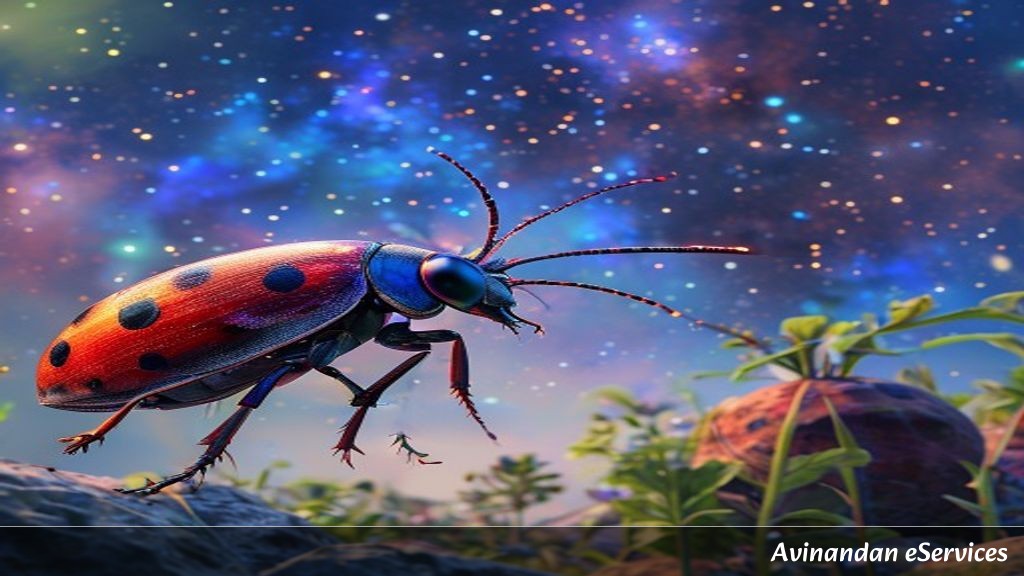
Rohan: Ananya, guess what? I was reading a stargazing book last night, and I found out that humans aren't the only ones looking up at the night sky. There is an insect that uses our whole galaxy to travel! Is that actually true or just a sci-fi myth?
Ananya: It is 100% true, Rohan! The insect you are talking about is the nocturnal African dung beetle. While some birds, seals, and humans use bright stars to find their way, these tiny beetles are the very first insects known to navigate using the faint light band of the Milky Way galaxy!
Rohan: That is mind-blowing! But wait... why would a beetle need to look at outer space in the first place? Isn't its main job just rolling big balls of poop around on the ground?
Ananya: Haha, it sounds silly, but rolling that dung ball is a matter of life and death for them! You see, when a pile of animal dung drops on the African savanna, hundreds of dung beetles rush over to get a share. It is like a crazy biological gold rush! Once a beetle shapes a nice, round ball of dung, it needs to escape from the crowded pile as fast as possible so other greedy beetles don't steal it.
Rohan: Okay, so they have to run away fast. But what does that have to do with the stars?
Ananya: To get away from the crowd quickly, the shortest and safest path is a perfectly straight line! If the beetle walks in circles or curves around, it might accidentally end up right back at the chaotic pile where its hard-earned ball will get snatched. During the day, dung beetles look at the Sun or patterns of sunlight to walk in straight lines. But at night, when it's pitch black, how do you keep moving straight without getting lost?
Rohan: Oh! So at night, there's no Sun. Do they use the Moon?
Ananya: They definitely use the Moon when it is shining brightly! But what happens on moonless nights, or when the Moon is just a tiny sliver? Scientists wondered about this for years. They noticed that even on clear, dark nights with no Moon, the beetles could still roll their dung balls in perfectly straight lines without veering off course.
Rohan: That is awesome! How did scientists figure out that they were actually looking at the galaxy? Did they build tiny beetle telescopes?
Ananya: Not quite telescopes, but close! In 2013, a team of scientists led by Dr. Marie Dacke did an amazing experiment inside a planetarium in South Africa. A planetarium is a big dome building where artificial stars are projected onto the ceiling.
Rohan: Wait, they brought dung beetles inside a planetarium? That sounds hilarious! What happened next?
Ananya: They placed the beetles in an open circular arena inside the planetarium along with their dung balls. When all the projected sky lights were on, showing thousands of stars and the glowing stripe of the Milky Way, the beetles moved in perfectly straight lines. Then, the scientists turned off all the individual bright stars, leaving ONLY the faint, hazy streak of the Milky Way glowing across the dome. And guess what? The beetles still rolled their balls in straight lines!
Rohan: No way! What happened when they turned off the Milky Way strip too, leaving the room completely dark?
Ananya: When the sky was totally black, the beetles got completely confused and started wandering in useless circles! To prove it even further, the scientists fitted some beetles with tiny cardboard caps—like mini hats—that blocked their view of the sky. Without being able to look up, those cap-wearing beetles couldn't walk straight either!
Rohan: Tiny cardboard hats on dung beetles! I would love to see a picture of that. But can these beetles see individual stars like the North Star or constellations like Orion?
Ananya: Actually, no. Dung beetles have compound eyes. Their eyes are great at detecting light intensity and polarization, but they don't have sharp vision like ours. They cannot pick out single faint stars. Instead, they see the Milky Way as a long, continuous stripe of light stretching across the dark sky. They use the contrast between that bright starry strip and the surrounding dark night as a giant celestial compass!
Rohan: Ah, I get it! It is like having a bright chalk line drawn across the sky. As long as they keep that line at the exact same angle relative to their body, they will keep walking in a straight line!
Ananya: Spot on, Rohan! And there's another super cool behavior they exhibit before they start rolling. Before moving off, a beetle climbs up onto top of its dung ball and performs a quick, spinning dance!
Rohan: A dung beetle dance party? Why do they do that?
Ananya: Scientists call it the 'orientation dance.' By standing on top of the ball and rotating around, the beetle takes a quick visual snapshot of the night sky with its eyes. It stores that image in its tiny brain as a reference point. Once it jumps down and starts pushing the ball backwards with its hind legs, it continuously compares what it sees with that mental snapshot to stay on target!
Rohan: They take a mental photo of the galaxy while dancing on a ball of poop... Nature is officially wilder than any comic book! But Ananya, why is this discovery important for us humans?
Ananya: It is huge for technology! Engineers who build autonomous robots, drones, and space rovers are studying dung beetle eyes. Standard GPS relies on satellites, which can fail or lose signal in deep caves or on other planets. By understanding how a beetle with a brain smaller than a seed can navigate using simple light patterns in the sky, scientists can design lightweight, low-power navigation sensors for robots exploring remote places—like Mars!
Rohan: That is incredible! A tiny beetle rolling poop could end up helping future rovers explore outer space. Science never fails to amaze me!
Ananya: It really is incredible! Let’s summarize everything we learned today before we head outside for some stargazing of our own.
So, What Did We Learn Today?
- Galaxy Navigation: Nocturnal dung beetles are the first known insects to navigate using the bright band of the Milky Way galaxy.
- Straight-Line Escape: Dung beetles must move in straight lines to escape crowded dung piles quickly so other beetles don't steal their food ball.
- The Orientation Dance: Before rolling their ball, beetles climb on top and spin around to take a mental snapshot of the night sky to stay on course.
- Celestial Compass: Beetles do not see individual stars; instead, they use the contrast of the bright galaxy band against the dark sky as a directional guide.
- Future Tech Inspiration: Studying beetle vision helps engineers build self-navigating robots and space rovers that don't rely on GPS satellites.
Rohan: Next time I look up at the Milky Way, I'll definitely remember our hard-working, star-navigating beetle friends!