The Human Respiratory System is one of the most vital topics in the Life Sciences / Biology section for Indian Railway examinations, including RRB NTPC, RRB Group D, RRB Technician Grade I, and RRB Technician Grade III. General Science carries a substantial weightage in both CBT 1 and CBT 2 exams, and questions from human physiology—particularly respiration—frequently appear in direct and conceptual formats.
Understanding how the body breathes, exchanges gases, and converts food into cellular energy is essential not only for scoring full marks in Biology but also for building a solid foundation in human anatomy. In this comprehensive guide, we will break down the entire human respiratory system into easy-to-understand concepts, anatomical structures, key chemical equations, tabular comparisons, solved examples, and exam-oriented practice questions.
Topic Weightage and Importance
In RRB examinations, General Science questions account for nearly 25% to 30% of the total General Awareness section. Within the Biology sub-section, Human Physiology is the single highest-weightage topic.
- RRB NTPC (CBT 1 & CBT 2): 1 to 3 direct or conceptual questions on respiration, gas transport, lung volumes, and respiratory organs.
- RRB Group D: 2 to 4 questions covering breathing mechanisms, aerobic vs. anaerobic respiration, and related biological terms.
- RRB Technician (Grade I & Grade III): 2 to 3 detailed questions targeting physiological processes, cellular respiration, and respiratory pigments.
By mastering this single topic, candidates can secure crucial marks that directly influence their cut-off scores.
Key Concepts and Formulas
1. What is Respiration?
Respiration is a biochemical process in which living organisms consume oxygen to break down glucose into energy (in the form of ATP - Adenosine Triphosphate), carbon dioxide, and water. It is different from simple breathing, which is merely the mechanical physical act of inhaling oxygen and exhaling carbon dioxide.
2. Types of Respiration
Respiration is categorized into two main types based on the presence or absence of oxygen:
| Parameter | Aerobic Respiration | Anaerobic Respiration |
|---|---|---|
| Oxygen Requirement | Requires oxygen (O₂) | Does not require oxygen |
| Location in Cell | Cytoplasm and Mitochondria | Cytoplasm only |
| Breakdown Product | CO₂, H₂O, and High Energy | Lactic Acid (in muscle cells) OR Ethanol + CO₂ (in yeast) |
| Energy Output | 36 to 38 ATP per glucose molecule | Only 2 ATP per glucose molecule |
| Chemical Equation | C₆H₁₂O₆ + 6O₂ → 6CO₂ + 6H₂O + 38 ATP | C₆H₁₂O₆ → 2C₃H₆O₃ + 2 ATP (Human muscle) |
3. Anatomy of the Human Respiratory System
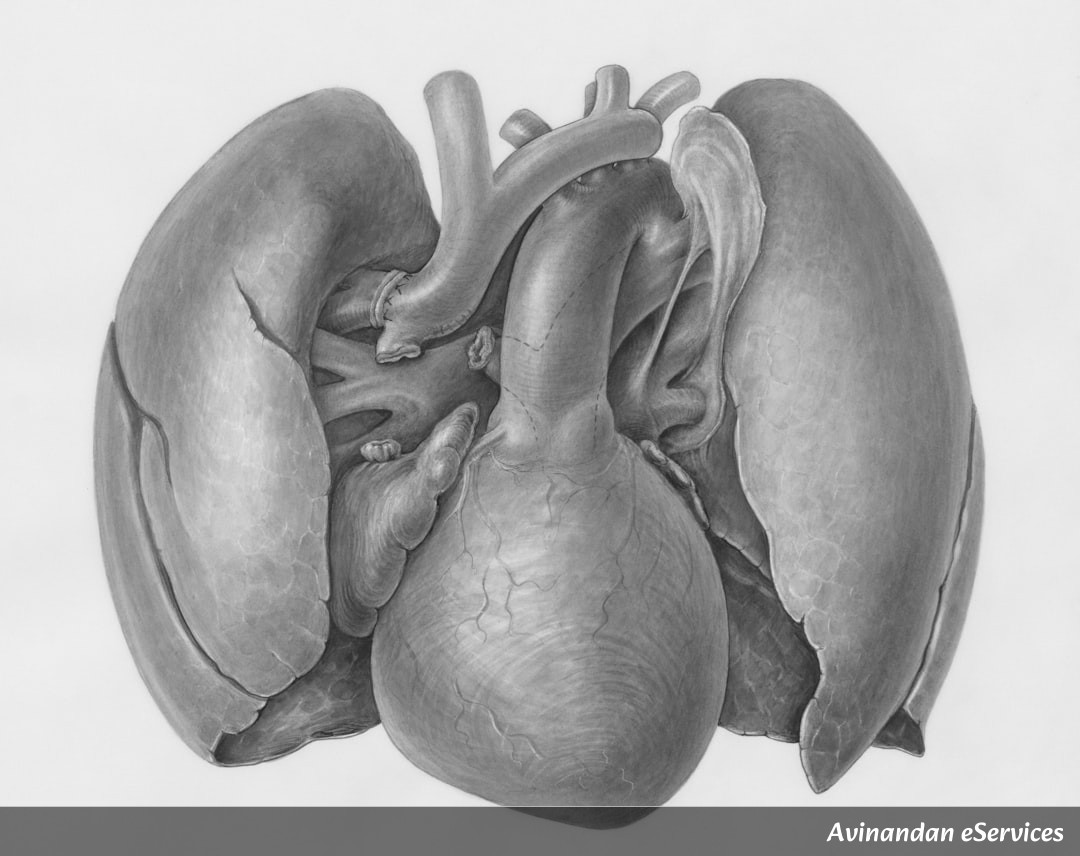
The human respiratory tract is divided into upper and lower respiratory tracts. Air travels through the following sequential path during inhalation:
Nostrils → Nasal Cavity → Pharynx → Larynx → Trachea → Bronchi → Bronchioles → Alveoli → Blood Capillaries
- Nostrils & Nasal Cavity: Air enters here; mucus and fine hair (cilia) filter out dust particles and warm the incoming air.
- Pharynx (Throat): A common passage for both food and air. The Epiglottis is a flap-like cartilage that covers the trachea during swallowing to prevent food from entering the windpipe.
- Larynx (Voice Box): Contains vocal cords that vibrate to produce sound. It is prominent in adult males as the Adam's Apple.
- Trachea (Windpipe): Supported by C-shaped cartilaginous rings that prevent the trachea from collapsing when there is less air inside.
- Bronchi and Bronchioles: The trachea branches into two primary bronchi (left and right lung), which divide into smaller tubes called bronchioles.
- Alveoli (Air Sacs): Tiny, balloon-like structures at the end of bronchioles. They provide a massive surface area (nearly 80 square meters) for actual gas exchange between air and blood capillaries.
- Diaphragm & Intercostal Muscles: A large, dome-shaped muscular sheet beneath the lungs that expands and contracts to drive the mechanical process of breathing.
4. Mechanism of Breathing
Breathing occurs in two distinct phases:
- Inspiration (Inhalation): Active process. Diaphragm contracts and flattens down; \texternal intercostal muscles lift ribs upward and outward. Volume of chest cavity increases → Pressure drops → Air enters lungs.
- Expiration (Exhalation): Passive process. Diaphragm relaxes and resumes its dome shape; intercostal muscles relax. Volume of chest cavity decreases → Pressure increases → Air is pushed out.
5. Transport of Gases in Human Blood
- Oxygen Transport: About 97% of O₂ is transported by Red Blood Cells (RBCs) combined with Hemoglobin as Oxyhemoglobin. The remaining 3% is dissolved in blood plasma.
- Carbon Dioxide Transport: CO₂ is transported in three forms:
- As Bicarbonate ions (HCO₃⁻) in plasma: ~70%
- As Carbaminohemoglobin bound to RBCs: ~20-25%
- Dissolved in blood plasma: ~7%
6. Pulmonary Lung Volumes & Capacities
| Volume / Capacity | Description | Average Value |
|---|---|---|
| Tidal Volume (TV) | Volume of air inhaled or exhaled during normal breathing. | 500 mL |
| Inspiratory Reserve Volume (IRV) | Additional air inhaled forcefully after normal inspiration. | 2500 - 3000 mL |
| Expiratory Reserve Volume (ERV) | Additional air exhaled forcefully after normal expiration. | 1000 - 1100 mL |
| Residual Volume (RV) | Air remaining in lungs even after maximal forceful exhalation. | 1100 - 1200 mL |
| Vital Capacity (VC) | Maximum volume of air a person can exhale after maximum inhalation (TV + IRV + ERV). | 3500 - 4500 mL |
| Total Lung Capacity (TLC) | Total air held in lungs after maximum inspiration (VC + RV). | 5000 - 6000 mL |
Solved Examples (Step-by-Step)
Example 1: Respiratory Volume Calculation
Question: A candidate has a Tidal Volume of 500 mL, an Inspiratory Reserve Volume of 2500 mL, an Expiratory Reserve Volume of 1000 mL, and a Residual Volume of 1200 mL. Calculate the Vital Capacity (VC) and Total Lung Capacity (TLC) of the individual.
Solution:
- Step 1: Formula for Vital Capacity (VC)
$$ \text{VC} = \text{TV} + \text{IRV} + \text{ERV}$$ - Step 2: Substitute given values
$$ \text{VC} = 500\, \text{mL} + 2500\, \text{mL} + 1000\, \text{mL} = 4000\, \text{mL}$$ - Step 3: Formula for Total Lung Capacity (TLC)
$$ \text{TLC} = \text{VC} + \text{RV}$$ - Step 4: Calculate TLC
$$ \text{TLC} = 4000\, \text{mL} + 1200\, \text{mL} = 5200\, \text{mL}$$
Answer: Vital Capacity is 4000 mL, and Total Lung Capacity is 5200 mL.
Example 2: Biochemical Process Identification
Question: During intense exercise, athletes often experience severe muscle cramps. What causes this, and how many net ATP molecules are produced per glucose molecule during this process?
Solution:
- Step 1: Identify the underlying physiological state. During heavy physical exertion, oxygen supply to muscle tissue becomes insufficient to meet energy demands.
- Step 2: Identify metabolic pathway. Muscle cells switch from aerobic to anaerobic respiration (lactic acid fermentation).
- Step 3: Determine products. Pyruvate is converted into Lactic Acid, which accumulates in muscle fibers causing pain and cramps.
- Step 4: Energy yield calculation. Anaerobic respiration breaks down glucose partially, yielding only 2 ATP molecules per glucose molecule (compared to 36–38 ATP in aerobic respiration).
Answer: Muscle cramps are caused by the accumulation of lactic acid due to anaerobic respiration, yielding 2 net ATP molecules.
Example 3: Structural Anatomy Identification
Question: Why do the cartilaginous rings in the human trachea not form complete circles, and what shape do they take?
Solution:
- Step 1: Analyze structure. The trachea is supported by 16 to 20 incomplete rings made of hyaline cartilage.
- Step 2: Identify shape. These rings are C-shaped (open at the posterior side facing the esophagus).
- Step 3: Physiological significance. The incomplete C-shape prevents the windpipe from collapsing when internal air pressure falls, while allowing the adjacent esophagus to expand during swallowing of food.
Answer: They are C-shaped cartilaginous rings designed to keep the airway permanently open without interfering with esophageal food transit.
Common Mistakes to Avoid
- Confusing Breathing with Respiration: Breathing is a simple mechanical process (ventilation), whereas respiration is a biochemical intracellular energy-producing pathway.
- Mixing up Gas Transport Percentages: Remember that 97% of oxygen is transported bound to hemoglobin, while 70% of carbon dioxide is transported as bicarbonate ions (HCO₃⁻), NOT bound to hemoglobin.
- Ignoring Residual Volume in Vital Capacity: Residual Volume (RV) cannot be voluntarily expelled; therefore, Vital Capacity does NOT include Residual Volume ($ \text{VC} = \text{TV} + \text{IRV} + \text{ERV}$). Total Lung Capacity includes RV ($ \text{TLC} = \text{VC} + \text{RV}$).
- Misunderstanding Plant vs. Human Respiration: Remember that humans exchange gas through alveoli via simple physical diffusion caused by partial pressure differences, not active transport.
Practice Questions with Solutions
Practice Questions
Q1. Which organ is known as the common passage for both swallowed food and inhaled air?
(a) Larynx
(b) Pharynx
(c) Trachea
(d) Esophagus
Q2. What prevents the food from entering the windpipe (trachea) during swallowing?
(a) Vocal Cords
(b) Mucus
(c) Epiglottis
(d) Cilia
Q3. What is the functional site of gas exchange in the human lungs?
(a) Bronchi
(b) Bronchioles
(c) Trachea
(d) Alveoli
Q4. In human blood, maximum transport of Carbon Dioxide ($ \text{CO}_2$) occurs in which form?
(a) Carbaminohemoglobin
(b) Dissolved gas in plasma
(c) Bicarbonate ions ($ \text{HCO}_3^-$)
(d) Carbonic Acid
Q5. What happens to the diaphragm during forced inhalation?
(a) It becomes dome-shaped and relaxes
(b) It flattens and contracts downwards
(c) It moves upward into the chest
(d) It remains completely stationary
Q6. The respiratory pigment present in human blood that has a high affinity for oxygen is:
(a) Chlorophyll
(b) Hemocyanin
(c) Hemoglobin
(d) Myoglobin
Detailed Solutions
Q1. Solution: (b) Pharynx
Explanation: The pharynx is the anatomical region situated behind the oral and nasal cavities that serves as a common path for both food entering the digestive system and air entering the respiratory tract.
Q2. Solution: (c) Epiglottis
Explanation: The epiglottis is a thin cartilaginous flap situated at the root of the tongue. During swallowing, it folds back over the glottis (opening of the larynx) to prevent food and liquid from entering the trachea.
Q3. Solution: (d) Alveoli
Explanation: Alveoli are microscopic, thin-walled, sac-like structures heavily surrounded by blood capillaries where oxygen diffuses into the blood and carbon dioxide diffuses out.
Q4. Solution: (c) Bicarbonate ions ($ \text{HCO}_3^-$)
Explanation: Approximately 70% of carbon dioxide produced in tissues is transported in the blood plasma as bicarbonate ions ($ \text{HCO}_3^-$), synthesized via the action of the enzyme carbonic anhydrase.
Q5. Solution: (b) It flattens and contracts downwards
Explanation: During inhalation, the muscular diaphragm contracts and shifts downwards, increasing the vertical volume of the thoracic cavity to allow air to enter down the pressure gradient.
Q6. Solution: (c) Hemoglobin
Explanation: Hemoglobin is an iron-containing protein pigment present in Red Blood Cells (RBCs) that reversibly binds to four oxygen molecules to form oxyhemoglobin.
Frequently Asked Questions (FAQs)
1. What is the normal human breathing rate at rest?
An average adult at rest breathes approximately 12 to 16 times per minute. This rate increases during physical exercise, fever, or excitement to fulfill higher body cellular oxygen requirements.
2. Why can't we completely empty air out of our lungs?
Because of the Residual Volume (RV), which is about 1100 to 1200 mL of air that always stays in the lungs even after maximum exhalation. This prevents the alveoli and tiny bronchial tubes from collapsing completely.
3. What controls the involuntary breathing rate in humans?
The respiratory rhythm is controlled involuntarily by the Medulla Oblongata and Pons region of the human brain, which monitor carbon dioxide ($ \text{CO}_2$) levels and pH changes in arterial blood.
4. Why is Carbon Monoxide ($ \text{CO}$) poisoning fatal?
Carbon Monoxide has an affinity for human hemoglobin that is roughly 200 to 250 times higher than oxygen. It forms a stable compound called Carboxyhemoglobin, which prevents oxygen binding and stops cell respiration, causing rapid asphyxiation.
Conclusion and Final Tips
Mastering the Human Respiratory System requires memorizing the exact airflow passage, key physiological volumes, cellular metabolic outputs, and gas transport mechanisms. RRB exams frequently test technical terms like epiglottis, alveoli, tidal volume, and lactic acid.
Final Revision Checklist:
- Revise the complete sequence of air movement from Nostrils to Alveoli.
- Memorize key numbers: Tidal Volume (500 mL), Respiration Rate (12-16 breaths/min), and Oxygen/CO₂ transport percentages.
- Understand the exact structural features: C-shaped cartilaginous rings and diaphragm movements.
- Practice conceptual numerical questions on Vital Capacity and Total Lung Capacity.
Keep revising regularly, practice mock questions consistently, and stay confident for your upcoming RRB NTPC, Group D, and Technician examinations!
","category":"RRB Exams","image_query":"human respiratory system","meta_description":"Master the Human Respiratory System for RRB NTPC & Group D exams. Learn organs, breathing mechanisms, gas exchange, solved questions, and practice tests.