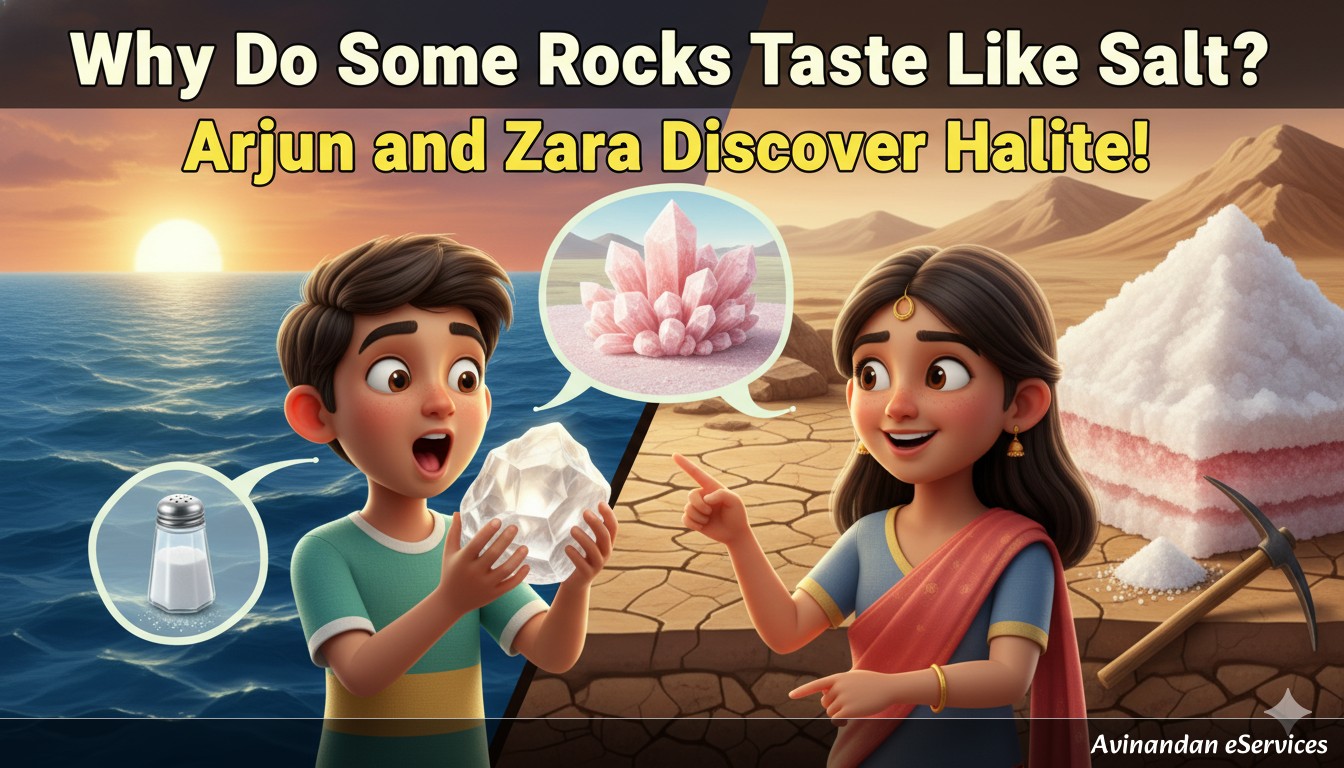
Arjun: Zara, I was helping Papa in the garden yesterday, and we found this weird, clear crystal rock. When I accidentally touched it to my tongue (I know, I shouldn't!), it tasted just like the salt we use for cooking! How can a rock taste like salt?
Zara: That's a fantastic question, Arjun! What you probably found is a rock called Halite. It's the mineral form of sodium chloride, which is exactly what table salt is made of!
Arjun: Wow! So, it's real salt, just in rock form? But how does salt get into rocks? Did someone accidentally spill salt everywhere millions of years ago?
Zara: Haha, not quite! Halite forms in a really interesting way. It happens when bodies of saltwater, like ancient oceans or large lakes, dry up over a very, very long time. As the water evaporates, it leaves behind dissolved minerals, and one of the most common is sodium chloride. These minerals then crystallize and form layers, which eventually get buried and can become rock deposits.
Arjun: So, all those dry deserts or places far away from the sea might have once been filled with water that evaporated?
Zara: Exactly! Many places we think of as dry land today were once underwater. Think about massive salt flats you might have seen pictures of. Those are formed from ancient lakes or seas that have long since disappeared. Over millions of years, the accumulated layers of salt crystals become compressed and turned into rock – that's Halite!
Arjun: That’s mind-blowing! So, when we mine salt, are we actually digging up these ancient, dried-up oceans?
Zara: In a way, yes! There are two main ways we get salt. One is by mining rock salt, which is the Halite we're talking about. This is done underground in mines, just like coal or other minerals. The other way is by evaporating seawater, which is how we get sea salt. But both come from the same source: dissolved salt in water.
Arjun: Is Halite always clear? The one I saw was. Or can it be different colors?
Zara: Halite can be clear, but it can also have different colors like white, grey, pink, or even blue and purple! These colors come from impurities. Sometimes, tiny bits of other minerals or organic matter get trapped in the salt crystals as they form, giving them these beautiful shades. For example, reddish or pinkish halite can be caused by iron oxides.
Arjun: That’s so cool! So, if I found a pink rock, it might be salt too?
Zara: It's possible! But remember, not everything that tastes salty is Halite. There are other minerals that might taste a bit salty, but Halite is the pure mineral form of sodium chloride. It's always best not to taste rocks, though, just in case they're not edible or safe!
Arjun: You're right! I got lucky. What else is Halite used for besides cooking?
Zara: Oh, it has tons of uses! Besides being our everyday table salt, it's used in the chemical industry to make things like chlorine and sodium hydroxide, which are used in plastics, soaps, and many other products. It's also used to de-ice roads in winter because salt lowers the freezing point of water. And in some ancient cultures, salt was so valuable it was used as currency!
Arjun: Currency? Like money? Wow, I never knew salt was so important!
Zara: It really is! It's essential for life, too. Our bodies need a certain amount of sodium and chloride to function properly. So, from ancient evaporated seas to our dinner tables and even industrial factories, Halite plays a huge role.
Arjun: It’s amazing to think that a simple rock could tell such a long story about history and the Earth!
Zara: That's the beauty of science, Arjun! Every little discovery can open up a whole world of understanding.
So, What Did We Learn Today?
- Halite is the mineral form of sodium chloride, which is exactly what table salt is.
- Halite forms when bodies of saltwater dry up, leaving behind crystallized minerals.
- These salt deposits can get buried and turn into rock over millions of years.
- Halite can come in various colors, such as clear, white, grey, pink, blue, and purple, due to impurities.
- Salt has many uses beyond cooking, including in industry, for de-icing roads, and it's essential for life.
Arjun: I'll definitely look at rocks a bit differently now! You never know what ancient story they might be holding!