A Puzzling Observation in the Kitchen!
Rohan: Zara, you are not going to believe what my Dadi (grandmother) told me today! I wanted to make ice cubes really fast for our lemonade, so I used the coldest water from the tap.
Zara: That makes sense, Rohan. Colder water should freeze faster, right? It has less heat to lose.
Rohan: Exactly! But Dadi saw me and said, 'Beta, if you want ice quickly, you should start with warm water.' I thought she was joking! How can something hot become frozen faster than something that's already cold? It feels like a riddle!
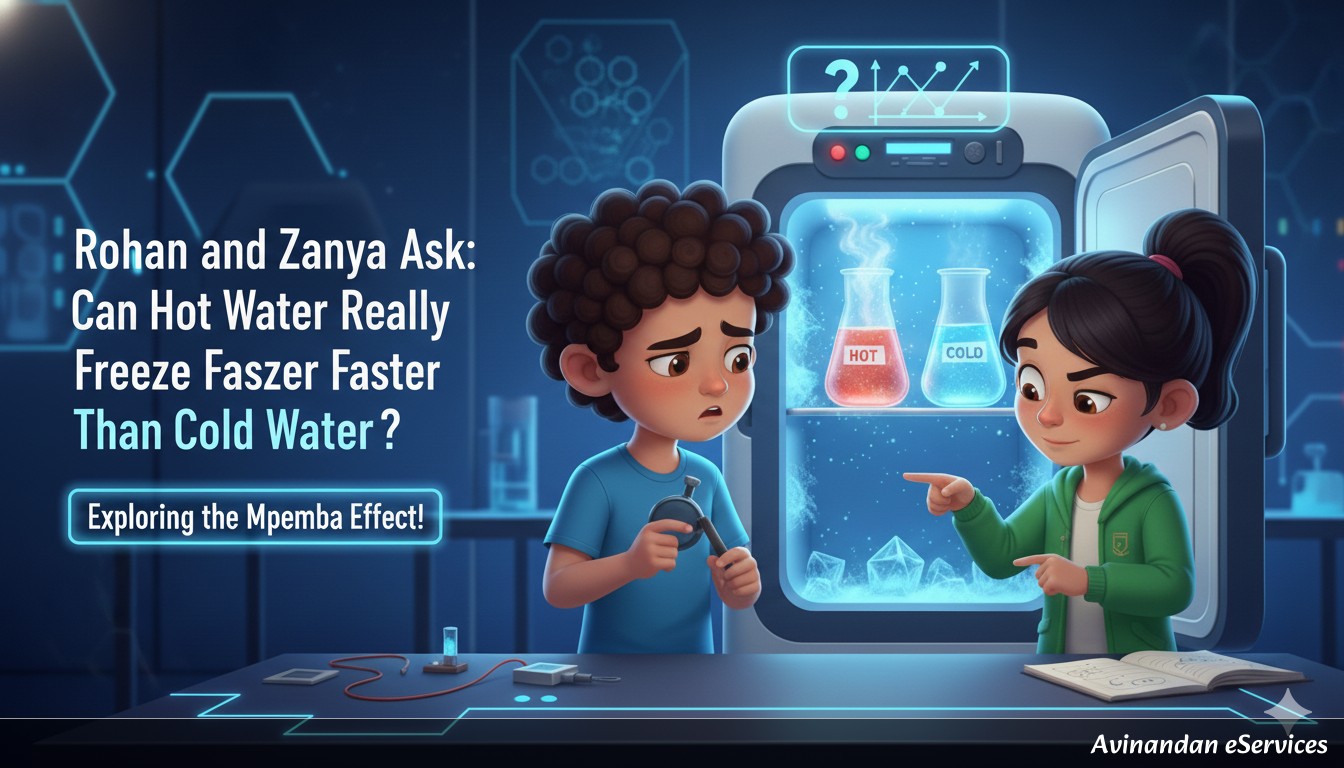
Zara: Haha, it does sound like a riddle, but your Dadi is talking about a real scientific mystery! It’s a famous observation called the Mpemba Effect. And for over 50 years, scientists have been trying to figure it out.
Rohan: The Mem-ba what? That’s a funny name! And scientists are studying it? So, it's real?
Zara: It's the M-pem-ba Effect. And yes, it's very real, though it only happens under certain conditions. It’s named after a Tanzanian student named Erasto Mpemba. Back in the 1960s, he was in a cooking class at his school, making ice cream. He was in a hurry, so he put his hot milk mixture into the freezer without letting it cool down first.
Rohan: Oh no, was he going to get in trouble?
Zara: That's what he was worried about! But he noticed something amazing. His hot mixture froze into ice cream even before his friend’s, who had followed the rules and cooled his mixture down first! When he asked his teacher about it, nobody believed him. But he kept asking questions, and eventually, a physicist helped him study it and they wrote a paper about it. All because a curious student didn't stop asking 'why?'.
Rohan: Wow! A student discovered a science puzzle! That’s so cool! But you still haven't told me how it works. How can hot water win a race to become ice?
Zara: Well, that’s the million-dollar question. Scientists don't have one single, definite answer, but they have a few very good ideas. It’s likely a combination of things.
Rohan: Like what? Tell me everything!
The Science Behind the Puzzle
Zara: Okay, first up is Evaporation. Think about a steaming cup of hot tea. That steam is water escaping into the air, right? That process is called evaporation. When you put a container of hot water in the freezer, it evaporates faster than cold water. Evaporation is a cooling process—as the fastest, most energetic water molecules escape as steam, they take a lot of heat energy with them. This means the total amount of water left in the hot container is a little less, and it cools down more quickly.
Rohan: So, part of the water just vanishes, taking heat with it? Okay, that makes some sense. What else?
Zara: The next idea is about something called Convection Currents. In the container of hot water, the warmer water at the bottom is less dense, so it rises, while the cooler, denser water at the top sinks. This creates a constant mixing, like a tiny whirlpool. This circulation helps the water lose heat to the cold air in the freezer much more efficiently all around the container.
Rohan: Oh! So, the hot water is better at getting its heat out? The cold water is just sitting there, being lazy?
Zara: You could say that! The temperature difference in the cold water isn't as big, so these currents are much weaker. The hot water is actively moving its heat to the surface to get rid of it.
Rohan: Smart water! Are there any other reasons?
Zara: Yes, one more big one: Dissolved Gases. Tap water has gases like oxygen and carbon dioxide dissolved in it. Cold water can hold more of these dissolved gases than hot water. When you heat water, these gases escape—that's why you see tiny bubbles forming before it even boils. Some scientists think these dissolved gases in the cold water might change its freezing properties, making it a little harder for ice crystals to form. Since the hot water has already gotten rid of most of its gases, it might have an easier path to freezing.
Rohan: So it’s evaporation, better mixing, AND fewer gases? That’s a lot of things happening at once. Can I try this at home?
Zara: You definitely can! But remember I said it only happens under certain conditions? You have to use two identical containers, with the exact same amount of water, and place them in the same spot in the freezer. Sometimes it won’t work, because the shape of the container or the type of freezer can change the results. It's a tricky experiment, which is why it's still such a fun puzzle for scientists!
So, What Did We Learn Today?
Zara: Let's quickly go over what we found out about this cool kitchen science mystery.
- The Mpemba Effect is the surprising discovery that, in some situations, hot water can freeze faster than cold water.
- It was named after Erasto Mpemba, a student who noticed it while making ice cream at school in the 1960s.
- There isn't one single answer, but scientists believe it's caused by a mix of factors like faster evaporation, convection currents (better heat distribution), and fewer dissolved gases in the hot water.
- It shows that science is full of amazing puzzles, and that even a simple question about everyday life can lead to a fascinating discovery!
Rohan: This is amazing! It proves that you should always ask questions, even if something sounds silly at first. I’m going to tell Dadi that her kitchen tip is actually a famous scientific effect. Science isn't just in labs; it's right there in our freezer!