A Puzzling Kitchen Experiment!
Rohan: Priya! You won't believe what happened! I was helping my mom make kulfi, and she told me to put the hot mixture in the freezer. I thought she was joking, but she said it would freeze faster. How can something hot freeze faster than something already cold? It makes no sense!
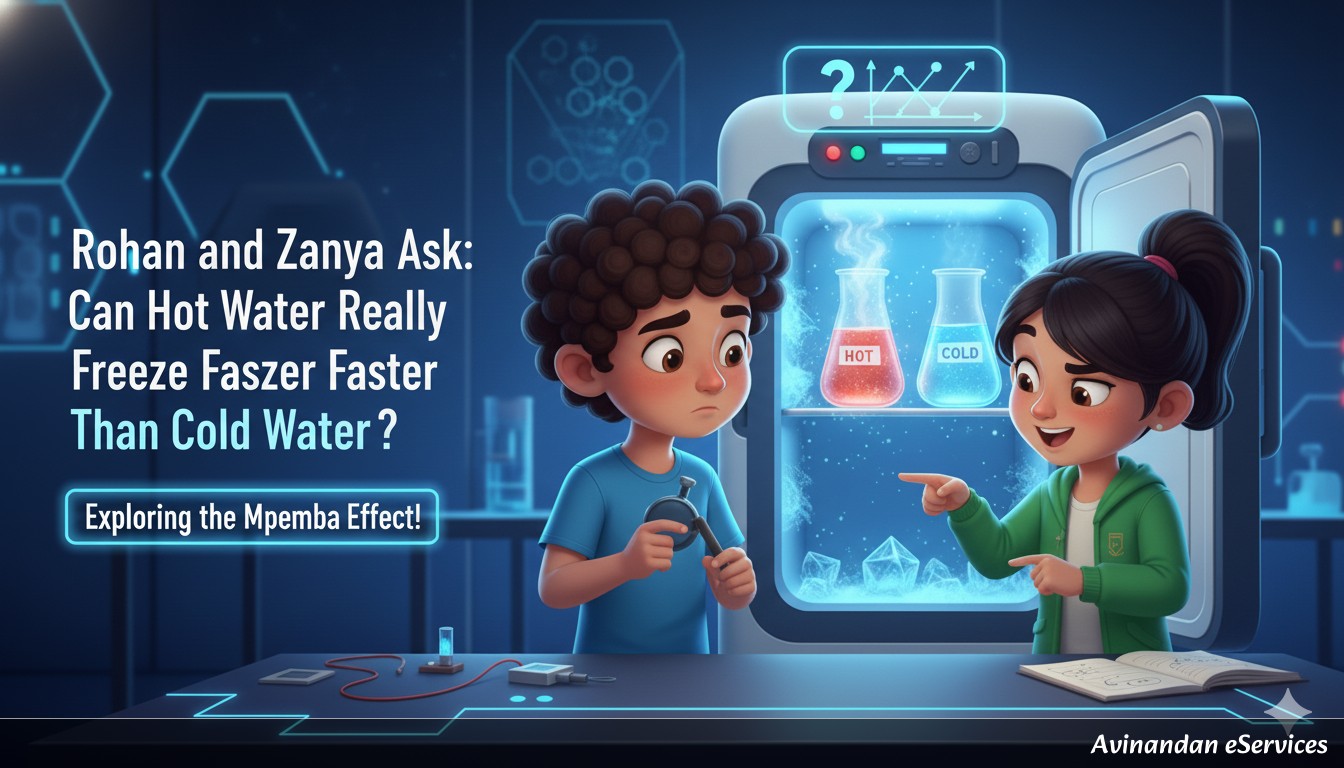
Priya: Hey, Rohan! That sounds like a puzzle, but your mom is right! It's a real scientific phenomenon. It's so famous it even has a name: the Mpemba effect.
Rohan: The 'Mpemba' effect? What a funny name! Who is it named after?
Priya: It’s named after a Tanzanian student named Erasto Mpemba. Back in the 1960s, he was in a cooking class making ice cream. He was in a hurry, so he put his hot milk mixture into the freezer without letting it cool down first. To his surprise, his hot mixture froze into ice cream before his classmates' cold mixtures did!
Rohan: Wow! So a student discovered this? Just like us! But how does it work? Is it magic?
Priya: Not magic, just very cool science! Scientists are still studying it, but they have a few good ideas about why it happens. It’s not just one thing, but a combination of reasons.
The Science Behind the Trick
Rohan: Okay, I'm ready. Explain it to me!
Priya: Alright, the first idea is something called evaporation. When water is hot, some of it turns into steam and floats away, right? That means the hot container actually ends up with a little less water to freeze than the cold one. Less water means less time to freeze!
Rohan: Oh, that makes sense! So it's a bit of a head start because there's less to freeze. What else?
Priya: The second idea is about how water moves when it cools. It's called convection. Think about a pot of soup warming up. The hot soup at the bottom rises, and the cooler soup from the top sinks to get heated. This movement is called a convection current. In the freezer, hot water has much stronger convection currents, which helps it cool down more quickly and evenly at first.
Rohan: So it’s like the hot water is stirring itself to cool down faster? That's clever!
Priya: Exactly! The third reason has to do with tiny, invisible things in the water: dissolved gases. Cold water can hold more dissolved gases, like oxygen and carbon dioxide, than hot water. When you heat water, these gases escape. Scientists think these gases might interfere with the freezing process, so the hot water, which has fewer gases, can freeze more easily.
Rohan: Gases in water? I had no idea! Okay, so we have evaporation, convection, and dissolved gases. Is there more?
Priya: There's one more really interesting idea called supercooling. Sometimes, water can get colder than its freezing point (0 degrees Celsius) without actually turning into ice. It's in a 'supercooled' state. For some reason, cold water is more likely to do this than hot water. So, while the cold water is stuck being supercool liquid, the hot water has already reached 0 degrees and started turning into solid ice.
Rohan: Whoa, that's wild! So the cold water gets 'stuck' and the hot water overtakes it in the race to become ice? This is one of the strangest things I've ever heard. It’s amazing that something we see every day, like water freezing, can have so many secrets.
Priya: It is! And the best part is that Erasto Mpemba was just a curious student who paid attention to a surprising result. It shows that anyone can make a scientific discovery if they keep asking questions.
So, What Did We Learn Today?
Priya: Let's quickly recap why hot water can sometimes freeze faster than cold water. It's all thanks to the Mpemba effect, which is likely caused by a few things working together:
- Evaporation: Hot water loses some of its mass as steam, so there is less water left to freeze.
- Convection: The stronger movement of water in the hot container helps it to lose heat more efficiently.
- Dissolved Gases: Hot water has fewer dissolved gases, which might make it easier for ice crystals to form.
- Supercooling: Cold water is more likely to drop below freezing temperature without becoming solid, giving the hot water a chance to catch up and freeze first.
Rohan: This is so cool! I’m going to ask my mom if we can do an experiment this weekend to see the Mpemba effect for ourselves. Science is everywhere, even in the kitchen making kulfi!