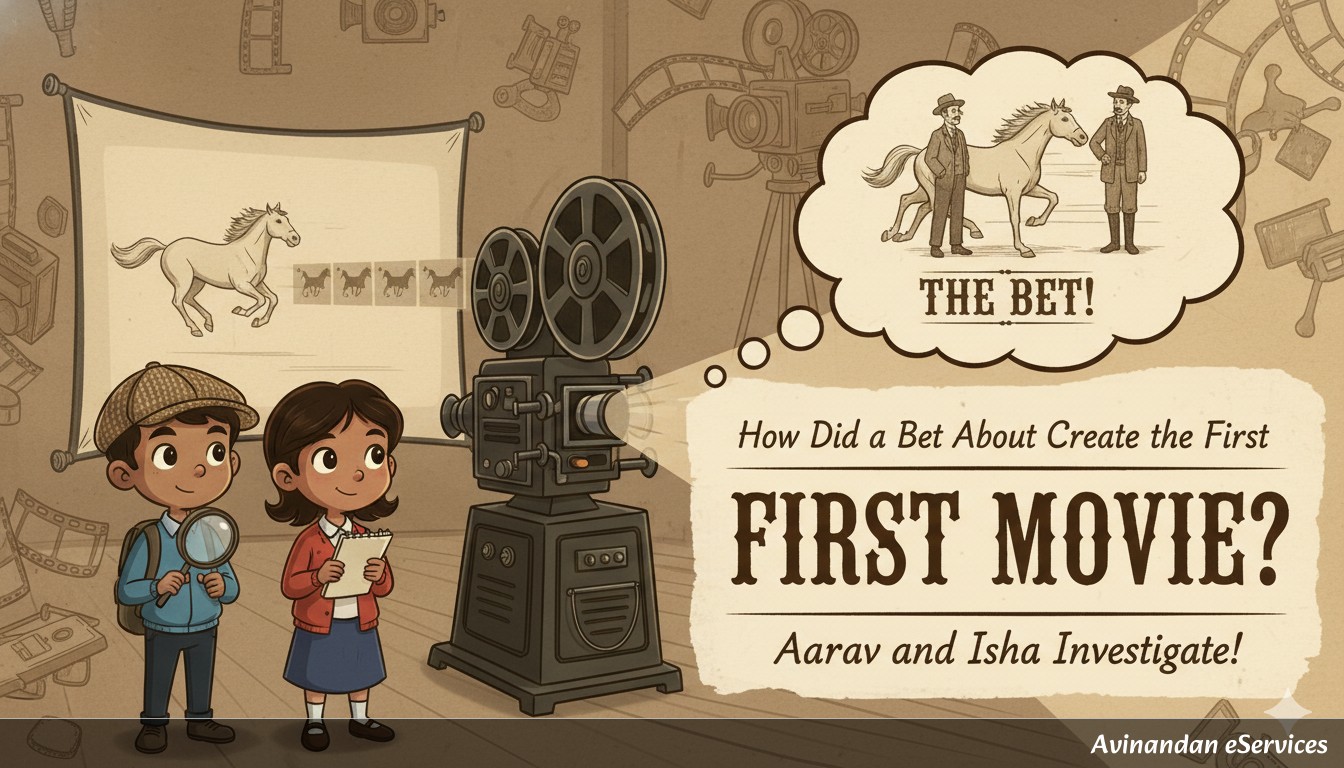
A Galloping Question Sparks a Cinematic Revolution!
Aarav: Isha! You won't believe what I just saw. I was watching a documentary about racehorses, and they showed a race in super-duper slow motion. For a tiny split second, the horse was actually flying! All four of its hooves were off the ground at the same time. It looked like a superhero!
Isha: That's so cool that you noticed that, Aarav! It’s a moment called 'unsupported transit'. But you know what's even cooler? For hundreds of years, nobody knew for sure if that actually happened. The horse’s legs move so fast that the human eye just can't track it. It took a famous bet and some brilliant science to finally solve the mystery.
Aarav: A bet? You mean like, 'I bet you my samosa you can't solve this puzzle'? Who made the bet?
Isha: Haha, it was a bit bigger than a samosa! The bet was made in the 1870s by a very rich man in California named Leland Stanford. He was a businessman and a huge horse racing fan. He was convinced that horses did have all four hooves off the ground at one point in their gallop, but his friends disagreed. They argued for ages, because nobody could prove it one way or the other.
Aarav: So how did he try to prove it? He couldn't exactly ask the horse to slow down.
Isha: Exactly! So he did what any smart person with a tricky problem does: he turned to science and technology. He hired a famous and very creative photographer named Eadweard Muybridge. Stanford challenged him to capture a photo of a horse mid-gallop, proving it was airborne.
Aarav: But wait, cameras back then were so slow! Weren't they the kind where you had to stand still for ages to get a clear picture? A running horse would just be one giant blur!
Isha: You're absolutely right! That was the main challenge. A single camera wasn't fast enough. So, Muybridge came up with an amazing plan. Instead of one camera, he set up a row of twelve cameras along the side of a racetrack. He then attached a thread, or a tripwire, to each camera's shutter mechanism and stretched it across the track.
Aarav: Tripwires? Like in a spy movie? So the horse would trigger the cameras itself?
Isha: Precisely! As the horse galloped down the track, its hooves would break each thread one by one, triggering the cameras to take a picture in perfect sequence. *Snap, snap, snap, snap!* Each camera captured a different slice of the horse's motion. It was a genius idea that combined mechanics, timing, and photography.
Aarav: Wow! That’s like building a 19th-century sports camera rig! So... did it work? Did he win the bet for Mr. Stanford?
Isha: He sure did! When they developed the photographs, they had a perfect stop-motion sequence of the horse galloping. And right there, in one of the middle frames, was the proof they needed: the horse with all four hooves curled up under its body, completely in the air. Leland Stanford won his bet, which was supposedly for $25,000 – a massive amount of money back then!
Aarav: That’s incredible! They solved a centuries-old debate just like that. But you said this created the first movie. How did a bunch of photos do that?
Isha: Well, this is where it gets even more exciting. Muybridge wasn't done. He realised that if he could show his pictures one after another very quickly, he could recreate the illusion of movement. He invented a device called a 'zoopraxiscope'. It was basically a spinning glass disc with his photographs painted around the edge. When he spun the disc and shone a light through it, the horse on the wall looked like it was actually galloping!
Aarav: No way! So people were watching a moving picture of a horse, years before actual movie theatres existed?
Isha: Yes! It was one of the very first steps towards creating cinema. His work on 'motion studies'—not just with horses, but with all sorts of animals and people—inspired other inventors, like Thomas Edison, to develop movie cameras and projectors. It all started because a man was curious about how his horse ran. It’s a perfect example of how trying to answer one simple question can lead to a world-changing invention.
So, What Did We Learn Today?
Isha: It was a pretty amazing journey from a simple question to a huge invention! Here’s a quick recap:
- For a long time, people couldn't tell with their own eyes if a galloping horse ever had all four hooves off the ground at the same time.
- A wealthy horse enthusiast, Leland Stanford, made a large bet that they did and hired photographer Eadweard Muybridge to prove it.
- Muybridge set up a series of cameras with tripwires that the horse triggered as it ran, capturing each moment of the gallop.
- The photos proved Stanford was right: horses are completely airborne for a split second during a gallop!
- By inventing the zoopraxiscope to project these images in sequence, Muybridge created one of the world's first motion pictures and paved the way for modern cinema.
Aarav: It just shows that science isn’t always about beakers and labs. Sometimes it’s about racehorses, curiosity, and a little bit of movie magic! Now I want to try making my own flipbook animation.


