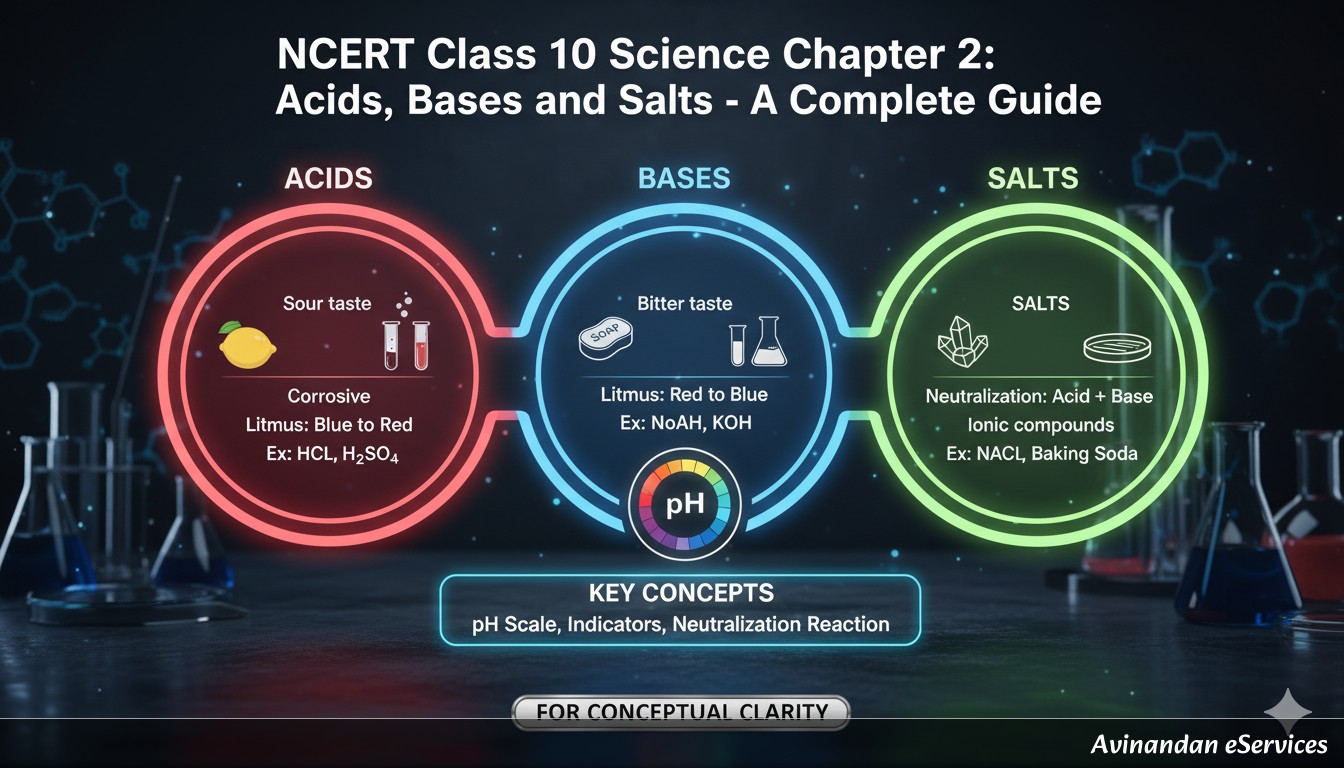
Introduction to Acids, Bases and Salts
Welcome, students, to a comprehensive exploration of Chapter 2 from your NCERT Class 10 Science textbook: 'Acids, Bases and Salts.' This chapter is a cornerstone of chemistry, helping us understand the properties of many substances we encounter daily. From the sour taste of a lemon to the bitter taste of baking soda and the saltiness of your food, the principles of this chapter are all around us. In this guide, we will break down every concept, from identifying acids and bases using indicators to understanding their chemical reactions, the significance of the pH scale, and the fascinating world of salts. By the end of this post, you will have a clear and in-depth understanding of how these three classes of compounds play a vital role in both chemistry and our everyday lives.
Understanding the Properties of Acids and Bases
Acids and bases are two fundamental categories of chemical compounds with distinct properties. Historically, acids were known for their sour taste (the word 'acid' comes from the Latin word 'acidus' meaning sour), while bases were known for their bitter taste and soapy feel. However, tasting chemicals is \textremely dangerous and should never be done! Instead, we use scientific methods and indicators to identify and study them.
1. Indicators: The Chemical Detectives
How do we know if a substance is acidic or basic without tasting it? We use special substances called indicators. An indicator is a dye that changes colour when it is put into an acid or a base. They are our chemical detectives, giving us visual clues about the nature of a solution.
Natural Indicators
- Litmus: The most common indicator used in school laboratories is litmus, which is \textracted from lichens. In a neutral solution, it is purple. When added to an acidic solution, it turns red. When added to a basic solution, it turns blue. Litmus is available as a solution or as strips of paper (blue litmus paper and red litmus paper).
- Turmeric (Haldi): A common spice in every Indian kitchen, turmeric is also a natural indicator. It is yellow in colour. In an acidic or neutral solution, it remains yellow. However, in a basic solution, it turns a distinct reddish-brown. You might have noticed this when a curry stain on your white shirt turns red after being washed with soap (which is basic).
- Red Cabbage Extract: The juice of red cabbage is originally purple. It turns reddish in acidic solutions and greenish-yellow in basic solutions.
Synthetic Indicators
These are man-made indicators used for more precise testing in labs.
- Phenolphthalein: This is a colourless solution. It remains colourless in acidic and neutral solutions but turns a vibrant pink in basic solutions.
- Methyl Orange: This indicator is orange in a neutral solution. It turns red in acidic solutions and yellow in basic solutions.
Olfactory Indicators
Some substances have a characteristic smell that changes in acidic or basic solutions. These are called olfactory indicators. They are particularly useful for visually impaired students.
- Onion: Finely chopped onions have a characteristic pungent smell. When a basic solution like sodium hydroxide is added to a cloth strip treated with onion juice, the onion smell cannot be detected. However, an acid like HCl does not destroy the smell.
- Vanilla Essence: Vanilla has a pleasant smell. This smell persists in an acidic solution but vanishes in a basic solution.
- Clove Oil: Similar to vanilla, clove oil retains its characteristic smell in an acid but loses it in a base.
| Indicator | Colour/Smell in Acidic Solution | Colour/Smell in Basic Solution |
|---|---|---|
| Blue Litmus | Red | No change (Blue) |
| Red Litmus | No change (Red) | Blue |
| Phenolphthalein | Colourless | Pink |
| Methyl Orange | Red | Yellow |
| Turmeric | No change (Yellow) | Reddish-brown |
| Onion (Olfactory) | Smell retained | Smell vanishes |
2. How Do Acids and Bases React with Metals?
A crucial chemical property is how acids and bases interact with metals. When an acid reacts with a reactive metal, it typically produces a metal salt and hydrogen gas. This can be observed by the effervescence (fizzing) of hydrogen gas bubbles.
The general reaction is:
Acid + Metal → Salt + Hydrogen gas
For example, when zinc granules react with dilute sulfuric acid:
H₂SO₄(aq) + Zn(s) → ZnSO₄(aq) + H₂(g)
Here, zinc sulfate (a salt) is formed, and hydrogen gas is evolved. To test for hydrogen gas, bring a burning splinter near the gas; it will \textinguish with a characteristic 'pop' sound.
Bases also react with certain active metals, like zinc and aluminium, to produce hydrogen gas. However, not all metals react with bases.
The general reaction is:
Base + Metal → Salt + Hydrogen gas
For example, when zinc reacts with a strong base like sodium hydroxide:
2NaOH(aq) + Zn(s) → Na₂ZnO₂(aq) + H₂(g)
The salt formed here is sodium zincate.
3. Reaction of Acids with Metal Carbonates and Metal Hydrogencarbonates
Acids react with metal carbonates (like washing soda) and metal hydrogencarbonates (like baking soda) to produce a salt, carbon dioxide gas, and water.
The general reactions are:
Acid + Metal Carbonate → Salt + Carbon Dioxide + Water
Acid + Metal Hydrogencarbonate → Salt + Carbon Dioxide + Water
For example, the reaction of hydrochloric acid with sodium carbonate:
Na₂CO₃(s) + 2HCl(aq) → 2NaCl(aq) + H₂O(l) + CO₂(g)
And with sodium hydrogencarbonate:
NaHCO₃(s) + HCl(aq) → NaCl(aq) + H₂O(l) + CO₂(g)
The carbon dioxide gas produced can be tested by passing it through limewater (a solution of calcium hydroxide, Ca(OH)₂). The limewater turns milky due to the formation of a white precipitate of calcium carbonate.
Ca(OH)₂(aq) + CO₂(g) → CaCO₃(s) + H₂O(l)
If excess CO₂ is passed, the milkiness disappears as the precipitate dissolves to form soluble calcium hydrogencarbonate.
CaCO₃(s) + H₂O(l) + CO₂(g) → Ca(HCO₃)₂(aq)
4. The Neutralization Reaction: Acids Reacting with Bases
What happens when an acid and a base are mixed? They neutralize each other's effects. This highly important reaction is called a neutralization reaction.
In this reaction, an acid and a base react to form a salt and water.
The general reaction is:
Acid + Base → Salt + Water
For example, when hydrochloric acid (an acid) reacts with sodium hydroxide (a base):
HCl(aq) + NaOH(aq) → NaCl(aq) + H₂O(l)
Here, sodium chloride (common salt) and water are formed. The H⁺ ion from the acid combines with the OH⁻ ion from the base to form water (H₂O), effectively cancelling out both the acidic and basic properties.
5. Reaction of Metallic Oxides with Acids
Metallic oxides (compounds of a metal and oxygen, like copper oxide or magnesium oxide) are generally basic in nature. Because they are basic, they react with acids in a neutralization reaction to form a salt and water.
The general reaction is:
Metallic Oxide + Acid → Salt + Water
For instance, when copper(II) oxide, a black solid, is treated with dilute hydrochloric acid, the solution turns blue-green due to the formation of copper(II) chloride, and the oxide dissolves.
CuO(s) + 2HCl(aq) → CuCl₂(aq) + H₂O(l)
This confirms that metallic oxides are basic oxides.
6. Reaction of Non-metallic Oxides with Bases
Conversely, non-metallic oxides (compounds of a non-metal and oxygen, like carbon dioxide or sulfur dioxide) are generally acidic in nature. As acidic oxides, they react with bases to form a salt and water.
The general reaction is:
Non-metallic Oxide + Base → Salt + Water
We already saw an example of this: the reaction between carbon dioxide (a non-metallic oxide) and calcium hydroxide (a base) to form calcium carbonate (a salt) and water.
CO₂(g) + Ca(OH)₂(aq) → CaCO₃(s) + H₂O(l)
This relationship helps us classify oxides based on their reactions.
What Do All Acids and All Bases Have in Common?
While acids and bases have different properties, they also share some common characteristics that define them. This commonality lies in the ions they produce when dissolved in water.
The Role of H⁺(aq) and OH⁻(aq) Ions
The key to understanding acids and bases is their behaviour in an aqueous solution (dissolved in water).
- All acids have hydrogen in common. When an acid is dissolved in water, it dissociates or ionizes to produce hydrogen ions (H⁺). It is the presence of these H⁺ ions that is responsible for their acidic properties. For example, HCl in water forms H⁺ and Cl⁻ ions.
- All bases have a hydroxyl group in common. When a base is dissolved in water, it dissociates to produce hydroxide ions (OH⁻). The presence of these OH⁻ ions is responsible for their basic properties. For example, NaOH in water forms Na⁺ and OH⁻ ions.
Behavior of Acids and Bases in Water Solution
An important experiment shows that acidic properties are only exhibited in the presence of water. For example, dry HCl gas does not change the colour of dry blue litmus paper. However, when the litmus paper is moist, it turns red. This is because HCl can only produce H⁺ ions when it dissolves in water.
The hydrogen ions (H⁺) produced by acids cannot exist alone. They are highly reactive and combine with the surrounding water molecules (H₂O) to form hydronium ions (H₃O⁺).
H⁺ + H₂O → H₃O⁺
So, the dissociation of HCl in water is more accurately represented as:
HCl(g) + H₂O(l) → H₃O⁺(aq) + Cl⁻(aq)
Similarly, bases like sodium hydroxide dissolve in water to give hydroxide ions:
NaOH(s) --(water)--> Na⁺(aq) + OH⁻(aq)
Bases that are soluble in water are called alkalis. Therefore, all alkalis are bases, but not all bases are alkalis (some bases are insoluble in water, like copper(II) hydroxide).
The process of dissolving an acid or a base in water is a highly exothermic reaction, meaning it releases a significant amount of heat. This is why you must always add acid slowly to water with constant stirring, and never the other way around. Adding water to a concentrated acid can generate so much heat that the mixture can splash out and cause severe burns.
The Strength of Acids and Bases: The pH Scale
Not all acids and bases are equally strong. Some, like hydrochloric acid, are highly corrosive (strong acids), while others, like acetic acid (in vinegar), are much milder (weak acids). We need a way to measure this strength quantitatively. This is where the pH scale comes in.
Understanding the pH Scale
The pH scale is a scale for measuring the hydrogen ion concentration in a solution. The 'p' in pH stands for 'potenz,' a German word meaning 'power.' The scale generally ranges from 0 to 14.
- A pH of 7 is considered neutral (like pure water).
- A pH less than 7 indicates an acidic solution.
- A pH greater than 7 indicates a basic (or alkaline) solution.
The lower the pH value (closer to 0), the stronger the acid. The higher the pH value (closer to 14), the stronger the base. For example, a solution with pH 1 is a much stronger acid than one with pH 6. A solution with pH 13 is a much stronger base than one with pH 8.
A universal indicator is a mixture of several indicators that gives different colours at different pH values, allowing for a more precise estimation of the pH of a solution compared to simple litmus paper.
The Importance of pH in Everyday Life
The pH scale isn't just a laboratory tool; it's crucial for many biological and environmental processes.
1. pH in our Digestive System
Our stomach produces hydrochloric acid (HCl), which creates a highly acidic environment with a pH of about 1.5 to 3.5. This low pH is essential for the enzyme pepsin to digest proteins. However, sometimes due to excess acid production, we suffer from 'acidity' or indigestion. To relieve this, we take antacids, which are mild bases like magnesium hydroxide (Milk of Magnesia) or sodium hydrogencarbonate. These antacids neutralize the excess acid in the stomach, providing relief.
2. pH Change as the Cause of Tooth Decay
Our teeth are coated with enamel, made of calcium hydroxyapatite, the hardest substance in our body. It does not dissolve in water but starts to corrode when the pH in the mouth falls below 5.5. Bacteria present in our mouth break down sugar and food particles to produce acids. Using toothpaste, which is generally basic, helps neutralize this acid and prevent tooth decay.
3. pH of Soil for Plants
Plants require a specific pH range for their healthy growth. Most plants thrive in soil that is close to neutral (pH 6.5 to 7.0). If the soil is too acidic or too basic, plants cannot grow properly. Farmers often treat acidic soil with bases like quicklime (calcium oxide) or slaked lime (calcium hydroxide) to neutralize it.
4. Self-defence by Animals and Plants
Many animals and plants use acids and bases for self-defence. When a bee stings, it injects an acidic liquid (formic acid) into the skin, causing intense pain and irritation. Applying a mild base like baking soda solution can provide relief. Similarly, the sting of a nettle leaf injects methanoic acid, causing a burning sensation. Dock leaves, which often grow near nettles, are basic and can be rubbed on the affected area to neutralize the sting.
A Deeper Dive into Salts
We learned that salts are formed from the reaction of an acid and a base. However, there is a vast variety of salts with different properties and uses.
The Family of Salts
Salts having the same positive ion (cation) or the same negative ion (anion) are said to belong to a family. For example:
- Sodium Salts: Sodium chloride (NaCl) and sodium sulfate (Na₂SO₄) belong to the family of sodium salts.
- Chloride Salts: Sodium chloride (NaCl) and potassium chloride (KCl) belong to the family of chloride salts.
The pH of Salts
Interestingly, a solution of a salt in water is not always neutral (pH 7). It can be acidic, basic, or neutral depending on the strength of the acid and base from which it was formed.
- Salts of a Strong Acid and a Strong Base: These salts, like NaCl (from HCl and NaOH), produce a neutral solution with a pH of 7.
- Salts of a Strong Acid and a Weak Base: These salts, like ammonium chloride (NH₄Cl, from HCl and NH₄OH), produce an acidic solution with a pH less than 7.
- Salts of a Weak Acid and a Strong Base: These salts, like sodium acetate (CH₃COONa, from CH₃COOH and NaOH), produce a basic solution with a pH greater than 7.
Common Salt: A Gateway to Many Chemicals
Common salt, or sodium chloride (NaCl), is not just a food flavouring. It's a vital raw material for producing many other useful chemicals.
1. Sodium Hydroxide (NaOH) - The Chlor-alkali Process
When electricity is passed through an aqueous solution of NaCl (called brine), it decomposes to form sodium hydroxide. This process is called the chlor-alkali process because of the products formed: 'chlor' for chlorine and 'alkali' for sodium hydroxide.
2NaCl(aq) + 2H₂O(l) → 2NaOH(aq) + Cl₂(g) + H₂(g)
The three products—sodium hydroxide, chlorine gas, and hydrogen gas—are all \textremely useful in various industries.
2. Bleaching Powder (CaOCl₂)
Bleaching powder is produced by the action of chlorine (from the chlor-alkali process) on dry slaked lime (Ca(OH)₂).
Ca(OH)₂(s) + Cl₂(g) → CaOCl₂(s) + H₂O(l)
Its uses include bleaching cotton and linen in the textile industry, bleaching wood pulp in paper factories, and disinfecting drinking water.
3. Baking Soda (NaHCO₃)
The chemical name for baking soda is sodium hydrogencarbonate. It is a mild, non-corrosive base. It is produced using sodium chloride as one of the raw materials.
NaCl + H₂O + CO₂ + NH₃ → NH₄Cl + NaHCO₃
Uses of Baking Soda:
- In the kitchen: It is used in cooking to make cakes and bread fluffy. When heated, it decomposes to produce carbon dioxide gas, which causes the dough to rise: 2NaHCO₃(s) --(Heat)--> Na₂CO₃(s) + H₂O(l) + CO₂(g). It is also a component of baking powder (a mixture of baking soda and a mild edible acid like tartaric acid).
- As an antacid: Being alkaline, it neutralizes excess stomach acid.
- In soda-acid fire \textinguishers: It reacts with acid to produce CO₂, which \textinguishes fires.
4. Washing Soda (Na₂CO₃·10H₂O)
Washing soda is sodium carbonate with 10 molecules of water of crystallisation. It can be obtained by heating baking soda to get anhydrous sodium carbonate (soda ash), and then recrystallizing it with water.
Na₂CO₃(s) + 10H₂O(l) → Na₂CO₃·10H₂O(s)
Uses of Washing Soda:
- In the glass, soap, and paper industries.
- In the manufacture of sodium compounds like borax.
- As a cleaning agent for domestic purposes.
- For removing the permanent hardness of water.
5. Plaster of Paris (CaSO₄·½H₂O)
Plaster of Paris is chemically known as calcium sulphate hemihydrate. It is prepared by heating gypsum (CaSO₄·2H₂O) at a carefully controlled temperature of 373 K (100°C).
CaSO₄·2H₂O(s) --(Heat at 373 K)--> CaSO₄·½H₂O(s) + 1½H₂O(g)
Plaster of Paris is a white powder. When mixed with water, it sets into a hard solid mass (gypsum) again.
CaSO₄·½H₂O(s) + 1½H₂O(l) → CaSO₄·2H₂O(s)
This property makes it useful for setting fractured bones, making toys, decorative materials, and for smoothening surfaces.
Water of Crystallisation: Are Crystals Really Dry?
Many salt crystals appear dry but contain a fixed number of water molecules chemically bonded within their crystal structure. This water is called the water of crystallisation, and such salts are called hydrated salts.
For example:
- Copper sulphate crystals (CuSO₄·5H₂O) are blue due to the presence of 5 molecules of water of crystallisation. When heated, they lose this water and turn into a white anhydrous powder.
- Washing soda (Na₂CO₃·10H₂O) has 10 molecules of water.
- Gypsum (CaSO₄·2H₂O) has 2 molecules of water.
Important Questions and Answers
Here are some solved questions from the NCERT textbook to help you test your understanding.
Question 1: Why do HCl, HNO₃, etc., show acidic characters in aqueous solutions while solutions of compounds like alcohol and glucose do not show acidic character?
Answer: The acidic character of a substance is due to the presence of hydrogen ions (H⁺) or hydronium ions (H₃O⁺) in its aqueous solution. When acids like HCl and HNO₃ are dissolved in water, they dissociate to release H⁺ ions. For example, HCl → H⁺ + Cl⁻. These H⁺ ions are responsible for their acidic properties, such as turning blue litmus red and conducting electricity. On the other hand, compounds like alcohol (e.g., C₂H₅OH) and glucose (C₆H₁₂O₆) also contain hydrogen atoms, but they do not ionize or dissociate in water to produce H⁺ ions. Since they do not furnish H⁺ ions in solution, they do not exhibit acidic character.
Question 2: What is a neutralization reaction? Give two examples.
Answer: A neutralization reaction is a chemical reaction in which an acid and a base react quantitatively with each other to form a salt and water. In this reaction, the H⁺ ions from the acid combine with the OH⁻ ions from the base to form water, thereby neutralizing the acidic and basic properties of the reactants. The general form is: Acid + Base → Salt + Water.
Example 1: Reaction between hydrochloric acid (a strong acid) and sodium hydroxide (a strong base).
HCl(aq) + NaOH(aq) → NaCl(aq) + H₂O(l)
Example 2: Reaction between sulfuric acid (a strong acid) and potassium hydroxide (a strong base).
H₂SO₄(aq) + 2KOH(aq) → K₂SO₄(aq) + 2H₂O(l)
Question 3: Give two important uses of washing soda and baking soda.
Answer:
Uses of Washing Soda (Sodium Carbonate):
- It is used in the glass, soap, and paper industries.
- It is used for removing the permanent hardness of water, making it suitable for washing and other purposes.
- It is used as an antacid to relieve indigestion and heartburn by neutralizing excess stomach acid.
- It is a primary ingredient in baking powder, which is used to make cakes, bread, and other baked goods rise and become fluffy.
Question 4: Write an equation to show the reaction between Plaster of Paris and water.
Answer: Plaster of Paris (calcium sulphate hemihydrate, CaSO₄·½H₂O) is a white powder. When it is mixed with water, it undergoes a chemical reaction to form gypsum (calcium sulphate dihydrate, CaSO₄·2H₂O), which is a hard, solid mass. This setting property is why it is used for immobilizing fractured bones.
The chemical equation for the reaction is:
CaSO₄·½H₂O (Plaster of Paris) + 1½H₂O (Water) → CaSO₄·2H₂O (Gypsum)
Chapter Summary
Let's quickly recap the key concepts we've covered in this chapter.
- Acids are substances that produce H⁺ (or H₃O⁺) ions in an aqueous solution. They are sour, turn blue litmus red, and have a pH less than 7.
- Bases are substances that produce OH⁻ ions in an aqueous solution. They are bitter, soapy to touch, turn red litmus blue, and have a pH greater than 7.
- Indicators are substances that show a distinct change in colour (or smell) in acidic and basic media.
- Neutralization Reaction: The reaction between an acid and a base to form a salt and water.
- Reactions of Acids: Acids react with metals to produce H₂ gas, and with metal carbonates/hydrogencarbonates to produce CO₂ gas.
- pH Scale: A logarithmic scale from 0 to 14 used to measure the acidity or basicity of a solution. 7 is neutral, <7 is acidic, and >7 is basic.
- Salts: Ionic compounds formed from neutralization reactions. Their aqueous solutions can be acidic, basic, or neutral.
- Important Chemicals from Common Salt (NaCl): Sodium Hydroxide (NaOH), Bleaching Powder (CaOCl₂), Baking Soda (NaHCO₃), and Washing Soda (Na₂CO₃·10H₂O).
- Plaster of Paris (CaSO₄·½H₂O): Prepared from gypsum, it sets into a hard mass upon mixing with water.
- Water of Crystallisation: The fixed number of water molecules present in one formula unit of a salt's crystal structure.