Introduction to Carbon and its Compounds
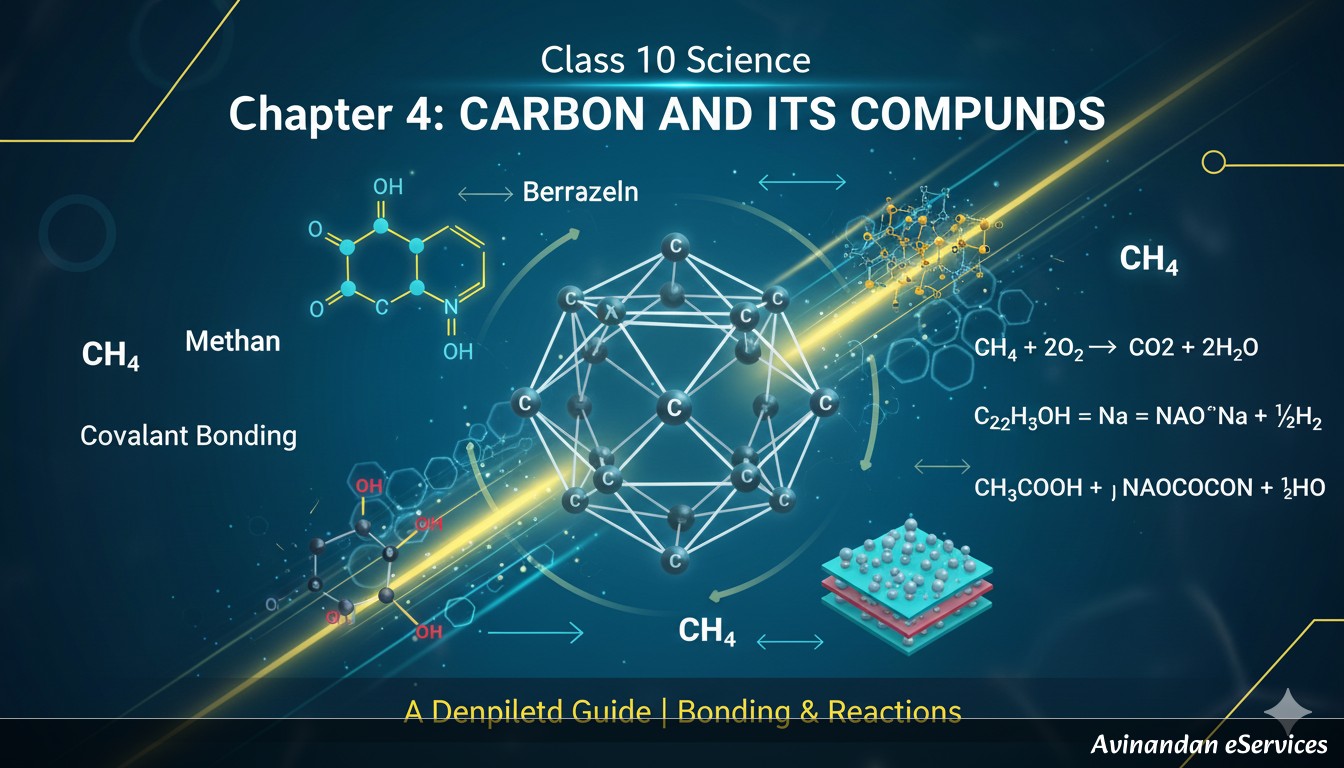
Welcome to our detailed exploration of Chapter 4 from the NCERT Class 10 Science syllabus: Carbon and its Compounds. Carbon is an element of immense significance, not just in chemistry, but in life itself. From the food we eat and the clothes we wear to the fuels that power our world, carbon is the fundamental building block. This chapter unravels the mystery behind carbon's unique ability to form an astonishingly large number of compounds. We will delve into the nature of bonding in carbon, its versatile properties like catenation and tetravalency, and explore the vast world of hydrocarbons, functional groups, and important carbon compounds like ethanol and ethanoic acid. By the end of this guide, you will have a strong foundation in organic chemistry, a crucial topic for higher studies.
Bonding in Carbon - The Covalent Bond
Carbon, with its atomic number 6, has an electronic configuration of 2, 4. This means it has four electrons in its outermost shell (the L shell). To achieve a stable, noble gas configuration, it needs to either gain four electrons, lose four electrons, or share four electrons.
- Losing four electrons (forming C4+ cation): This would require a tremendous amount of energy to remove four electrons from the atom, making it highly unstable.
- Gaining four electrons (forming C4- anion): It would be very difficult for a nucleus with only 6 protons to hold onto ten electrons, making this option energetically unfavourable.
Faced with these challenges, carbon adopts a brilliant solution: it shares its four valence electrons with other atoms. This sharing of electrons between atoms to achieve a stable electronic configuration is known as covalent bonding. The compounds formed through this type of bonding are called covalent compounds.
Formation of Covalent Bonds
A covalent bond is formed when two atoms share one or more pairs of electrons. Let's look at some examples:
- Hydrogen Molecule (H2): A hydrogen atom has one electron. Two hydrogen atoms share their single electrons to form a pair, giving each atom a stable configuration of two electrons, like the noble gas Helium. This is a single covalent bond.
- Oxygen Molecule (O2): An oxygen atom has six valence electrons. Two oxygen atoms each share two electrons, forming two shared pairs (a double bond), so that each atom achieves a stable octet (8 electrons).
- Methane Molecule (CH4): This is the simplest carbon compound. One carbon atom shares its four valence electrons with four individual hydrogen atoms. Each hydrogen atom shares its one electron with the carbon. As a result, the carbon atom achieves a stable octet, and each hydrogen atom achieves a stable duet.
Properties of Covalent Compounds
Covalent compounds have distinct properties that arise from the nature of their bonding:
- Low Melting and Boiling Points: The forces of attraction between the molecules of covalent compounds (intermolecular forces) are relatively weak. Less energy is required to overcome these forces, resulting in low melting and boiling points compared to ionic compounds.
- Poor Conductors of Electricity: Since electrons are shared and no charged particles (ions) are formed, covalent compounds are generally poor conductors of electricity in both solid and molten states.
Versatile Nature of Carbon
Carbon forms the backbone of millions of compounds. This incredible diversity is primarily due to two unique properties of the carbon atom:
Catenation
Catenation is the unique ability of an atom to form strong covalent bonds with other atoms of the same element, resulting in long chains, branched chains, or rings. Carbon exhibits this property to the maximum \textent because the C-C bond is very strong and stable. This allows carbon atoms to link together to form stable chains of varying lengths and structures. Silicon also shows some catenation, but its compounds are highly reactive and far less stable than carbon compounds because the Si-Si bond is weaker.
Tetravalency
As we discussed, carbon has a valency of four (it is tetravalent). This means one carbon atom has the capacity to form covalent bonds with four other atoms. These atoms can be other carbon atoms or atoms of other elements like hydrogen, oxygen, nitrogen, sulfur, and halogens. This ability to form four stable bonds allows for a huge variety of molecular structures and compounds.
Saturated and Unsaturated Carbon Compounds
The compounds of carbon and hydrogen are known as hydrocarbons. They are the simplest organic compounds and can be broadly classified based on the type of bonds between carbon atoms.
Saturated Hydrocarbons (Alkanes)
Hydrocarbons in which the carbon atoms are connected only by single covalent bonds are called saturated hydrocarbons or alkanes. They are called 'saturated' because each carbon atom has bonded to the maximum number of other atoms possible, and no more atoms can be added. The general formula for alkanes is CnH2n+2, where 'n' is the number of carbon atoms.
Examples:
- Methane (CH4)
- Ethane (C2H6)
- Propane (C3H8)
Unsaturated Hydrocarbons (Alkenes and Alkynes)
Hydrocarbons that contain at least one double or triple covalent bond between carbon atoms are called unsaturated hydrocarbons. They are 'unsaturated' because they can accommodate more atoms by breaking the double or triple bonds.
- Alkenes: These contain at least one carbon-carbon double bond (C=C). Their general formula is CnH2n. Examples include Ethene (C2H4) and Propene (C3H6).
- Alkynes: These contain at least one carbon-carbon triple bond (C≡C). Their general formula is CnH2n-2. Examples include Ethyne (C2H2) and Propyne (C3H4).
Chains, Branches, and Rings
The property of catenation allows carbon skeletons to be formed in various ways:
- Straight Chains: Carbon atoms linked one after another in a continuous chain (e.g., Butane, C4H10).
- Branched Chains: A chain where one or more carbon atoms are attached as a 'branch' to the main chain. For example, the formula C4H10 can represent both straight-chain butane and a branched structure called isobutane. Compounds with the same molecular formula but different structural arrangements are called structural isomers.
- Rings (Cyclic Compounds): Carbon atoms can link to form closed rings. For example, cyclohexane (C6H12) is a saturated cyclic hydrocarbon where six carbon atoms form a ring. Benzene (C6H6) is an important unsaturated cyclic hydrocarbon with alternating single and double bonds.
Homologous Series
A homologous series is a series of organic compounds which have the same functional group and similar chemical properties, in which the successive members differ by a –CH2 group.
Characteristics of a homologous series:
- All members can be represented by a single general formula (e.g., Alkanes: CnH2n+2).
- Each successive member differs from the next by one carbon atom and two hydrogen atoms (a –CH2 group), which corresponds to a mass difference of 14 u.
- They have similar chemical properties due to the presence of the same functional group.
- There is a gradual change in their physical properties, such as melting point, boiling point, and density, as the molecular mass increases down the series.
Examples include the series of alkanes (methane, ethane, propane...), alcohols (methanol, ethanol, propanol...), and carboxylic acids (methanoic acid, ethanoic acid, propanoic acid...).
Nomenclature of Carbon Compounds
With millions of organic compounds, a systematic method of naming them is essential. The system recommended by the International Union of Pure and Applied Chemistry (IUPAC) is followed worldwide. The IUPAC name of a compound is based on a 'word root' indicating the number of carbon atoms, modified by prefixes and suffixes to indicate the nature of bonds and functional groups.
Steps for IUPAC Nomenclature:
- Identify the longest carbon chain: This determines the 'word root'.
- Identify the functional group: The presence of a functional group is indicated by either a suffix or a prefix. A functional group is an atom or a group of atoms that determines the chemical properties of an organic compound.
- Name the compound: Combine the prefix, word root, and suffix according to IUPAC rules.
| No. of C Atoms | Word Root |
|---|---|
| 1 | Meth- |
| 2 | Eth- |
| 3 | Prop- |
| 4 | But- |
| 5 | Pent- |
| 6 | Hex- |
The name is modified with a suffix: '-ane' for single bonds, '-ene' for double bonds, and '-yne' for triple bonds.
Functional Groups
| Functional Group | Formula | Prefix/Suffix | Example |
|---|---|---|---|
| Halogen (Halo- group) | -Cl, -Br | Prefix: Chloro-, Bromo- | CH3Cl (Chloromethane) |
| Alcohol | -OH | Suffix: -ol | CH3OH (Methanol) |
| Aldehyde | -CHO | Suffix: -al | HCHO (Methanal) |
| Ketone | -C=O | Suffix: -one | CH3COCH3 (Propanone) |
| Carboxylic Acid | -COOH | Suffix: -oic acid | CH3COOH (Ethanoic acid) |
Chemical Properties of Carbon Compounds
Combustion
Carbon and its compounds burn in the presence of oxygen to produce carbon dioxide, water, heat, and light. This process is called combustion. It is an exothermic reaction.
CH4 (g) + 2O2 (g) → CO2 (g) + 2H2O (g) + Heat and light
- Complete Combustion: Saturated hydrocarbons generally burn with a clean, blue flame due to complete combustion.
- Incomplete Combustion: Unsaturated hydrocarbons burn with a yellow, sooty flame because of incomplete combustion, which produces unburnt carbon particles (soot).
Oxidation
Oxidation is the addition of oxygen or removal of hydrogen. Alcohols can be oxidized to carboxylic acids using oxidizing agents.
An oxidizing agent is a substance that gives oxygen to another substance. Examples include alkaline potassium permanganate (KMnO4) or acidified potassium dichromate (K2Cr2O7).
CH3CH2OH (Ethanol) + [O] (from oxidizing agent) → CH3COOH (Ethanoic acid) + H2O
Addition Reaction
Unsaturated hydrocarbons undergo addition reactions, where atoms are added across the double or triple bond to form a saturated compound. A common example is hydrogenation, the addition of hydrogen.
This reaction typically occurs in the presence of a catalyst like nickel (Ni), palladium (Pd), or platinum (Pt). A catalyst is a substance that increases the rate of a reaction without being consumed in the process.
CH2=CH2 (Ethene) + H2 --(Ni catalyst)--> CH3-CH3 (Ethane)
This process is used commercially to convert unsaturated vegetable oils (liquids at room temperature) into saturated fats like vanaspati ghee (solid at room temperature).
Substitution Reaction
Saturated hydrocarbons are relatively unreactive. However, in the presence of sunlight, they undergo substitution reactions, where one or more hydrogen atoms are replaced by another atom or group of atoms, typically a halogen.
CH4 (Methane) + Cl2 (Chlorine) --(Sunlight)--> CH3Cl (Chloromethane) + HCl (Hydrogen chloride)
This reaction can continue, replacing more hydrogen atoms to form dichloromethane (CH2Cl2), trichloromethane (CHCl3), and tetrachloromethane (CCl4).
Important Carbon Compounds: Ethanol and Ethanoic Acid
Properties of Ethanol (C2H5OH)
Ethanol, commonly known as alcohol, is a volatile liquid with a characteristic smell. It is the active ingredient in alcoholic beverages and is also used as a solvent, in medicines (like tincture of iodine), and as a fuel.
- Reaction with Sodium: Ethanol reacts with active metals like sodium to produce sodium ethoxide and hydrogen gas.
- 2Na + 2CH3CH2OH → 2CH3CH2ONa + H2
- Dehydration: When heated with excess concentrated sulphuric acid at 443 K, ethanol gets dehydrated to form ethene. The sulphuric acid acts as a dehydrating agent.
- CH3CH2OH --(Conc. H2SO4)--> CH2=CH2 + H2O
Properties of Ethanoic Acid (CH3COOH)
Ethanoic acid is commonly known as acetic acid. A 5-8% solution of acetic acid in water is called vinegar. Pure ethanoic acid is a colorless liquid that freezes during winter, earning it the name glacial acetic acid.
- Acidic Nature: It is a weak acid and turns blue litmus red.
- Esterification Reaction: Ethanoic acid reacts with an alcohol in the presence of an acid catalyst to form a sweet-smelling compound called an ester. This reaction is called esterification.
- CH3COOH + CH3CH2OH --(Acid)--> CH3COOCH2CH3 (Ethyl ethanoate) + H2O
- Esters are used in making perfumes and as flavouring agents.
- Saponification: When an ester is treated with a base like sodium hydroxide (NaOH), it is converted back to the parent alcohol and the sodium salt of the carboxylic acid. This reaction is called saponification and is used in the preparation of soap.
- CH3COOC2H5 + NaOH → C2H5OH + CH3COONa
- Reaction with Bases and Carbonates: Ethanoic acid reacts with bases (like NaOH) to form salt and water (neutralization) and with carbonates/hydrogencarbonates to produce salt, water, and carbon dioxide gas.
Soaps and Detergents
Soaps and detergents are essential cleaning agents that we use daily. Their cleansing action is based on their unique molecular structure.
Structure of a Soap Molecule
A soap is the sodium or potassium salt of a long-chain carboxylic acid (fatty acid). A soap molecule has two distinct parts:
- A long hydrocarbon tail, which is hydrophobic (water-repelling) and soluble in oil and grease.
- A short ionic head (the -COO-Na+ part), which is hydrophilic (water-attracting) and soluble in water.
Cleansing Action of Soap (Micelle Formation)
When soap is dissolved in water, the molecules form clusters called micelles. In a micelle, the hydrophobic tails point inwards towards the center, away from the water, while the hydrophilic heads face outwards, interacting with the water. When a soapy solution is applied to a dirty cloth, the hydrophobic tails of the soap molecules attach themselves to the oily dirt particle. The hydrophilic heads remain in the water. When the cloth is agitated or rinsed, the micelles containing the trapped dirt are washed away with the water, leaving the surface clean.
Soaps and Hard Water
Hard water contains dissolved salts of calcium (Ca2+) and magnesium (Mg2+). When soap is used in hard water, it reacts with these ions to form an insoluble precipitate called scum. This scum sticks to the fabric and reduces the cleaning efficiency of the soap, wasting a significant amount of it.
Detergents - A Better Alternative
Detergents are generally ammonium or sulphonate salts of long-chain carboxylic acids. Like soaps, they have a hydrophilic head and a hydrophobic tail. However, the charged head of a detergent does not form insoluble precipitates with the calcium and magnesium ions present in hard water. Therefore, detergents are effective cleaning agents in both soft and hard water. They are widely used in shampoos and products for cleaning clothes.
Important Questions and Answers
Question 1: Explain the formation of scum when hard water is treated with soap.
Answer: Hard water contains dissolved mineral salts, primarily calcium (Ca2+) and magnesium (Mg2+) ions. Soap molecules are sodium or potassium salts of long-chain fatty acids (e.g., sodium stearate, C17H35COONa). When soap is added to hard water, a chemical reaction occurs where the sodium ions of the soap are replaced by the calcium or magnesium ions from the hard water. This results in the formation of insoluble calcium or magnesium stearate. This insoluble, sticky precipitate is called scum. The formation of scum prevents the soap from forming lather and reduces its cleansing ability.
2C17H35COONa (Soap) + Ca2+ (from Hard Water) → (C17H35COO)2Ca (Scum) + 2Na+
Question 2: What would be the electron dot structure of a molecule of sulfur which is made up of eight atoms of sulfur? (Hint – The eight atoms of sulfur are joined together in the form of a ring.)
Answer: The atomic number of sulfur (S) is 16, and its electronic configuration is 2, 8, 6. It has 6 valence electrons and needs 2 more electrons to complete its octet. In the S8 molecule, eight sulfur atoms are arranged in a puckered ring structure. Each sulfur atom forms single covalent bonds with its two neighbouring sulfur atoms, sharing one electron with each neighbour. This allows each sulfur atom to share a total of two electrons and have six of its own (including two lone pairs), thus completing its octet of 8 electrons. The structure is a crown-shaped ring. Describing the dot structure: Draw eight 'S' symbols in a circle. For each 'S', draw two dots between it and its left neighbour, and two dots between it and its right neighbour (representing shared pairs). Then, add four more dots (two lone pairs) to each 'S' atom to complete its octet.
Question 3: How would you distinguish experimentally between an alcohol and a carboxylic acid?
Answer: We can distinguish between an alcohol and a carboxylic acid using the following tests:
- Litmus Test: Add a few drops of blue litmus solution to both test tubes. The carboxylic acid, being acidic, will turn the blue litmus solution red. The alcohol, being neutral, will show no change in the color of the litmus solution.
- Sodium Bicarbonate Test: Add a pinch of sodium bicarbonate (NaHCO3) powder to both samples. The carboxylic acid will react with sodium bicarbonate to produce brisk effervescence due to the evolution of carbon dioxide gas. The alcohol will not react, and no effervescence will be observed.
- Reaction: CH3COOH + NaHCO3 → CH3COONa + H2O + CO2↑
Question 4: What are oxidizing agents?
Answer: Oxidizing agents are substances that can cause oxidation. In organic chemistry, they are typically substances that can add oxygen to other substances or remove hydrogen from them. They achieve this by readily giving up an oxygen atom or accepting electrons in a reaction. Two common oxidizing agents used for converting alcohols to carboxylic acids are:
- Alkaline Potassium Permanganate (KMnO4): A strong oxidizing agent. The solution is purple and becomes colorless as it gets used up in the reaction.
- Acidified Potassium Dichromate (K2Cr2O7): Another strong oxidizing agent. The solution turns from orange to green as it oxidizes the alcohol.
Chapter Summary
- Carbon is a versatile element that forms the basis for all living organisms and many of the things we use.
- Carbon achieves a stable octet by forming covalent bonds through the sharing of electrons.
- Carbon's versatile nature is due to catenation (self-linking ability) and tetravalency (valency of four).
- Hydrocarbons are compounds of carbon and hydrogen. They can be saturated (alkanes, single bonds) or unsaturated (alkenes with double bonds, alkynes with triple bonds).
- Carbon compounds can have straight chains, branched chains, or cyclic structures. Compounds with the same molecular formula but different structures are called isomers.
- A homologous series is a group of compounds with the same functional group, where successive members differ by a –CH2 group.
- A functional group (like -OH, -CHO, -COOH) determines the chemical properties of an organic compound.
- Important chemical reactions of carbon compounds include combustion, oxidation, addition, and substitution reactions.
- Ethanol and Ethanoic acid are commercially important carbon compounds with distinct physical and chemical properties.
- The reaction between a carboxylic acid and an alcohol forms an ester (esterification).
- Soaps are sodium or potassium salts of long-chain fatty acids. Their cleansing action depends on the formation of micelles.
- Soaps are ineffective in hard water as they form scum. Detergents work effectively in both hard and soft water.