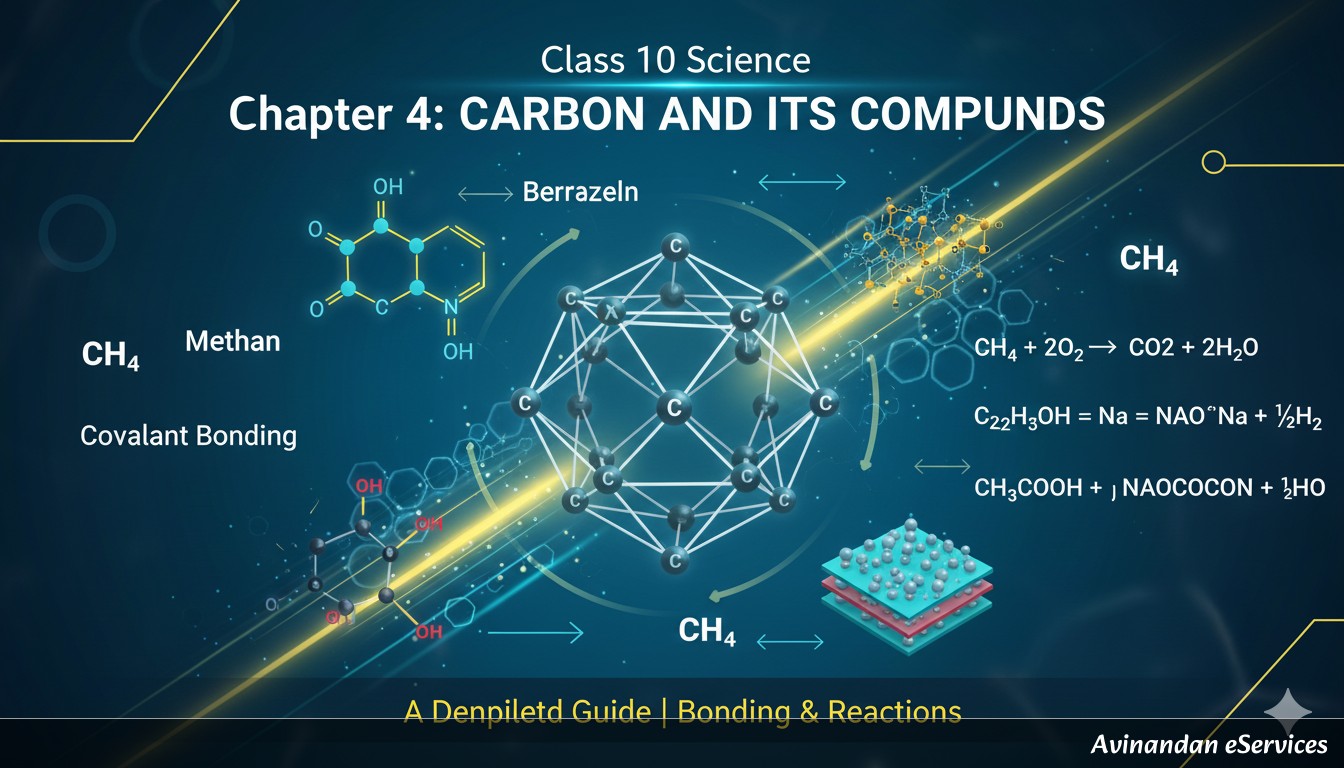
Introduction to Carbon and its Compounds
Welcome, students, to a deep dive into one of the most fascinating and fundamental chapters of chemistry: Chapter 4, Carbon and its Compounds. Carbon is not just another element on the periodic table; it is the very backbone of life as we know it. From the food we eat and the clothes we wear to the medicines that cure us and the fuels that power our world, carbon compounds are everywhere. The study of carbon and its compounds is so vast and important that it constitutes a separate branch of chemistry called Organic Chemistry.
Why is carbon so special? What gives it the ability to form millions of different compounds, far more than all other elements combined? In this chapter, we will unravel the mysteries of carbon's unique properties. We will explore its special type of bonding—the covalent bond—and understand why its versatile nature, characterized by tetravalency and catenation, makes it the king of elements. We'll examine its different physical forms, known as allotropes, like the sparkling diamond and the slippery graphite. We will then journey through the vast world of hydrocarbons, learn how to name complex carbon compounds using IUPAC nomenclature, and study their key chemical reactions. Finally, we'll look at some commercially important carbon compounds like ethanol and ethanoic acid, and understand the science behind the cleansing action of soaps and detergents. This chapter will lay a strong foundation for your understanding of the chemical world around you.
Bonding in Carbon – The Covalent Bond
To understand carbon's unique behavior, we must first understand how it connects with other atoms. Atoms form bonds to achieve a stable electron configuration, usually by having a full outermost shell, similar to that of a noble gas. This can be achieved by either transferring electrons (forming ionic bonds) or sharing electrons (forming covalent bonds).
Why Carbon Forms Covalent Bonds
Let's look at carbon's electronic configuration. Carbon has an atomic number of 6, which means its electronic configuration is 2, 4. It has four electrons in its outermost shell (the L shell). To achieve a stable noble gas configuration, it has two theoretical options:
- Gaining four electrons: It could gain four electrons to form a C⁴⁻ anion. However, it would be \textremely difficult for a nucleus with only 6 protons to hold onto 10 electrons (6 original + 4 gained). The strong electron-electron repulsion would make the anion highly unstable.
- Losing four electrons: It could lose its four valence electrons to form a C⁴⁺ cation. This would require an enormous amount of energy to remove four successive electrons from the atom, which is not energetically feasible.
Since both gaining and losing four electrons are difficult, carbon adopts a middle path. It overcomes this problem by sharing its valence electrons with other atoms of carbon or with atoms of other elements. This sharing of electrons leads to the formation of covalent bonds.
Formation of Covalent Bonds
A covalent bond is a chemical bond formed by the mutual sharing of one or more pairs of electrons between two atoms. The shared pair of electrons belongs to the outer shells of both atoms, allowing both to attain a stable noble gas configuration.
Let's see some examples:
- Formation of Hydrogen molecule (H₂): A hydrogen atom has 1 electron. It needs one more to fill its K shell. Two hydrogen atoms share one electron each to form a single covalent bond, H-H.
- Formation of Oxygen molecule (O₂): An oxygen atom (atomic number 8; configuration 2, 6) has 6 valence electrons. It needs two more. Two oxygen atoms share two pairs of electrons, forming a double covalent bond, O=O.
- Formation of Nitrogen molecule (N₂): A nitrogen atom (atomic number 7; configuration 2, 5) needs three electrons. Two nitrogen atoms share three pairs of electrons, forming a triple covalent bond, N≡N.
- Formation of Methane molecule (CH₄): A carbon atom shares its four valence electrons with four hydrogen atoms. Each hydrogen atom shares its single electron with carbon. This results in four single covalent bonds, allowing carbon to have a stable octet and each hydrogen to have a stable duet.
Properties of Covalent Compounds
Covalent compounds exhibit distinct properties due to the nature of their bonding:
- Low Melting and Boiling Points: The covalent bonds within a molecule are very strong. However, the forces of attraction between the molecules (intermolecular forces) are generally weak. Therefore, less energy is required to overcome these weak forces, resulting in low melting and boiling points.
- Poor Conductors of Electricity: Covalent compounds are generally poor conductors of electricity. This is because the electrons are shared between atoms and are not free to move. Since there are no charged particles (ions or free electrons) to carry a current, they do not conduct electricity in solid, liquid, or aqueous states.
Versatile Nature of Carbon
The existence of an estimated 10 million carbon compounds is a testament to the element's remarkably versatile nature. Two key properties of carbon are responsible for this incredible diversity: catenation and tetravalency.
Catenation
Catenation is the unique ability of an atom to form strong covalent bonds with other atoms of the same element, resulting in the formation of long chains, branched chains, and rings of various sizes. Carbon exhibits this property to the maximum \textent due to the following reasons:
- Strong Carbon-Carbon Bond: The C-C single bond is exceptionally strong and stable (bond energy ≈ 348 kJ/mol). This stability allows carbon atoms to link together to form long, unreactive chains and complex structures without breaking apart easily.
- Small Size: Carbon's small atomic size allows for effective overlap of orbitals, contributing to the strength of the C-C bond.
Other elements like silicon also show catenation, but to a much lesser \textent. Silicon forms compounds with hydrogen (silanes) with chains of up to seven or eight atoms, but these compounds are highly reactive because the Si-Si bond is much weaker than the C-C bond.
Tetravalency
Tetravalency refers to the ability of an atom to form four covalent bonds. Since carbon has four valence electrons, it has a valency of four. This means a single carbon atom can bond with four other monovalent atoms (like H, Cl), two divalent atoms (like O), or a combination thereof. This ability to form four stable bonds allows carbon to create a vast array of three-dimensional structures and to bond with a wide variety of other elements like hydrogen, oxygen, nitrogen, sulfur, and halogens, leading to the formation of an enormous number of compounds with different properties and functions.
Allotropes of Carbon
Allotropes are different structural forms of the same element in the same physical state. These forms have different physical properties but similar chemical properties. Carbon exists in several well-known allotropic forms.
Diamond
- Structure: In a diamond crystal, each carbon atom is covalently bonded to four other carbon atoms, forming a rigid, three-dimensional tetrahedral network. This strong and compact structure \textends throughout the crystal.
- Properties: This rigid structure makes diamond the hardest known natural substance. It has a very high melting point (over 3500 °C). Since all four valence electrons of each carbon atom are locked in covalent bonds, there are no free electrons, making diamond a poor conductor of electricity. It is transparent and has a high refractive index, giving it its characteristic brilliance.
- Uses: Used in jewelry, for cutting glass, and in rock drilling equipment due to its hardness.
Graphite
- Structure: In graphite, each carbon atom is bonded to three other carbon atoms in the same plane, forming flat hexagonal rings. These rings join to form two-dimensional sheets or layers. These layers are stacked on top of each other and are held together by weak van der Waals forces.
- Properties: Because the layers can easily slide over one another, graphite is soft, slippery, and greasy to the touch. The fourth valence electron of each carbon atom is delocalized (free to move) within its layer, which makes graphite a good conductor of electricity. It is opaque and greyish-black.
- Uses: Used as a lubricant, in pencil ‘leads’, and as electrodes in batteries and industrial electrolysis.
Fullerenes (Buckminsterfullerene - C-60)
- Structure: Fullerenes are a class of allotropes that form cage-like or spherical molecules. The first one to be identified was Buckminsterfullerene (C-60), which has 60 carbon atoms arranged in the shape of a soccer ball (a truncated icosahedron), consisting of 20 hexagonal and 12 pentagonal rings.
- Properties: They are dark solids at room temperature and have different properties from diamond and graphite. They can be found in soot.
Saturated and Unsaturated Carbon Compounds
The simplest carbon compounds are those formed with hydrogen, known as hydrocarbons. Based on the type of bonds between carbon atoms, they are classified as saturated or unsaturated.
Saturated Hydrocarbons (Alkanes)
These are hydrocarbons in which all the carbon atoms are connected only by single covalent bonds. They are called 'saturated' because each carbon atom is bonded to the maximum possible number of hydrogen atoms, and no more atoms can be added. They are also known as alkanes. The general formula for alkanes is CₙH₂ₙ₊₂.
- Methane (CH₄): n=1
- Ethane (C₂H₆): n=2
- Propane (C₃H₈): n=3
Unsaturated Hydrocarbons
These are hydrocarbons that contain at least one carbon-carbon double (C=C) or triple (C≡C) bond. They are 'unsaturated' because they have fewer hydrogen atoms than the corresponding alkane, and more atoms (like hydrogen or halogens) can be added across the multiple bonds. They are more reactive than saturated hydrocarbons.
Alkenes
Alkenes are unsaturated hydrocarbons that contain at least one carbon-carbon double bond. Their general formula is CₙH₂ₙ.
- Ethene (C₂H₄): The simplest alkene.
- Propene (C₃H₆)
Alkynes
Alkynes are unsaturated hydrocarbons that contain at least one carbon-carbon triple bond. Their general formula is CₙH₂ₙ₋₂.
- Ethyne (C₂H₂): The simplest alkyne, commonly known as acetylene.
- Propyne (C₃H₄)
Chains, Branches, and Rings
The properties of catenation and tetravalency allow carbon skeletons to be formed in various ways:
- Straight Chains: Carbon atoms are linked one after another in a continuous chain (e.g., butane, C₄H₁₀).
- Branched Chains: Some carbon atoms are attached to the side of the main chain (e.g., isobutane, also C₄H₁₀).
- Rings (Cyclic Compounds): Carbon atoms are arranged in a ring (e.g., cyclohexane, C₆H₁₂).
Compounds that have the same molecular formula but different structural arrangements are called structural isomers. For example, butane and isobutane are structural isomers. They have the same formula (C₄H₁₀) but different structures and, consequently, different physical properties (like boiling points).
Homologous Series
A homologous series is a series of organic compounds which have the same functional group and similar chemical properties, in which the successive members differ by a –CH₂ group.
Characteristics of a Homologous Series:
- All members can be represented by a single general formula (e.g., Alkanes: CₙH₂ₙ₊₂).
- Each successive member differs from the next by one –CH₂ group.
- The difference in molecular mass between any two adjacent members is 14 atomic mass units (u).
- They show similar chemical properties due to the presence of the same functional group.
- They show a gradual change in their physical properties, such as melting point, boiling point, and density, as the molecular mass increases. For example, the boiling point increases down the series because of increasing intermolecular forces.
Examples of homologous series include alkanes (methane, ethane, propane...), alcohols (methanol, ethanol, propanol...), and so on.
Nomenclature of Carbon Compounds
With millions of organic compounds, a systematic method of naming is essential. The system recommended by the International Union of Pure and Applied Chemistry (IUPAC) is followed worldwide.
Steps for Naming a Carbon Compound (IUPAC System)
- Identify the Parent Chain: Find the longest continuous chain of carbon atoms. The number of carbon atoms in this chain gives the root word (e.g., 1-Meth, 2-Eth, 3-Prop, 4-But, 5-Pent, 6-Hex).
- Identify the Type of Bond: If the chain has only single bonds, the primary suffix is '-ane'. If it has a double bond, it is '-ene'. If it has a triple bond, it is '-yne'.
- Identify the Functional Group: The presence of a functional group is indicated by either a prefix or a suffix. If the suffix for the functional group begins with a vowel (a, e, i, o, u), the final 'e' of the alkane name is dropped.
Functional Groups
A functional group is an atom or a group of atoms (heteroatom) that replaces a hydrogen atom in a hydrocarbon chain and is responsible for the characteristic chemical properties of the compound.
| Class of Compound | Functional Group | Formula | IUPAC Naming |
|---|---|---|---|
| Haloalkane | Halogen | -Cl, -Br, -I | Prefix: Chloro-, Bromo-, Iodo- |
| Alcohol | Hydroxyl | -OH | Suffix: -ol |
| Aldehyde | Aldehyde | -CHO | Suffix: -al |
| Ketone | Ketone | -CO- | Suffix: -one |
| Carboxylic Acid | Carboxyl | -COOH | Suffix: -oic acid |
Examples:
- CH₃Cl: One carbon (Meth) + single bonds (ane) + Cl group (Chloro). Name: Chloromethane.
- CH₃CH₂OH: Two carbons (Eth) + single bonds (ane) + OH group (ol). Name: Ethane - e + ol = Ethanol.
- CH₃CHO: Two carbons (Eth) + single bonds (ane) + CHO group (al). Name: Ethane - e + al = Ethanal.
- CH₃COCH₃: Three carbons (Prop) + single bonds (ane) + CO group (one). The CO is on the 2nd carbon. Name: Propane - e + one = Propanone.
- CH₃COOH: Two carbons (Eth) + single bonds (ane) + COOH group (oic acid). Name: Ethane - e + oic acid = Ethanoic acid.
Chemical Properties of Carbon Compounds
Combustion
Combustion is the process of burning a substance in the presence of oxygen to produce heat and light. Carbon and its compounds burn in air to produce carbon dioxide, water vapour, heat, and light.
CH₄(g) + 2O₂(g) → CO₂(g) + 2H₂O(g) + Heat and Light
- Saturated hydrocarbons generally burn with a clean, blue flame because the percentage of carbon is relatively low, and it gets completely oxidized.
- Unsaturated hydrocarbons burn with a yellow, sooty flame. The higher carbon percentage leads to incomplete combustion, producing unburnt carbon particles (soot) that glow yellow in the flame.
Oxidation
Oxidation is the controlled addition of oxygen. Alcohols can be oxidized to carboxylic acids using oxidizing agents.
An oxidizing agent is a substance that supplies oxygen. Common examples are alkaline Potassium Permanganate (KMnO₄) or acidified Potassium Dichromate (K₂Cr₂O₇).
CH₃CH₂OH (Ethanol) + [O] --(Alkaline KMnO₄ + Heat)--> CH₃COOH (Ethanoic Acid) + H₂O
Addition Reaction
This is a characteristic reaction of unsaturated hydrocarbons (alkenes and alkynes). In an addition reaction, an unsaturated compound adds another molecule (like hydrogen, chlorine, or bromine) across its double or triple bond to become saturated.
Hydrogenation: This is the addition of hydrogen to an unsaturated hydrocarbon in the presence of a catalyst like nickel (Ni), palladium (Pd), or platinum (Pt). This reaction is widely used to convert vegetable oils (which are unsaturated fats) into vegetable ghee (saturated fats).
CH₂=CH₂ (Ethene) + H₂ --(Ni catalyst)--> CH₃-CH₃ (Ethane)
Substitution Reaction
This is a characteristic reaction of saturated hydrocarbons (alkanes). In a substitution reaction, one or more hydrogen atoms of a hydrocarbon are replaced by another atom or group of atoms. These reactions are generally slow and require energy in the form of sunlight or heat.
For example, methane reacts with chlorine in the presence of diffused sunlight.
CH₄ + Cl₂ --(Sunlight)--> CH₃Cl (Chloromethane) + HCl
The reaction can continue to replace all hydrogen atoms, forming CH₂Cl₂, CHCl₃, and finally CCl₄.
Some Important Carbon Compounds: Ethanol and Ethanoic Acid
Ethanol (C₂H₅OH)
Ethanol, commonly known as alcohol, is the active ingredient in all alcoholic beverages.
- Properties: It is a colorless, pleasant-smelling liquid with a burning taste. It is miscible with water in all proportions. It is a good solvent.
- Reactions of Ethanol:
- Reaction with Sodium: Ethanol reacts with active metals like sodium to produce sodium ethoxide and hydrogen gas. This reaction is a test for the presence of the -OH group.
2Na(s) + 2CH₃CH₂OH(l) → 2CH₃CH₂ONa(aq) + H₂(g) - Dehydration: When ethanol is heated with excess concentrated sulphuric acid at 443 K (170°C), it gets dehydrated (loses a water molecule) to form ethene.
CH₃CH₂OH --(Hot conc. H₂SO₄)--> CH₂=CH₂ + H₂O - Uses: In alcoholic drinks, as a solvent in the paint and perfume industry, in medicines like tincture of iodine and cough syrups, and as an additive in petrol (gasohol).
- Harmful Effects: Consumption of even small quantities of pure ethanol (absolute alcohol) can be lethal. It is a depressant, slowing down metabolic processes and depressing the central nervous system. This leads to impaired judgment, lack of coordination, and can cause long-term liver damage (cirrhosis).
Ethanoic Acid (CH₃COOH)
Ethanoic acid is commonly known as acetic acid. A 5-8% solution of acetic acid in water is called vinegar.
- Properties: It is a colorless liquid with a sour taste and a pungent smell like vinegar. Its melting point is 290 K (17°C), so it often freezes during winter in cold climates, giving it the name glacial acetic acid.
- Reactions of Ethanoic Acid:
- Esterification Reaction: Ethanoic acid reacts with an absolute alcohol in the presence of an acid catalyst to form a sweet-smelling compound called an ester. This reaction is known as esterification.
CH₃COOH(l) + CH₃CH₂OH(l) --(Acid catalyst)--> CH₃COOC₂H₅(l) (Ethyl ethanoate) + H₂O(l) - Reaction with a Base (Neutralisation): It reacts with bases like sodium hydroxide to form a salt (sodium ethanoate) and water.
NaOH(aq) + CH₃COOH(aq) → CH₃COONa(aq) + H₂O(l) - Reaction with Carbonates and Hydrogencarbonates: It reacts with carbonates and hydrogencarbonates to produce a salt, carbon dioxide, and water. The brisk effervescence of CO₂ is a test for carboxylic acids.
2CH₃COOH + Na₂CO₃ → 2CH₃COONa + H₂O + CO₂ - Uses: Used as a preservative in pickles (as vinegar), as a solvent, and in the manufacture of esters, dyes, and plastics.
Soaps and Detergents
Structure of a Soap Molecule
A soap is the sodium or potassium salt of a long-chain carboxylic acid (fatty acid). A soap molecule has two distinct parts with different properties:
- A long hydrocarbon part (tail): This part is non-polar and hydrophobic (water-repelling). It is soluble in oil and grease.
- A short ionic part (head): This is the carboxylate group (-COO⁻Na⁺). This part is polar and hydrophilic (water-attracting). It is soluble in water.
Cleansing Action of Soap - Micelle Formation
The unique structure of soap molecules helps in cleaning. When soap is dissolved in water, the molecules form clusters called micelles.
- In a micelle, the soap molecules arrange themselves in a spherical structure. The hydrophobic tails point inwards, towards the center of the sphere, away from the water. The hydrophilic heads point outwards, towards the water.
- Most dirt is oily in nature. When soapy water is applied to a dirty, greasy surface, the hydrophobic tails of the soap molecules attach themselves to the oil/grease droplet.
- The hydrophilic heads remain on the outer surface, interacting with the water. This results in the oil droplet being surrounded by an army of soap molecules, forming a micelle with the oil trapped in the center.
- These micelles remain suspended in the water as an emulsion. The outer layer of negatively charged heads prevents the micelles from coming together and re-depositing on the cloth.
- When the water is rinsed away, the micelles containing the dirt are washed away too, leaving the surface clean.
Scum Formation in Hard Water
Hard water contains dissolved salts of calcium (Ca²⁺) and magnesium (Mg²⁺) ions. When soap is used in hard water, it reacts with these ions to form an insoluble, sticky precipitate called scum.
2C₁₇H₃₅COONa (Soap) + Ca²⁺ (from hard water) → (C₁₇H₃₅COO)₂Ca (Scum) + 2Na⁺
This scum sticks to the clothes and the container, reducing the cleaning efficiency of the soap. A large amount of soap is wasted in reacting with these ions before it can begin its cleansing action.
Detergents - A Better Cleansing Agent
Detergents are synthetic cleansing agents. They are generally ammonium or sulphonate salts of long-chain carboxylic acids. Like soaps, they have a hydrophobic tail and a hydrophilic head.
The key advantage of detergents is that their calcium and magnesium salts are soluble in water. Therefore, they do not form scum with hard water and are effective even in hard water. This makes them more effective cleaning agents than soaps in many situations. Detergents are widely used in shampoos and products for cleaning clothes.
Important Questions and Answers
Q1: Why are covalent compounds generally poor conductors of electricity?
A: Covalent compounds are formed by the sharing of electrons between atoms. In these compounds, the electrons are held tightly within the covalent bonds and are not free to move. The conduction of electricity requires the presence of mobile charged particles, such as free electrons or ions. Since covalent compounds do not have free electrons and do not dissociate into ions, they are generally poor conductors of electricity in both solid and molten states.
Q2: What is a homologous series? Explain with an example.
A: A homologous series is a series of organic compounds that have a similar structure, the same functional group, and similar chemical properties. The successive members of the series differ by a –CH₂ group. For example, the homologous series of alcohols includes Methanol (CH₃OH), Ethanol (C₂H₅OH), Propanol (C₃H₇OH), and so on. All members of this series have the -OH functional group, can be represented by the general formula CₙH₂ₙ₊₁OH, and show similar chemical reactions, such as oxidation to form carboxylic acids.
Q3: Differentiate between soaps and detergents.
A:
| Feature | Soaps | Detergents |
|---|---|---|
| Chemical Nature | Sodium or potassium salts of long-chain fatty acids. | Sodium salts of long-chain benzene sulphonic acids or alkyl hydrogen sulphates. |
| Action in Hard Water | Ineffective. They react with Ca²⁺ and Mg²⁺ ions to form insoluble scum. | Effective. They do not form scum with hard water as their Ca²⁺ and Mg²⁺ salts are soluble. |
| Source | They are derived from natural sources like vegetable oils and animal fats. | They are synthetic and derived from petroleum hydrocarbons. |
| Biodegradability | They are biodegradable. | Some detergents are non-biodegradable and can cause water pollution. |
Q4: Explain the mechanism of the cleansing action of soap.
A: The cleansing action of soap is based on the formation of micelles. A soap molecule has two parts: a long hydrophobic hydrocarbon tail that dissolves in oil, and a short hydrophilic ionic head that dissolves in water. When soap is added to water, the molecules arrange themselves into spherical clusters called micelles, with the tails pointing inward and heads outward. When soapy water is applied to a greasy cloth, the hydrophobic tails of the soap molecules attach to the grease particles, while the hydrophilic heads remain in contact with the water. This forms a micelle around the grease particle, trapping it. Agitation, like scrubbing, helps break the grease into smaller droplets and allows more soap molecules to surround them. When the cloth is rinsed, the water washes away the micelles, carrying the trapped grease and dirt along with them, thus cleaning the cloth.
Q5: What are isomers? Draw the structures of two isomers of butane (C₄H₁₀).
A: Isomers are compounds that have the same molecular formula but different structural arrangements of atoms. Due to their different structures, they often have different physical and chemical properties. Butane (C₄H₁₀) has two structural isomers:
- n-Butane (normal butane): This is a straight-chain isomer. Its structure is CH₃-CH₂-CH₂-CH₃.
- Isobutane (2-methylpropane): This is a branched-chain isomer. Its structure has a three-carbon chain with a methyl (-CH₃) group attached to the central carbon.
Both structures have the molecular formula C₄H₁₀ but are different compounds with different boiling points.
Chapter Summary
- Carbon is a versatile element that forms the basis of all living organisms and many of the things we use.
- Carbon forms covalent bonds by sharing its four valence electrons to achieve a stable octet.
- The unique properties of carbon that lead to the formation of a large number of compounds are catenation (self-linking) and tetravalency (valency of four).
- Carbon exists in different forms called allotropes, such as diamond, graphite, and fullerenes.
- Hydrocarbons are compounds of carbon and hydrogen. They can be saturated (alkanes, with single bonds) or unsaturated (alkenes with double bonds, and alkynes with triple bonds).
- Carbon compounds can have straight chains, branched chains, or ring structures. Compounds with the same molecular formula but different structures are called isomers.
- A homologous series is a group of compounds with the same functional group and similar chemical properties.
- A functional group is an atom or group of atoms that determines the chemical properties of an organic compound.
- Important chemical properties of carbon compounds include combustion, oxidation, addition reactions, and substitution reactions.
- Ethanol and ethanoic acid are commercially important carbon compounds with various industrial and domestic uses.
- Soaps are sodium or potassium salts of long-chain fatty acids. They clean by forming micelles that trap oily dirt.
- Soaps are ineffective in hard water as they form scum. Detergents are synthetic cleaning agents that work effectively in both soft and hard water.