Introduction to Acids, Bases and Salts
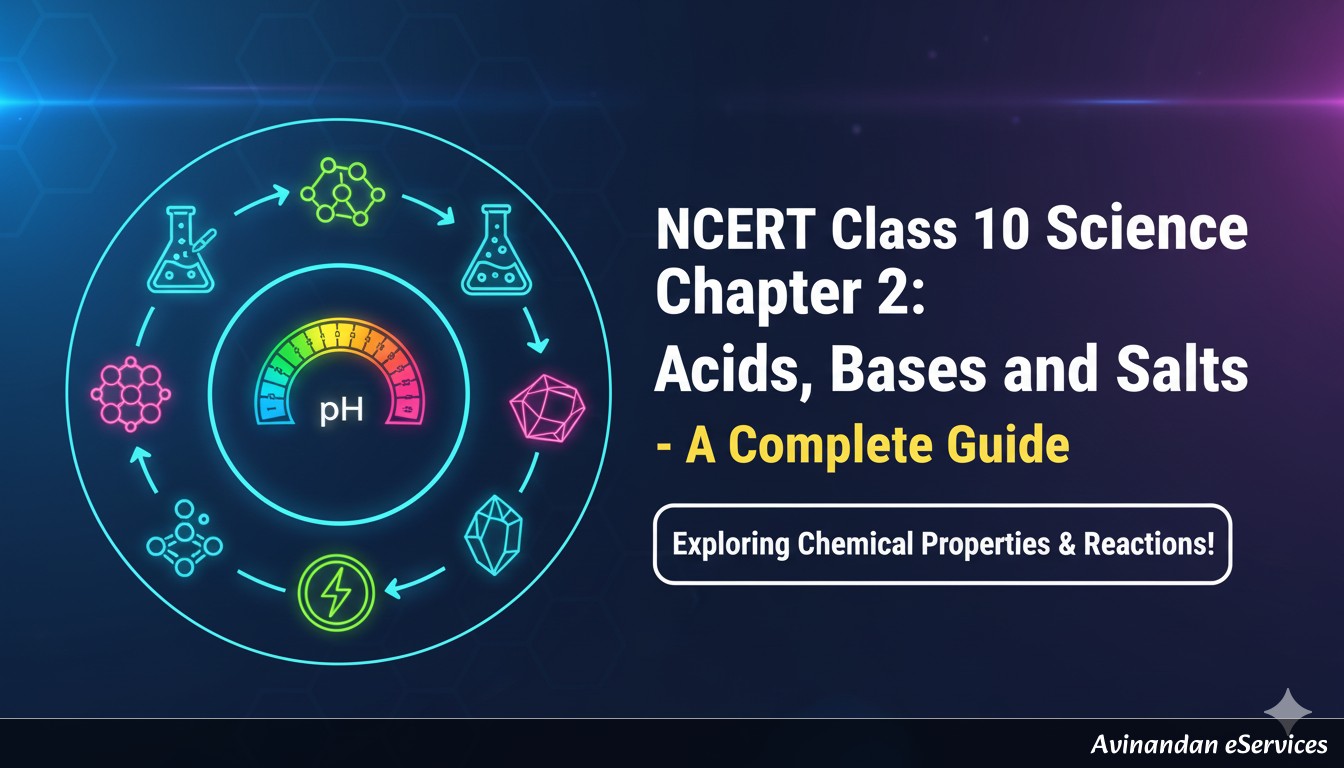
Welcome, students, to a comprehensive exploration of Chapter 2 from your NCERT Class 10 Science textbook: 'Acids, Bases, and Salts'. This chapter is a cornerstone of chemistry, introducing you to three fundamental classes of chemical compounds that we encounter every single day. From the tangy taste of a lemon (due to citric acid) to the soapy feel of baking soda solution (a base) and the essential flavour of table salt, these substances are woven into the fabric of our lives. Understanding their properties, reactions, and the ways we measure their strength is not just crucial for your exams but also for appreciating the chemistry that happens all around us and within us. This guide will break down every concept section by section, providing clear explanations, examples, and important reactions to help you master this fascinating chapter.
Understanding Acids and Bases: Properties and Indicators
The earliest classification of chemical substances was based on their taste. Substances that tasted sour were called acids (from the Latin word 'acidus' meaning sour), and those that tasted bitter and felt soapy were called bases. While this is a simple starting point, tasting chemicals in a laboratory is \textremely dangerous and strictly forbidden! Instead, chemists use specific properties and special substances called indicators to identify and differentiate between acids and bases.
Properties of Acids
Acids are a group of compounds with distinct, identifiable properties. Here are the key characteristics:
- Taste: They have a sour taste. Examples include citric acid in lemons and acetic acid in vinegar.
- Effect on Litmus: Acids turn blue litmus paper (or solution) to red. This is a primary test for identifying an acid.
- Electrical Conductivity: Aqueous solutions of acids conduct electricity because they release mobile ions (H+) in water.
- Reaction with Metals: Acids react with certain active metals (like zinc, magnesium, and iron) to produce a metal salt and hydrogen gas.
General Reaction: Acid + Metal → Salt + Hydrogen gas
Example: When dilute sulphuric acid reacts with zinc granules, zinc sulphate and hydrogen gas are formed.
Zn(s) + H₂SO₄(aq) → ZnSO₄(aq) + H₂(g) - Reaction with Metal Carbonates and Metal Hydrogencarbonates: Acids react with metal carbonates and hydrogencarbonates to produce a corresponding salt, carbon dioxide gas, and water.
General Reaction: Acid + Metal Carbonate/Hydrogencarbonate → Salt + Carbon Dioxide + Water
Example: Hydrochloric acid reacts with sodium carbonate to produce sodium chloride, carbon dioxide, and water.
Na₂CO₃(s) + 2HCl(aq) → 2NaCl(aq) + H₂O(l) + CO₂(g)
Properties of Bases
Bases are the chemical opposites of acids and have their own unique set of properties:
- Taste and Touch: They have a bitter taste and feel soapy or slippery to the touch. An example is a solution of baking soda or washing soda.
- Effect on Litmus: Bases turn red litmus paper (or solution) to blue.
- Electrical Conductivity: Like acids, aqueous solutions of bases also conduct electricity due to the presence of mobile ions (OH-).
- Reaction with Acids: Bases react with acids to nullify each other's effects. This is known as a neutralisation reaction, which we will discuss in detail later.
- Reaction with certain metals: Strong bases can also react with active metals like zinc to produce hydrogen gas.
Example: Sodium hydroxide reacts with zinc to produce sodium zincate and hydrogen.
2NaOH(aq) + Zn(s) → Na₂ZnO₂(aq) + H₂(g)
Indicators: Our Chemical Detectives
An indicator is a chemical substance (a dye) that changes its colour when it is put into an acid or a base. They are used to test whether a substance is acidic or basic without tasting it. Indicators can be classified into several types.
Natural Indicators
These are obtained from natural sources like plants.
- Litmus: The most common indicator, litmus is a natural dye \textracted from lichens. It is available as a solution or as strips of paper (blue and red). Acids turn blue litmus red, and bases turn red litmus blue.
- Turmeric (Haldi): This common kitchen spice is a yellow dye. Its colour remains yellow in acidic and neutral solutions but turns reddish-brown in basic solutions. You may have noticed this when a curry stain on a white shirt turns red upon washing with soap (which is basic).
- Red Cabbage Extract: The juice of red cabbage is originally purple. It turns reddish in an acidic solution and greenish-yellow in a basic solution.
Synthetic Indicators
These are man-made chemicals used in laboratories.
- Phenolphthalein: It is a colourless solution. It remains colourless in acidic and neutral solutions but turns pink in basic solutions.
- Methyl Orange: Its original colour is orange. It turns red in acidic solutions and yellow in basic solutions.
Olfactory Indicators
These are substances whose smell (odour) changes in acidic or basic media. They are particularly useful for visually impaired students.
- Onion: Onion has a characteristic pungent smell. In a basic solution (like NaOH), the smell of onion is destroyed. However, the smell persists in an acidic solution (like HCl).
- Vanilla Essence: It has a pleasant smell. The smell can be detected in an acidic medium but is destroyed in a basic medium.
Chemical Reactions of Acids and Bases
Now, let's delve deeper into the chemical reactions that define acids and bases, which form the core of this chapter.
How do Acids and Bases React with Metals?
As mentioned earlier, acids react with most active metals to liberate hydrogen gas. The metal displaces hydrogen from the acid, forming a salt. The presence of hydrogen gas can be tested by bringing a burning candle or splinter near the gas bubbles; it will \textinguish the flame with a 'pop' sound. Bases, specifically strong alkalis, also react with certain metals like zinc and aluminium to produce hydrogen gas.
How do Metal Carbonates and Metal Hydrogencarbonates React with Acids?
This is a characteristic reaction of acids. When an acid reacts with a metal carbonate or hydrogencarbonate, it produces a salt, water, and carbon dioxide gas. The CO₂ gas is evolved with a brisk effervescence. To test for CO₂, we can pass it through limewater (a solution of calcium hydroxide, Ca(OH)₂). The limewater turns milky due to the formation of a white precipitate of calcium carbonate (CaCO₃).
Test for CO₂: Ca(OH)₂(aq) + CO₂(g) → CaCO₃(s) + H₂O(l)
If excess CO₂ is passed, the milkiness disappears due to the formation of soluble calcium hydrogencarbonate.
CaCO₃(s) + H₂O(l) + CO₂(g) → Ca(HCO₃)₂(aq)
The Neutralisation Reaction: Acids Reacting with Bases
This is one of the most important reactions in this chapter. When an acid and a base react with each other, they nullify or cancel out each other's properties. The products of this reaction are always a salt and water.
General Reaction: Acid + Base → Salt + Water
Example: When hydrochloric acid (an acid) reacts with sodium hydroxide (a base), sodium chloride (a salt) and water are formed.
HCl(aq) + NaOH(aq) → NaCl(aq) + H₂O(l)
This reaction is called a neutralisation reaction because the acidic and basic natures are destroyed, and the resulting solution is often neutral.
Reaction of Metallic Oxides with Acids
Metallic oxides (like copper oxide, magnesium oxide) are generally basic in nature. This is because when they dissolve in water, they form bases. Therefore, they react with acids in a way similar to bases, i.e., in a neutralisation reaction, to form salt and water.
General Reaction: Metallic Oxide + Acid → Salt + Water
Example: Copper(II) oxide, which is black, reacts with dilute hydrochloric acid to form a blue-green solution of copper(II) chloride and water.
CuO(s) + 2HCl(aq) → CuCl₂(aq) + H₂O(l)
Reaction of a Non-metallic Oxide with a Base
Conversely, non-metallic oxides (like carbon dioxide, sulphur dioxide) are acidic in nature. When they dissolve in water, they form acids (e.g., CO₂ forms carbonic acid). Thus, they react with bases to form salt and water.
General Reaction: Non-metallic Oxide + Base → Salt + Water
Example: Carbon dioxide reacts with calcium hydroxide (a base) to form calcium carbonate (a salt) and water. This is the same reaction used in the test for CO₂.
CO₂(g) + Ca(OH)₂(aq) → CaCO₃(s) + H₂O(l)
What Do All Acids and All Bases Have in Common?
We've seen that acids and bases have common properties. This is due to a common structural feature they share when dissolved in water.
The Role of H⁺ and OH⁻ Ions
The common link between all acids is that they produce hydrogen ions (H⁺(aq)) when dissolved in water. The H⁺ ion cannot exist alone, so it attaches to a water molecule (H₂O) to form a hydronium ion (H₃O⁺). It is the presence of these H⁺ ions that gives acids their acidic properties.
Example: HCl(aq) → H⁺(aq) + Cl⁻(aq)
Similarly, the common link between all bases is that they produce hydroxide ions (OH⁻(aq)) when dissolved in water. It is the presence of these OH⁻ ions that gives them their basic properties. Bases that are soluble in water are called alkalis.
Example: NaOH(aq) → Na⁺(aq) + OH⁻(aq)
This is why compounds like glucose (C₆H₁₂O₆) and alcohol (C₂H₅OH), which contain hydrogen atoms, do not show acidic character. They do not ionise in water to produce H⁺ ions.
The Process of Dilution
Mixing an acid or a base with water is called dilution. This process decreases the concentration of H₃O⁺ or OH⁻ ions per unit volume. This is a highly exothermic process, meaning it releases a significant amount of heat. Therefore, you must exercise \textreme caution. Always add the concentrated acid or base slowly to water with constant stirring. NEVER add water to the acid. If you add water to a concentrated acid, the heat generated may cause the mixture to splash out and cause severe burns, and the glass container may even break due to excessive local heating.
How Strong are Acid or Base Solutions? The pH Scale
All acidic solutions contain H⁺ ions, but the concentration of these ions can vary. Some acids are strong (dissociate completely), and some are weak (dissociate partially). To quantitatively measure the strength of an acid or a base, we use the pH scale.
Understanding the pH Scale
The pH scale is a numerical scale, developed by Søren Sørensen, that ranges from 0 to 14. The 'p' in pH stands for 'potenz' in German, meaning power. It measures the concentration of hydrogen ions in a solution.
- A solution with a pH of 7 is considered neutral (e.g., pure water).
- A solution with a pH less than 7 is acidic. The lower the pH, the stronger the acid.
- A solution with a pH greater than 7 is basic or alkaline. The higher the pH, the stronger the base.
A universal indicator paper (or pH paper) is used to measure the approximate pH of a solution. It is a mixture of several indicators and shows different colours at different pH values.
Importance of pH in Everyday Life
The concept of pH is not just a laboratory measurement; it's vital for many biological and environmental processes.
- pH in our Digestive System: Our stomach produces hydrochloric acid (HCl), creating a highly acidic environment (pH 1.5-3.5) that helps digest food. Sometimes, due to excess acid production (indigestion), we feel pain and irritation. To relieve this, we use 'antacids', which are mild bases like Magnesium Hydroxide (Milk of Magnesia), that neutralise the excess stomach acid.
- pH Change and Tooth Decay: Tooth enamel, the hardest substance in our body, is made of calcium hydroxyapatite. It starts to corrode when the pH in the mouth falls below 5.5. Bacteria present in our mouth break down sugar and food particles, producing acids that lower the pH. Using toothpaste, which is generally basic, helps to neutralise this acid and prevent tooth decay.
- pH for Plants and Animals: Living organisms can only survive in a narrow range of pH change. Our body works within a pH range of 7.0 to 7.8. When the pH of rainwater drops below 5.6, it is called acid rain. This acid rain flows into rivers, lowering the pH of the river water and making the survival of aquatic life difficult. Similarly, plants require a specific pH range for their healthy growth.
- Self-defence by Animals and Plants: Many animals and plants use acids for self-defence. When a bee stings, it injects an acidic liquid (formic acid) into the skin, causing pain and irritation. Applying a mild base like baking soda solution on the stung area provides relief. Similarly, the stinging hair of nettle leaves injects methanoic acid, causing a burning sensation.
More About Salts
Salts are ionic compounds formed from the neutralisation reaction between an acid and a base. The positive part (cation) of a salt comes from the base, and the negative part (anion) comes from the acid.
The Family of Salts
Salts having the same positive or negative ions are said to belong to the same family. For example, NaCl and Na₂SO₄ belong to the family of sodium salts. Similarly, NaCl and KCl belong to the family of chloride salts.
pH of Salts
While the product of neutralisation is often neutral, not all salt solutions have a pH of 7.
- Salts of a Strong Acid and a Strong Base: These are neutral with a pH of 7 (e.g., NaCl, KNO₃).
- Salts of a Strong Acid and a Weak Base: These are acidic with a pH less than 7 (e.g., NH₄Cl, AlCl₃). The salt hydrolyzes in water to produce more H⁺ ions.
- Salts of a Weak Acid and a Strong Base: These are basic with a pH greater than 7 (e.g., CH₃COONa, Na₂CO₃). The salt hydrolyzes in water to produce more OH⁻ ions.
Important Chemicals from Common Salt (NaCl)
Common salt, or sodium chloride, is not just used for cooking; it's a vital raw material for producing many other essential chemicals.
Sodium Hydroxide (NaOH)
Sodium hydroxide is produced by the electrolysis of an aqueous solution of NaCl (called brine). This process is known as the chlor-alkali process because the products are chlorine ('chlor') and an alkali ('alkali', NaOH).
Reaction: 2NaCl(aq) + 2H₂O(l) → 2NaOH(aq) + Cl₂(g) + H₂(g)
During this process, chlorine gas is given off at the anode, hydrogen gas at the cathode, and sodium hydroxide solution is formed near the cathode. All three products are very useful: Hydrogen is used as a fuel, Chlorine for water treatment and PVC production, and NaOH for degreasing metals and in the paper industry.
Bleaching Powder (CaOCl₂)
Bleaching powder is produced by the action of chlorine gas (from the chlor-alkali process) on dry slaked lime (Ca(OH)₂).
Reaction: Ca(OH)₂(s) + Cl₂(g) → CaOCl₂(s) + H₂O(l)
Uses: It is used for bleaching cotton and linen in the textile industry, bleaching wood pulp in paper factories, and as an oxidizing agent. It is also a powerful disinfectant used for cleaning drinking water.
Baking Soda (NaHCO₃)
The chemical name is sodium hydrogencarbonate. It is a mild, non-corrosive base. When heated, it decomposes to form sodium carbonate, water, and carbon dioxide.
2NaHCO₃(s) + Heat → Na₂CO₃(s) + H₂O(l) + CO₂(g)
Uses:
- In Baking: The CO₂ produced during heating causes bread or cake to rise, making them soft and spongy. Baking powder is a mixture of baking soda and a mild edible acid like tartaric acid.
- As an Antacid: Being alkaline, it neutralises excess acid in the stomach.
- In Soda-Acid Fire Extinguishers: It reacts with acid to produce CO₂, which \textinguishes fires.
Washing Soda (Na₂CO₃.10H₂O)
Its chemical name is sodium carbonate decahydrate. It is produced by heating baking soda to get anhydrous sodium carbonate (soda ash), which is then recrystallized by dissolving in water.
Na₂CO₃(s) + 10H₂O(l) → Na₂CO₃.10H₂O(s)
Uses:
- In the manufacturing of glass, soap, and paper.
- As a cleaning agent for domestic purposes.
- For removing the permanent hardness of water.
Water of Crystallisation
Many salts exist as crystals with a fixed number of water molecules chemically attached to them. This fixed number of water molecules is called the water of crystallisation. Salts containing this water are called hydrated salts.
- Example: Hydrated copper sulphate (CuSO₄.5H₂O) is blue. When heated, it loses its water of crystallisation and turns into white anhydrous copper sulphate (CuSO₄). The blue colour returns when water is added back.
- Gypsum (CaSO₄.2H₂O): It is a hydrated salt of calcium sulphate. When gypsum is heated carefully to 373 K (100°C), it loses some of its water molecules and becomes Calcium sulphate hemihydrate (CaSO₄.½H₂O). This is commonly known as Plaster of Paris (POP).
- Plaster of Paris (POP): It is a white powder. On mixing with water, it changes back to gypsum, setting into a hard solid mass. This property is used for making casts for fractured bones, for making toys, decorative materials, and for smoothing surfaces.
Important Questions and Answers
Question 1: Why do HCl, HNO₃, etc., show acidic characters in aqueous solutions while solutions of compounds like alcohol and glucose do not show acidic character?
Answer: HCl and HNO₃ show acidic character because they ionise in aqueous solutions to produce hydrogen ions (H⁺). This dissociation into ions allows them to exhibit acidic properties. Compounds like alcohol and glucose also contain hydrogen, but they do not dissociate in water to release H⁺ ions. Since they do not produce H⁺ ions, they do not show acidic character.
Question 2: A milkman adds a very small amount of baking soda to fresh milk. (a) Why does he shift the pH of the fresh milk from 6 to slightly alkaline? (b) Why does this milk take a long time to set as curd?
Answer: (a) Fresh milk is slightly acidic with a pH of around 6. It turns sour as bacteria produce lactic acid. The milkman adds baking soda (sodium hydrogencarbonate), which is a mild base, to neutralise the lactic acid that will be formed. This prevents the milk from souring quickly and shifts the pH to the slightly alkaline side.
(b) Curd is set when the milk becomes acidic enough for the proteins to curdle. Since the milkman has made the milk slightly alkaline, the lactic acid produced by the bacteria first has to neutralise this alkalinity before it can reach the acidic pH required for curdling. This entire process takes a longer time.
Question 3: What is the common name of the compound CaOCl₂? How is it prepared? Write its uses.
Answer: The common name of CaOCl₂ is Bleaching Powder. It is prepared by passing chlorine gas over dry slaked lime [Ca(OH)₂].
Ca(OH)₂(s) + Cl₂(g) → CaOCl₂(s) + H₂O(l)
Uses:
1. For bleaching cotton and linen in the textile industry.
2. As a disinfectant for drinking water to make it germ-free.
Question 4: What is a neutralisation reaction? Give two examples.
Answer: A neutralisation reaction is a chemical reaction in which an acid and a base react quantitatively with each other to form a salt and water. In this reaction, the H⁺ ions from the acid combine with the OH⁻ ions from the base to form water, effectively neutralising each other's properties.
Examples:
1. Reaction between Hydrochloric Acid (strong acid) and Sodium Hydroxide (strong base):
HCl(aq) + NaOH(aq) → NaCl(aq) + H₂O(l)
2. Reaction between Sulphuric Acid (strong acid) and Calcium Hydroxide (strong base):
H₂SO₄(aq) + Ca(OH)₂(aq) → CaSO₄(s) + 2H₂O(l)
Chapter Summary
Here are the key takeaways from our deep dive into Acids, Bases, and Salts:
- Acids are sour, turn blue litmus red, and produce H⁺ ions in aqueous solutions.
- Bases are bitter, soapy, turn red litmus blue, and produce OH⁻ ions in aqueous solutions.
- Indicators are substances that change colour to help distinguish between acids and bases.
- A neutralisation reaction occurs when an acid and a base react to form a salt and water.
- The reaction of an acid with a metal produces salt and hydrogen gas.
- The reaction of an acid with a metal carbonate/hydrogencarbonate produces salt, water, and carbon dioxide gas.
- The pH scale (0-14) measures the strength of an acid or base based on its hydrogen ion concentration. pH 7 is neutral, <7 is acidic, and >7 is basic.
- pH plays a crucial role in biological systems like digestion and can cause environmental issues like acid rain.
- Salts are ionic compounds formed from neutralisation. Their solutions can be acidic, basic, or neutral.
- Common salt (NaCl) is a vital raw material for making sodium hydroxide, bleaching powder, baking soda, and washing soda.
- Water of crystallisation is the fixed number of water molecules in a salt's crystalline structure, as seen in washing soda, gypsum, and copper sulphate.