Introduction to Life Processes
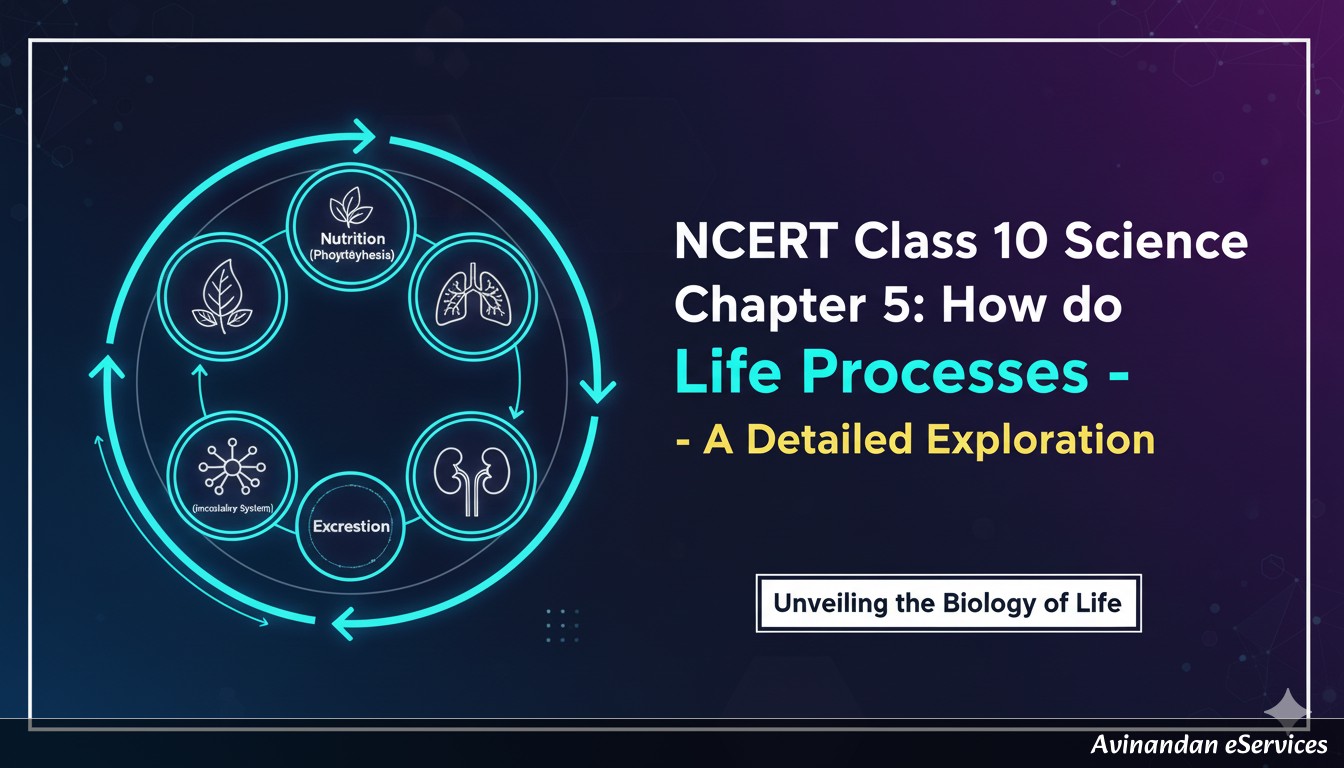
Welcome to our comprehensive guide on Chapter 5 of the NCERT Class 10 Science syllabus, "Life Processes." This foundational chapter in biology helps us understand the very essence of what it means to be alive. What are the criteria we use to decide if something is living? Often, we think of visible movements like running, breathing, or growing. However, many life-sustaining processes are not immediately visible. These are the molecular movements happening within the cells of all living organisms. To combat the natural tendency towards disorder and decay, and to repair and maintain their structures, living organisms must perform a series of essential functions. These maintenance functions are collectively known as life processes.
In this chapter, we will delve deep into four fundamental life processes that are crucial for an organism's survival:
- Nutrition: The process of taking in food and utilizing it for energy, growth, and repair.
- Respiration: The process of breaking down food to release energy at the cellular level.
- Transportation: The process of moving substances like food, oxygen, and waste products from one part of the body to another.
- Excretion: The process of removing harmful metabolic waste products from the body.
Let's explore each of these intricate processes in detail to appreciate the complexity and wonder of life itself.
Nutrition: The Process of Acquiring Food
Every living organism requires energy to perform its life processes. This energy comes from the food it consumes. Nutrition is the scientific term for the process of obtaining and utilizing food. The substances in food that provide this energy and materials for growth are called nutrients. However, not all organisms get their food in the same way. The methods of procuring food vary widely, leading to different modes of nutrition.
Modes of Nutrition
Broadly, there are two main modes of nutrition in the living world:
- Autotrophic Nutrition: The term 'auto' means 'self,' and 'trophe' means 'nutrition.' In this mode, organisms synthesize their own food from simple inorganic raw materials like carbon dioxide and water, using an \texternal energy source like sunlight. Green plants and some bacteria are prime examples of autotrophs. They are the producers of the ecosystem.
- Heterotrophic Nutrition: The term 'hetero' means 'other.' In this mode, organisms cannot produce their own food and depend directly or indirectly on autotrophs for their nutritional requirements. All animals, fungi, and most bacteria are heterotrophs.
Autotrophic Nutrition in Detail
The most well-known form of autotrophic nutrition is photosynthesis, the process by which green plants create their food.
What is Photosynthesis?
Photosynthesis is a complex process where green plants convert light energy into chemical energy. They use carbon dioxide (from the atmosphere) and water (from the soil) in the presence of sunlight and a green pigment called chlorophyll to produce glucose (a carbohydrate) and oxygen.
The overall balanced chemical equation for photosynthesis is:
6CO₂ (Carbon dioxide) + 6H₂O (Water) → (in the presence of Sunlight and Chlorophyll) → C₆H₁₂O₆ (Glucose) + 6O₂ (Oxygen)
Key Events in Photosynthesis:
- Absorption of light energy: The pigment chlorophyll, located in cellular organelles called chloroplasts, traps energy from sunlight.
- Conversion of light energy: The absorbed light energy is converted into chemical energy. This energy is used to split water molecules (H₂O) into hydrogen and oxygen. This process is called photolysis.
- Reduction of carbon dioxide: The hydrogen produced from the splitting of water is used to reduce carbon dioxide (CO₂) into carbohydrates like glucose.
The Role of Stomata:
Stomata (singular: stoma) are tiny pores present mostly on the surface of leaves. They play a crucial role in photosynthesis by allowing the intake of carbon dioxide from the atmosphere. Each stoma is surrounded by a pair of bean-shaped cells called guard cells. These cells control the opening and closing of the stomatal pore. When water flows into the guard cells, they swell and become turgid, causing the pore to open. When the guard cells lose water, they become flaccid and shrink, causing the pore to close. This mechanism not only regulates gas exchange but also controls water loss through transpiration.
Heterotrophic Nutrition in Detail
Heterotrophs obtain their food in various ways, leading to different types of heterotrophic nutrition:
- Holozoic Nutrition: The organism takes in complex solid or liquid food and breaks it down inside its body. This involves ingestion, digestion, absorption, assimilation, and egestion. Humans, dogs, and amoebas are examples.
- Saprophytic Nutrition: The organism feeds on dead and decaying organic matter. They secrete digestive enzymes onto the substrate, which breaks it down \texternally. The simpler substances are then absorbed. Fungi like mushrooms and bread mould, and many bacteria, are saprophytes.
- Parasitic Nutrition: The organism (parasite) lives on or inside another living organism (host) and derives its nutrition from it, often causing harm to the host. Examples include Cuscuta (amarbel), ticks, and tapeworms.
How Do Organisms Obtain Their Nutrition?
Let's look at how specific organisms, from the simplest to the most complex, obtain their nutrition.
Nutrition in Unicellular Organisms:
In single-celled organisms like Amoeba, the entire process occurs through the cell surface. Amoeba uses temporary finger-like \textensions called pseudopodia to engulf a food particle, forming a food vacuole. Inside this vacuole, digestive enzymes break down the complex food into simpler substances, which then diffuse into the cytoplasm. The undigested waste is moved to the surface and thrown out. This process is known as phagocytosis.
Nutrition in Human Beings:
Humans have a highly specialized and complex system for nutrition called the digestive system. It consists of the alimentary canal and associated digestive glands.
The Alimentary Canal: This is a long tube \textending from the mouth to the anus. Let's trace the journey of food through it.
- Mouth (Oral Cavity): The process of digestion begins here. Food is ingested and broken down physically by the teeth (mastication). The tongue helps in mixing the food with saliva, which is secreted by the salivary glands. Saliva contains an enzyme called salivary amylase, which starts the digestion of starch into simpler sugars.
- Oesophagus (Food Pipe): The slightly digested food is swallowed and moves down the oesophagus. The walls of the food pipe have muscles that contract and relax rhythmically to push the food forward. This movement is called peristalsis.
- Stomach: This J-shaped organ receives food from the oesophagus. The stomach walls contain gastric glands that secrete gastric juice. This juice contains three main substances:
- Hydrochloric Acid (HCl): Creates an acidic medium which is necessary for the enzyme pepsin to act. It also kills any harmful bacteria that enter with the food.
- Pepsin: A protein-digesting enzyme that begins the breakdown of proteins into smaller fragments.
- Mucus: Protects the inner lining of the stomach from the corrosive action of the acid.
- Small Intestine: This is the longest part of the alimentary canal and the site of complete digestion of carbohydrates, proteins, and fats. It receives secretions from two important glands:
- Liver: The largest gland in the body, it secretes bile juice. Bile does not contain any enzymes but performs a crucial function: emulsification of fats. It breaks down large fat globules into smaller ones, increasing the surface area for enzymes to act upon.
- Pancreas: This gland secretes pancreatic juice containing enzymes like trypsin (for digesting proteins) and lipase (for breaking down emulsified fats).
- Absorption in the Small Intestine: The inner lining of the small intestine has millions of tiny finger-like projections called villi. These villi vastly increase the surface area available for absorption. The digested food is absorbed through the thin walls of the villi into the bloodstream.
- Large Intestine: The unabsorbed food is sent into the large intestine. Here, most of the water is reabsorbed from the material. The rest of the material is stored in the rectum and removed from the body via the anus (egestion).
Respiration: The Process of Releasing Energy
Once food is absorbed, the body needs to \textract the energy stored in its chemical bonds. This is the role of respiration. Respiration is a metabolic process that occurs in all living cells to produce energy in the form of ATP (Adenosine Triphosphate) by breaking down glucose. It is important to distinguish this from breathing, which is the physical process of inhaling oxygen and exhaling carbon dioxide.
Breakdown of Glucose by Various Pathways
The first step in cellular respiration is the breakdown of glucose, a 6-carbon molecule, into a 3-carbon molecule called pyruvate. This process occurs in the cytoplasm and is common to all types of respiration.
The fate of pyruvate depends on the availability of oxygen:
- Aerobic Respiration (in the presence of oxygen): This occurs in the mitochondria of cells. Pyruvate is completely broken down into carbon dioxide and water, releasing a large amount of energy (approx. 38 ATP molecules). This is the primary mode of respiration for most organisms, including humans.
Equation: Pyruvate → (in Mitochondria, with O₂) → 6CO₂ + 6H₂O + Energy (ATP) - Anaerobic Respiration (in the absence of oxygen):
- In Yeast: Pyruvate is converted into ethanol and carbon dioxide. This process is called fermentation and is used in the brewing and baking industries.
Equation: Pyruvate → (in Yeast, without O₂) → Ethanol + CO₂ + Energy (2 ATP) - In Human Muscle Cells: During vigorous physical activity, the demand for oxygen can exceed the supply. In such situations, muscle cells respire anaerobically, converting pyruvate into lactic acid. The accumulation of lactic acid is what causes muscle cramps.
Equation: Pyruvate → (in Muscle Cells, lack of O₂) → Lactic Acid + Energy (2 ATP)
- In Yeast: Pyruvate is converted into ethanol and carbon dioxide. This process is called fermentation and is used in the brewing and baking industries.
Respiration in Human Beings
Humans have a sophisticated respiratory system to facilitate the exchange of gases.
The Human Respiratory System:
Air is taken into the body through the nostrils, where it is filtered by fine hairs and mucus. It then passes through the pharynx, larynx (voice box), and into the trachea (windpipe). The trachea is supported by rings of cartilage to prevent it from collapsing. The trachea branches into two bronchi, one leading to each lung. Inside the lungs, the bronchi further divide into smaller and smaller tubes called bronchioles, which finally terminate in balloon-like structures called alveoli.
Mechanism of Gaseous Exchange:
The alveoli are the primary sites of gas exchange. They have very thin walls and are surrounded by a dense network of blood capillaries. Oxygen from the inhaled air diffuses from the alveoli into the blood. In the blood, oxygen binds to a respiratory pigment called haemoglobin found in red blood cells (RBCs). This oxygenated blood is then transported to all the cells of the body. Simultaneously, carbon dioxide, a waste product from the cells, is transported by the blood back to the lungs. It diffuses from the blood into the alveoli and is expelled during exhalation.
Respiration in Plants
Like animals, plants also respire to get energy. They take in oxygen and release carbon dioxide. Gaseous exchange in plants occurs through:
- Stomata in leaves.
- Lenticels in stems.
- The surface of the roots.
A key difference is that during the day, the rate of photosynthesis is usually much higher than the rate of respiration. Therefore, the net result is the release of oxygen. At night, with no photosynthesis, plants only respire, leading to a net release of carbon dioxide.
Transportation: The Body's Supply System
In complex multicellular organisms, simple diffusion is not sufficient to meet the requirements of all cells. A dedicated transport system is needed to carry food, oxygen, water, and waste materials throughout the body. This is the circulatory system.
Transportation in Human Beings
The human circulatory system comprises the heart, blood vessels, and blood, along with the lymphatic system.
The Heart:
The human heart is a muscular, four-chambered organ. The upper two chambers are called atria (singular: atrium), and the lower two are called ventricles. The left and right sides are separated by a muscular wall called the septum, which prevents the mixing of oxygenated and deoxygenated blood.
Double Circulation:
In humans, blood passes through the heart twice for each complete circuit of the body. This is known as double circulation.
- Pulmonary Circulation: Deoxygenated blood from the body enters the right atrium, which pumps it to the right ventricle. The right ventricle then pumps this blood to the lungs for oxygenation.
- Systemic Circulation: Oxygenated blood from the lungs returns to the left atrium of the heart. The left atrium pumps it to the left ventricle, which then pumps it with great pressure to all parts of the body through the aorta.
This separation of oxygenated and deoxygenated blood allows for a highly efficient supply of oxygen to the body, which is essential for warm-blooded animals like humans who need more energy to maintain their body temperature.
Blood Vessels:
- Arteries: Carry blood away from the heart. They have thick, elastic walls to withstand the high pressure of blood being pumped from the heart.
- Veins: Carry blood towards the heart. They have thinner walls and contain valves to ensure blood flows in only one direction.
- Capillaries: These are the narrowest blood vessels. They form a network throughout the body's tissues, allowing for the exchange of materials between the blood and the cells.
Blood:
Blood is a fluid connective tissue with several components:
- Plasma: The liquid matrix of blood, which transports food, carbon dioxide, and nitrogenous wastes.
- Red Blood Cells (RBCs): Contain haemoglobin and are responsible for transporting oxygen.
- White Blood Cells (WBCs): The soldiers of the body, they fight against infections.
- Platelets: Help in the clotting of blood to prevent excessive bleeding from injuries.
Transportation in Plants
Plants have two main types of conducting tissues for transportation:
1. Xylem:
This tissue is responsible for the transport of water and dissolved minerals from the roots to all other parts of the plant. The upward movement of water is primarily driven by a process called transpiration pull. Transpiration is the loss of water in the form of vapor from the aerial parts of the plant (mainly leaves). This creates a suction force that pulls water up the xylem vessels. Root pressure also contributes to this upward movement, especially at night.
2. Phloem:
This tissue transports the food (sugars, mainly sucrose) synthesized during photosynthesis from the leaves to other parts of the plant, such as roots, fruits, and seeds. This process of transporting food is called translocation. Unlike water transport in xylem, translocation is an active process that requires energy in the form of ATP.
Excretion: The Removal of Waste
Metabolic activities in the body generate various waste products, many of which are toxic if allowed to accumulate. Excretion is the biological process involved in the removal of these harmful metabolic wastes from the body.
Excretion in Human Beings
The main excretory system in humans includes a pair of kidneys, a pair of ureters, a urinary bladder, and a urethra.
The Kidneys and the Nephron:
The kidneys are bean-shaped organs that act as the body's primary filters. The basic functional and structural unit of the kidney is the nephron. Each kidney contains about a million nephrons.
A nephron has two main parts:
- The Glomerulus: A cluster of thin-walled blood capillaries.
- The Renal Tubule: A long, coiled tubule that begins with a cup-shaped structure called Bowman's capsule, which encloses the glomerulus.
The Process of Urine Formation:
- Glomerular Filtration: Blood enters the glomerulus under high pressure, forcing water, glucose, salts, amino acids, and nitrogenous wastes (like urea) to filter out into the Bowman's capsule. This filtrate is called the glomerular filtrate.
- Selective Reabsorption: As the filtrate passes through the long tubule, the body reabsorbs useful substances. The amount of water reabsorbed depends on the body's needs and the amount of waste to be excreted.
- Tubular Secretion: Certain waste products like potassium and hydrogen ions are actively secreted from the blood into the tubule.
The fluid remaining after these processes is urine, which consists of water, urea, and other waste salts. The urine from each kidney flows through the ureters into the urinary bladder for storage, and is eventually expelled from the body through the urethra.
Artificial Kidney (Haemodialysis):
In case of kidney failure, a machine called a dialyzer can be used to filter the blood. In haemodialysis, the patient's blood is passed through tubes made of a selectively permeable membrane, which are immersed in a dialyzing fluid. Waste products diffuse from the blood into the fluid, and the purified blood is pumped back into the patient.
Excretion in Plants
Plants use a variety of techniques to get rid of waste products:
- Gaseous wastes like CO₂ (from respiration) and O₂ (from photosynthesis) are removed through stomata.
- Excess water is removed by transpiration.
- Many plant waste products are stored in cellular vacuoles.
- Some waste products are stored in leaves that later fall off.
- Other waste products like resins and gums are stored in old xylem tissue.
- Plants also excrete some waste substances into the soil around them.
Important Questions and Answers
Here are some solved questions from the chapter to help you test your understanding.
Q1: What are the differences between autotrophic nutrition and heterotrophic nutrition?
Answer:
| Basis for Comparison | Autotrophic Nutrition | Heterotrophic Nutrition |
|---|---|---|
| Food Source | Organisms produce their own food from inorganic materials. | Organisms obtain food from other living organisms. |
| Energy Source | Uses light energy (photosynthesis) or chemical energy (chemosynthesis). | Derives energy by consuming other organisms. |
| Presence of Chlorophyll | Chlorophyll is present (in photosynthetic autotrophs). | Chlorophyll is absent. |
| Examples | Green plants, algae, some bacteria. | Animals, fungi, most bacteria. |
Q2: What is the role of acid in our stomach?
Answer: The acid in our stomach, hydrochloric acid (HCl), has two main roles:
- It creates an acidic environment that facilitates the action of the protein-digesting enzyme, pepsin. Pepsin works effectively only in a highly acidic medium.
- It kills most of the harmful microorganisms (like bacteria) that may have entered the body along with the food, thus preventing infections.
Q3: What are the functions of blood?
Answer: Blood performs several vital functions:
- Transportation of Gases: It transports oxygen from the lungs to the body tissues and carbon dioxide from the tissues back to the lungs.
- Transportation of Nutrients: It carries digested food from the small intestine to all body cells.
- Transportation of Waste Products: It transports metabolic wastes like urea to the kidneys for excretion.
- Regulation of Body Temperature: It helps in distributing heat and maintaining a constant body temperature.
- Defense: White blood cells (WBCs) in the blood protect the body from diseases by engulfing bacteria and producing antibodies.
- Clotting: Platelets in the blood help in the formation of a clot at the site of an injury to prevent excessive blood loss.
Q4: Describe the structure and functioning of nephrons.
Answer: A nephron is the filtering unit of a kidney. It consists of a cup-shaped structure called Bowman's capsule, which contains a bundle of capillaries called the glomerulus. The Bowman's capsule \textends into a long, coiled renal tubule, which eventually joins a collecting duct.
Functioning: Blood enters the glomerulus under high pressure. This pressure causes filtration of blood, where water and small solutes (like glucose, amino acids, salts, urea) are forced into the Bowman's capsule. This is called ultrafiltration. As this filtrate passes through the renal tubule, essential substances like glucose, amino acids, salts, and a major amount of water are selectively reabsorbed back into the blood. The remaining fluid, containing metabolic waste like urea, forms urine. This urine is collected in the collecting duct and passed to the urinary bladder.
Chapter Summary
Let's recap the key concepts from this chapter:
- Life processes are the essential maintenance functions performed by living organisms to sustain life.
- Nutrition is the process of acquiring food. It can be autotrophic (self-feeding, e.g., plants via photosynthesis) or heterotrophic (depending on others, e.g., animals).
- Human digestion involves the alimentary canal and various enzymes that break down carbohydrates, proteins, and fats into absorbable forms.
- Respiration is the process of releasing energy from food. It can be aerobic (with oxygen, high energy yield) or anaerobic (without oxygen, low energy yield).
- The human respiratory system facilitates gas exchange in the alveoli of the lungs.
- Transportation in humans is carried out by the circulatory system, featuring a four-chambered heart and double circulation, which efficiently separates oxygenated and deoxygenated blood.
- In plants, xylem transports water and minerals, while phloem transports food (translocation).
- Excretion is the removal of metabolic wastes. In humans, this is primarily done by the kidneys, through the functional units called nephrons, which form urine.
- Plants excrete waste through various means, including transpiration, storing it in falling leaves, or as gums and resins.