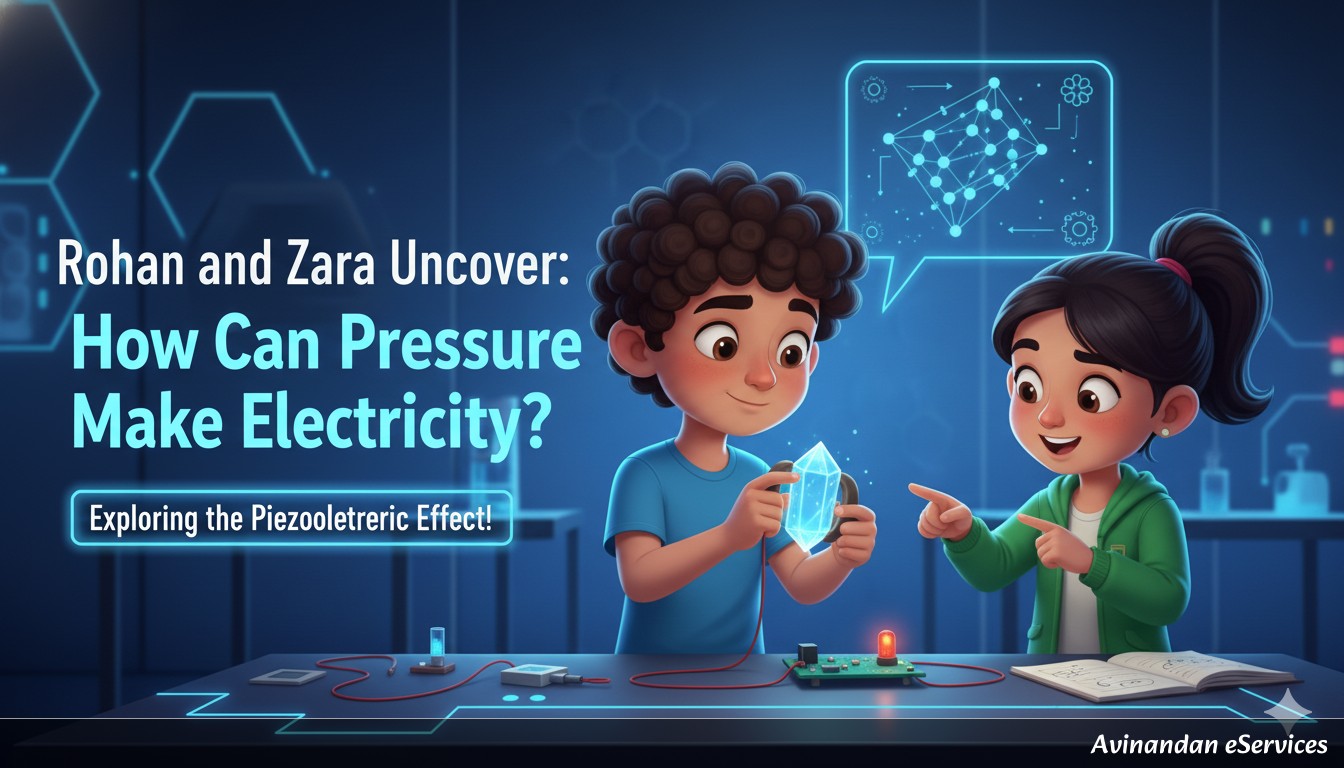
Rohan: Zara, you know how sometimes when we're at my grandma's house, she uses one of those gas lighters that makes a click and a spark, without any batteries? How does that even work? Is it some kind of magic?
Zara: (chuckles) No magic, Rohan! It's super cool science, actually. What you're talking about is a perfect example of something called piezoelectricity. Ever heard of it?
Rohan: Piezo-what-now? That's a mouthful! Sounds like something from a superhero movie. So, pressure can make electricity? Like, if I squeeze a lemon really hard, will it light up a bulb?
Zara: (laughs) Not quite a lemon, but you're on the right track with the "pressure" part! Piezoelectricity comes from two Greek words: 'piezein', meaning to squeeze or press, and 'elektron', meaning amber, which is where we get the word electricity. So, it literally means "squeezing electricity"!
Rohan: Wow! Squeezing electricity! So, what exactly gets squeezed? And how does that make electricity?
Zara: Good question! Certain special materials, mostly crystals like quartz or even some ceramics, have a unique internal structure. Imagine their tiny atoms and molecules are arranged in a very specific, orderly pattern, almost like a miniature LEGO structure that repeats itself. In these materials, the positive and negative electrical charges are perfectly balanced and evenly distributed when the material is at rest.
Rohan: Balanced, like a perfectly still seesaw?
Zara: Exactly! But when you apply mechanical pressure to these materials – when you squeeze them, bend them, or even twist them – this perfect, balanced arrangement gets slightly distorted. It's like pushing one side of that seesaw down. The atoms shift just enough that the positive and negative electrical charges within the material no longer cancel each other out perfectly. They separate to opposite sides, creating an electrical charge difference – a tiny voltage, which is a form of electricity!
Rohan: So, those gas lighters have a tiny crystal inside them that gets squeezed really fast to make a spark?
Zara: Precisely! When you click the lighter, a tiny spring-loaded hammer strikes a small piezoelectric crystal inside. That sudden, sharp pressure is enough to instantly generate a high-voltage spark, which then ignites the gas. It's incredibly efficient because no batteries are needed, just a bit of mechanical force turned directly into electrical energy!
Rohan: That's amazing! Who even figured this out? Sounds like a super smart discovery!
Zara: It was! The discovery of piezoelectricity dates back to 1880, made by two brilliant French physicists, brothers Jacques and Pierre Curie. Yes, the same Pierre Curie who later, along with his wife Marie Curie, did groundbreaking work on radioactivity! They were experimenting with crystals like quartz and tourmaline when they noticed this incredible property. They even showed how the effect could be reversed!
Rohan: So, it's been around for ages! Is it just used in lighters, or are there other cool uses for this "squeezing power"?
Zara: Oh, Rohan, it's used everywhere, often without us even realizing it! Think about microphones. When you speak into a microphone, your voice creates sound waves, which are essentially vibrations in the air. These vibrations hit a special diaphragm inside the mic, which is connected to a piezoelectric crystal. The crystal gets squeezed and stretched by these tiny vibrations, converting them into electrical signals that can then be recorded, amplified, or transmitted!
Rohan: Whoa! So my voice literally turns into electricity? That's like science fiction right in our hands!
Zara: It is, but it's real science! And it works in reverse too! That's called the "inverse piezoelectric effect." If you apply an electrical voltage to a piezoelectric material, it will actually change shape – it will expand or contract slightly. This is how some speakers work: electrical signals from your music or voice make a crystal vibrate, which then pushes the air to create sound waves. It's also used in things like ultrasound machines, where electrical pulses make a crystal vibrate rapidly, creating high-frequency sound waves that bounce off internal body parts to create detailed images of organs or even babies in the womb.
Rohan: So, it can make sounds, hear sounds, and even see inside you! What else? Does it have a role in computers?
Zara: Absolutely! Many modern devices use it as incredibly sensitive sensors. For example, in some advanced touchscreens, tiny piezoelectric sensors can detect the precise pressure of your finger, not just whether you've touched it. Even some car airbags use piezoelectric sensors to detect collisions; the impact pressure generates a tiny electrical signal that tells the airbag to deploy almost instantly. It's also used in precise timing devices, like in some quartz watches, where the consistent vibration of a piezoelectric quartz crystal keeps perfect time.
Rohan: That's so clever! Could we use it to make electricity for our homes just by walking around? Like, power a whole city with footsteps?
Zara: That's an excellent question and a huge area of ongoing research, Rohan! Imagine tiles on a busy sidewalk or a dance floor that generate electricity every time someone steps on them. Some experimental projects have already tried this, generating small amounts of power from foot traffic. While it's not yet efficient enough to power an entire city – we'd need a *lot* of people walking! – it holds great promise for generating clean energy in smaller, localized applications, like charging your phone from your shoe, lighting up bus stop signs, or even powering sensors embedded in roads from the vibrations of passing vehicles.
Rohan: So, from a simple clicker to making power from footsteps, and even helping cars be safer! Piezoelectricity is truly amazing. I had no idea something so tiny and simple could do so much!
Zara: It really shows how much hidden science there is in everyday objects and how clever engineers can be in applying these natural phenomena. These materials are like tiny, silent power generators, just waiting for a good squeeze or vibration!
So, What Did We Learn Today?
- Piezoelectricity is the ability of certain materials, especially crystals like quartz, to generate an electric charge in response to mechanical stress (like squeezing or pressure).
- It was discovered by brothers Jacques and Pierre Curie in 1880, and they also observed the reverse effect.
- The mechanical pressure temporarily distorts the atomic structure of the crystal, separating positive and negative charges to create a small voltage.
- It's used in many everyday items: gas lighters, microphones, speakers, ultrasound machines, and various sensors like those in touchscreens and car airbags.
- The inverse piezoelectric effect is when an electrical voltage applied to these materials causes them to change shape, which is crucial for speakers and some medical devices.
- Scientists are actively exploring its potential for sustainable energy generation, such as harvesting electricity from footsteps or vibrations for localized power needs.
Rohan: So basically, sometimes all it takes is a little squeeze to light up our world, or at least a gas stove and power some cool tech! That's way cooler than magic!