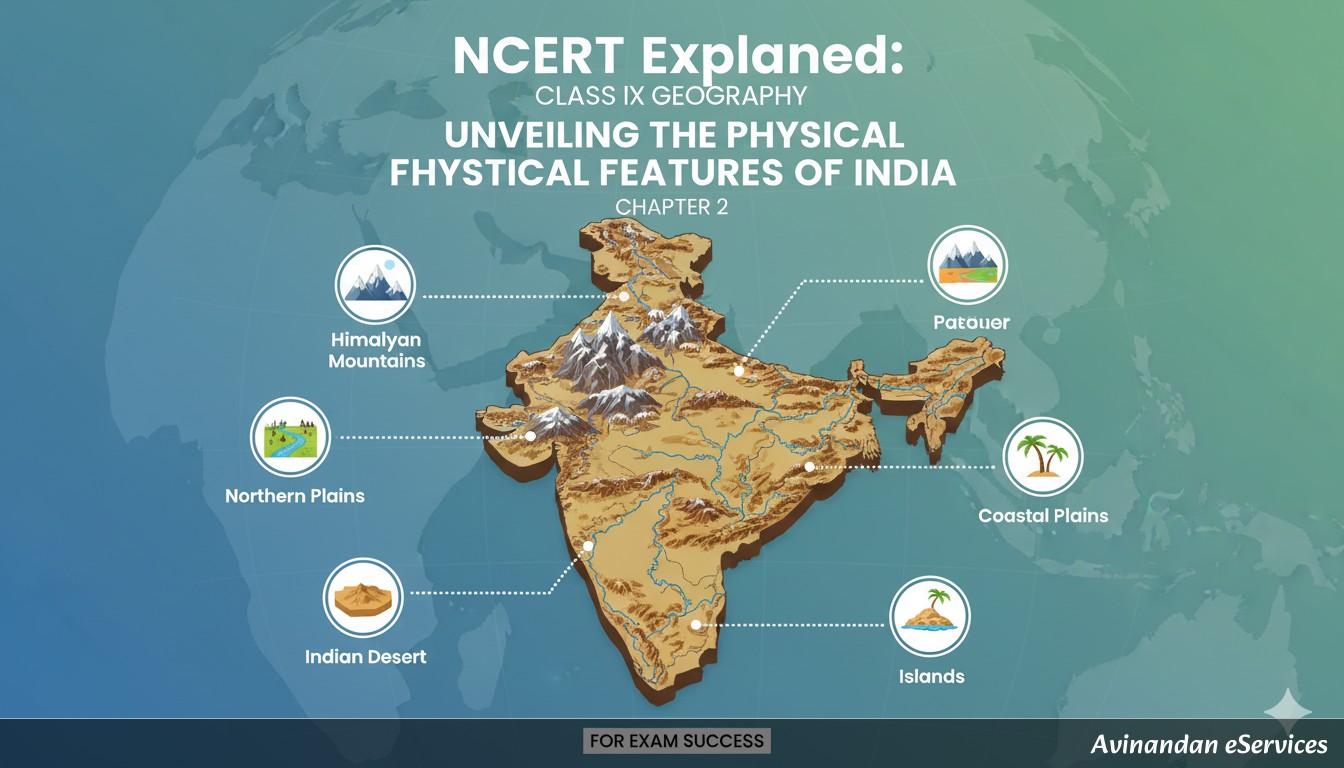
Introduction to the Topic
Have you ever wondered why it snows in the Himalayas while people in Chennai experience a warm, humid climate almost year-round? Or why farmers in most of India eagerly await the months of June and July? The answer to these questions lies in a single, powerful concept: Climate. Chapter 4 of the Class IX Geography NCERT textbook, "Contemporary India – I," delves into the fascinating and complex climate of our country. Understanding India's climate is not just about knowing when to carry an umbrella; it's about understanding the very rhythm of life on the subcontinent. From our food and clothing to our festivals and economy, climate is the invisible force that shapes our lives in countless ways.
This blog post will act as your guide, breaking down the essential concepts of India's climate. We will explore the difference between weather and climate, unravel the various factors that control our climatic conditions, journey through the distinct seasons, and finally, appreciate the monsoon as a great unifier of the nation. So, let’s embark on this journey to understand the winds, the rains, and the temperatures that make India so climatically diverse and unique.
Key Concepts Explained
Weather vs. Climate: What's the Difference?
Before we dive deep, it's crucial to understand two terms that are often used interchangeably but mean very different things: weather and climate.
- Weather refers to the state of the atmosphere over a specific area at any given point in time. It is a short-term phenomenon. When you ask, "Will it be sunny today?" or "Is it going to rain this evening?" you are talking about the weather. It includes elements like temperature, humidity, atmospheric pressure, wind, and precipitation for a short duration—a day, a week, or even a few hours. Weather is highly variable and can change rapidly.
- Climate, on the other hand, is the sum total of weather conditions and variations over a large area for a long period of time—typically more than thirty years. It's the 'average' weather of a place. For example, we know that Rajasthan generally has a hot and dry climate, while Kerala has a tropical wet climate. This is based on decades of weather data. Think of it this way: weather is what you wear on a particular day, while climate is the entire collection of clothes in your wardrobe for all seasons.
Factors Affecting India's Climate
India's climate is controlled by a combination of factors, which can be broadly divided into those related to location and relief, and those related to air pressure and winds. Let's break down the six major controls.
1. Latitude
The latitude of a place determines the amount of solar energy it receives. The Tropic of Cancer (23.5°N) passes almost through the middle of India, dividing the country into two distinct climatic zones. The area south of the Tropic of Cancer lies in the tropical zone, which is closer to the equator and experiences high temperatures with small annual temperature ranges. The area to the north of the Tropic of Cancer lies in the sub-tropical zone, which experiences a continental type of climate with a much wider temperature range between summer and winter.
2. Altitude
As we move up from the surface of the earth, the temperature decreases. This is because the atmosphere becomes less dense at higher altitudes. For every 165 metres of ascent, the temperature drops by approximately 1°C. This is why hill stations like Shimla, Darjeeling, and Ooty are cooler than the plains, even though they might be on the same latitude. The mighty Himalayas in the north of India have a profound impact on our climate. They act as a massive barrier, protecting the subcontinent from the cold, dry winds blowing from Central Asia during winter. It is this mountain wall that allows North India to have a comparatively milder winter than other regions on the same latitude.
3. Pressure and Wind Systems
This is perhaps the most dynamic factor influencing India's climate. The climate and associated weather conditions in India are governed by a unique set of atmospheric conditions:
- Pressure and Surface Winds: In winter, a high-pressure area develops north of the Himalayas. Cold, dry winds blow from this region towards the low-pressure areas over the oceans to the south. In summer, the situation reverses. A low-pressure area develops over interior Asia as well as over northwestern India due to intense heating. This causes a complete reversal of the direction of winds. Air moves from the high-pressure area over the southern Indian Ocean, crosses the equator, and turns right towards the low-pressure areas over the Indian subcontinent. These are the South-West Monsoon winds, which bring widespread rainfall to the entire country.
- Upper Air Circulation (Jet Streams): The winds in the upper atmosphere (about 12,000 meters high) also play a crucial role. These fast-flowing, narrow air currents are called jet streams. The Sub-Tropical Westerly Jet Stream, which flows south of the Himalayas during winter, is responsible for the western cyclonic disturbances. In summer, this jet stream moves north of the Himalayas, allowing the Tropical Easterly Jet Stream to blow over peninsular India, which plays a significant role in the onset of the monsoon.
- Western Cyclonic Disturbances and Tropical Cyclones: The western cyclonic disturbances are weather phenomena of the winter months brought in by the westerly flow from the Mediterranean region. They cause the much-needed winter rains over the plains and snowfall in the mountains. Tropical cyclones, which originate over the Bay of Bengal and the Arabian Sea, affect the coastal regions, especially during the monsoon and the retreating monsoon season (October-November).
4. Distance from the Sea (Continentality)
The sea has a moderating influence on the climate. Water heats up and cools down much more slowly than land. As a result, coastal areas like Mumbai and Chennai experience less \textreme temperatures throughout the year. Their annual range of temperature is low. This is known as a maritime or equable climate. On the other hand, places located in the interior of the country, far away from the sea's influence, experience \textreme weather conditions. Delhi, for example, has very hot summers and very cold winters. This is known as a continental climate.
5. Ocean Currents
Ocean currents, along with onshore winds, affect the climate of coastal areas. Any warm or cold current flowing past a coast will affect the temperature and rainfall of that region. While their impact is more pronounced in other parts of the world, they do have a minor effect on the Indian climate system, particularly in influencing the temperature of coastal air.
6. Relief Features
Relief, or the physical features of the land, plays a vital role in determining the climate of a place. High mountains can act as barriers for cold or hot winds. They can also force moisture-laden winds to rise, causing them to cool and result in precipitation. This is known as orographic rainfall. For example, the Western Ghats stand as a barrier in the path of the South-West Monsoon winds coming from the Arabian Sea. The windward side of the Ghats (the western side) receives very heavy rainfall, while the leeward side (the eastern side), known as the rain shadow area, receives very little rainfall.
The Rhythms of the Seasons: The Indian Monsoon
The climate of India is strongly influenced by monsoon winds. The word 'monsoon' is derived from the Arabic word 'mausim,' which literally means 'season.' It refers to the seasonal reversal in the wind direction during a year. This phenomenon is central to understanding India's climate.
The mechanism of the monsoon is complex but can be understood through a few key points:
- The differential heating and cooling of land and water creates a low-pressure zone on the landmass of India while the seas around experience comparatively high pressure.
- The shift of the position of the Inter-Tropical Convergence Zone (ITCZ) in summer, over the Ganga plain, acts as the monsoon trough, attracting the winds.
- The presence of the high-pressure area, east of Madagascar, affects the Indian Monsoon.
- The intense heating of the Tibetan plateau during summer results in strong vertical air currents and the formation of low pressure over the plateau.
- The movement of the westerly jet stream to the north of the Himalayas and the presence of the tropical easterly jet stream over the Indian peninsula in summer.
The monsoon is not a steady, continuous rain. It is punctuated by 'breaks' or dry spells. The onset of the monsoon usually happens around the first week of June in the southern tip of the Indian peninsula. It then splits into two branches: the Arabian Sea branch and the Bay of Bengal branch. The Arabian Sea branch moves northwards along the Western Ghats, reaching Mumbai by about the 10th of June. The Bay of Bengal branch advances rapidly and arrives in Assam in the first week of June. The two branches eventually merge over the northwestern part of the Ganga plains. By mid-July, the monsoon covers the entire country.
The Four Main Seasons in India
The distinct seasonal pattern in India is a direct result of the monsoon. We can identify four main seasons:
1. The Cold Weather Season (Winter)
Lasting from mid-November to February, this season is characterized by clear skies, low temperatures, and low humidity. The temperature decreases from south to north. The average temperature of Chennai is between 24°-25° Celsius, while in the northern plains, it ranges between 10°-15° Celsius. The aforementioned Western Cyclonic Disturbances cause light rainfall in the northern plains, which is very beneficial for the 'rabi' crops like wheat.
2. The Hot Weather Season (Summer)
From March to May, there is a progressive increase in temperature across the country. In northwestern parts, temperatures can soar to 45°C. A striking feature of this season is the 'Loo' – strong, gusty, hot, dry winds blowing during the day over north and northwestern India. This is also the season of pre-monsoon showers. In Kerala and Karnataka, they are known as 'Mango Showers' as they help in the early ripening of mangoes. In West Bengal, these storms are known as 'Kaal Baisakhi' or the calamity of the month of Baisakh.
3. Advancing Monsoon (The Rainy Season)
From early June to mid-September, the country receives the bulk of its annual rainfall. The arrival of the monsoon brings a dramatic change in the weather, with a sudden downpour often called the 'burst' of the monsoon. The rainfall is unevenly distributed. Mawsynram in the southern ranges of the Khasi Hills receives the highest average rainfall in the world. In contrast, places like Rajasthan and parts of Gujarat get scanty rainfall.
4. Retreating/Post Monsoon (The Transition Season)
During October and November, the monsoon trough becomes weaker as the sun appears to move southwards. The monsoon starts withdrawing from the northern plains. This period is marked by clear skies and a rise in temperature. The combination of high temperature and high humidity creates an oppressive weather condition during the day, commonly known as 'October Heat'. The low-pressure conditions shift to the Bay of Bengal, leading to the occurrence of cyclonic depressions which often hit the eastern coasts, causing heavy and widespread rain.
Distribution of Rainfall and the Monsoon as a Unifying Bond
The distribution of rainfall in India is highly unequal. Parts of the Western Ghats and northeastern India receive over 400 cm of rainfall annually. However, it is less than 60 cm in western Rajasthan and adjoining parts of Gujarat, Haryana, and Punjab. Similarly, rainfall is low in the interior of the Deccan plateau and east of the Sahyadris. The Leh region in Jammu and Kashmir also receives very low precipitation.
Despite its uncertainties and uneven distribution, the monsoon acts as a powerful unifying bond for the Indian subcontinent. The Indian agricultural calendar revolves around it. The entire landscape, its flora, and fauna are all heavily influenced by the monsoon. Year after year, people from north to south and east to west eagerly await its arrival. The rivers, which are fed by these rains, unite the country by providing water and creating fertile alluvial plains. Many festivals are also linked to the agricultural cycle and the arrival of the monsoon. This rhythm of seasons, dictated by the monsoon, is a common experience that binds every Indian together.
Summary & Key Takeaways
- Weather vs. Climate: Weather is short-term atmospheric conditions, while climate is the long-term average (30+ years) of those conditions.
- Six Major Controls of Climate: India's climate is influenced by Latitude, Altitude, Pressure and Wind Systems, Distance from the Sea, Ocean Currents, and Relief Features.
- The Himalayas' Role: They act as a crucial climatic divide, protecting India from cold northern winds and forcing monsoon winds to shed their moisture within the subcontinent.
- The Indian Monsoon: A seasonal reversal of winds that brings the majority of India's rainfall. It is a complex phenomenon driven by differential heating of land and sea.
- The Four Seasons: The Cold Weather Season (Winter), The Hot Weather Season (Summer), The Advancing Monsoon (Rainy Season), and The Retreating Monsoon (Transition Season).
- A Unifying Force: Despite its regional variations and unpredictability, the monsoon unifies the entire country through its impact on agriculture, river systems, cultural festivals, and the overall rhythm of life.