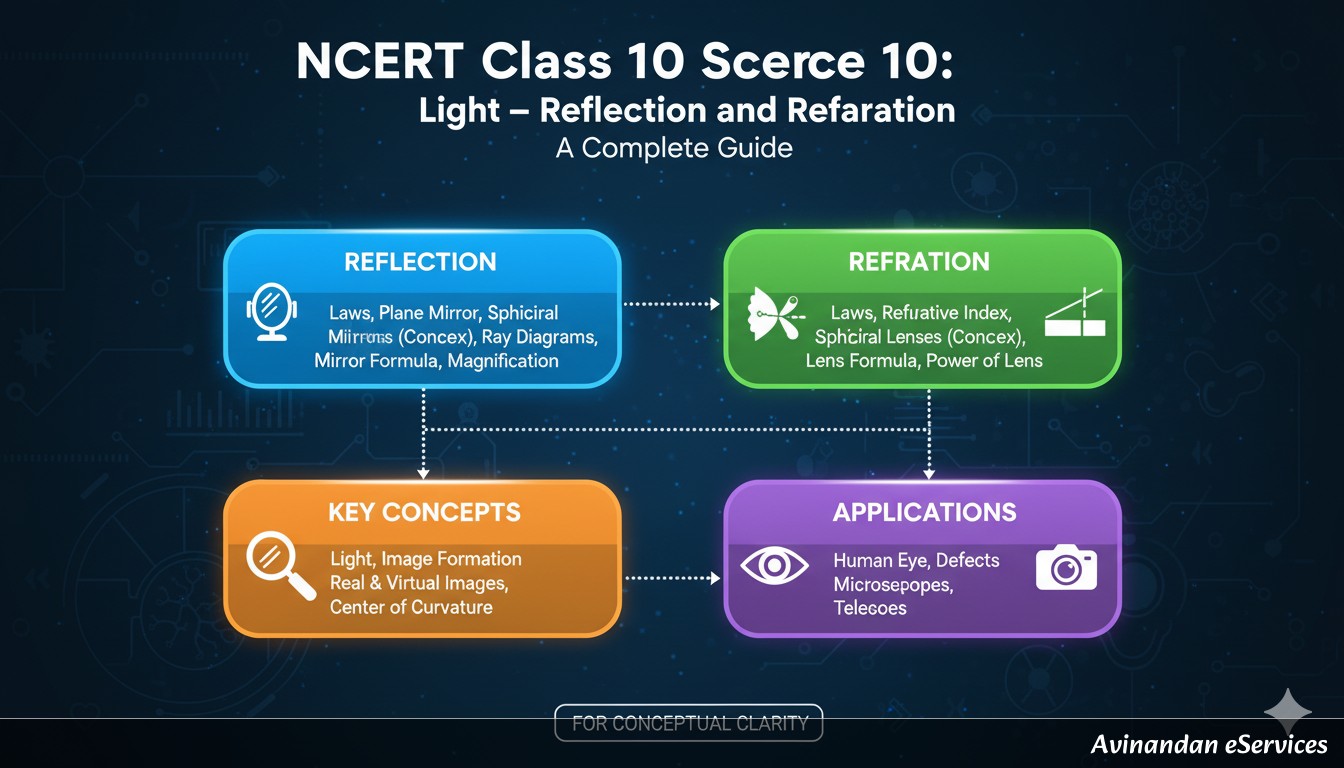
Introduction to Light – Reflection and Refraction
Welcome, students! Have you ever wondered how we see the world around us? The vibrant colours of a rainbow, the sparkle of a diamond, or your own reflection in a mirror are all phenomena governed by the properties of light. Light is a form of energy that enables our sense of sight. In this comprehensive guide to Chapter 10 of the NCERT Class 10 Science syllabus, 'Light – Reflection and Refraction,' we will embark on a fascinating journey to understand the fundamental principles that govern how light behaves.
This chapter is crucial as it lays the foundation for understanding optics. We will explore two primary phenomena: reflection, the bouncing back of light, and refraction, the bending of light as it passes from one medium to another. We'll delve into the world of spherical mirrors and lenses, learn to draw ray diagrams to predict image formation, and apply mathematical formulas to solve real-world problems. By the end of this post, you will have a clear and detailed understanding of the concepts that make sight and optical instruments like cameras, telescopes, and microscopes possible.
Reflection of Light
Reflection of light is the phenomenon of light rays bouncing back after striking a surface. A highly polished surface, such as a mirror, reflects most of the light falling on it. Understanding reflection begins with understanding its fundamental laws.
Laws of Reflection
The reflection of light from any surface, whether smooth or rough, follows two simple laws known as the Laws of Reflection:
- First Law: The angle of incidence is equal to the angle of reflection. (∠i = ∠r)
- Second Law: The incident ray, the normal to the mirror at the point of incidence, and the reflected ray, all lie in the same plane.
Let's break down the terms used here:
- Incident Ray: The ray of light that strikes the surface.
- Point of Incidence: The point on the surface where the incident ray strikes.
- Reflected Ray: The ray of light that is sent back from the surface.
- Normal: An imaginary line drawn perpendicular (at 90°) to the surface at the point of incidence.
- Angle of Incidence (∠i): The angle between the incident ray and the normal.
- Angle of Reflection (∠r): The angle between the reflected ray and the normal.
Image Formation by a Plane Mirror
When you stand in front of a plane mirror, you see an image of yourself. This image has specific characteristics that are always consistent:
- Virtual and Erect: The image formed by a plane mirror is virtual, meaning it cannot be projected onto a screen because the light rays do not actually meet there. They only appear to diverge from a point behind the mirror. The image is also erect, meaning it is upright, not upside down.
- Same Size: The size of the image is exactly the same as the size of the object.
- Same Distance: The image is formed as far behind the mirror as the object is in front of it.
- Laterally Inverted: The image is laterally inverted, which means the left side of the object appears as the right side of the image, and vice versa. This is why the word 'AMBULANCE' is often written in reverse on the front of emergency vehicles.
Spherical Mirrors
While plane mirrors have flat reflecting surfaces, spherical mirrors have curved reflecting surfaces. These surfaces are part of a sphere. Spherical mirrors are primarily of two types.
Types of Spherical Mirrors
- Concave Mirror: A spherical mirror whose reflecting surface is curved inwards, facing towards the centre of the sphere. It is also known as a converging mirror because it converges parallel rays of light to a single point.
- Convex Mirror: A spherical mirror whose reflecting surface is curved outwards. It is also known as a diverging mirror because it diverges parallel rays of light, making them appear to come from a point behind the mirror.
Important Terms Related to Spherical Mirrors
To understand how images are formed by spherical mirrors, we must first familiarize ourselves with some key terminology:
- Pole (P): The centre of the reflecting surface of the spherical mirror. It lies on the surface of the mirror.
- Centre of Curvature (C): The centre of the sphere of which the reflecting surface is a part. It is not a part of the mirror; it lies in front of a concave mirror and behind a convex mirror.
- Radius of Curvature (R): The radius of the sphere of which the reflecting surface is a part. It is the distance between the pole (P) and the centre of curvature (C).
- Principal Axis: The imaginary straight line passing through the pole (P) and the centre of curvature (C) of a spherical mirror.
- Principal Focus (F): For a concave mirror, it is a point on the principal axis where the light rays coming parallel to the principal axis actually meet after reflection. For a convex mirror, it is the point on the principal axis from which the parallel rays appear to diverge after reflection.
- Focal Length (f): The distance between the pole (P) and the principal focus (F). For spherical mirrors with a small aperture, the radius of curvature is found to be twice the focal length. R = 2f.
Image Formation by Spherical Mirrors
The nature, position, and size of the image formed by a spherical mirror depend on the position of the object in front of the mirror. We can determine this by drawing ray diagrams.
Rules for Ray Tracing
To construct accurate ray diagrams, we generally use at least two of the following four rays whose paths are easy to trace:
- A ray parallel to the principal axis: After reflection, this ray will pass through the principal focus (F) in a concave mirror or appear to diverge from the principal focus (F) in a convex mirror.
- A ray passing through the principal focus (F): For a concave mirror, or a ray directed towards the principal focus of a convex mirror, this ray will emerge parallel to the principal axis after reflection.
- A ray passing through the centre of curvature (C): For a concave mirror, or directed towards the centre of curvature of a convex mirror, this ray reflects back along the same path. This happens because the ray strikes the mirror normally (at 90°).
- A ray incident obliquely to the principal axis, towards the pole (P): This ray is reflected obliquely, following the laws of reflection, making the angle of incidence equal to the angle of reflection (∠i = ∠r) with the principal axis.
Image Formation by a Concave Mirror
A concave mirror can form both real and virtual images, depending on the object's position. The six possible cases are summarized below.
| Position of the Object | Position of the Image | Size of the Image | Nature of the Image |
|---|---|---|---|
| At infinity | At the focus (F) | Highly diminished, point-sized | Real and inverted |
| Beyond the centre of curvature (C) | Between F and C | Diminished | Real and inverted |
| At the centre of curvature (C) | At C | Same size | Real and inverted |
| Between C and F | Beyond C | Enlarged | Real and inverted |
| At the focus (F) | At infinity | Highly enlarged | Real and inverted |
| Between pole (P) and focus (F) | Behind the mirror | Enlarged | Virtual and erect |
Image Formation by a Convex Mirror
A convex mirror always forms a virtual, erect, and diminished image, regardless of the object's position. This makes it very useful for applications where a wide field of view is needed.
| Position of the Object | Position of the Image | Size of the Image | Nature of the Image |
|---|---|---|---|
| At infinity | At the focus (F), behind the mirror | Highly diminished, point-sized | Virtual and erect |
| Between infinity and the pole (P) | Between P and F, behind the mirror | Diminished | Virtual and erect |
Uses of Concave and Convex Mirrors
- Uses of Concave Mirrors: They are used in torches, searchlights, and vehicle headlights to produce a powerful, parallel beam of light. They are also used as shaving mirrors to see a larger image of the face. Dentists use them to see an enlarged image of the teeth. Large concave mirrors are used to concentrate sunlight to produce heat in solar furnaces.
- Uses of Convex Mirrors: They are commonly used as rear-view (wing) mirrors in vehicles because they give an erect, diminished image and provide a wider field of view, allowing the driver to see traffic behind them. They are also used at blind turns and in shops for security purposes.
Sign Convention and Mirror Formula
To solve numerical problems related to spherical mirrors, we use a set of sign conventions called the New Cartesian Sign Convention.
New Cartesian Sign Convention
- The object is always placed to the left of the mirror. This means light from the object falls on the mirror from the left-hand side.
- All distances parallel to the principal axis are measured from the pole (P) of the mirror.
- All distances measured to the right of the pole (along the direction of incident light) are taken as positive (+).
- All distances measured to the left of the pole (against the direction of incident light) are taken as negative (-).
- Heights measured upwards and perpendicular to the principal axis are taken as positive (+).
- Heights measured downwards and perpendicular to the principal axis are taken as negative (-).
Based on this convention:
- Object distance (u) is always negative.
- Focal length (f) of a concave mirror is negative.
- Focal length (f) of a convex mirror is positive.
Mirror Formula and Magnification
The relationship between the object distance (u), image distance (v), and focal length (f) is given by the mirror formula:
1/v + 1/u = 1/f
Magnification (m) produced by a spherical mirror gives the relative \textent to which the image of an object is magnified with respect to the object size. It is expressed as the ratio of the height of the image (h') to the height of the object (h).
m = h'/h
The magnification is also related to the object distance (u) and image distance (v):
m = -v/u
- A negative sign in the value of the magnification indicates that the image is real and inverted.
- A positive sign in the value of the magnification indicates that the image is virtual and erect.
- If |m| > 1, the image is enlarged. If |m| < 1, the image is diminished. If |m| = 1, the image is of the same size.
Refraction of Light
We have observed that light travels in a straight line in a uniform medium. But what happens when it enters a different medium? The path of light changes. This phenomenon is called refraction.
What is Refraction?
Refraction is the bending of light when it travels obliquely from one transparent medium to another. This bending occurs because the speed of light is different in different media. For example, the speed of light is highest in a vacuum (approximately 3 × 10⁸ m/s) and is less in denser media like water or glass.
- When a ray of light goes from a rarer medium (e.g., air) to a denser medium (e.g., glass), it slows down and bends towards the normal.
- When a ray of light goes from a denser medium (e.g., glass) to a rarer medium (e.g., air), it speeds up and bends away from the normal.
Laws of Refraction
Similar to reflection, refraction also follows two laws:
- The incident ray, the refracted ray, and the normal to the interface of the two transparent media at the point of incidence, all lie in the same plane.
- Snell's Law of Refraction: The ratio of the sine of the angle of incidence (i) to the sine of the angle of refraction (r) is a constant, for the light of a given colour and for the given pair of media. This constant is called the refractive index of the second medium with respect to the first.
Mathematically, sin(i) / sin(r) = constant = n₂₁
Refractive Index
The refractive index (n) of a medium is a measure of how much the speed of light is reduced inside that medium. The more optically dense a medium is, the higher its refractive index.
The absolute refractive index of a medium is the ratio of the speed of light in a vacuum (c) to the speed of light in the medium (v).
n = c/v
The relative refractive index of medium 2 with respect to medium 1 (n₂₁) is the ratio of the speed of light in medium 1 (v₁) to the speed of light in medium 2 (v₂).
n₂₁ = v₁/v₂ = n₂/n₁
Refraction through a Rectangular Glass Slab
When a ray of light passes through a rectangular glass slab, it gets refracted twice: once when entering the glass from the air, and again when exiting the glass back into the air. The emergent ray is parallel to the incident ray, but it is shifted sideways slightly. This perpendicular shift in the path of the light is called lateral displacement. The \textent of the lateral displacement depends on the refractive index of the glass, the thickness of the slab, and the angle of incidence.
Spherical Lenses
A lens is a transparent material bound by two surfaces, of which one or both surfaces are spherical. Lenses work on the principle of refraction.
Types of Spherical Lenses
- Convex Lens: It is thicker at the centre than at the edges. It is also known as a converging lens because it converges parallel rays of light at its principal focus.
- Concave Lens: It is thinner at the centre than at the edges. It is also known as a diverging lens because it diverges parallel rays of light, making them appear to come from its principal focus.
Important Terms Related to Spherical Lenses
- Optical Centre (O): The central point of a lens. A ray of light passing through the optical centre emerges without any deviation.
- Centre of Curvature (C): A lens has two spherical surfaces, and each surface forms a part of a sphere. The centres of these two spheres are called the centres of curvature of the lens (C₁ and C₂).
- Principal Axis: An imaginary straight line passing through the two centres of curvature of a lens.
- Principal Focus (F): A lens has two principal foci. For a convex lens, the first principal focus (F₁) is the point from which light rays appear to diverge to become parallel to the principal axis after refraction. The second principal focus (F₂) is the point where parallel rays actually converge after refraction. The reverse is true for a concave lens. We generally refer to F₂ as the principal focus.
- Focal Length (f): The distance of the principal focus from the optical centre.
Image Formation by Spherical Lenses
Just like mirrors, we can determine the nature, position, and size of images formed by lenses using ray diagrams.
Rules for Ray Tracing for Lenses
- A ray parallel to the principal axis: After refraction from a convex lens, it passes through the principal focus on the other side. For a concave lens, it appears to diverge from the principal focus located on the same side of the lens.
- A ray passing through the principal focus: After refraction from a convex lens, it will emerge parallel to the principal axis. For a concave lens, a ray appearing to meet at the principal focus on the other side will emerge parallel to the principal axis.
- A ray passing through the optical centre (O): It will emerge from the lens without any deviation.
Image Formation by a Convex Lens
| Position of the Object | Position of the Image | Size of the Image | Nature of the Image |
|---|---|---|---|
| At infinity | At focus F₂ | Highly diminished, point-sized | Real and inverted |
| Beyond 2F₁ | Between F₂ and 2F₂ | Diminished | Real and inverted |
| At 2F₁ | At 2F₂ | Same size | Real and inverted |
| Between F₁ and 2F₁ | Beyond 2F₂ | Enlarged | Real and inverted |
| At focus F₁ | At infinity | Highly enlarged | Real and inverted |
| Between F₁ and optical centre O | On the same side of the lens as the object | Enlarged | Virtual and erect |
Image Formation by a Concave Lens
A concave lens always forms a virtual, erect, and diminished image, regardless of the object's position.
| Position of the Object | Position of the Image | Size of the Image | Nature of the Image |
|---|---|---|---|
| At infinity | At focus F₁ | Highly diminished, point-sized | Virtual and erect |
| Between infinity and optical centre O | Between focus F₁ and optical centre O | Diminished | Virtual and erect |
Sign Convention, Lens Formula, and Magnification
Sign Convention for Spherical Lenses
The sign convention for lenses is similar to that for mirrors, with the key difference that all distances are measured from the optical centre (O).
- Object distance (u) is always negative.
- Focal length (f) of a convex lens is positive.
- Focal length (f) of a concave lens is negative.
Lens Formula and Magnification
The relationship between object distance (u), image distance (v), and focal length (f) for a spherical lens is given by the lens formula:
1/v - 1/u = 1/f
Note the negative sign, which is different from the mirror formula.
Magnification (m) for a lens is defined similarly to that for a mirror:
m = h'/h = v/u
Note that the magnification formula for a lens does not have a negative sign in the v/u term.
Power of a Lens
The power (P) of a lens is a measure of its degree of convergence or divergence of light rays. It is defined as the reciprocal of its focal length.
P = 1/f
The SI unit of power is the dioptre (D). One dioptre is the power of a lens whose focal length is 1 metre (1 D = 1 m⁻¹). The focal length (f) must be expressed in metres when calculating power.
- The power of a convex lens is positive.
- The power of a concave lens is negative.
If several thin lenses are placed in contact, the total power of the combination is the algebraic sum of their individual powers: P = P₁ + P₂ + P₃ + ...
Important Questions and Answers
Question 1: Define the principal focus of a concave mirror.
Answer: The principal focus (F) of a concave mirror is a point on its principal axis where light rays that are initially parallel to the principal axis actually meet (converge) after being reflected from the mirror. It is a real focus.
Question 2: A convex mirror used for a rear-view on an automobile has a radius of curvature of 3.00 m. If a bus is located at 5.00 m from this mirror, find the position, nature, and size of the image.
Answer:
Given:
- Radius of curvature, R = +3.00 m (A convex mirror has a positive R)
- Object distance, u = -5.00 m (Object is always placed to the left)
First, we find the focal length (f):
f = R/2 = +3.00 / 2 = +1.50 m
Now, we use the mirror formula: 1/v + 1/u = 1/f
1/v + 1/(-5.00) = 1/1.50
1/v = 1/1.50 + 1/5.00
1/v = (5.00 + 1.50) / (1.50 × 5.00) = 6.50 / 7.50
v = 7.50 / 6.50 = +1.15 m
The positive sign for 'v' indicates the image is formed behind the mirror. So, the position of the image is 1.15 m behind the mirror.
Now, we find the magnification (m):
m = -v/u = -(1.15) / (-5.00) = +0.23
Since the magnification is positive and less than 1:
- Nature of the image: Virtual and erect.
- Size of the image: Diminished (0.23 times the size of the bus).
Question 3: A concave lens has a focal length of 15 cm. At what distance should the object from the lens be placed so that it forms an image at 10 cm from the lens? Also, find the magnification produced by the lens.
Answer:
Given:
- Focal length, f = -15 cm (A concave lens has a negative f)
- Image distance, v = -10 cm (A concave lens always forms a virtual image on the same side as the object)
We use the lens formula: 1/v - 1/u = 1/f
1/(-10) - 1/u = 1/(-15)
-1/10 - 1/u = -1/15
-1/u = -1/15 + 1/10
-1/u = (-2 + 3) / 30 = 1/30
u = -30 cm
So, the object should be placed at a distance of 30 cm from the lens.
Now, we find the magnification (m):
m = v/u = (-10) / (-30) = +1/3 = +0.33
The positive sign indicates the image is virtual and erect. The value 0.33 (which is less than 1) indicates the image is diminished.
Question 4: What is meant by the power of a lens? What is its SI unit?
Answer: The power of a lens is a measure of its ability to converge or diverge light rays falling on it. It is defined as the reciprocal of its focal length expressed in metres. A lens with a shorter focal length has more power, as it bends the light more sharply. The SI unit of power is the dioptre (D). One dioptre is the power of a lens that has a focal length of one metre.
Chapter Summary
Here are the key takeaways from our exploration of Light – Reflection and Refraction:
- Light is a form of energy that travels in straight lines.
- Reflection is the bouncing back of light from a surface. It follows two laws: ∠i = ∠r, and the incident ray, reflected ray, and normal all lie in the same plane.
- Spherical mirrors are of two types: concave (converging) and convex (diverging).
- The Mirror Formula relates object distance (u), image distance (v), and focal length (f): 1/v + 1/u = 1/f.
- Magnification (m) by a mirror is given by m = -v/u.
- Refraction is the bending of light as it passes from one medium to another. It follows Snell's Law: sin(i) / sin(r) = constant.
- The Refractive Index (n) is a measure of the bending of light and is related to the speed of light in the medium.
- Spherical lenses are of two types: convex (converging) and concave (diverging).
- The Lens Formula is 1/v - 1/u = 1/f.
- Magnification (m) by a lens is given by m = v/u.
- The Power of a Lens (P) is the reciprocal of its focal length in metres (P = 1/f), and its unit is the dioptre (D).