Introduction to The Human Eye and the Colourful World
The human eye is one of the most valuable and sensitive sensory organs in the human body. It enables us to perceive the fascinating world around us, distinguishing shapes, distances, and vibrant colors. While optics in Physics explains how light reflects and refracts through mirrors and lenses, this chapter integrates biology and physics to reveal how the natural optical system of the eye functions alongside beautiful atmospheric optical phenomena.
In NCERT Class 10 Science Chapter 10, The Human Eye and the Colourful World, students delve into the structural mechanics of human vision, common defects of vision and their ray diagram corrections, as well as natural light phenomena such as the formation of rainbows, the twinkling of stars, and the vibrant hues of sunrise and sunset.
The Human Eye: Structure and Function
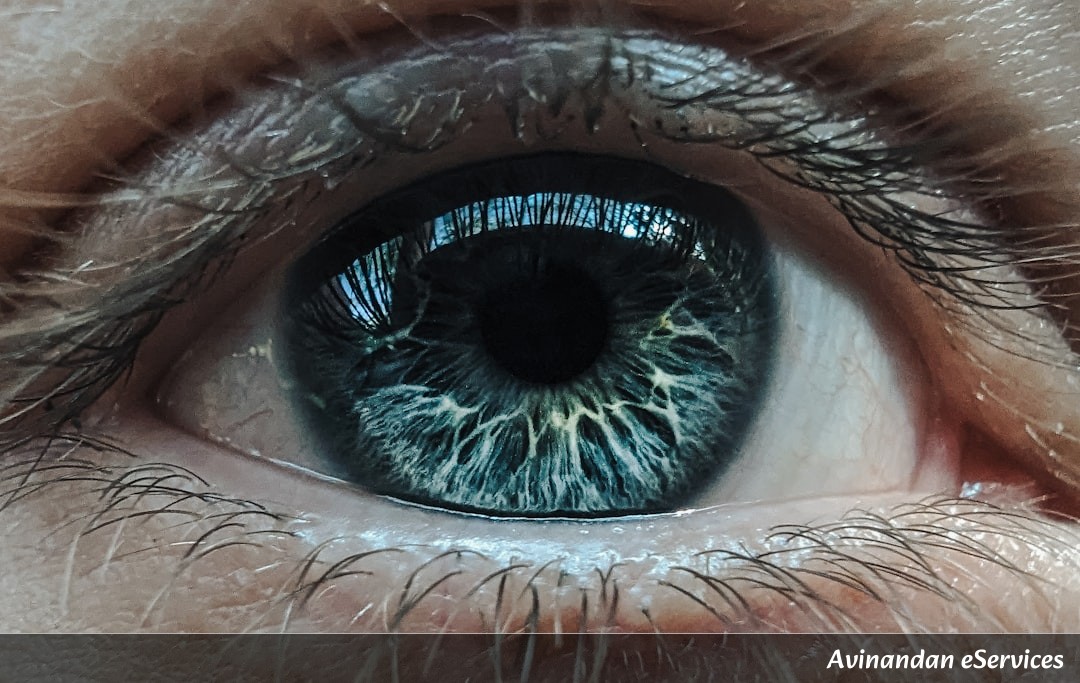
The human eye acts remarkably like a natural camera. Its optical system forms a real, inverted image of an object on a light-sensitive screen called the retina. The essential anatomical components of the eye work together seamlessly to regulate light entry and focus images clearly.
Structure of the Human Eye
The human eyeball is roughly spherical in shape with a diameter of about 2.3 cm. Below are the key anatomical structures of the eye and their functions:
- Cornea: The transparent, outermost spherical membrane covering the front of the eye. Most of the refraction for light rays entering the eye occurs at the outer surface of the cornea.
- Iris: A dark muscular diaphragm located behind the cornea. It controls the size of the pupil and gives the eye its distinctive color.
- Pupil: The central aperture in the iris. It regulates and controls the amount of light entering the eye. In dim light, the pupil expands; in bright light, it contracts.
- Crystalline Lens: A fibrous, jelly-like convex lens located behind the pupil. It provides the finer adjustment of focal length required to focus objects at varying distances onto the retina.
- Ciliary Muscles: Ring-like muscles holding the eye lens in place. They modify the curvature and focal length of the crystalline lens.
- Retina: A delicate membrane lined with enormous numbers of light-sensitive cells (rods and cones). Rods respond to light intensity (dim light), while cones respond to bright light and color distinctions.
- Optic Nerve: Transmits electrical signals generated by retinal cells to the brain, which interprets these signals as visual images.
- Aqueous Humor & Vitreous Humor: Aqueous humor is a fluid filling the space between the cornea and lens, providing nourishment and maintaining intraocular pressure. Vitreous humor is a clear gel filling the space between the lens and the retina, keeping the eyeball spherical.
Power of Accommodation
The ability of the human eye lens to adjust its focal length to see both nearby and distant objects clearly is called the Power of Accommodation.
- Viewing Distant Objects: When looking at far objects, the ciliary muscles relax. The eye lens becomes thin, increasing its focal length. This allows parallel light rays from infinity to converge precisely on the retina.
- Viewing Nearby Objects: When looking at close objects, the ciliary muscles contract. The eye lens becomes thicker and more spherical, decreasing its focal length. This converges diverging light rays onto the retina.
Key Vision Limits:
- Near Point (Least Distance of Distinct Vision): The minimum distance at which objects can be seen clearly without strain. For a healthy adult eye, the near point is 25 cm.
- Far Point: The farthest distance up to which the eye can see objects clearly. For a normal human eye, the far point is at Infinity (∞).
Defects of Vision and Their Correction
Sometimes, due to aging, structural changes, or muscle weakness, the eye gradually loses its power of accommodation. Consequently, images are not focused accurately on the retina, leading to vision defects.
Myopia (Nearsightedness)
A person with myopia can see nearby objects clearly but cannot see distant objects distinctly. The far point of a myopic eye is closer than infinity.
- Cause: Excessive curvature of the eye lens (lens is too thick) or elongation of the eyeball.
- Image Position: Light rays from a distant object converge in front of the retina rather than on it.
- Correction: Myopia is corrected using a Concave Lens (diverging lens) of suitable focal length and power. The concave lens diverges incoming light rays so that they appear to originate from the myopic far point, forming a sharp image on the retina.
Hypermetropia (Farsightedness)
A person with hypermetropia can see distant objects clearly but cannot see nearby objects distinctly. The near point of the hypermetropic eye is farther away than 25 cm.
- Cause: Focal length of the eye lens is too long (lens is too thin) or the eyeball has become too short.
- Image Position: Light rays from a nearby object focus behind the retina.
- Correction: Hypermetropia is corrected using a Convex Lens (converging lens) of suitable power. The convex lens converges incoming rays slightly before they enter the eye, shifting the near point back to 25 cm.
Presbyopia
Presbyopia is a type of farsightedness caused by the natural aging process. The near point gradually recedes, making reading comfortable distance difficult without corrective glasses.
- Cause: Gradual weakening of ciliary muscles and diminishing flexibility of the crystalline lens.
- Correction: Corrected using convex lenses of suitable power. If a person suffers from both myopia and hypermetropia, they require Bifocal Lenses (upper portion concave for distant vision, lower portion convex for reading).
| Defect | Symptoms | Primary Cause | Corrective Lens |
|---|---|---|---|
| Myopia | Distant objects blurred | Elongated eyeball / Thick lens | Concave Lens |
| Hypermetropia | Nearby objects blurred | Shortened eyeball / Thin lens | Convex Lens |
| Presbyopia | Age-related nearby vision loss | Weak ciliary muscles | Convex / Bifocal Lens |
Refraction of Light Through a Prism
When light passes through a transparent triangular glass prism, it undergoes refraction twice—first when entering the prism from air, and second when exiting the prism back into air.
Prism Refraction and Angle of Deviation
A triangular prism has two triangular bases and three rectangular lateral surfaces inclined at an angle called the Angle of Prism (A). When a ray of monochromatic light enters a glass prism:
- It bends towards the normal at the first refracting surface (air to glass).
- It bends away from the normal at the second refracting surface (glass to air).
- The peculiar shape of the prism causes the emergent ray to bend at an angle to the direction of the incident ray. This angle is called the Angle of Deviation (δ).
Dispersion of White Light by a Glass Prism
In 1665, Sir Isaac Newton discovered that when a narrow beam of sunlight (white light) passes through a glass prism, it splits into a band of seven colors. This phenomenon of splitting white light into its component colors is called Dispersion.
The sequence of colors formed on a screen is remembered using the acronym VIBGYOR:
- V - Violet (maximum bending / maximum deviation)
- I - Indigo
- B - Blue
- G - Green
- Y - Yellow
- O - Orange
- R - Red (minimum bending / minimum deviation)
Scientific Reason: White light is composed of seven distinct wavelengths. In a vacuum, all colors travel at the same speed ($3 \times 10^8\text{ m/s}$). However, in a transparent medium like glass, light rays of different wavelengths travel at different speeds. Red light has the longest wavelength and travels fastest in glass, bending the least. Violet light has the shortest wavelength and travels slowest, bending the most.
Recombination of White Light Spectrum
Isaac Newton demonstrated that dispersion is reversible. He placed a second identical glass prism in an inverted position relative to the first prism. The first prism split the white light into seven spectrum colors, while the second inverted prism recombined these colors back into a single beam of white light.
Formation of a Rainbow
A rainbow is a natural optical spectrum appearing in the sky after a rain shower, caused by the dispersion of sunlight by tiny spherical water droplets suspended in the atmosphere.
- Water droplets act like tiny glass prisms.
- When sunlight enters a raindrop, it first undergoes refraction and dispersion.
- The dispersed light then undergoes total internal reflection at the back inner surface of the drop.
- Finally, light undergoes refraction again as it exits the raindrop into the air.
- Due to this sequence of dispersion and reflection, vivid color bands reach the observer's eyes with the sun always positioned behind the observer.
Atmospheric Refraction
Atmospheric refraction is the bending of light as it passes through layers of Earth's atmosphere having varying optical densities and temperatures. Warm air is optically rarer (lower refractive index) than cool air (higher refractive index).
Twinkling of Stars
Stars twinkle at night due to atmospheric refraction of starlight over immense distances:
- Stars are located \textremely far from Earth, behaving as point sources of light.
- As starlight penetrates Earth's atmosphere, it undergoes continuous refraction through layers of constantly fluctuating physical conditions and densities.
- The path of light rays bends continuously, causing the apparent position of the star to fluctuate slightly.
- The amount of starlight entering the eye fluctuates randomly, making the star appear brighter at one instant and dimmer at the next. This creates the twinkling effect.
Why Planets Do Not Twinkle: Planets are much closer to Earth than stars and appear as \textended sources of light (a collection of numerous point sources). The total variation in light intensity from all individual point sources averages out to zero, neutralizing the twinkling effect.
Advanced Sunrise and Delayed Sunset
The Earth's atmosphere causes the Sun to appear visible about 2 minutes before actual sunrise and remain visible for about 2 minutes after actual sunset.
- Actual sunrise occurs when the Sun crosses the astronomical horizon.
- When the Sun is slightly below the horizon, light rays passing through dense atmospheric layers bend downwards due to continuous atmospheric refraction.
- As a result, the Sun appears raised above the horizon to an observer on Earth, shifting its apparent position.
Scattering of Light
Scattering of light is the phenomenon in which light rays are deflected in various directions when they strike tiny particles (dust, water droplets, air molecules) present in a medium.
Tyndall Effect
When a beam of light passes through a colloidal solution, the suspended colloidal particles scatter the light rays, making the path of the beam visible. This optical phenomenon is called the Tyndall Effect.
Everyday Examples of Tyndall Effect:
- Sunlight passing through a dense forest canopy where tiny water droplets in mist scatter light.
- Light entering a dark, dusty room through a small hole or window gap.
- Smoke emerging from an engine or chimney scattering light beam from a flashlight.
Why is the Colour of the Clear Sky Blue?
The Earth's atmosphere consists of gas molecules ($N_2$, $O_2$) and fine particles that are smaller than the wavelength of visible light.
- According to Rayleigh's Scattering Law, shorter wavelengths of light are scattered much more strongly than longer wavelengths.
- Blue and violet light have shorter wavelengths (~400-450 nm) compared to red light (~700 nm).
- When sunlight passes through the atmosphere, fine atmospheric particles scatter blue light far more intensely in all directions.
- This scattered blue light reaches our eyes, giving the clear sky its characteristic blue color.
- Note: If Earth had no atmosphere, light would not scatter, and the sky would appear completely dark/black, as observed by astronauts in outer space.
Colour of the Sun at Sunrise and Sunset
At sunrise and sunset, the Sun appears reddish, whereas at noon, it appears yellowish-white.
- At Sunrise/Sunset: The Sun is near the horizon. Sunlight must travel a longer distance through thick layers of Earth's atmosphere to reach our eyes. Shorter wavelengths (blue/violet) are scattered away by atmospheric particles. Only the longer wavelengths (red/orange) penetrate the long distance to reach our eyes, making the Sun appear red.
- At Noon: The Sun is directly overhead. Sunlight travels a relatively short distance through the atmosphere, experiencing minimal scattering. Almost all wavelengths reach us together, making the Sun appear bright white.
Important Questions and Answers
Q1: What is meant by power of accommodation of the eye?
Ans: The power of accommodation refers to the natural ability of the eye lens to adjust its focal length using ciliary muscles. This enables the eye to clearly focus images of both nearby and distant objects onto the retina.
Q2: A person with a myopic eye cannot see objects beyond 1.2 m distinctly. What should be the type and power of the corrective lens used to restore proper vision?
Ans: To correct myopia, a concave lens is required. The focal length of the concave lens must equal the far point distance of the myopic eye ($f = -1.2\text{ m}$).
Power of lens ($P$) = $\frac{1}{f(\text{in meters})} = \frac{1}{-1.2\text{ m}} = -0.83\text{ Dioptres (D)}$.
Therefore, a concave lens of power -0.83 D should be used.
Q3: Why do stars twinkle, but planets do not?
Ans: Stars twinkle because they are point-sized light sources \textremely far away. Starlight undergoes continuous atmospheric refraction through turbulent air layers of changing densities, causing fluctuating light intensity. Planets are closer \textended sources; variations from individual points cancel out, so they do not twinkle.
Q4: Explain how a rainbow is formed in the atmosphere with a labelled optical sequence.
Ans: A rainbow is formed when sunlight strikes suspended atmospheric water droplets. The sequence consists of: (1) Refraction and dispersion of incoming sunlight upon entering the droplet, (2) Total internal reflection at the back of the droplet, and (3) Refraction upon exiting the droplet, directing spectrum colors to the observer's eye.
Q5: Why does the sky appear dark instead of blue to an astronaut in outer space?
Ans: Outer space lacks an atmosphere and air particles. Without atmospheric particles to cause light scattering, no light enters the astronaut's eyes from ambient directions, making space appear black.
Chapter Summary
- The human eye focuses light onto the retina using a flexible, crystalline convex lens controlled by ciliary muscles.
- The normal eye's near point is 25 cm, and its far point is infinity (∞).
- Myopia (nearsightedness) is corrected using a concave lens; Hypermetropia (farsightedness) is corrected using a convex lens.
- Presbyopia is age-related loss of accommodation, corrected with convex or bifocal lenses.
- A glass prism splits white light into a 7-color spectrum (VIBGYOR) through dispersion because different wavelengths travel at different speeds in glass.
- Red light deviates the least (longest wavelength); violet light deviates the most (shortest wavelength).
- Atmospheric refraction causes twinkling of stars, advanced sunrise (2 min), and delayed sunset (2 min).
- The Tyndall effect is the scattering of light by colloidal particles in a medium.
- The clear sky appears blue because short blue wavelengths are scattered strongly by atmospheric gas molecules. At sunrise/sunset, red light predominates because blue light is scattered away during its longer atmospheric path.