Introduction
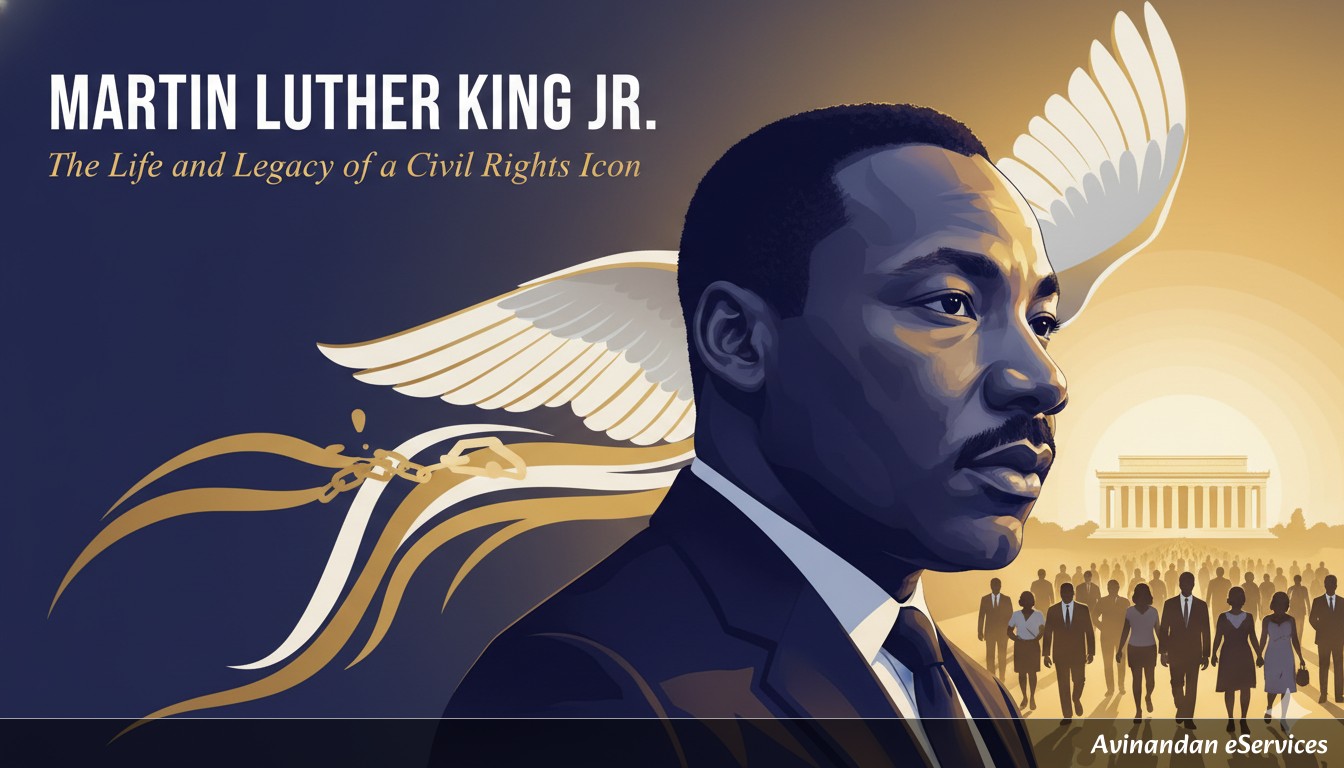
Martin Luther King Jr. was a Baptist minister and activist who became the most visible spokesperson and leader in the American Civil Rights Movement from 1955 until his assassination in 1968. Born in Atlanta, Georgia, King is best known for advancing civil rights through nonviolence and civil disobedience, inspired by his Christian beliefs and the peaceful teachings of Mahatma Gandhi. His powerful oratory and unwavering commitment to equality left an indelible mark on the United States and the world. King’s leadership was instrumental in the passage of the Civil Rights Act of 1964 and the Voting Rights Act of 1965, landmark legislation that outlawed segregation and protected the voting rights of African Americans.
Early Life and Education
Born Michael King Jr. on January 15, 1929, in Atlanta, Georgia, he was the middle child of Michael King Sr. and Alberta Williams King. His father, a pastor at Ebenezer Baptist Church, changed his own name and his son's to Martin Luther in honor of the German Protestant reformer after a trip to Germany in 1934. Growing up in a segregated South, King experienced racism from a young age. One notable incident occurred when he was six years old and the white parents of his close friend told him he could no longer play with their son because of his race. Such experiences with discrimination profoundly shaped his worldview.
King was a gifted student, skipping two grades in high school. At the age of 15, he enrolled in Morehouse College, a historically Black college in Atlanta. Initially, he was uncertain about a career in the ministry, even though his father, grandfather, and great-grandfather were all Baptist ministers. However, under the mentorship of Morehouse's president, Dr. Benjamin Mays, King was inspired to enter the ministry, seeing it as a way to address social and racial injustice. After graduating from Morehouse with a Bachelor of Arts degree in sociology in 1948, he attended Crozer Theological Seminary in Pennsylvania, where he was elected student body president and graduated as valedictorian in 1951. He then went on to earn a Ph.D. in systematic theology from Boston University in 1955.
Major Accomplishments and Career
Martin Luther King Jr.'s public life as a civil rights leader began in 1955 when he was chosen to lead the Montgomery Bus Boycott. The boycott, sparked by Rosa Parks' refusal to give up her seat to a white man, lasted for 381 days and resulted in the Supreme Court ruling that segregation on public buses was unconstitutional. The success of the Montgomery boycott brought King to national prominence.
Southern Christian Leadership Conference (SCLC)
In 1957, King, along with other civil rights leaders, founded the Southern Christian Leadership Conference (SCLC) to coordinate the efforts of local protest groups throughout the South. As president of the SCLC, King championed the use of nonviolent direct action to challenge segregation and discrimination. The SCLC organized numerous campaigns, including voter registration drives and protests against segregation in cities like Albany, Georgia, and Birmingham, Alabama.
The Birmingham Campaign and the 'Letter from Birmingham Jail'
The 1963 Birmingham campaign was a pivotal moment in the Civil Rights Movement. The protests were met with a brutal response from the police, who used high-pressure fire hoses and police dogs on peaceful demonstrators, including children. The images of this violence were broadcast across the nation and the world, galvanizing support for the civil rights cause. During his incarceration in Birmingham, King penned his famous "Letter from Birmingham Jail," a powerful defense of nonviolent protest and a call for racial justice.
The March on Washington and the 'I Have a Dream' Speech
Later in 1963, King helped organize the March on Washington for Jobs and Freedom. On August 28, 1963, from the steps of the Lincoln Memorial, King delivered his iconic "I Have a Dream" speech to a crowd of over 250,000 people. In what is considered one of the greatest speeches in American history, King articulated his vision of a society where people would not be judged by the color of their skin but by the content of their character. The speech was a defining moment of the Civil Rights Movement and had a profound impact on the national consciousness.
Nobel Peace Prize
In 1964, at the age of 35, Martin Luther King Jr. became the youngest person to receive the Nobel Peace Prize. He was awarded the prize for his nonviolent struggle against racial inequality. King announced that he would donate the prize money of $54,123 to the furtherance of the civil rights movement.
Legacy and Impact
Martin Luther King Jr.'s life was tragically cut short on April 4, 1968, when he was assassinated at the Lorraine Motel in Memphis, Tennessee, at the age of 39. His death sparked riots in numerous cities across the United States. James Earl Ray was convicted of the assassination.
King's legacy is one of profound and lasting change. His advocacy for nonviolent resistance as a means of achieving social justice has inspired movements for freedom and equality around the world. In the United States, he is honored with a national holiday, Martin Luther King Jr. Day, and a memorial on the National Mall in Washington, D.C. His life and work continue to be a powerful reminder of the struggle for equality and the importance of peaceful protest in a democratic society.
Quick Facts
- His birth name was Michael King Jr.
- He was so intelligent that he skipped the 9th and 12th grades and entered college at the age of 15.
- King was jailed 29 times, often on trumped-up charges.
- He survived an earlier assassination attempt in 1958 when a woman stabbed him with a letter opener.
- His recording of “Why I Oppose the War in Vietnam” won a Grammy for Best Spoken Word Album in 1971.
- At the Atlanta premiere of the movie *Gone with the Wind*, a young Martin sang with his church choir.
- There are over 730 streets in the United States named after him.