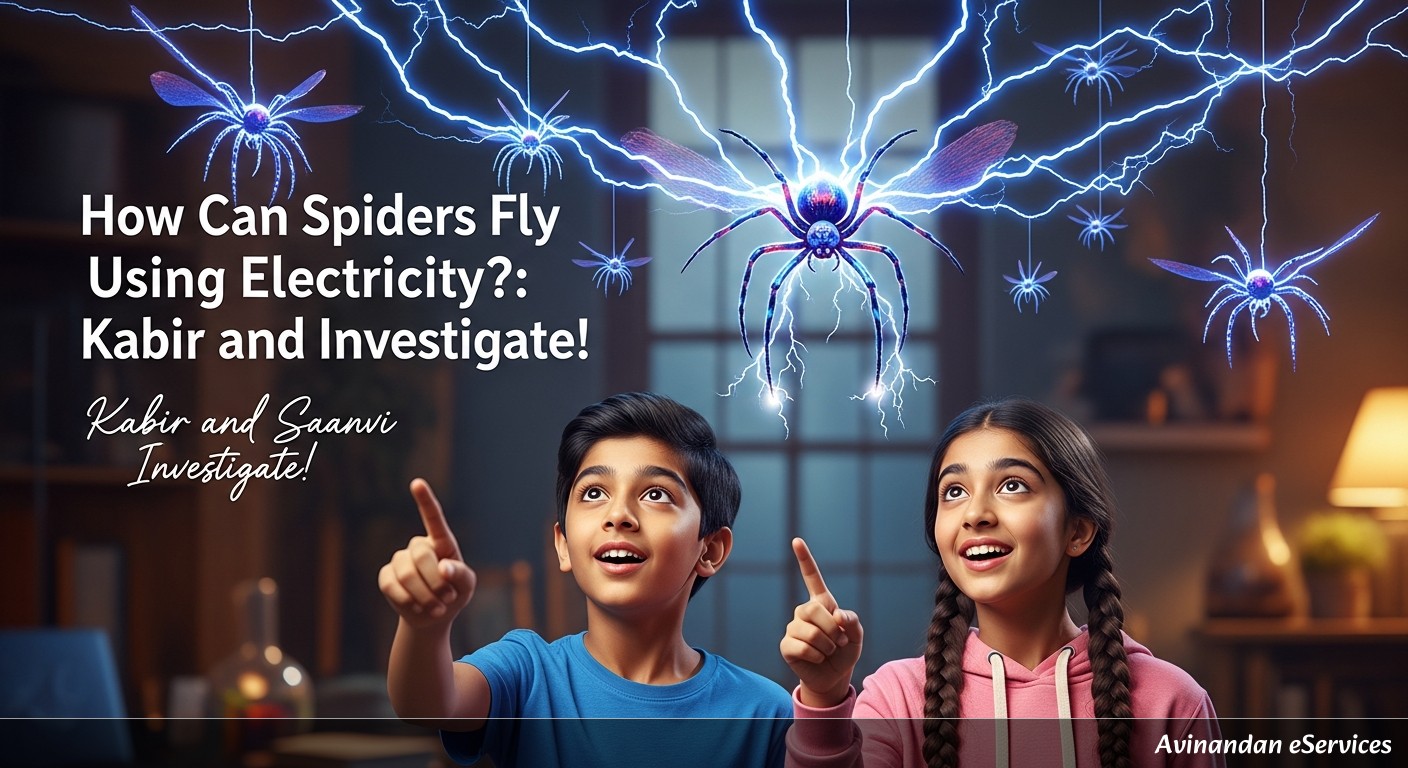
Kabir: Saanvi, come look at this! See that tiny little spider on the very top leaf of this bush? How in the world did it get up there? I don’t see any web connecting it to the ground or another branch. It’s like it just appeared. Do you think spiders have tiny, invisible wings?
Saanvi: Haha, that would be amazing, but no, spiders don’t have wings, Kabir! You’re right to be curious, though. They have a way of travelling through the air that’s even cooler than wings. They use a kind of natural superpower: electricity!
Kabir: Electricity? You’re joking! You mean like the electricity that powers our TV? Is it going to get a shock?
Saanvi: Not that kind of electricity. It’s static electricity, the same invisible force that makes a balloon stick to your hair after you rub it, or that gives you a tiny zap when you touch a doorknob in the winter. It’s all around us in nature, and some spiders have learned how to use it.
The Earth's Invisible Highway
Kabir: Wow! So how does a tiny spider use static electricity to fly? It doesn’t have a balloon to rub on its head!
Saanvi: That’s the brilliant part! Our whole planet is like a giant, weak battery. The surface of the Earth generally has a negative electric charge, and the atmosphere high above has a positive electric charge. This difference creates something called the Atmospheric Potential Gradient, which is just a fancy name for a natural electric field that goes from the ground up into the sky.
Kabir: Okay... I think I get that. There's an invisible electric force all around us. But what does the spider do with it?
Saanvi: It performs a clever little trick. The spider will climb to a high point, like the tip of a leaf or a fence post. Then it does a little 'tiptoe' stance, sticking its abdomen up in the air. From there, it releases one or more super-lightweight strands of silk. As the silk flies out, it usually picks up a negative charge.
Kabir: And I remember from science class, two negative things push each other away, right? Like with magnets!
Saanvi: Exactly! The negatively charged silk is repelled by the negatively charged ground it’s standing on. At the same time, because opposites attract, the negative silk is pulled upward towards the positive charge in the atmosphere. If the push and pull are strong enough, it creates enough lift to carry the tiny spider right off its feet and up into the air! This whole process is called 'ballooning'.
More Than Just a Breeze
Kabir: So it’s not the wind? I always thought the wind just blew their webs around.
Saanvi: That’s what scientists believed for a very long time! Even the famous naturalist Charles Darwin, when he was sailing on his ship the HMS Beagle, saw thousands of little spiders landing on the boat when it was far, far out at sea. He thought they must have been carried there by the wind. And the wind definitely helps them travel even faster and farther.
Kabir: But it's not just the wind. How did scientists figure that out?
Saanvi: Well, they noticed that spiders could still balloon on very calm days when there was no wind at all. It was a puzzle. So, more recently, scientists did some cool experiments. They put spiders inside a special, sealed box where they could create and control an electric field, just like the one in nature. When they turned the electric field on, the spiders started to tiptoe and lift off. When they turned the field off, they would come back down. They did this with no wind in the box at all, which proved that the spiders were really using electricity to fly!
Kabir: That is one of the coolest things I’ve ever heard! But why do they do it? Isn't it super dangerous to just float away?
Saanvi: It can be, but it’s also essential for their survival. Most of the spiders that do this are spiderlings, or baby spiders. Soon after hatching, they need to find their own territory to hunt and build webs. Ballooning allows them to leave the nest and spread out over huge distances, finding new homes with plenty of food and less competition from their hundreds of siblings. It's how spiders manage to live on almost every continent and even show up on brand new islands formed by volcanoes!
So, What Did We Learn Today?
Saanvi: Okay, let's do a quick recap of the spider's electric superpower.
- Spiders can 'fly' or travel through the air for long distances using a method called ballooning.
- They don't use wings, but instead use the Earth's natural electric field.
- This field exists because the ground has a different electric charge than the air above it.
- The spider releases special silk strands that gain a negative charge. This charge is repelled by the ground and attracted by the air, creating enough lift to carry the spider away.
- This allows spiders to explore and find new homes, which is why they are found all over the world!
Kabir: So the next time I see a tiny spider, I won't just think about its web. I’ll remember it’s a tiny explorer with an electric superpower, ready to sail the invisible currents of the sky. That’s amazing!
Saanvi: It really is! It just shows you that even in the most common creatures, science has hidden some truly \textraordinary secrets.


