Introduction to the Topic
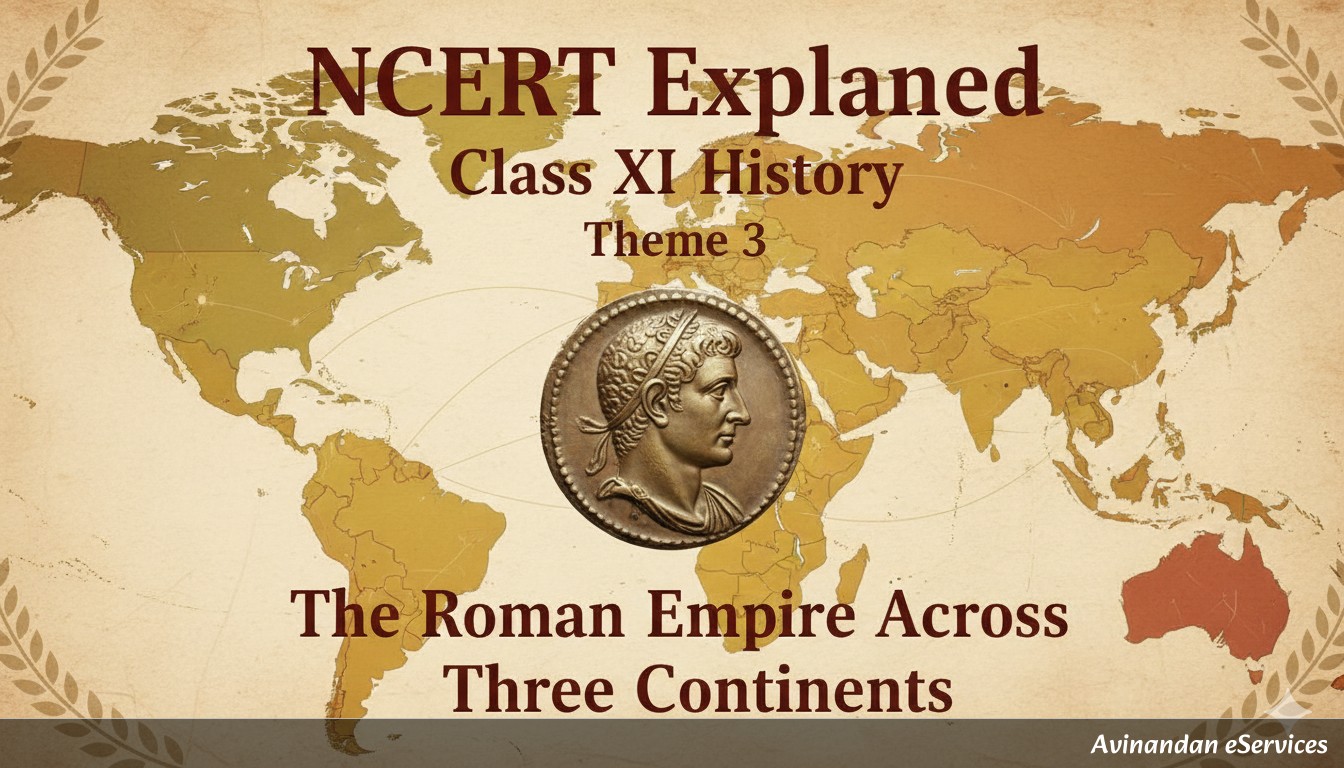
Welcome, history enthusiasts! Today, we embark on a fascinating journey back in time to explore one of the most powerful and influential civilizations in human history—the Roman Empire. Imagine an empire so vast that its territories spanned three continents: Europe, Africa, and Asia. An empire that left an indelible mark on our laws, languages, architecture, and political systems. This is the story we’ll unravel, based on Theme 3 of your Class XI NCERT History textbook, 'An Empire Across Three Continents'.
Why is studying the Roman Empire so important? Because understanding its rise, its complex society, its incredible economic machine, and its eventual decline gives us a unique window into how empires are built, sustained, and how they transform over time. The Romans were master engineers, shrewd administrators, and formidable warriors, but they also had a complex social structure and faced immense challenges. This chapter helps us piece together this incredible story using historical evidence. So, let's dive into the world of gladiators, emperors, and legions, and discover what made Rome the superpower of the ancient world.
Key Concepts Explained
The Vast Expanse: A World Centered on the Mediterranean
The first thing to grasp about the Roman Empire is its sheer scale. At its peak in the second century CE, it was a colossal entity. The heart of this empire was the Mediterranean Sea, which the Romans aptly called 'mare nostrum', meaning 'our sea'. It was their superhighway, connecting all parts of the empire through trade and transport.
Let's break down its geography:
- In Europe: The empire stretched from the Iberian Peninsula (modern Spain and Portugal) and Britain in the west, through Gaul (modern France) and Italy, all the way to Greece and the Balkan region.
- In Asia: It controlled the Near East, including territories like Anatolia (modern Turkey), Syria, and Judea.
- In Africa: The entire northern coast of Africa, from Morocco to the jewel in the crown, Egypt, was under Roman control. Egypt was incredibly important as it was the breadbasket of the empire, supplying vast quantities of grain to feed the city of Rome.
This vast territory was not a single, uniform block. It was a mosaic of different cultures, languages, and religions, all held together by a sophisticated system of Roman administration and military power. The empire was divided into provinces, each governed by a Roman official, ensuring that taxes were collected and Roman law was upheld.
Unlocking the Past: How We Know What We Know
How do historians reconstruct the story of an empire that vanished over 1500 years ago? They act like detectives, piecing together clues from three main types of sources:
- Texts: These are written materials. They include histories written by contemporaries like Tacitus, letters exchanged between officials like Pliny the Younger and Emperor Trajan, speeches, and legal codes. These texts give us insights into the attitudes and concerns of the literate elite.
- Documents: Unlike literary texts, documents were not usually intended for a wide audience. These include official inscriptions carved on stone monuments, which announced new laws or the achievements of an emperor. Another incredible source is papyri. Papyrus was a reed-like plant that grew along the Nile in Egypt, and it was used to create a form of paper. Thousands of contracts, letters, and official accounts have survived on papyri in the dry climate of Egypt, giving us a glimpse into the everyday lives of ordinary people.
- Material Remains: This is the physical evidence that archaeologists uncover. It includes entire cities like Pompeii (preserved under volcanic ash), buildings like the Colosseum and aqueducts, pottery (especially 'amphorae' used for transporting liquids like wine and olive oil), coins that carry images of emperors, and mosaics that decorated the floors of villas.
By combining these different sources, historians can build a rich and detailed picture of Roman life, from the grand strategies of emperors to the personal accounts of a humble soldier.
The Political Evolution: From Republic to Empire
Rome wasn’t always an empire ruled by one man. For centuries, it was a Republic (from 509 BCE), governed by a group of wealthy landowners who sat in an assembly called the Senate. However, by the first century BCE, the Republic was in crisis, torn apart by civil wars between powerful generals. From this chaos emerged one man: Octavian, the adopted son and heir of Julius Caesar.
In 27 BCE, Octavian, having defeated all his rivals, took the title ‘Augustus’ and became the first Roman Emperor. This marked the beginning of the Roman Empire. The regime he established is known as the Principate. Augustus was clever; he didn't call himself a king or dictator. Instead, he called himself 'Princeps', meaning 'first citizen', to maintain the illusion that the Republic was still alive. In reality, he held supreme power.
The Three Pillars of the Empire
The stability of this new imperial system rested on three key institutions:
- The Emperor: The emperor was the single source of authority. His power depended on his control over the army. He was the commander-in-chief, and the soldiers swore an oath of loyalty directly to him. A successful emperor was one who could keep the army happy and secure the empire's borders.
- The Senate: The Senate was the body that had governed Rome during the Republic. Under the empire, it lost most of its real power to the emperor. However, it still held immense prestige and represented the Roman aristocracy—the wealthy families who owned most of the land in Italy. Emperors needed to manage their relationship with the Senate carefully. A hostile Senate could damage an emperor's reputation, even after his death.
- The Army: The Roman army was a professional, paid force. Soldiers had to serve for 25 years, and upon retirement, they received a piece of land or a sum of money. The army was massive, with hundreds of thousands of soldiers stationed along the frontiers of the empire. While its primary role was defence against \texternal threats, it was also a major political force. The army had the power to make or break emperors, and a disgruntled army could easily proclaim its own general as the new ruler.
The Third-Century Crisis and Late Antiquity
The first two centuries of the empire were largely a period of peace and prosperity, often called the Pax Romana (the Roman Peace). However, the third century CE was a period of intense crisis. The empire faced simultaneous threats on multiple fronts—from new, more aggressive tribes in the north (like the Goths) and a powerful new dynasty in Persia (the Sasanians) in the east. Internally, there was immense political instability, with a rapid succession of over 25 emperors in just 50 years, most of whom were assassinated. This period of civil war, foreign invasion, and economic turmoil almost led to the collapse of the empire.
The empire was saved and transformed by a series of powerful emperors in the period known as Late Antiquity. Emperor Diocletian (284-305 CE) realized the empire was too large for one man to govern effectively. He divided it into four parts, creating a system known as the Tetrarchy (rule of four). He also strengthened the administration and the army.
His successor, Constantine, made two monumental changes. First, he founded a new capital city in the east, Constantinople (modern-day Istanbul), which shifted the political centre of gravity away from Rome. Second, he converted to Christianity. Over the fourth century, Christianity went from being a persecuted minority religion to the official state religion of the Roman Empire, a transformation that would profoundly shape the future of Europe.
Economic Life: The Engine of the Empire
The Roman Empire was an economic powerhouse, built on a foundation of agriculture, trade, and, crucially, slave labour.
Agriculture and Trade
The vast majority of the population was involved in agriculture. The wealthiest Romans owned huge estates called latifundia, which produced goods for the market. Key agricultural products included grain, grapes (for wine), and olives (for olive oil). The empire was a single economic zone, and goods were transported on a massive scale. Olive oil from Spain, wine from Gaul, and wheat from North Africa and Egypt were shipped across the Mediterranean in large clay containers called amphorae. This vast commercial network was supported by a stable currency (the silver denarius), a sophisticated banking system, and an incredible infrastructure of roads and ports built and maintained by the Roman state.
The Institution of Slavery
It is impossible to discuss the Roman economy without acknowledging the central role of slavery. Slavery was deeply embedded in Roman society. Slaves were considered property under the law and had no rights. They were acquired through warfare, piracy, or were born to slave mothers. They performed a vast range of jobs: they worked in brutal conditions in mines and quarries, toiled on agricultural estates, and served in the households of the rich as cooks, cleaners, and tutors. While some masters were kind, the system was inherently brutal. The reliance on slave labour meant there was little incentive to develop labour-saving technology. After the major wars of conquest ended in the first century CE, the supply of new slaves dwindled, forcing landowners to find alternative sources of labour, such as hiring paid workers or leasing out land to tenants.
Society and Culture in the Roman World
Roman society was highly stratified, with a vast gap between the rich and the poor.
A Hierarchical Social Order
At the very top were the Senators, the wealthiest landowners who dominated politics. Below them were the equites (or 'knights'), a second tier of the aristocracy who were often involved in business and administration. Then came the 'respectable' middle class, which included merchants and bureaucrats. The vast majority of the population, however, belonged to the lower classes, known as the humiliores ('the lowlier ones'). This group included urban craftspeople, small farmers, and the unemployed poor of Rome who depended on free grain handouts from the state. At the very bottom of the social ladder were the slaves, who constituted a significant portion of the total population.
Family, Literacy, and Culture
The Roman family was headed by a patriarch, the paterfamilias, who held legal authority over his wife, children, and slaves. However, Roman women had more rights than in many other ancient societies. They could inherit and own property and often played a significant role in managing family businesses. Marriages were typically arranged to form strategic alliances between families.
Literacy was not universal but was more widespread than in many pre-modern societies, especially in towns and among soldiers and officials. The empire was culturally diverse. While Latin was the language of law and administration in the west and Greek was dominant in the east, hundreds of local languages and dialects continued to be spoken. The Romans were generally tolerant of local religions and cults, often incorporating foreign gods into their own pantheon. This changed dramatically with the rise of monotheistic Christianity, which became the sole official religion in the late fourth century.
The End of an Era: The 'Fall' of Rome
By the fifth century CE, the western part of the Roman Empire faced overwhelming challenges. Constant pressure from Germanic tribes along the frontiers, coupled with internal political instability and economic decay, led to its gradual disintegration. In 410 CE, the city of Rome was sacked by the Visigoths, a shocking event that sent tremors across the empire. By 476 CE, the last Roman emperor in the west was deposed. This date is traditionally seen as the 'fall' of the Roman Empire.
However, it is important to remember two things. First, this was a long, slow process of transformation, not a single event. Second, the story of Rome did not end. The Eastern Roman Empire, with its capital at Constantinople, not only survived but thrived for another thousand years. We know it today as the Byzantine Empire. It preserved Roman law, Greek culture, and Christian tradition long after the west had fragmented into various Germanic kingdoms.
Summary & Key Takeaways
Let's quickly recap the essential points from our exploration of the Roman Empire:
- A Vast Empire: The Roman Empire was a massive political entity spanning Europe, North Africa, and the Middle East, with the Mediterranean Sea at its core.
- From Republic to Empire: It transitioned from a Republic governed by the Senate to an Empire ruled by an autocrat, starting with Emperor Augustus in 27 BCE.
- The Three Pillars: The Emperor, the Senate, and the Army were the three main institutions that shaped Roman political life. The emperor's control over the professional army was key to his power.
- Economic Engine: The economy was based on agriculture and \textensive trade, facilitated by Roman infrastructure and peace (Pax Romana), but heavily dependent on the institution of slavery.
- Stratified Society: Roman society was deeply hierarchical, with a huge divide between the elite (Senators, Equites) and the masses (Humiliores), with slaves at the bottom.
- Late Antiquity Transformation: The Third-Century Crisis nearly destroyed the empire, but it was reformed and stabilized by emperors like Diocletian and Constantine, who also paved the way for Christianity to become the state religion.
- A Tale of Two Halves: The Western Roman Empire gradually disintegrated in the fifth century CE, while the Eastern Roman (Byzantine) Empire continued for another millennium, preserving Rome's legacy.
The Roman Empire's story is one of incredible achievement, brutal conquest, complex society, and lasting legacy. It continues to influence our world in countless ways, making it a crucial chapter in the grand narrative of human history.