Introduction to the Topic
Imagine a nation reborn. On 15th August 1947, India awoke to freedom, but it also awoke to immense challenges. The colonial rulers had left behind an economy that was stagnant, underdeveloped, and crippled. The country's agriculture was backward, its industrial base was weak, and millions of its citizens were trapped in \textreme poverty. The newly independent nation's leaders, led by Prime Minister Jawaharlal Nehru, faced a monumental task: to build a modern, prosperous, and equitable India from the ground up. This wasn't just about making policies; it was about choosing a path, a vision for the future.
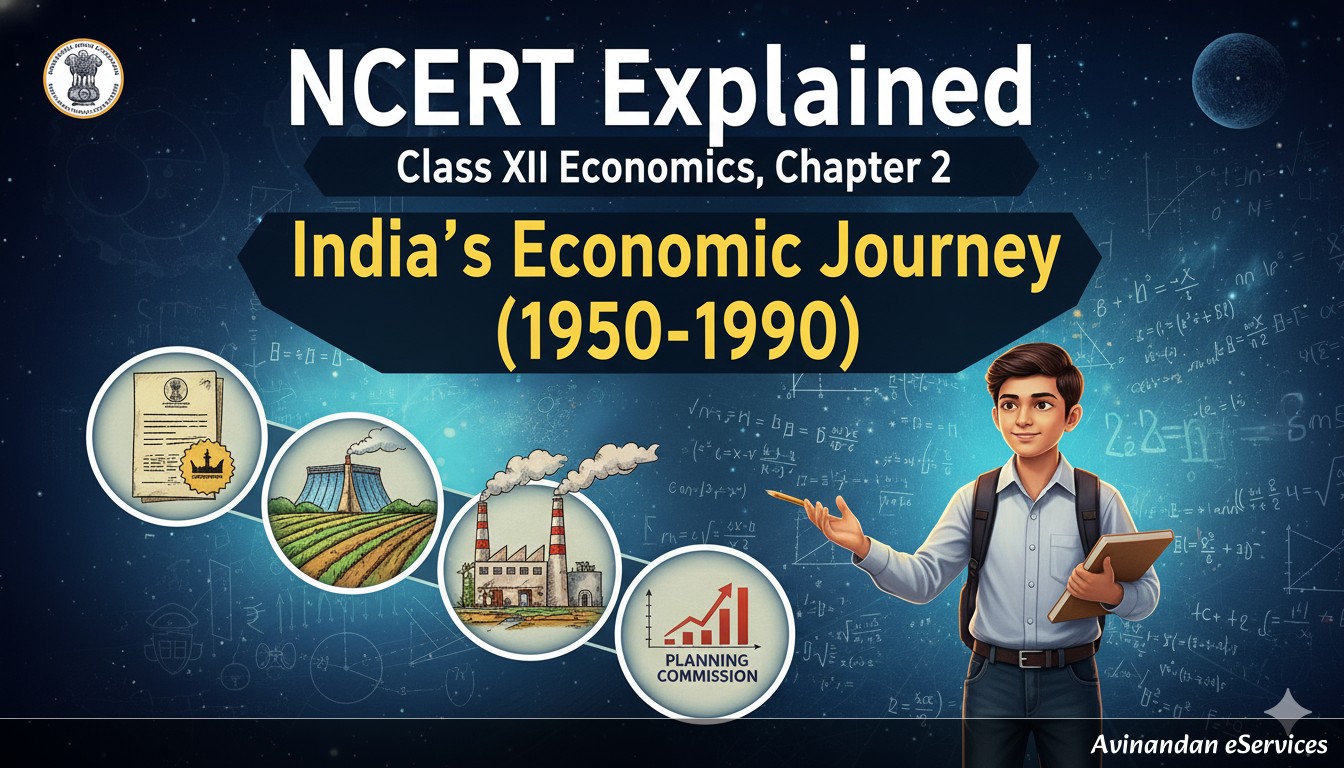
This chapter, 'Indian Economy 1950-1990', is the story of that path. It delves into the first four decades of India's economic journey, an era defined by central planning, the famous Five-Year Plans, and a determined push towards self-reliance. Understanding this period is crucial because the decisions made then have shaped the Indian economy we see today. It explains why certain industries are government-owned, why our grandparents talk about the 'license raj', and how India transformed from a food-importing nation to one that could feed itself. Let's embark on this fascinating journey to understand the dreams, the strategies, and the outcomes of India's formative economic years.
Key Concepts Explained
The Central Problem: What Type of Economic System?
After independence, the first big question was: what kind of economic system should India adopt? Think of an economic system as the set of rules that governs how a country produces, distributes, and consumes goods and services. Broadly, there were three main options on the table:
- Capitalist Economy: In this system, also known as a market economy, most means of production (factories, farms, machines) are owned by private individuals. What to produce, how much to produce, and at what price to sell are all decided by market forces of demand and supply. The main motive is profit. The USA is a prime example.
- Socialist Economy: In this system, the government owns and controls the means of production on behalf of society. The government decides what should be produced and how it should be distributed, keeping in mind the welfare of the people rather than profit. The former Soviet Union is a classic example.
- Mixed Economy: As the name suggests, this system is a blend of both capitalism and socialism. The market provides whatever goods and services it can produce well, and the government provides essential goods and services which the market might fail to provide. Both the public sector (government) and the private sector coexist.
India's leaders, particularly Jawaharlal Nehru, were drawn to the socialist model's emphasis on equality and social welfare but did not want to completely eliminate private property and democracy. They chose a middle path: the mixed economy. They envisioned an India where the government would play a significant role in 'commanding heights' of the economy—the crucial industries and infrastructure—to guide development and ensure social justice, while the private sector would also have a role to play and could operate for profit. This framework set the stage for the next major step: planning.
The Era of Planning: The Five-Year Plans
How do you steer a massive, complex economy towards specific goals? The answer for India was 'planning'. In 1950, the Planning Commission was established, with the Prime Minister as its chairperson. Its primary task was to create comprehensive plans for the country's development.
The most famous outcome of this was the series of Five-Year Plans. The idea was simple: instead of letting the economy drift, the government would set clear objectives and allocate resources to achieve them over a five-year period. The First Five-Year Plan was launched in 1951. But what were these plans trying to achieve?
The Goals of the Five-Year Plans:
The plans were guided by four overarching goals:
- Growth: This refers to a sustained increase in the country's capacity to produce goods and services. The most common way to measure this is through the Gross Domestic Product (GDP). Simply put, GDP is the total market value of all final goods and services produced within a country in a year. A growing GDP means the economic 'pie' is getting bigger, which in turn means more goods and services are available for the people, leading to a higher standard of living.
- Modernisation: This goal was about more than just using new machines. It had two dimensions. First, it meant adopting new technology to increase productivity in farms and factories. For example, using tractors instead of bullocks. Second, and just as importantly, it meant a change in social outlook, such as recognizing that women should have the same rights as men and can contribute equally to the economy in factories, banks, and schools.
- Self-Reliance: Having just emerged from two centuries of colonial rule, India's leaders were determined to avoid dependence on other countries. Self-reliance meant developing India's own resources and reducing reliance on foreign aid and imports, especially for critical items like food grains and industrial machinery. The idea was to protect the nation's sovereignty and prevent foreign interference in its policies.
- Equity: This was perhaps the most important social goal. Growth, modernisation, and self-reliance would mean very little if their benefits were cornered by a small, rich segment of the population. Equity meant ensuring that the fruits of economic development reached the poor and that the gap between the rich and the poor was reduced. It called for a just and fair distribution of wealth and opportunities.
It's important to note that sometimes these goals could conflict. For instance, focusing on modern, capital-intensive technology (Modernisation) might lead to fewer jobs, which could conflict with the goal of Equity. The planners had the difficult job of balancing these different objectives.
Sectoral Focus: Agriculture (1950-1990)
At independence, nearly 75% of India's population depended on agriculture. However, the sector was plagued by low productivity and stagnation. The British had only been interested in \textracting revenue, not in developing agriculture. To build a strong economy, India had to first fix its farms. The government's strategy was two-pronged: land reforms and technological upgradation (the Green Revolution).
Land Reforms:
The colonial land tenure system had created a class of intermediaries, like zamindars, who owned vast tracts of land but did not cultivate it themselves. They simply collected rent from the actual tillers, often exploiting them. To promote equity and increase productivity, the government initiated land reforms.
- Abolition of Intermediaries: The first major step was to abolish the zamindari system. The goal was noble: to make the tillers the owners of the land they cultivated ('land to the tiller'). This brought about 200 lakh tenants into direct contact with the government. However, the implementation was not perfect. Many former zamindars used loopholes in the law to evict tenants and claim to be 'self-cultivators', retaining control over large areas of land.
- Land Ceilings: This policy aimed at reducing the concentration of land ownership. A 'ceiling' or a maximum limit was fixed on how much agricultural land one individual or family could own. Any land above this ceiling was to be taken over by the government and redistributed among the landless cultivators and small farmers. Unfortunately, this policy also met with limited success. Big landlords challenged the legislation in court, causing long delays. They also used this time to register their land in the names of relatives to bypass the law.
The Green Revolution:
While land reforms were changing the institutional structure, a technological revolution was about to transform Indian agriculture. By the mid-1960s, India was facing a severe food crisis and was heavily dependent on food aid from countries like the USA. The solution came in the form of the Green Revolution.
This 'revolution' referred to the large increase in the production of food grains resulting from the use of a new package of technology:
- High-Yielding Variety (HYV) Seeds: These were miracle seeds, especially for wheat and rice, which could produce much larger quantities of grain from a single plant.
- Chemical Fertilisers and Pesticides: The HYV seeds required a specific combination of chemical inputs to achieve their full potential.
- Assured Irrigation: Unlike traditional seeds that could survive on monsoon rains, these new seeds needed a regular and reliable supply of water.
The Green Revolution was introduced in phases. The first phase (mid-1960s to mid-1970s) was restricted to affluent states like Punjab, Andhra Pradesh, and Tamil Nadu, which had better infrastructure and irrigation. In the second phase (mid-1970s to mid-1980s), the technology spread to more states. The impact was dramatic. India achieved self-sufficiency in food grains and even built up a buffer stock to be used during food shortages. The risk of famine was significantly reduced.
However, the Green Revolution was not without its critics. It created a stark divide between rich and poor farmers, as only those who could afford the expensive seeds, fertilisers, and irrigation benefited. This increased income disparities. It also led to regional disparities, with the western and southern parts of the country benefiting more than the eastern parts. There were also environmental concerns, such as soil degradation and water depletion due to the excessive use of chemicals and groundwater.
Sectoral Focus: Industry and Trade (1950-1990)
India's planners believed that a strong industrial base was essential for economic growth and modernisation. They noted that developed countries were all industrialised. Hence, a significant focus of the Five-Year Plans was on developing industries.
Industrial Policy Resolution (IPR) 1956:
This policy resolution was a landmark document that shaped the Indian industrial sector for the next three decades. It laid out the guiding principles for industrial development, giving a dominant role to the state.
IPR 1956 classified industries into three categories:
- Schedule A: This included 17 industries that were to be exclusively owned and operated by the state (public sector). These were core industries like arms and ammunition, atomic energy, heavy machinery, and railways.
- Schedule B: This list contained 12 industries where the state would take the lead in setting up new units, but the private sector could supplement these efforts. This included industries like aluminum, machine tools, and fertilisers.
- Schedule C: All remaining industries were left to the private sector. However, even these industries were subject to state control through a system of licensing.
The 'Permit-License Raj':
A key feature of the industrial policy was industrial licensing. To start a new industry or to expand an existing one, a private entrepreneur had to obtain a license from the government. The idea was to channel investment into priority areas and prevent the concentration of economic power. However, this system became infamous as the 'Permit-License Raj'. It created long bureaucratic delays, bred corruption, and discouraged entrepreneurship. Instead of promoting efficiency, it often protected inefficient firms from competition.
Small-Scale Industries (SSI):
The government also made a special effort to promote small-scale industries. A committee in 1955 (the Karve Committee) highlighted their potential for generating employment and promoting rural development. The government supported SSIs by 'reserving' the production of a number of items exclusively for them. This meant large industries could not manufacture these goods. SSIs were also given concessions like lower excise duty and bank loans at lower interest rates.
Trade Policy: Import Substitution
In the first seven Five-Year Plans, India's foreign trade policy was characterized by an 'inward-looking' strategy. This strategy is technically known as import substitution.
The goal was simple: to replace or substitute imports with domestically produced goods. For example, instead of importing cars from foreign countries, the policy encouraged Indian companies to manufacture them within the country. The rationale was twofold: to achieve self-reliance and to protect India's nascent industries from competition from more established foreign producers.
To implement this policy, the government used two main tools:
- Tariffs: These are taxes imposed on imported goods. By making imported goods more expensive, tariffs discourage their use and encourage people to buy domestic alternatives.
- Quotas: These specify the maximum quantity of a good that can be imported. This directly restricts the volume of foreign goods entering the country.
A Critical Appraisal of the Policy:
This protectionist policy had a mixed impact. On the positive side, it did help India build a diversified industrial base. The share of industry in India's GDP increased significantly between 1950 and 1990. We started producing a wide variety of goods that we were previously importing.
However, the lack of competition had a serious downside. It bred inefficiency. Domestic producers, sheltered from foreign competition, had little incentive to improve the quality of their products or reduce their costs. This resulted in a situation where Indian consumers had limited choices and often had to buy low-quality goods at high prices. The growth of some public sector enterprises was hampered by inefficiency, corruption, and political interference, turning them into loss-making ventures that drained the nation's resources. This entire system ultimately set the stage for the major economic crisis of 1991, which forced India to rethink its economic strategy entirely.
Summary & Key Takeaways
The period from 1950 to 1990 was a foundational era for the Indian economy. It was a time of great hopes, bold experiments, and mixed results. Here are the key takeaways from this chapter:
- Choosing a Path: After independence, India chose a mixed economy model, combining elements of socialism and capitalism, with a strong emphasis on state-led development.
- The Age of Planning: Economic development was driven by a series of Five-Year Plans formulated by the Planning Commission.
- The Four Pillars: The primary goals of these plans were Growth (increasing GDP), Modernisation (adopting new technology and social outlooks), Self-Reliance (reducing dependence on foreign countries), and Equity (ensuring fair distribution of wealth).
- Agricultural Transformation: The government attempted land reforms (abolishing zamindars, land ceilings) with limited success. The Green Revolution, based on HYV seeds and modern inputs, made India self-sufficient in food grains but also increased economic and regional disparities.
- Industrial Strategy: The Industrial Policy Resolution of 1956 gave the public sector a dominant role. The private sector was controlled through a complex system of licensing, often called the 'Permit-License Raj'.
- Inward-Looking Trade: India followed a policy of import substitution, using high tariffs and quotas to protect domestic industries. While this helped diversify the industrial base, it also led to inefficiency and poor quality of goods.
- Legacy of the Era: This period successfully laid the groundwork for India's industrial diversification and achieved food security. However, the over-reliance on the state and protectionism created inefficiencies that eventually led to a major economic crisis, paving the way for the new economic policies of 1991.