A Hiss from the Dawn of Time
Samir: Saanvi, remember that old radio at my grandfather’s house? When we couldn't find a music station, all it made was this weird, persistent 'hiss-s-s-s' sound. What is that static, anyway? Is it just… nothing?
Saanvi: That's a fantastic question, Samir! It’s definitely not nothing. In fact, a tiny part of that static you hear is actually the oldest light in the entire universe! It’s like listening to a faint echo from the very beginning of time.
Samir: The beginning of time? From an old radio? No way! You must be kidding. How is that even possible?
Saanvi: I'm totally serious! It’s one of the most amazing discoveries in science, and it was found completely by accident. It’s a story about a giant antenna, some very confused scientists, and… pigeons!
Samir: Pigeons? Now I know you’re making this up! What do pigeons have to do with the beginning of the universe?
The Mystery of the Cosmic Hiss
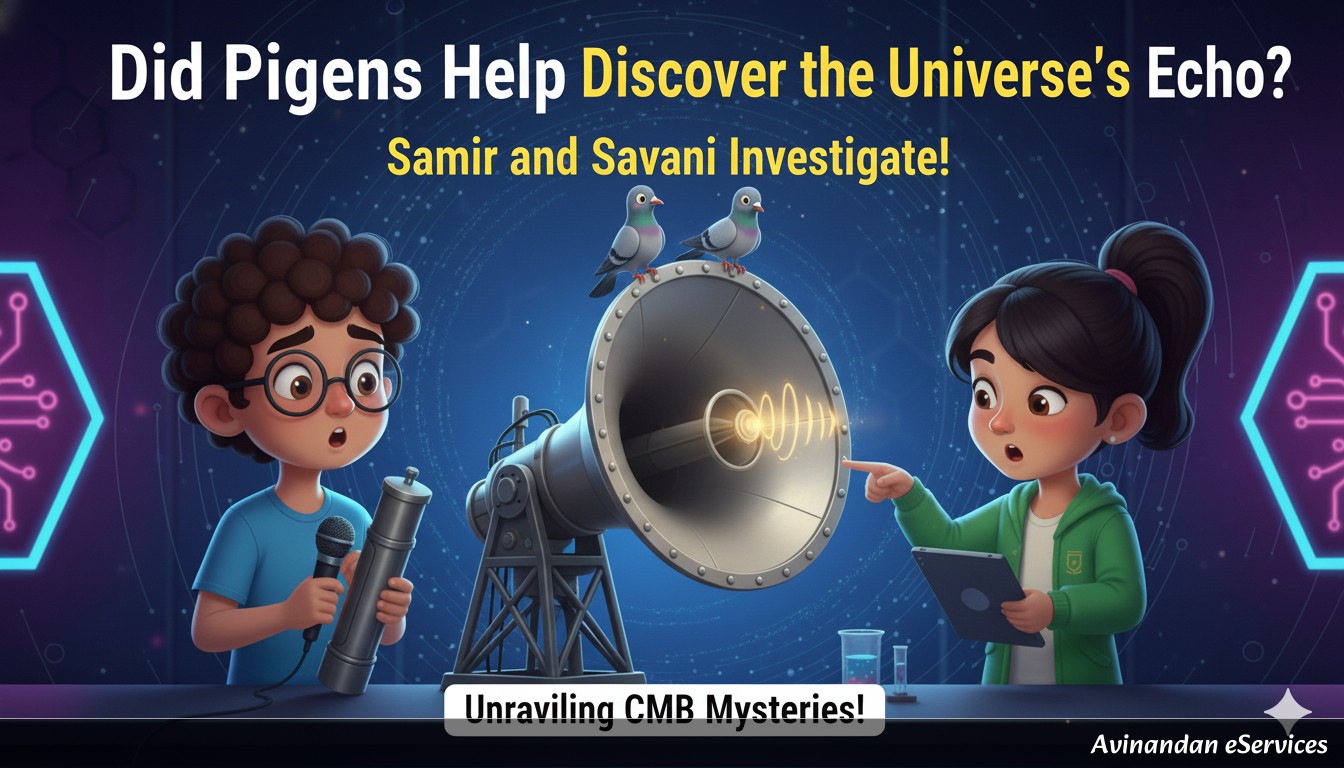
Saanvi: Okay, let me explain. Back in 1964, two American astronomers named Arno Penzias and Robert Wilson were using a huge, horn-shaped radio antenna. It was super sensitive, designed to detect faint radio waves from space. But they had a problem. No matter where they pointed their antenna, they picked up a constant, faint, humming or hissing noise.
Samir: Like the static on the radio?
Saanvi: Exactly like that! It was a mystery. They thought something must be wrong with their equipment. They checked all the wires, re-checked their systems, and did everything they could think of. But the hiss was always there. It didn’t matter if they pointed the antenna at a star, at an empty patch of sky, or what time of day it was. The hiss was uniform, coming from every single direction.
Samir: So they couldn't get rid of it? That must have been so frustrating for them.
Saanvi: It was! They even noticed a couple of pigeons had made a nest inside their giant antenna. They thought, 'Aha! Maybe the birds and their droppings are causing this weird interference!' So, they cleaned the entire antenna very carefully to get rid of what they politely called a 'white dielectric material.'
Samir: Wait, are you telling me they thought pigeon poop was blocking a message from space? That’s hilarious!
Saanvi: It really is! But even after the antenna was perfectly clean, the hiss remained. It wasn't the pigeons. It wasn't New York City nearby. It wasn't their equipment. The noise was real, and it was coming from everywhere in the universe.
An Echo of the Big Bang
Samir: So… what was it then? If it wasn't pigeons, what could make a noise that comes from everywhere at once?
Saanvi: It was the echo of creation! At the same time Penzias and Wilson were trying to get rid of their hiss, another group of scientists at a nearby university, led by a physicist named Robert Dicke, had a theory. They predicted that if the universe started with a massive explosion—the Big Bang—there should be some leftover energy, a kind of cosmic afterglow, still present today.
Samir: Like the heat you can still feel from a bonfire even after the flames have gone out?
Saanvi: That’s a perfect way to think about it! The theory was that the early universe was incredibly hot and dense. As it expanded over billions of years, it cooled down, and that intense initial light stretched out into much longer, cooler wavelengths—microwaves, to be exact. Dicke and his team were building their own antenna to try and find this exact radiation.
Samir: Let me guess! The hiss that Penzias and Wilson found was the exact thing the other scientists were looking for?
Saanvi: You got it! When the two groups of scientists finally talked to each other, they realized what had happened. Penzias and Wilson had accidentally stumbled upon the Cosmic Microwave Background, or CMB. It was the leftover heat from the Big Bang, a 'baby picture' of the universe when it was only about 380,000 years old. That mysterious hiss was the strongest evidence we had that the Big Bang theory was correct. And for that accidental discovery, they won the Nobel Prize in Physics!
So, What Did We Learn Today?
Saanvi: It's such a cool story, right? It shows that sometimes the biggest discoveries come from unexpected places.
- The universe began with an incredibly hot, dense event called the Big Bang about 13.8 billion years ago.
- As the universe expanded and cooled, it left behind a faint afterglow of energy, like the warmth from a campfire after the flames die down.
- This afterglow is called the Cosmic Microwave Background (CMB) and is found uniformly in every direction in space.
- In 1964, scientists Arno Penzias and Robert Wilson accidentally discovered the CMB using a large radio antenna while trying to eliminate a mysterious background hiss.
- They even thought pigeons were causing the noise at first, but their discovery became the most powerful evidence we have for the Big Bang theory!
Samir: Wow! And a tiny piece of that ancient cosmic hiss is what we hear in the static on an old radio or see on a TV with no signal. So next time I hear it, I’ll know I’m listening to the echo of the universe being born! That is the coolest fact ever!
Saanvi: Exactly! Science is full of amazing accidental discoveries like this. You just have to stay curious and keep asking questions… and maybe check for pigeons!