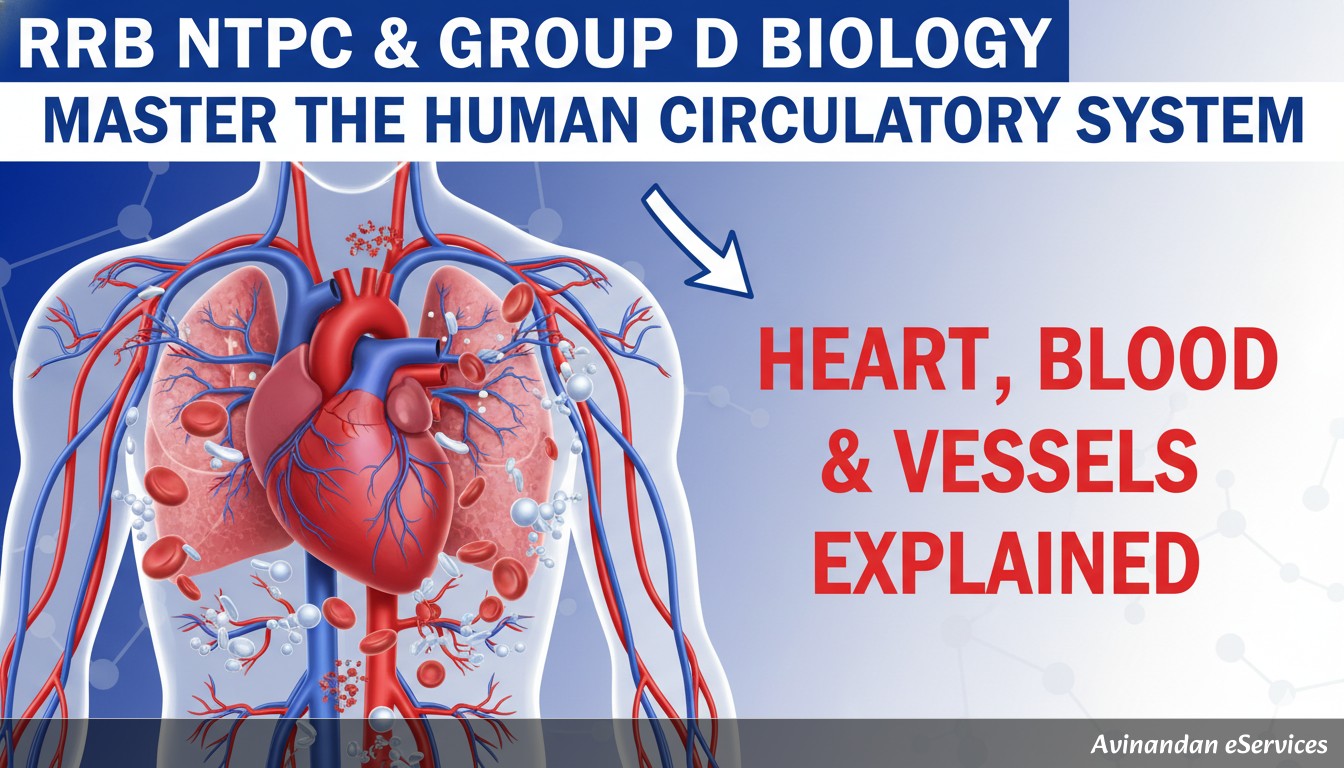
Introduction to the Human Circulatory System for RRB Exams
Welcome, aspiring railway professionals! If you are preparing for the highly competitive RRB NTPC, RRB Group D, or RRB Technician exams, you know that the General Science section holds significant weight. Within this section, Biology questions are frequently asked, and one of the most vital and recurring topics is the Human Circulatory System. Understanding how our heart pumps blood, what blood is made of, and the network of vessels that carry it is not just fascinating, it's crucial for scoring well.
This comprehensive guide is designed to be your one-stop resource for mastering the Human Circulatory System. We will break down complex concepts into simple, understandable parts, cover all the essential facts, and provide solved examples and practice questions tailored specifically for the RRB exam pattern. By the end of this post, you'll have the confidence and knowledge to tackle any question on this topic.
Why is the Human Circulatory System Important for RRB Exams?
In the General Science syllabus for RRB exams, Life Sciences (Biology) often contribute a significant number of questions. The Human Circulatory System is a favourite among examiners because it tests fundamental biological knowledge. You can expect 2-3 questions directly or indirectly related to this topic in your exam paper. These questions can range from:
- Identifying the functions of different components of blood (RBC, WBC, Platelets).
- Understanding the structure and function of the human heart (chambers, valves).
- Differentiating between arteries, veins, and capillaries.
- Questions about blood groups, blood pressure, and related diseases.
Mastering this single topic can significantly boost your score in the General Science section, bringing you one step closer to your dream job in the Indian Railways.
Components of the Human Circulatory System
The human circulatory system, also known as the cardiovascular system, is responsible for transporting nutrients, oxygen, hormones, and other essential substances to cells throughout the body, and for removing waste products like carbon dioxide. It consists of three main components: the heart, the blood, and the blood vessels.
1. The Heart: The Pumping Powerhouse
The heart is a muscular organ located in the chest, slightly to the left of the breastbone. It functions as a powerful pump, continuously pushing blood through the network of blood vessels. It is protected by a double-walled sac called the pericardium.
Structure of the Human Heart
The human heart is divided into four chambers:
- Two Upper Chambers (Atria): The right atrium and the left atrium receive blood returning to the heart.
- Two Lower Chambers (Ventricles): The right ventricle and the left ventricle pump blood out of the heart.
A muscular wall called the septum separates the left and right sides of the heart, preventing the mixing of oxygenated (oxygen-rich) and deoxygenated (oxygen-poor) blood.
Valves of the Heart
Valves are like one-way doors that ensure blood flows in the correct direction. The heart has four main valves:
- Tricuspid Valve: Located between the right atrium and the right ventricle.
- Pulmonary Valve: Located between the right ventricle and the pulmonary artery.
- Mitral (Bicuspid) Valve: Located between the left atrium and the left ventricle.
- Aortic Valve: Located between the left ventricle and the aorta.
The Cardiac Cycle
The cardiac cycle is the sequence of events that occurs during one heartbeat. It consists of two main phases:
- Systole: The contraction phase, where the ventricles pump blood out of the heart. The pressure during this phase is called systolic pressure.
- Diastole: The relaxation phase, where the chambers of the heart fill with blood. The pressure during this phase is called diastolic pressure.
2. Blood: The Fluid of Life
Blood is a specialized connective tissue that circulates throughout the body, performing many critical functions. An average adult has about 5-6 liters of blood.
Composition of Blood
Blood is composed of two main parts: plasma and formed elements (blood cells).
| Component | Description | Key Functions |
|---|---|---|
| Plasma | The liquid matrix of blood (about 55%). It's a straw-colored fluid, mostly water (92%), with proteins, glucose, hormones, and waste products. | Transporting blood cells, nutrients, hormones, and waste products; regulating body temperature. Key proteins include albumin (maintains osmotic pressure), globulin (immunity), and fibrinogen (blood clotting). |
| Red Blood Cells (RBCs) / Erythrocytes | Biconcave discs without a nucleus in mammals. They contain hemoglobin, a red, iron-rich protein. | Transporting oxygen from the lungs to the body tissues and carrying carbon dioxide back to the lungs. |
| White Blood Cells (WBCs) / Leukocytes | Irregularly shaped cells with a nucleus. They are larger than RBCs but fewer in number. Main types are Neutrophils, Lymphocytes, Monocytes, Eosinophils, and Basophils. | Form the body's defense system (immune system) by fighting infections and diseases. |
| Platelets / Thrombocytes | Small, colorless cell fragments, not complete cells. They lack a nucleus. | Crucial for blood clotting (coagulation), which prevents excessive bleeding from injuries. |
Blood Groups
Blood is classified based on the presence or absence of specific antigens on the surface of RBCs. The most important system is the ABO system, which gives four main blood types: A, B, AB, and O.
- Type A: Has A antigens.
- Type B: Has B antigens.
- Type AB: Has both A and B antigens. Known as the Universal Recipient because it can receive blood from any ABO group.
- Type O: Has neither A nor B antigens. Known as the Universal Donor because its blood can be given to any ABO group.
The Rh factor (Rhesus factor) is another important antigen. If it's present, the blood is Rh-positive (e.g., A+); if absent, it's Rh-negative (e.g., O-). An O- individual is the true universal donor.
3. Blood Vessels: The Highway Network
Blood vessels are a network of tubes that transport blood throughout the body. There are three main types:
- Arteries: These are thick-walled, muscular vessels that carry blood away from the heart. They usually carry oxygenated blood (except for the pulmonary artery). The largest artery is the Aorta.
- Veins: These vessels carry blood towards the heart. Their walls are thinner than arteries, and they contain valves to prevent the backflow of blood. They usually carry deoxygenated blood (except for the pulmonary veins).
- Capillaries: These are the smallest blood vessels, forming a vast network that connects arteries and veins. Their walls are only one cell thick, which allows for the efficient exchange of oxygen, nutrients, and waste products between the blood and body tissues.
The Double Circulation System
Humans have a double circulation system, meaning blood passes through the heart twice for each complete circuit of the body. This is highly efficient and consists of two loops: pulmonary circulation and systemic circulation.
Pulmonary Circulation
This loop transports deoxygenated blood from the heart to the lungs and brings oxygenated blood back to the heart.
Path: Right Ventricle → Pulmonary Artery → Lungs (blood gets oxygenated) → Pulmonary Veins → Left Atrium.
Systemic Circulation
This loop carries oxygenated blood from the heart to all other parts of the body and returns deoxygenated blood to the heart.
Path: Left Ventricle → Aorta → Arteries → Capillaries in body tissues (oxygen is delivered) → Veins → Vena Cava → Right Atrium.
Key Terms and Concepts at a Glance
| Term | Definition |
|---|---|
| Blood Pressure | The pressure of circulating blood against the walls of blood vessels. Measured as Systolic/Diastolic (e.g., 120/80 mm Hg is normal). |
| Sphygmomanometer | The instrument used to measure blood pressure. |
| Heart Rate | The number of times the heart beats per minute (bpm). Normal resting rate for an adult is 60-100 bpm. |
| ECG (Electrocardiogram) | A test that measures the electrical activity of the heartbeat. |
| Lymphatic System | A network of tissues and organs that help rid the body of toxins, waste, and other unwanted materials. It works closely with the circulatory system. |
Common Diseases of the Circulatory System
A basic understanding of common circulatory diseases is often tested in RRB exams.
- Hypertension (High Blood Pressure): A condition where the long-term force of the blood against artery walls is high enough to cause health problems, such as heart disease.
- Atherosclerosis: The buildup of fats, cholesterol, and other substances in and on the artery walls (plaque), which can restrict blood flow.
- Heart Attack (Myocardial Infarction): Occurs when the blood flow to a part of the heart is blocked for a long enough time that part of the heart muscle is damaged or dies.
- Anemia: A condition in which you lack enough healthy red blood cells to carry adequate oxygen to your body's tissues. Often caused by iron deficiency.
- Leukemia: Cancer of the body's blood-forming tissues, including the bone marrow and the lymphatic system, which results in the overproduction of abnormal WBCs.
Solved Examples (Previous Year Questions - PYQs)
Let's tackle some questions similar to those asked in previous RRB exams to solidify your understanding.
Example 1
Question: Which component of blood is responsible for blood clotting?
a) Red Blood Cells
b) White Blood Cells
c) Plasma
d) Platelets
Solution: (d) Platelets. Platelets, or thrombocytes, are cell fragments that circulate in the blood. When a blood vessel is damaged, they gather at the site and form a plug (clot) to stop the bleeding. This process is called coagulation.
Example 2
Question: Which chamber of the human heart pumps oxygenated blood to the rest of the body?
a) Right Atrium
b) Right Ventricle
c) Left Atrium
d) Left Ventricle
Solution: (d) Left Ventricle. The left ventricle is the strongest chamber of the heart. It receives oxygenated blood from the left atrium and pumps it into the aorta, the main artery that distributes blood to the entire body (systemic circulation).
Example 3
Question: Which of the following is known as the 'Universal Donor' blood group?
a) A
b) B
c) AB
d) O
Solution: (d) O. Blood group O lacks both A and B antigens on the surface of its RBCs. Therefore, it can be transfused to individuals of any other blood group without causing an immune reaction, making it the universal donor. Specifically, O-negative is the true universal donor.
Example 4
Question: The muscular wall that separates the right and left sides of the heart is called:
a) Pericardium
b) Septum
c) Aorta
d) Valve
Solution: (b) Septum. The septum is the thick muscular wall that divides the heart into a left and right side, preventing the mixing of oxygen-rich and oxygen-poor blood.
Example 5
Question: Which blood vessels have the smallest diameter?
a) Arteries
b) Arterioles
c) Veins
d) Capillaries
Solution: (d) Capillaries. Capillaries are the smallest and most numerous of the blood vessels. They form the connection between arteries (via arterioles) and veins (via venules) and are the primary site for the exchange of materials between the blood and tissue cells.
Practice Questions for RRB Aspirants
Test your knowledge with these practice questions. The answers are provided at the end.
- The red colour of human blood is due to the presence of ________.
- Which is the largest artery in the human body?
- A normal adult's resting heart rate is typically in the range of:
- What does the 'pulmonary artery' carry?
- The instrument used for measuring blood pressure is known as:
- Which blood cells are the primary agents of the body's immune system?
- The bicuspid valve is also known as the ________.
- The condition of having a lower-than-normal number of red blood cells or quantity of hemoglobin is called:
- Where are red blood cells primarily produced in adults?
- The contraction of the heart is known as:
a) Hemocyanin
b) Myoglobin
c) Hemoglobin
d) Plasma
a) Pulmonary Artery
b) Aorta
c) Vena Cava
d) Carotid Artery
a) 40-60 bpm
b) 60-100 bpm
c) 100-120 bpm
d) 120-140 bpm
a) Oxygenated blood to the lungs
b) Deoxygenated blood to the lungs
c) Oxygenated blood from the lungs
d) Deoxygenated blood from the lungs
a) Stethoscope
b) Barometer
c) Sphygmomanometer
d) Electrocardiograph
a) Erythrocytes
b) Leukocytes
c) Thrombocytes
d) All of the above
a) Tricuspid valve
b) Aortic valve
c) Pulmonary valve
d) Mitral valve
a) Leukemia
b) Anemia
c) Hypertension
d) Hemophilia
a) Liver
b) Spleen
c) Bone marrow
d) Heart
a) Systole
b) Diastole
c) Lub
d) Dub
Solutions to Practice Questions
- (c) Hemoglobin: Hemoglobin is the iron-containing protein in red blood cells that binds to oxygen and gives blood its characteristic red color.
- (b) Aorta: The aorta is the main and largest artery in the body, originating from the left ventricle of the heart and \textending down to the abdomen.
- (b) 60-100 bpm: The normal resting heart rate for adults ranges from 60 to 100 beats per minute.
- (b) Deoxygenated blood to the lungs: The pulmonary artery is unique because, unlike other arteries, it carries deoxygenated blood from the right ventricle to the lungs for oxygenation.
- (c) Sphygmomanometer: It is the medical device used to measure blood pressure.
- (b) Leukocytes: White blood cells (Leukocytes) are the cornerstone of the body's immune system, identifying and destroying pathogens.
- (d) Mitral valve: The bicuspid valve, located between the left atrium and left ventricle, is also called the mitral valve.
- (b) Anemia: Anemia is a medical condition characterized by a deficiency of red blood cells or hemoglobin.
- (c) Bone marrow: In adults, hematopoiesis (the formation of blood cells) primarily occurs in the red bone marrow.
- (a) Systole: Systole is the phase of the cardiac cycle when the heart muscle contracts and pumps blood from the chambers into the arteries.
Conclusion and Final Tips
The Human Circulatory System is a fundamental and high-scoring topic for the RRB NTPC, Group D, and Technician exams. By thoroughly understanding the functions of the heart, the composition of blood, and the network of blood vessels, you can confidently answer the questions thrown your way.
Final Tips for Revision:
- Draw and Label: Draw the human heart and the path of double circulation. Labeling the parts yourself is a powerful memory aid.
- Use Flashcards: Create flashcards for key terms like Systole/Diastole, Universal Donor/Recipient, and the names of the heart valves.
- Make Flowcharts: Create a flowchart to trace the path of a red blood cell through the entire circulatory system.
- Practice Regularly: Keep practicing MCQs from previous years' papers and mock tests to get familiar with the question patterns.
We hope this detailed guide helps you master the Human Circulatory System. Keep up your hard work and dedication, and you will surely achieve your goal of joining the Indian Railways. All the best!