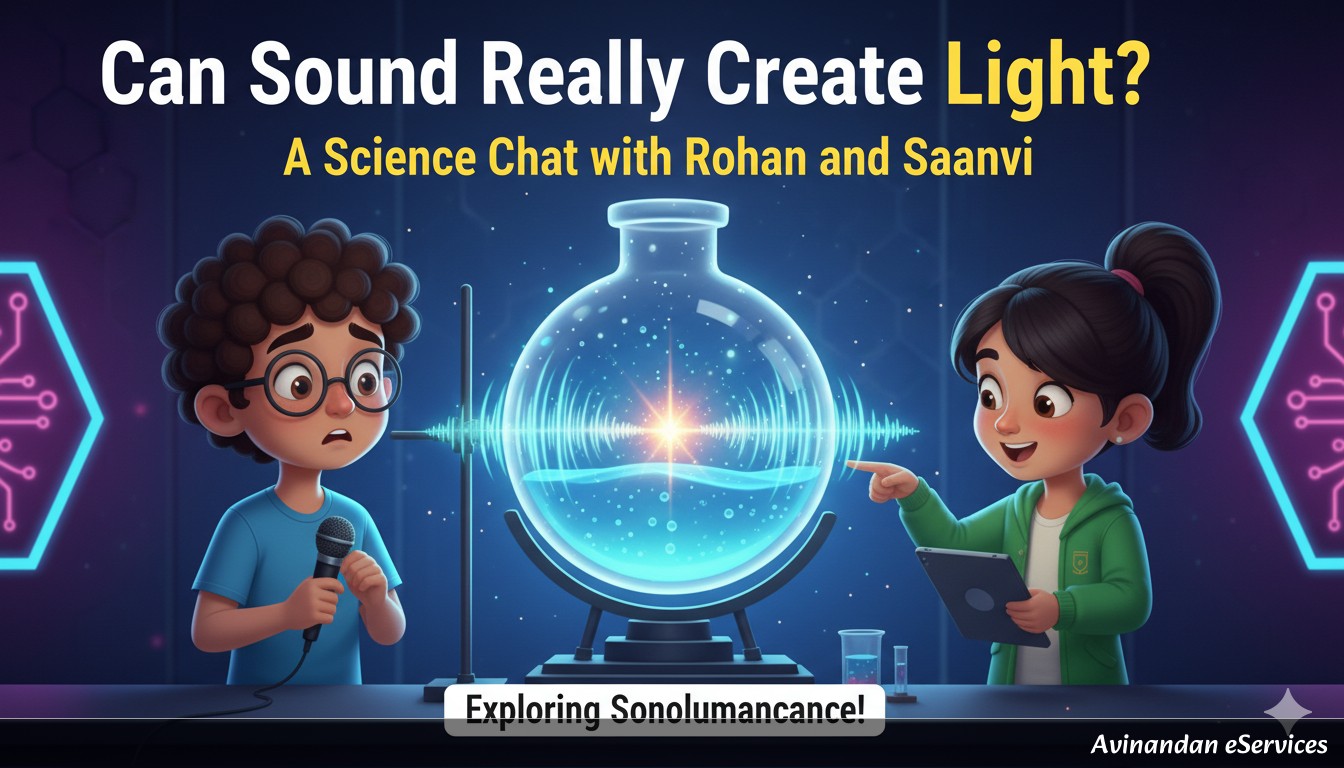
Turning Sound Waves into Tiny Stars!
Rohan: Saanvi, you won't believe the movie I saw last night! The scientists in it used a giant sound cannon to create this massive flash of light. It was so cool, but it can’t be real, right? You can't just make light out of sound.
Saanvi: Actually, Rohan, in a way, you can! It’s not as dramatic as a giant movie cannon, but the basic idea of turning sound into light is a real scientific phenomenon. It's called Sonoluminescence!
Rohan: Whoa, seriously? Sono... lum... what was that again?
Saanvi: Sonoluminescence! Let's break it down. 'Sono' comes from the Latin word for sound, like in 'sonar'. And 'luminescence' means to emit light without heat, like a firefly. So, it literally means 'light from sound'.
Rohan: Okay, my mind is officially blown. How does it even work? Do you just clap your hands really hard and a lightbulb turns on?
Saanvi: Haha, not quite! It’s much more delicate and happens on a super tiny scale. Imagine you have a small flask of water. Inside that water, scientists trap a single, tiny bubble of air or gas, smaller than a grain of sand.
Rohan: A tiny bubble? That's it? That doesn't sound very powerful.
Saanvi: That’s the amazing part! They then hit the flask with powerful sound waves, kind of like a very specific, very strong hum. Now, you know how sound travels in waves, right? With high-pressure peaks and low-pressure troughs?
Rohan: Yeah, like ripples in a pond.
Saanvi: Exactly! The low-pressure part of the sound wave passes, and it pulls on the bubble, making it expand to many times its original size. Then, almost instantly, the high-pressure part of the wave hits. It’s like a giant invisible hand squeezing the bubble from all sides. The bubble collapses incredibly fast – faster than you can even imagine.
Rohan: So the bubble just pops? How does a popping bubble make light?
Saanvi: This is where the magic of physics happens. The collapse is so violent and so fast that the gas molecules trapped inside the bubble have nowhere to go. They all slam into the center at once. This generates an unbelievable amount of heat and pressure inside that tiny, tiny space. For a split second, the temperature inside that bubble can reach thousands of degrees Celsius – some scientists think it might even be as hot as the surface of the sun!
Rohan: AS HOT AS THE SUN?! From a tiny bubble in some water? No way!
Saanvi: It's true! And anything that hot glows. So, for a picosecond—that's a trillionth of a second—the superheated gas inside the collapsing bubble emits a tiny, bright flash of light. The sound wave keeps coming, so the bubble expands and collapses over and over, flashing with light each time, like a tiny, pulsating star.
Rohan: That is one of the coolest things I have ever heard. Who discovered this? They must have been a genius!
Saanvi: Well, like many great discoveries, it was partly an accident! Back in 1934, two German scientists named H. Frenzel and H. Schultes were working on powerful sonar equipment for the navy. They noticed that the water around their equipment was creating tiny, unexplained flashes of light. They didn't fully understand why, but they recorded what they saw. It wasn't until decades later, in the late 1980s, that scientists were able to study it properly and give it the name Sonoluminescence.
Rohan: So, what's the point of it? Can we use it to make sonoluminescence lamps for our houses?
Saanvi: That would be cool, but the flashes are too small and too short to light up a room. For now, it’s mostly a tool for scientists to study \textreme conditions. Think about it: we can create sun-like temperatures in a simple flask in a lab! It helps them understand how matter behaves under incredible pressure and heat. But… there is one really big, futuristic idea.
Rohan: Ooh, a futuristic idea! Tell me!
Saanvi: Some scientists have wondered if the conditions inside the collapsing bubble are intense enough to cause nuclear fusion. That’s the same process that powers the sun, where atoms are squeezed together to release huge amounts of energy. If they could achieve 'bubble fusion', it could be a source of clean, almost limitless energy. It's a very controversial idea and it hasn't been proven yet, but it’s one of the exciting mysteries that makes sonoluminescence so important to study.
So, What Did We Learn Today?
Saanvi: Let's quickly go over the main points about our tiny, light-up bubble.
- Sonoluminescence is a real phenomenon where sound waves can be used to generate light.
- It works by using sound to trap and then violently collapse a tiny gas bubble in a liquid.
- This super-fast collapse heats the gas inside the bubble to \textreme temperatures, as hot as the sun's surface, causing it to glow and emit a flash of light.
- It was discovered by accident in the 1930s by scientists working with sonar.
- Scientists are still studying it to understand the laws of physics and explore future energy ideas like 'bubble fusion'.
Rohan: Wow. So even the tiniest bubble can hold a secret as powerful and bright as a star. Science is amazing! I'm going to tell everyone at school about this tomorrow!