Introduction
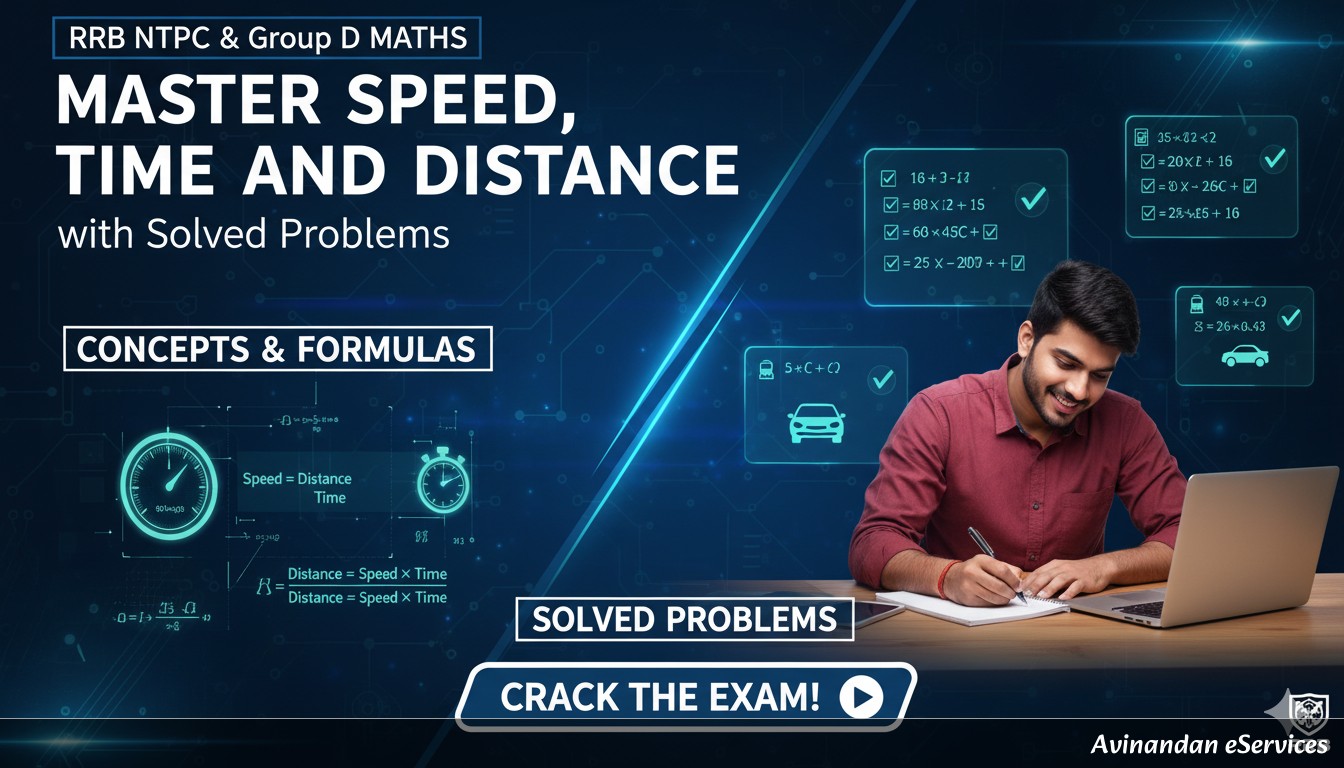
Dear aspirants, are you gearing up for the highly competitive Indian Railway Recruitment Board (RRB) NTPC or Group D exams? If so, you're in the right place! One of the most frequently tested and crucial topics in the Quantitative Aptitude section is Speed, Time, and Distance. A strong grasp of this concept is not just about memorizing formulas; it's about understanding the underlying principles and applying them strategically to solve a wide range of problems. From calculating how fast a train travels to determining the speed of a boat in a river, this topic covers diverse scenarios that are essential for scoring high marks.
Many candidates find Speed, Time, and Distance problems challenging due to the various sub-topics like relative speed, average speed, problems on trains, and boats and streams. However, with a systematic approach, clear understanding of concepts, and consistent practice, you can easily conquer these questions. This comprehensive guide will serve as your ultimate resource, breaking down every aspect of Speed, Time, and Distance, providing clear explanations, essential formulas, step-by-step solved examples, and practice questions to solidify your learning.
By the end of this post, you will not only be confident in tackling any Speed, Time, and Distance problem thrown your way in the RRB exams but also develop the analytical skills required for success in other competitive examinations. Let's embark on this learning journey to master this vital topic!
Understanding the Fundamentals: Speed, Time, and Distance
At its core, Speed, Time, and Distance problems revolve around three interlinked variables. Let's define each:
- Distance (D): The total length of the path covered by a moving object. It is typically measured in kilometers (km) or meters (m).
- Time (T): The duration for which the object is in motion. It is usually measured in hours (hr), minutes (min), or seconds (s).
- Speed (S): The rate at which an object covers a certain distance. It is defined as the distance covered per unit of time. Speed indicates how fast or slow an object is moving.
The Core Relationship
The fundamental relationship between these three variables is:
Distance = Speed × Time (D = S × T)
From this basic formula, we can derive the other two relationships:
- Speed = Distance / Time (S = D / T)
- Time = Distance / Speed (T = D / S)
This triangle relationship is the cornerstone of all problems in this topic. Always remember to use consistent units for all three variables to avoid errors.
Units and Conversions
One of the most common pitfalls in Speed, Time, and Distance problems is inconsistent units. It's crucial to ensure that all units are uniform before performing calculations. Here are the most common units and their conversions:
- Distance: km, m
- Time: hr, min, s
- Speed: km/hr, m/s
Key Conversions:
1. Kilometers per hour (km/hr) to Meters per second (m/s):
To convert speed from km/hr to m/s, multiply by 5/18.
S (m/s) = S (km/hr) × (1000 m / 3600 s) = S (km/hr) × (5/18)
2. Meters per second (m/s) to Kilometers per hour (km/hr):
To convert speed from m/s to km/hr, multiply by 18/5.
S (km/hr) = S (m/s) × (3600 s / 1000 m) = S (m/s) × (18/5)
3. Other useful conversions:
- 1 hour = 60 minutes = 3600 seconds
- 1 km = 1000 meters
Example: Convert 72 km/hr to m/s. Solution: 72 × (5/18) = 4 × 5 = 20 m/s
Key Concepts and Formulas for RRB Exams
1. Average Speed
Average speed is not simply the average of different speeds. It's the total distance covered divided by the total time taken. This is a common trick question in exams.
Average Speed = Total Distance / Total Time
Case 1: When an object covers different distances at different speeds for different times.
If D1, D2, D3... are distances covered at speeds S1, S2, S3... in times T1, T2, T3... respectively:
Total Distance = D1 + D2 + D3 + ...
Total Time = T1 + T2 + T3 + ...
Average Speed = (D1 + D2 + D3 + ...) / (T1 + T2 + T3 + ...)
Case 2: When an object covers the same distance at two different speeds.
If an object covers a distance 'D' at speed S1 and returns the same distance 'D' at speed S2:
Total Distance = D + D = 2D
Total Time = (D/S1) + (D/S2)
Average Speed = 2D / [(D/S1) + (D/S2)] = 2S1S2 / (S1 + S2)
This formula is very handy for round trips or situations where two equal distances are covered at different speeds.
2. Relative Speed
Relative speed is used when two or more objects are moving, and we need to calculate the speed of one object with respect to another. This concept is crucial for problems involving trains crossing each other or meeting.
Case 1: Objects moving in the same direction.
If two objects are moving in the same direction with speeds S1 and S2 (where S1 > S2), their relative speed is the difference between their speeds.
Relative Speed = (S1 - S2)
The faster object is gaining (S1 - S2) distance per unit of time on the slower object.
Case 2: Objects moving in opposite directions.
If two objects are moving in opposite directions with speeds S1 and S2, their relative speed is the sum of their speeds.
Relative Speed = (S1 + S2)
They are approaching each other or moving away from each other at this combined speed.
3. Problems on Trains
Train problems are a specific application of Speed, Time, and Distance, where the length of the train (and sometimes the object it crosses) plays a significant role. Always ensure consistent units.
Case 1: Train crossing a pole, a standing man, or a signal post.
In this scenario, the length of the pole/man/signal post is negligible compared to the train's length. The distance covered by the train is equal to its own length.
Let L be the length of the train and S be its speed.
Time taken = L / S
Case 2: Train crossing a platform, a bridge, or a tunnel.
When a train crosses an object with a considerable length (like a platform, bridge, or another train), the total distance covered by the train is the sum of its own length and the length of the object it crosses.
Let L_train be the length of the train and L_object be the length of the platform/bridge/tunnel. S is the speed of the train.
Total Distance = L_train + L_object
Time taken = (L_train + L_object) / S
Case 3: Two trains crossing each other.
This involves the concept of relative speed and the sum of their lengths.
Let L1 and L2 be the lengths of the two trains, and S1 and S2 be their speeds.
Total Distance to be covered = L1 + L2 (This is always the case, irrespective of direction)
a) If trains are moving in the same direction:
Relative Speed = |S1 - S2|
Time taken = (L1 + L2) / |S1 - S2|
b) If trains are moving in opposite directions:
Relative Speed = S1 + S2
Time taken = (L1 + L2) / (S1 + S2)
4. Problems on Boats and Streams (or Upstream & Downstream)
These problems involve the concept of a boat moving in water that itself is flowing. The speed of the water (stream) affects the effective speed of the boat.
Let:
- Speed of boat in still water = V_b
- Speed of stream (current) = V_s
a) Downstream:
When the boat moves in the same direction as the stream, the stream's speed adds to the boat's speed, making it faster.
Effective Speed (Downstream) = V_d = V_b + V_s
b) Upstream:
When the boat moves against the direction of the stream, the stream's speed opposes the boat's speed, making it slower.
Effective Speed (Upstream) = V_u = V_b - V_s (V_b must be greater than V_s for the boat to move upstream)
Formulas to find V_b and V_s if V_d and V_u are known:
Speed of boat in still water (V_b) = (V_d + V_u) / 2
Speed of stream (V_s) = (V_d - V_u) / 2
Solved Examples: Speed, Time and Distance for RRB Exams
Let's apply these concepts to various problems commonly seen in RRB NTPC and Group D exams. Pay close attention to the units and the step-by-step solutions.
Example 1: Basic Calculation & Unit Conversion
Question: A car travels at a speed of 54 km/hr. How much distance will it cover in 20 seconds?
Solution: 1. Convert speed from km/hr to m/s:
Speed = 54 km/hr × (5/18) = 3 × 5 = 15 m/s
2. Use the formula Distance = Speed × Time:
Time = 20 seconds
Distance = 15 m/s × 20 s = 300 meters
Answer: The car will cover 300 meters.
Example 2: Average Speed (Same Distance)
Question: A person travels from city A to city B at a speed of 40 km/hr and returns from city B to city A at a speed of 60 km/hr. What is the average speed for the entire journey?
Solution: This is a case where the distance is the same for both legs of the journey. We can use the formula: Average Speed = 2S1S2 / (S1 + S2)
S1 = 40 km/hr, S2 = 60 km/hr
Average Speed = (2 × 40 × 60) / (40 + 60)
Average Speed = (4800) / (100)
Average Speed = 48 km/hr
Answer: The average speed for the entire journey is 48 km/hr.
Example 3: Average Speed (Different Times)
Question: A cyclist travels for 3 hours at 10 km/hr and for 2 hours at 12 km/hr. Find his average speed.
Solution: 1. Calculate total distance:
Distance 1 = Speed 1 × Time 1 = 10 km/hr × 3 hr = 30 km
Distance 2 = Speed 2 × Time 2 = 12 km/hr × 2 hr = 24 km
Total Distance = 30 km + 24 km = 54 km
2. Calculate total time:
Total Time = 3 hr + 2 hr = 5 hr
3. Calculate average speed:
Average Speed = Total Distance / Total Time = 54 km / 5 hr = 10.8 km/hr
Answer: The average speed is 10.8 km/hr.
Example 4: Relative Speed (Same Direction)
Question: A thief steals a car at 2:00 PM and drives it at 60 km/hr. The theft is discovered at 2:30 PM, and the owner starts chasing him in another car at 75 km/hr. At what time will the owner catch the thief?
Solution: 1. Distance covered by thief before owner starts chasing:
Time thief drove alone = 2:30 PM - 2:00 PM = 30 minutes = 0.5 hours
Distance = Speed × Time = 60 km/hr × 0.5 hr = 30 km
2. Now, the owner starts chasing. Both are moving in the same direction.
Relative Speed = Speed of owner - Speed of thief = 75 km/hr - 60 km/hr = 15 km/hr
3. Time taken by owner to cover the 30 km lead:
Time = Distance / Relative Speed = 30 km / 15 km/hr = 2 hours
4. Time when owner catches the thief:
Owner started at 2:30 PM. He takes 2 hours to catch up.
Catching Time = 2:30 PM + 2 hours = 4:30 PM
Answer: The owner will catch the thief at 4:30 PM.
Example 5: Relative Speed (Opposite Direction)
Question: Two cars start from points A and B, 300 km apart, at the same time. If they move towards each other at speeds of 40 km/hr and 35 km/hr respectively, after how much time will they meet?
Solution: 1. Calculate relative speed (moving towards each other means opposite directions):
Relative Speed = Speed 1 + Speed 2 = 40 km/hr + 35 km/hr = 75 km/hr
2. Distance to be covered = 300 km
3. Time to meet = Total Distance / Relative Speed = 300 km / 75 km/hr = 4 hours
Answer: They will meet after 4 hours.
Example 6: Train Crossing a Pole
Question: A train 120 meters long is running at a speed of 60 km/hr. How long will it take to pass an electric pole?
Solution: 1. Convert train speed to m/s:
Speed = 60 km/hr × (5/18) = (10 × 5) / 3 = 50/3 m/s
2. Distance to be covered = length of train = 120 meters
3. Time taken = Distance / Speed = 120 m / (50/3 m/s) = (120 × 3) / 50 = 360 / 50 = 36 / 5 = 7.2 seconds
Answer: The train will take 7.2 seconds to pass the electric pole.
Example 7: Train Crossing a Platform
Question: A 150-meter long train crosses a platform of 250 meters in 20 seconds. Find the speed of the train in km/hr.
Solution: 1. Calculate total distance covered:
Total Distance = Length of train + Length of platform = 150 m + 250 m = 400 m
2. Time taken = 20 seconds
3. Calculate speed in m/s:
Speed = Distance / Time = 400 m / 20 s = 20 m/s
4. Convert speed from m/s to km/hr:
Speed = 20 m/s × (18/5) = 4 × 18 = 72 km/hr
Answer: The speed of the train is 72 km/hr.
Example 8: Two Trains Crossing Each Other (Opposite Directions)
Question: Two trains, one 100 meters long and the other 120 meters long, are moving in opposite directions at speeds of 60 km/hr and 48 km/hr respectively. How long will they take to cross each other?
Solution: 1. Calculate total distance to be covered:
Total Distance = Length of train 1 + Length of train 2 = 100 m + 120 m = 220 m
2. Calculate relative speed (opposite directions, so add speeds):
Relative Speed = 60 km/hr + 48 km/hr = 108 km/hr
3. Convert relative speed to m/s:
Relative Speed = 108 km/hr × (5/18) = 6 × 5 = 30 m/s
4. Calculate time taken to cross:
Time = Total Distance / Relative Speed = 220 m / 30 m/s = 22/3 seconds ≈ 7.33 seconds
Answer: They will take approximately 7.33 seconds to cross each other.
Example 9: Boat and Stream (Finding Speed of Boat in Still Water)
Question: A man can row downstream at 15 km/hr and upstream at 9 km/hr. Find the speed of the man in still water and the speed of the current.
Solution: 1. Given:
Speed downstream (V_d) = 15 km/hr
Speed upstream (V_u) = 9 km/hr
2. Calculate speed of man in still water (V_b):
V_b = (V_d + V_u) / 2 = (15 + 9) / 2 = 24 / 2 = 12 km/hr
3. Calculate speed of current (V_s):
V_s = (V_d - V_u) / 2 = (15 - 9) / 2 = 6 / 2 = 3 km/hr
Answer: The speed of the man in still water is 12 km/hr, and the speed of the current is 3 km/hr.
Example 10: Time and Distance with Ratios
Question: The ratio of the speeds of A and B is 3:4. If A takes 20 minutes more than B to cover a certain distance, find the time taken by A to cover the distance.
Solution: 1. If distance is constant, Speed is inversely proportional to Time (S ∝ 1/T).
Given S_A : S_B = 3 : 4
Therefore, T_A : T_B = 4 : 3
2. Let T_A = 4x and T_B = 3x. The difference in time is T_A - T_B = 4x - 3x = x.
3. Given that A takes 20 minutes more than B, so x = 20 minutes.
4. Time taken by A (T_A) = 4x = 4 × 20 = 80 minutes.
Answer: A takes 80 minutes (or 1 hour 20 minutes) to cover the distance.
Practice Questions with Solutions
Now, it's your turn to test your understanding. Solve these practice questions and then compare your answers with the detailed solutions provided.
Practice Question 1
A train travels at 90 km/hr. How far will it travel in 10 minutes?
Solution 1: 1. Convert speed to m/s: 90 km/hr × (5/18) = 5 × 5 = 25 m/s 2. Convert time to seconds: 10 minutes = 10 × 60 = 600 seconds 3. Distance = Speed × Time = 25 m/s × 600 s = 15000 meters or 15 km. Answer: 15 km
Practice Question 2
A man covers a certain distance by car driving at 30 km/hr and he returns to the starting point riding on a scooter at 20 km/hr. Find the average speed for the whole journey.
Solution 2: Using the formula for equal distances: Average Speed = 2S1S2 / (S1 + S2) Average Speed = (2 × 30 × 20) / (30 + 20) = 1200 / 50 = 24 km/hr. Answer: 24 km/hr
Practice Question 3
Two trains of lengths 160 m and 140 m are running on parallel tracks in the same direction. The speeds of the trains are 77 km/hr and 67 km/hr respectively. How much time will the faster train take to pass the slower train?
Solution 3: 1. Total distance = 160 + 140 = 300 m 2. Relative speed (same direction) = 77 - 67 = 10 km/hr 3. Convert relative speed to m/s: 10 km/hr × (5/18) = 50/18 = 25/9 m/s 4. Time = Distance / Speed = 300 / (25/9) = (300 × 9) / 25 = 12 × 9 = 108 seconds. Answer: 108 seconds
Practice Question 4
A train 200 m long passes a signal post in 10 seconds. Find the speed of the train.
Solution 4: 1. Distance = length of train = 200 m 2. Time = 10 s 3. Speed = Distance / Time = 200 m / 10 s = 20 m/s 4. Convert to km/hr: 20 m/s × (18/5) = 4 × 18 = 72 km/hr. Answer: 72 km/hr
Practice Question 5
A boat can travel 20 km downstream in 2 hours and 16 km upstream in 2 hours. Find the speed of the boat in still water and the speed of the stream.
Solution 5: 1. Downstream speed (V_d) = 20 km / 2 hr = 10 km/hr 2. Upstream speed (V_u) = 16 km / 2 hr = 8 km/hr 3. Speed of boat in still water (V_b) = (V_d + V_u) / 2 = (10 + 8) / 2 = 18 / 2 = 9 km/hr 4. Speed of stream (V_s) = (V_d - V_u) / 2 = (10 - 8) / 2 = 2 / 2 = 1 km/hr. Answer: Boat speed = 9 km/hr, Stream speed = 1 km/hr
Practice Question 6
A train 180 meters long is running at a speed of 54 km/hr. How much time will it take to cross a bridge of length 270 meters?
Solution 6: 1. Total distance = Length of train + Length of bridge = 180 m + 270 m = 450 m 2. Convert speed to m/s: 54 km/hr × (5/18) = 3 × 5 = 15 m/s 3. Time = Total Distance / Speed = 450 m / 15 m/s = 30 seconds. Answer: 30 seconds
Practice Question 7
A and B are two stations 330 km apart. A train starts from A at 8 a.m. and travels towards B at 60 km/hr. Another train starts from B at 9 a.m. and travels towards A at 75 km/hr. At what time do they meet?
Solution 7: 1. Train from A travels for 1 hour (from 8 a.m. to 9 a.m.) before train from B starts. 2. Distance covered by A in 1 hour = 60 km/hr × 1 hr = 60 km. 3. Remaining distance between trains at 9 a.m. = 330 km - 60 km = 270 km. 4. Relative speed (opposite directions) = 60 km/hr + 75 km/hr = 135 km/hr. 5. Time to meet = Remaining Distance / Relative Speed = 270 km / 135 km/hr = 2 hours. 6. They meet 2 hours after 9 a.m., which is 11 a.m. Answer: 11 a.m.
Practice Question 8
A person takes 20 minutes to travel a certain distance if he walks at 3 km/hr. How long will he take if he runs at 5 km/hr?
Solution 8: 1. First, find the distance. Time = 20 min = 20/60 hr = 1/3 hr. 2. Distance = Speed × Time = 3 km/hr × (1/3) hr = 1 km. 3. Now, if speed is 5 km/hr, Time = Distance / Speed = 1 km / 5 km/hr = 1/5 hr. 4. Convert time to minutes: (1/5) hr × 60 min/hr = 12 minutes. Answer: 12 minutes
Practice Question 9
A man rows 10 km upstream and 20 km downstream, taking 5 hours each time. Find the speed of the current.
Solution 9: 1. Upstream speed (V_u) = 10 km / 5 hr = 2 km/hr 2. Downstream speed (V_d) = 20 km / 5 hr = 4 km/hr 3. Speed of current (V_s) = (V_d - V_u) / 2 = (4 - 2) / 2 = 2 / 2 = 1 km/hr. Answer: 1 km/hr
Practice Question 10
Without any stoppages, a train travels at an average speed of 60 km/hr, and with stoppages, it travels at an average speed of 40 km/hr. How many minutes per hour does the train stop?
Solution 10: 1. The difference in speeds (60 - 40 = 20 km/hr) is due to stoppages. 2. Time lost due to stoppages per hour = (Difference in Speed / Speed without stoppages) × 60 minutes. 3. Time = (20 / 60) × 60 = 20 minutes. Answer: 20 minutes per hour
Tips for Mastering Speed, Time, and Distance
To truly ace this topic in your RRB exams, consider these strategic tips:
- Understand the Basics: Don't just memorize formulas. Understand why Distance = Speed × Time and how each derived formula works. A conceptual understanding makes problem-solving easier.
- Master Unit Conversions: This is where many aspirants lose marks. Practice converting km/hr to m/s and vice versa until it's second nature. Always ensure consistent units throughout your calculations.
- Practice Diverse Problems: Work through a wide variety of questions covering all sub-topics: basic, average speed, relative speed, trains, and boats & streams. Don't shy away from complex, multi-step problems.
- Use Diagrams: For train or relative motion problems, drawing a simple diagram can help visualize the situation and identify the correct approach (e.g., adding or subtracting lengths/speeds).
- Identify Keywords: Pay attention to words like 'towards each other', 'in the same direction', 'crosses a pole', 'crosses a platform', 'downstream', 'upstream'. These indicate which formulas to apply.
- Time Management: Speed, Time, and Distance questions can be time-consuming. Practice solving problems under timed conditions to improve both accuracy and speed. Look for shortcuts or mental math opportunities.
- Review and Analyze: After solving practice sets, review your answers. Understand where you went wrong and why. This helps in strengthening weak areas.
Conclusion
Speed, Time, and Distance is an indispensable topic for any aspirant targeting RRB NTPC, Group D, or Technician exams. By diligently working through the concepts, formulas, solved examples, and practice questions provided in this \textensive guide, you are well-equipped to tackle even the most challenging problems. Remember, consistency in practice and a clear understanding of fundamentals are your keys to success. Keep practicing, stay focused, and you will undoubtedly achieve your dream of securing a government job. Best of luck!