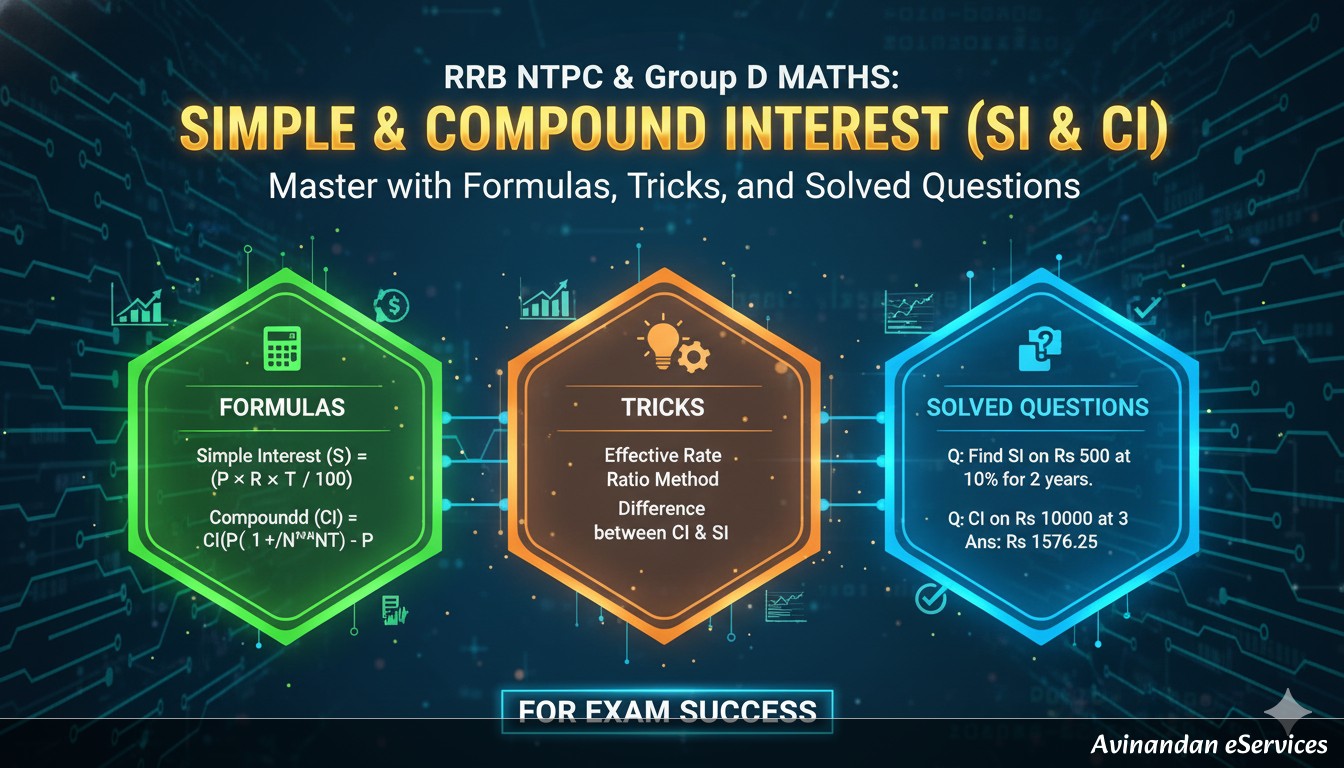
Introduction to Simple and Compound Interest for RRB Exams
Welcome, future railway professionals! If you are diligently preparing for highly competitive exams like the RRB NTPC, RRB Group D, RRB Technician Grade I, or RRB Technician Grade III, you know that the Quantitative Aptitude (Mathematics) section is a critical battleground. Among the various topics in this section, 'Simple and Compound Interest' (SI & CI) stands out as a high-frequency, score-boosting area. A strong command over SI & CI concepts not only guarantees you a few certain marks but also enhances your overall problem-solving speed and accuracy.
Questions from this chapter test your fundamental understanding of percentages and your ability to apply formulas to real-world scenarios involving loans, investments, and depreciation. The Railway Recruitment Board (RRB) often includes 2-3 questions from this topic in every paper, ranging from direct formula-based problems to more complex, application-oriented questions. Mastering this topic is not just about memorizing formulas; it's about understanding the core difference between simple and compound growth and knowing when to use which shortcut to save precious seconds in the examination hall.
This comprehensive guide is designed to be your one-stop resource for mastering Simple and Compound Interest for all RRB exams. We will break down every concept from the basics, provide crystal-clear formulas, work through solved examples, and equip you with powerful shortcuts and a robust set of practice questions to solidify your learning.
Understanding the Core Concepts: Principal, Interest, Rate, Time
Before we dive into the formulas and problems, let's build a strong foundation by understanding the terminology that forms the language of interest calculations.
- Principal (P): This is the initial or original sum of money that is borrowed, lent, or invested. It's the base amount on which interest is calculated. For example, if you take a loan of ₹50,000, then P = ₹50,000.
- Interest (I): This is the \textra money paid by the borrower to the lender for using the principal amount. It is essentially the 'cost' of borrowing money. From the lender's perspective, it is the income earned from their investment. Interest can be Simple (SI) or Compound (CI).
- Rate of Interest (R): This is the percentage at which the interest is calculated on the principal. It is usually expressed as a percentage per annum (p.a.). For instance, a rate of 8% p.a. means that for every ₹100 of the principal, ₹8 is charged as interest for one year.
- Time (T): This is the duration for which the money is borrowed or invested. It is typically measured in years. If the time is given in months or days, you must convert it into years to use it in the standard formulas (e.g., 6 months = 0.5 years).
- Amount (A): This is the total sum of money that the borrower has to repay to the lender at the end of the specified time period. It is the sum of the Principal and the Interest. Amount (A) = Principal (P) + Interest (I).
Part 1: Simple Interest (SI) - The Foundation
What is Simple Interest?
Simple Interest is the most basic form of interest calculation. The key principle here is that the interest is calculated only on the original principal amount (P) throughout the entire loan or investment period. The interest earned in one year does not get added back to the principal to earn further interest in the subsequent years. This means the interest amount remains constant for each year.
The Golden Formula for Simple Interest
The calculation of Simple Interest is straightforward using a single formula:
Simple Interest (SI) = (P × R × T) / 100
Where:
- P = Principal Amount
- R = Rate of Interest (in % per annum)
- T = Time Period (in years)
From this primary formula, we can also derive formulas to find P, R, or T if the other variables are known:
- Principal (P) = (SI × 100) / (R × T)
- Rate (R) = (SI × 100) / (P × T)
- Time (T) = (SI × 100) / (P × R)
Calculating Amount (A) in Simple Interest
As defined earlier, the total Amount is the sum of the principal and the simple interest.
Amount (A) = Principal (P) + Simple Interest (SI)
Substituting the formula for SI, we get:
A = P + [(P × R × T) / 100]
A = P [1 + (RT / 100)]
Solved Examples for Simple Interest
Example 1: Find the simple interest on ₹8,000 for 4 years at a rate of 5% per annum.
Solution:
Given: P = ₹8,000, R = 5% p.a., T = 4 years.
Using the formula: SI = (P × R × T) / 100
SI = (8000 × 5 × 4) / 100
SI = 80 × 5 × 4
SI = ₹1,600
Therefore, the simple interest is ₹1,600.
Example 2: A sum of money becomes ₹12,100 in 3 years at 7% per annum simple interest. What was the original sum (principal)?
Solution:
Given: A = ₹12,100, T = 3 years, R = 7% p.a.
We know the formula for Amount: A = P [1 + (RT / 100)]
12100 = P [1 + (7 × 3) / 100]
12100 = P [1 + 21 / 100]
12100 = P [(100 + 21) / 100]
12100 = P [121 / 100]
P = (12100 × 100) / 121
P = 100 × 100
P = ₹10,000
Therefore, the original sum was ₹10,000.
Part 2: Compound Interest (CI) - The Power of Compounding
What is Compound Interest?
Compound Interest is where things get more interesting and powerful. In this method, the interest for the first period is calculated on the principal. For the second period, the interest is calculated on a new principal, which is the sum of the original principal and the interest from the first period. This process continues for the entire duration. In simple terms, you earn interest on interest. This is why Albert Einstein reportedly called compound interest the "eighth wonder of the world."
The Fundamental Formula for Compound Interest
The formula to calculate the final amount (A) under compound interest is:
Amount (A) = P (1 + R/100)T
Where:
- P = Principal Amount
- R = Rate of Interest (in % per annum)
- T = Time Period (in years)
Once you find the Amount (A), you can easily calculate the Compound Interest (CI):
Compound Interest (CI) = Amount (A) - Principal (P)
CI = [P (1 + R/100)T] - P
Formulas for Different Compounding Frequencies
In RRB exams, questions often specify that the interest is compounded more frequently than once a year (e.g., half-yearly or quarterly). In such cases, the rate and time need to be adjusted accordingly.
| Compounding Frequency | Adjusted Rate | Adjusted Time | Amount (A) Formula |
|---|---|---|---|
| Annually (Once a year) | R % | T years | P (1 + R/100)T |
| Half-yearly (Twice a year) | (R/2) % | 2T periods | P (1 + (R/2)/100)2T |
| Quarterly (Four times a year) | (R/4) % | 4T periods | P (1 + (R/4)/100)4T |
Solved Examples for Compound Interest
Example 1: Find the compound interest on ₹10,000 for 2 years at 10% per annum, compounded annually.
Solution:
Given: P = ₹10,000, R = 10% p.a., T = 2 years.
First, calculate the amount (A):
A = P (1 + R/100)T
A = 10000 (1 + 10/100)2
A = 10000 (1 + 1/10)2
A = 10000 (11/10)2
A = 10000 × (121/100)
A = 100 × 121 = ₹12,100
Now, calculate the compound interest (CI):
CI = A - P = 12100 - 10000 = ₹2,100
Therefore, the compound interest is ₹2,100.
Example 2: What will be the amount on ₹16,000 in 1 year at a rate of 20% per annum if the interest is compounded half-yearly?
Solution:
Given: P = ₹16,000, R = 20% p.a., T = 1 year.
Since interest is compounded half-yearly, we adjust the rate and time:
New Rate (R') = R/2 = 20/2 = 10% per half-year.
New Time (T') = 2T = 2 × 1 = 2 half-years.
Using the formula A = P (1 + R'/100)T':
A = 16000 (1 + 10/100)2
A = 16000 (11/10)2
A = 16000 × (121/100)
A = 160 × 121 = ₹19,360
Therefore, the total amount will be ₹19,360.
Key Differences Between Simple Interest and Compound Interest
Understanding the distinction between SI and CI is crucial for solving comparison-based problems.
| Basis of Comparison | Simple Interest (SI) | Compound Interest (CI) |
|---|---|---|
| Calculation Basis | Calculated only on the original principal amount. | Calculated on the principal and the accumulated interest. |
| Interest Amount | The interest amount remains constant every year. | The interest amount increases with each compounding period. |
| Growth | Linear growth of money. | Exponential growth of money. |
| Return | Returns are lower. | Returns are higher (except for the first year, where SI = CI). |
Important Tricks and Shortcuts for RRB Exams
To gain an edge in competitive exams, you must solve questions quickly. Here are some indispensable tricks for SI and CI problems.
1. Difference between CI and SI for 2 Years
When the principal (P) and rate (R) are the same, the difference between the compound interest and simple interest for 2 years is given by:
Difference (CI - SI) for 2 years = P (R/100)2
Example: The difference between the CI and SI on a certain sum of money for 2 years at 5% p.a. is ₹25. Find the sum.
Solution:
Using the shortcut: Difference = P (R/100)2
25 = P (5/100)2
25 = P (1/20)2
25 = P / 400
P = 25 × 400 = ₹10,000
The sum is ₹10,000.
2. Difference between CI and SI for 3 Years
Similarly, for 3 years, the formula is:
Difference (CI - SI) for 3 years = P (R/100)2 (3 + R/100) or P (R/100)2 ((300+R)/100)
Example: Find the difference between CI and SI on ₹20,000 for 3 years at 10% p.a.
Solution:
Using the shortcut: Difference = P (R/100)2 (3 + R/100)
Difference = 20000 (10/100)2 (3 + 10/100)
Difference = 20000 (1/10)2 (3 + 1/10)
Difference = 20000 × (1/100) × (31/10)
Difference = 200 × (31/10) = 20 × 31 = ₹620
The difference is ₹620.
3. Successive Percentage Method for CI
You can think of compound interest as a series of successive percentage increases. For two years at rate R%, the effective percentage increase is not 2R. It is calculated as:
Effective Rate for 2 years = R + R + (R×R)/100
Example: Find CI on ₹5000 for 2 years at 10% p.a.
Solution:
Effective Rate = 10 + 10 + (10×10)/100 = 20 + 1 = 21%
CI = 21% of 5000 = (21/100) × 5000 = ₹1050.
This is much faster than the traditional formula method.
Practice Questions with Detailed Solutions
Now, it's time to test your knowledge. Try to solve these questions, which are designed based on the RRB exam pattern.
Practice Questions
- What would be the simple interest accrued in 4 years on a principal of ₹18,440 at the rate of 15% per annum?
- A sum of money at simple interest amounts to ₹815 in 3 years and to ₹854 in 4 years. The sum is:
- What is the compound interest on ₹2,500 for 2 years at a rate of 4% per annum?
- The difference between simple and compound interests compounded annually on a certain sum of money for 2 years at 4% per annum is ₹1. The sum is:
- At what rate of compound interest per annum will a sum of ₹1,200 become ₹1,348.32 in 2 years?
- A sum becomes ₹1,352 in 2 years at 4% per annum compound interest. The sum is:
- What is the difference between the compound interests on ₹5,000 for 1.5 years at 4% per annum compounded yearly and half-yearly?
- A man took a loan from a bank at the rate of 12% p.a. simple interest. After 3 years he had to pay ₹5,400 interest only for the period. The principal amount borrowed by him was:
- In how many years will a sum of ₹800 at 10% per annum compound interest, compounded semi-annually become ₹926.10?
- If a sum of money doubles itself in 8 years at simple interest, what is the rate of interest per annum?
Solutions and Explanations
1. Solution:
P = ₹18,440, R = 15%, T = 4 years.
SI = (P × R × T) / 100 = (18440 × 15 × 4) / 100 = 184.4 × 60 = ₹11,064.
2. Solution:
Amount after 4 years = P + SI for 4 years = ₹854
Amount after 3 years = P + SI for 3 years = ₹815
Subtracting the two equations, we get: SI for 1 year = 854 - 815 = ₹39.
SI for 3 years = 39 × 3 = ₹117.
Principal (Sum) = Amount after 3 years - SI for 3 years = 815 - 117 = ₹698.
3. Solution:
P = ₹2,500, T = 2 years, R = 4%.
A = P (1 + R/100)T = 2500 (1 + 4/100)2 = 2500 (1 + 1/25)2 = 2500 (26/25)2
A = 2500 × (676/625) = 4 × 676 = ₹2,704.
CI = A - P = 2704 - 2500 = ₹204.
4. Solution:
Difference = ₹1, R = 4%, T = 2 years.
Using the shortcut: Difference = P (R/100)2
1 = P (4/100)2 = P (1/25)2
1 = P / 625 => P = ₹625.
5. Solution:
P = ₹1,200, A = ₹1,348.32, T = 2 years.
A = P (1 + R/100)T
1348.32 = 1200 (1 + R/100)2
1348.32 / 1200 = (1 + R/100)2
1.1236 = (1 + R/100)2
Taking the square root: √1.1236 = 1.06
1.06 = 1 + R/100 => R/100 = 0.06 => R = 6%.
6. Solution:
A = ₹1,352, T = 2 years, R = 4%.
A = P (1 + R/100)T
1352 = P (1 + 4/100)2 = P (26/25)2
1352 = P × (676/625)
P = (1352 × 625) / 676 = 2 × 625 = ₹1,250.
7. Solution:
Case 1 (Compounded Yearly): For 1.5 years, we calculate CI for 1 year and then SI for the next 0.5 year on the new amount.
CI for 1st year = (5000 × 4 × 1)/100 = ₹200. Amount = ₹5200.
SI for next 0.5 year = (5200 × 4 × 0.5)/100 = ₹104.
Total CI (Yearly) = 200 + 104 = ₹304.
Case 2 (Compounded Half-Yearly): T = 1.5 years = 3 half-years. R = 4% p.a. = 2% per half-year.
A = 5000 (1 + 2/100)3 = 5000 (51/50)3 = 5000 × (132651/125000) = ₹5306.04.
Total CI (Half-yearly) = 5306.04 - 5000 = ₹306.04.
Difference = 306.04 - 304 = ₹2.04.
8. Solution:
SI = ₹5,400, R = 12%, T = 3 years.
Using P = (SI × 100) / (R × T)
P = (5400 × 100) / (12 × 3) = 540000 / 36 = ₹15,000.
9. Solution:
P = ₹800, A = ₹926.10, R = 10% p.a. (compounded semi-annually).
New Rate (R') = 10/2 = 5% per semi-annum. Let the time be T' semi-annual periods.
A = P (1 + R'/100)T'
926.10 = 800 (1 + 5/100)T'
926.10 / 800 = (1 + 1/20)T'
9261 / 8000 = (21/20)T'
We know that 213 = 9261 and 203 = 8000. So, (21/20)3 = (21/20)T'.
Therefore, T' = 3 semi-annual periods. This is equal to 1.5 years.
10. Solution:
Let Principal (P) be x. The sum doubles, so Amount (A) = 2x.
Time (T) = 8 years.
Simple Interest (SI) = A - P = 2x - x = x.
Using R = (SI × 100) / (P × T)
R = (x × 100) / (x × 8) = 100 / 8 = 12.5%.
Conclusion and Final Preparation Tips
Simple and Compound Interest is a predictable and high-scoring topic in RRB exams. The key to success lies in building a strong conceptual foundation, memorizing the essential formulas, and practicing a wide variety of problems. Remember the crucial difference between SI and CI, and know the shortcut formulas for finding the difference between them for 2 and 3 years, as these are frequently asked.
To seal your preparation, follow these tips:
- Practice Daily: Solve at least 5-10 SI & CI problems every day from previous year papers and mock tests.
- Memorize Formulas: Create a formula sheet and review it regularly. This includes the basic formulas and the shortcuts.
- Focus on Calculation Speed: This topic involves calculations with percentages, squares, and cubes. Work on improving your mental math and approximation skills.
- Analyze Your Mistakes: After solving practice questions, carefully analyze your errors to understand where you went wrong – was it a conceptual error, a calculation mistake, or a misinterpretation of the question?
By following this structured approach, you can transform Simple and Compound Interest from a challenging topic into one of your strongest scoring areas in the RRB exams. Keep practicing, stay focused, and march confidently towards your goal!