Introduction: A Moment in Time
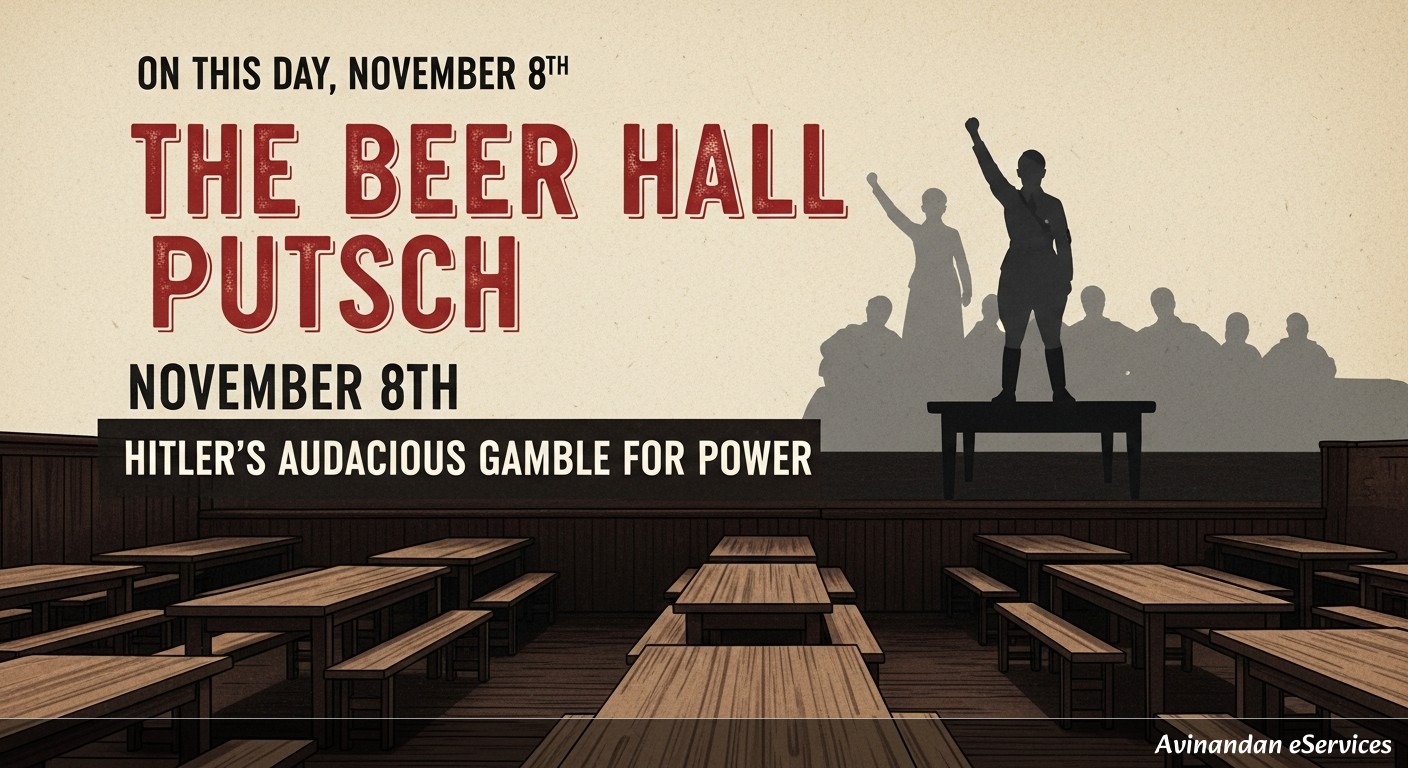
The evening of November 8, 1923, cast a tense and agitated pall over Munich. The air in the city, and indeed across all of Germany, was thick with discontent. The fledgling Weimar Republic was teetering on the brink of collapse, battered by the gales of hyperinflation, the humiliation of the Versailles Treaty, and the simmering resentment of a populace that felt betrayed. It was a nation adrift, searching for a savior or a scapegoat, and in the smoky, cavernous halls of its beer cellars, \textremist politics found fertile ground. On this particular evening, inside the Bürgerbräukeller, one of Munich's largest beer halls, Bavarian State Commissioner Gustav von Kahr was addressing a crowd of around 3,000 businessmen, politicians, and officials. Little did they know, this routine political gathering was about to become the stage for one of the most audacious and pivotal events in 20th-century history: a brazen, if ultimately clumsy, attempt to seize power that would introduce the world to its protagonist, Adolf Hitler. The Beer Hall Putsch was about to erupt, a chaotic and violent gamble that, despite its immediate failure, would set in motion a chain of events leading to the rise of the Third Reich.
The Build-Up: What Led to This Day?
The seeds of the Beer Hall Putsch were sown in the ashes of the First World War. The Treaty of Versailles had imposed crippling reparations on Germany, leading to economic ruin. By November 1923, hyperinflation had spiraled out of control to an almost surreal degree; a loaf of bread cost billions of marks, and life savings were rendered worthless overnight. This economic catastrophe was compounded by political instability. The Weimar Republic, Germany's first attempt at democracy, was perceived as weak and ineffective, constantly under attack from both the far-left and the far-right. In January 1923, French and Belgian troops occupied the industrial Ruhr region to enforce reparation payments, an act that was seen as a national humiliation and further fueled nationalist fervor.
In this climate of crisis, the southern state of Bavaria became a hotbed of right-wing \textremism. Here, the Nazi Party (NSDAP), with its charismatic and fiery leader Adolf Hitler, was gaining prominence. Hitler, inspired by Benito Mussolini's successful "March on Rome" a year earlier, believed that the time was ripe for a similar seizure of power in Germany. He forged an alliance with other nationalist groups, forming a coalition known as the Kampfbund. A ruling triumvirate in Bavaria, consisting of State Commissioner Gustav von Kahr, General Otto von Lossow (the commander of the army in Bavaria), and Colonel Hans von Seisser (the head of the state police), shared Hitler's contempt for the Berlin government, though they were wary of his impetuousness. Hitler, however, feared they would act without him or lose their nerve. He felt compelled to seize the moment, deciding that the public meeting at the Bürgerbräukeller, with the triumvirate conveniently gathered in one place, was the perfect opportunity to launch his "national revolution."
The Event Itself
As von Kahr droned on with his speech around 8:30 PM, the calm of the Bürgerbräukeller was shattered. Adolf Hitler, flanked by his stormtroopers (the SA), burst dramatically into the hall. He clambered onto a chair, fired a pistol shot into the ceiling, and silenced the stunned audience with a thunderous declaration: "The national revolution has broken out!" He proclaimed that the hall was surrounded by 600 armed men and that both the Bavarian and the national governments were deposed.
At gunpoint, Hitler herded von Kahr, von Lossow, and von Seisser into a side room. There, with a mix of threats and promises, he attempted to coerce them into joining his new government. He even brought in the revered World War I General Erich Ludendorff, a key figure in the putsch, to lend legitimacy to the cause. Under duress, the three men reluctantly agreed to support the coup. Returning to the main hall, a triumphant Hitler announced their collaboration to the cheering crowd, who were swept up in the revolutionary fervor.
"The government of the November criminals and the Reich President are declared to be removed. A new national government will be named this very day in Munich. A new German National Army will be formed immediately... Tomorrow will find either a National Government in Germany or us dead!" - Adolf Hitler, Bürgerbräukeller, November 8, 1923
However, the putsch quickly began to unravel due to a series of critical errors. While Hitler was away from the beer hall dealing with a skirmish elsewhere, Ludendorff, in a grave miscalculation, allowed the triumvirate to leave on the promise that they would honor their commitment. Once free, they immediately renounced the putsch and began organizing resistance. By the morning of November 9th, it was clear that the coup had failed to gain the support of the army or the police. In a desperate, last-ditch effort to salvage the situation, Hitler and Ludendorff decided to lead a march of about 2,000 Nazis into the center of Munich to rally popular support. As they reached the Odeonsplatz, near the Feldherrnhalle, their path was blocked by a cordon of state police. A shot rang out, and in the ensuing firefight, which lasted less than a minute, sixteen Nazis and four police officers were killed. Hitler was pulled to the ground, dislocating his shoulder, and quickly fled the scene. The Beer Hall Putsch had ended in a bloody fiasco.
The Aftermath and Legacy
In the immediate aftermath, the Nazi Party was outlawed, and its leaders were rounded up. Hitler was found hiding in the countryside and arrested two days after the failed coup. What seemed like a definitive end to his political ambitions turned out to be a remarkable turning point. The subsequent trial for high treason in early 1924 provided Hitler with a national stage. With the sympathy of the right-leaning judges, he transformed the courtroom into a propaganda platform, delivering hours-long speeches where he portrayed himself as a patriot acting against the "November criminals" who had betrayed Germany. His defiant stance won him widespread admiration among nationalists and brought him to the attention of the entire German nation and the world.
Though found guilty, Hitler received an astonishingly lenient sentence of five years in Landsberg Prison, with the possibility of parole after just a few months. He served only nine months, during which he lived in relative comfort and dictated his political manifesto, "Mein Kampf" (My Struggle), to his fellow inmate Rudolf Hess. The putsch, though a tactical failure, taught Hitler a crucial lesson: power in Germany was not to be won through armed insurrection but through the manipulation of the political system. He resolved to pursue a "legal path" to power, using the democratic process to ultimately destroy democracy itself.
The failed coup was also transformed into a potent myth in Nazi propaganda. The sixteen fallen Nazis were elevated to the status of martyrs, the "blood witnesses" of the movement. November 9th became a sacred day in the Nazi calendar, commemorated annually with solemn ceremonies. The Blutfahne, a flag supposedly stained with the blood of the martyrs, became a holy relic of the party. Thus, a bungled attempt to overthrow the state was reborn as a heroic act of sacrifice, a foundational story of the Nazi struggle. The gunshots that echoed through Munich on that November day in 1923 may have signaled the failure of a putsch, but they also heralded the birth of a political strategy that would, a decade later, deliver Germany into Hitler's hands.
References
Britannica. (n.d.). Beer Hall Putsch. Retrieved from britannica.com.
The History Place. (1996). The Beer Hall Putsch. Retrieved from historyplace.com.
Holocaust Encyclopedia. (2023). Beer Hall Putsch (Munich Putsch). Retrieved from encyclopedia.ushmm.org.
HistoryExtra. (2023). How the Munich Beer Hall Putsch set Hitler on his road to power. Retrieved from historyextra.com.
Wikipedia. (n.d.). Beer Hall Putsch. Retrieved from en.wikipedia.org.
History Skills. (n.d.). The Beer Hall Putsch: Hitler's failed first attempt at seizing power in Germany. Retrieved from historyskills.com.