Introduction to the Topic
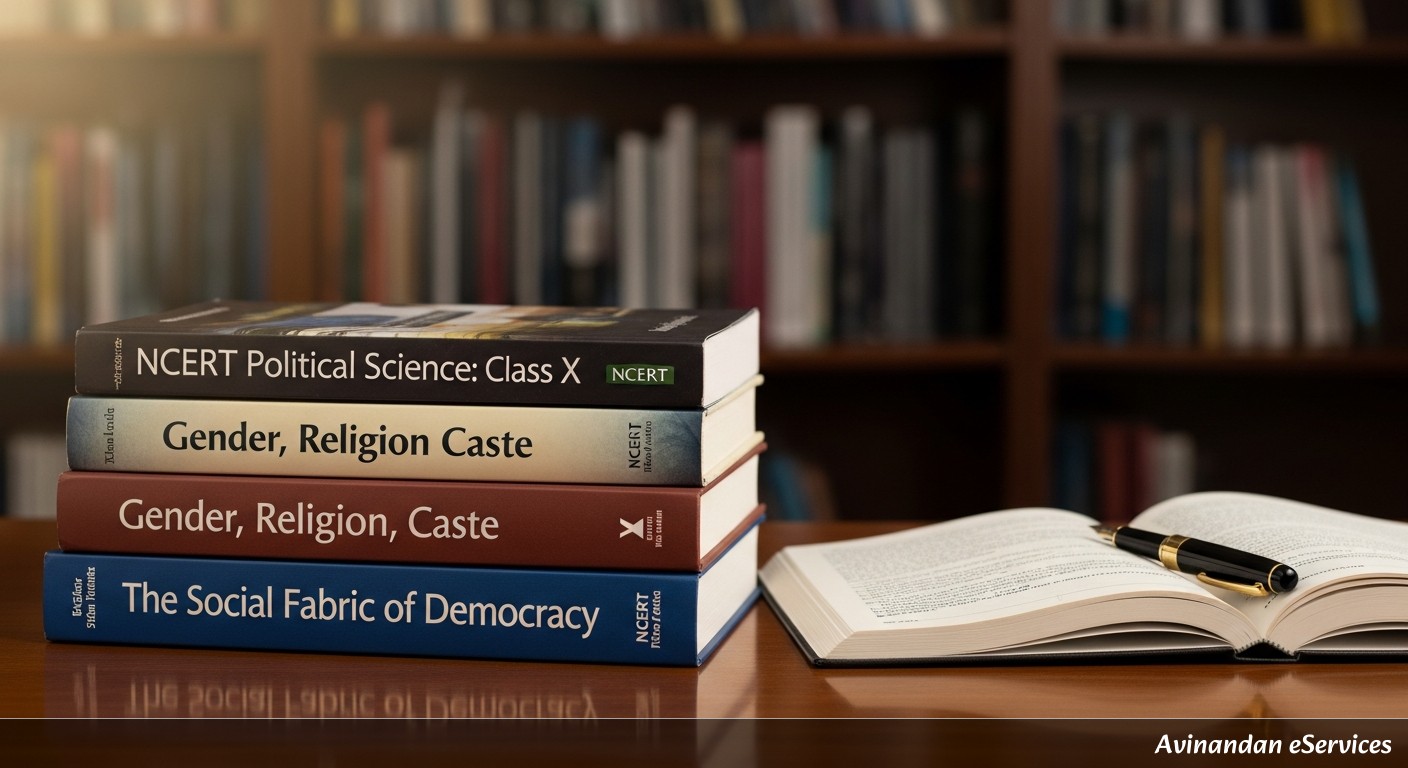
Welcome, students! When we think of democracy, we often think of elections, governments, and laws. But have you ever wondered how our everyday social lives connect with the larger political world? In a country as vast and diverse as India, our identities are complex. We are not just citizens; we are also men and women, followers of different faiths, and members of various caste groups. These social differences are not just personal matters; they deeply influence and are influenced by politics. Chapter 4 of your Class X Political Science textbook, 'Gender, Religion and Caste,' delves into these fascinating and crucial intersections.
This chapter explores three fundamental social divisions and how they manifest in the political arena. It challenges us to see politics not as a separate, isolated activity, but as a reflection of our society's deepest structures, conflicts, and aspirations. Understanding these dynamics is essential to becoming an informed and engaged citizen. It helps us appreciate why some groups are under-represented, how identity can be used to unite or divide people, and how democracy provides a platform for even the most marginalized communities to demand justice and equality. Let's unravel these three powerful forces and see how they shape the very fabric of our democratic society.
Key Concepts Explained
1. Gender and Politics: The Quest for Equality
The first social division we explore is based on gender. It's often assumed that the differences between men and women are natural and unchangeable. However, political science teaches us that most of these inequalities are not based on biology, but on social expectations and stereotypes. This is what we call the sexual division of labour.
The Public vs. Private Divide: Traditionally, society has assigned different roles to men and women. Women were expected to manage the household and raise children—work that, despite being crucial, is often unpaid and undervalued. This is the 'private' sphere. Men, on the other hand, were expected to work outside the home in the 'public' sphere, earning money and participating in politics. This division created a world where public life, including politics, became dominated by men. For a very long time, women in many parts of the world were denied the right to vote, let alone contest elections.
The Rise of Feminist Movements: The result of this division was the political and social marginalization of women. This gave rise to feminist movements around the world. What is feminism? In simple terms, feminism is a range of movements and ideologies that aim to define, establish, and achieve political, economic, personal, and social equality of the sexes. It's not about making women superior to men; it's about radical equality. These movements raised demands for equal rights in education, career opportunities, wages, and personal freedom. Thanks to these struggles, the role of women in society has dramatically changed, and their participation in public life has increased.
Women's Political Representation in India: Despite progress, the goal of gender equality is still far away, especially in the highest echelons of politics. Let's look at the situation in India. The representation of women in the Lok Sabha, our national parliament, has historically been very low. For the first time in 2019, it crossed the 14% mark. While this is an improvement, it is still significantly lower than the global average and far behind countries like Sweden or Rwanda, where women hold a much larger share of parliamentary seats. The situation is even more dismal in most State Assemblies.
So, how can this be fixed? One of the most debated and effective solutions is a legal quota or reservation for women in elected bodies. India has already implemented this at the local level. The 73rd and 74th Constitutional Amendments mandated that at least one-third of all positions in rural and urban local bodies (Panchayats and Municipalities) be reserved for women. This has been a revolutionary step, bringing over a million women into political decision-making at the grassroots level. It has not only empowered these women but has also made local governance more responsive to issues like water, sanitation, and health.
Building on this success, there has been a long-standing demand for similar reservation in the Lok Sabha and State Assemblies. The Women's Reservation Bill, which proposes to reserve 33% of seats, has been debated for decades and was recently passed as the Nari Shakti Vandan Adhiniyam. Its implementation is a crucial next step towards ensuring women's voices are heard equally in the halls of power.
2. Religion, Communalism, and Politics: A Delicate Balance
Religious diversity is a defining feature of India. Unlike gender, which is a universal division, religious differences can sometimes lead to deep-seated social cleavages. The relationship between religion and politics can be complex and, at times, dangerous.
Religion in Politics - A Moral Compass?: Mahatma Gandhi famously said that those who believe religion has nothing to do with politics do not understand religion. For him, religion was not about any particular faith like Hinduism or Islam, but about the ethical values and moral codes that are common to all religions. He believed politics should be guided by these ethics to serve humanity. In this sense, human rights groups often argue that the values of justice and equality drawn from various religions can and should inform political discourse.
The Peril of Communalism: The problem begins when religion is used in an exclusive and partisan way in politics. This leads to communalism. Communalism is a political ideology based on the belief that religion is the primary identity of a social group, and that the interests of different religious groups are inherently opposed to each other. It's a dangerous path with several stages:
- Stage 1: Everyday Beliefs: It starts with a mild belief that followers of a particular religion form a single community and their fundamental interests are the same. This often involves prejudice against other religious groups and a belief in the superiority of one's own religion.
- Stage 2: Political Mobilisation: In its more overt form, communalism seeks to build a political constituency along religious lines. This involves using sacred symbols, religious leaders, and emotional appeals to bring followers of one religion together in the political arena, often against another group.
- Stage 3: Communal Violence: The most \textreme form of communalism involves hatred and hostility towards other religions, often leading to riots, massacres, and violence. The partition of India in 1947 was the most tragic outcome of communal politics. Post-independence India has also witnessed several instances of large-scale communal violence.
The Secular State: India's Answer to Communalism: The framers of the Indian Constitution were acutely aware of the dangers of communalism. To counter it, they envisioned a secular state. The Indian model of secularism is unique and has the following key features:
- No Official Religion: Unlike countries like Pakistan (Islamic Republic) or England (which has an official church), India does not have an official state religion.
- Freedom of Religion: The Constitution grants all citizens the freedom to profess, practice, and propagate any religion they choose, or not to follow any religion at all.
- No Discrimination: The state cannot discriminate against any citizen on the grounds of their religion.
- Permissible Intervention: Crucially, Indian secularism does not mean a strict separation of religion and state. The state can, and does, intervene in religious matters to ensure equality and end oppressive social practices. For example, the Constitution banned untouchability, a practice justified by some sections of Hindu tradition. The state also has the power to regulate family laws based on different religions to ensure gender justice.
This commitment to secularism is the bedrock of our democracy. It is a constant challenge that requires active effort from the state and its citizens to uphold, ensuring that religious diversity remains a source of strength, not conflict.
3. Caste and Politics: A Transforming Relationship
Caste is a social division unique to the Indian subcontinent. It is a form of social stratification that is hereditary and hierarchical. The traditional caste system ranked people in a ladder-like formation, with some castes considered 'superior' and others 'inferior' or even 'untouchable'. This system dictated social interactions, marriage, and occupation, leading to centuries of exclusion and discrimination against the so-called 'lower' castes.
Caste in Modern India: With economic development, large-scale urbanization, growth of literacy, and occupational mobility, the old notions of the caste hierarchy are breaking down. The Constitution of India prohibited any caste-based discrimination and laid the foundations for policies to remedy the injustices of the caste system. However, caste has not disappeared from contemporary India. It continues to be a significant factor in social life, especially in matters of marriage and, importantly, in politics.
The relationship between caste and politics can be viewed in two ways:
1. Caste *in* Politics (The Negative View): This refers to the way caste identity is used to mobilize voters. When parties choose candidates for an election, they often keep the caste composition of the electorate in mind and nominate candidates from different castes to muster support. Some political parties are even known to favour certain castes and are seen as their representatives. When governments are formed, political parties usually try to give representation to different castes and tribes. This exclusive focus on caste can be divisive. However, to say that elections in India are *all* about caste is an oversimplification for several reasons:
- No parliamentary constituency in the country has a clear majority of a single caste. So, every candidate and party needs to win the confidence of more than one caste and community.
- People have multiple identities. Their caste is one, but they are also poor or rich, men or women, and residents of a particular region. Voters often prioritize these other identities over their caste.
- The performance of the ruling party and the popularity of its leaders are often the decisive factors in an election, overriding caste considerations.
2. Politics *in* Caste (The Positive/Transformative View): This perspective turns the first one on its head. It argues that it is not politics that gets caste-ridden, but caste that gets politicized. This can be a force for positive change. By entering politics, marginalized caste groups have used the democratic platform to demand their rights and fight for social justice. This has several dimensions:
- Voice for the Voiceless: Politics has given marginalized communities, like Dalits and Other Backward Classes (OBCs), a space to demand an end to discrimination, dignity, and a fair share in power and resources.
- Asserting Identity: Caste groups have organized themselves into political parties and pressure groups to advance their interests. This political assertion has challenged the dominance of the 'upper' castes.
- New Groupings: Politics has also helped in creating broader coalitions. Several caste groups that were previously seen as distinct have come together under the umbrella of 'backward' or 'forward' castes, creating new political identities.
In this sense, the expression of caste identity in politics has allowed disadvantaged communities to claim their space in the democratic decision-making process. It is a testament to the power of democracy that it can transform a system of hierarchy into a tool for empowerment and social justice.
Summary & Key Takeaways
This chapter reveals that social divisions based on gender, religion, and caste are not threats to democracy if they are managed well. In fact, democracy is arguably the best system to accommodate and negotiate these differences. The expression of social identity becomes problematic only when one group tries to dominate another or when these identities are used to fuel hatred and violence.
A healthy democracy is one where marginalized groups can voice their grievances and demand their fair share of power. The political expression of gender, religious, and caste identities, when aimed at seeking justice and equality, actually deepens democracy by making it more inclusive and representative. The ultimate outcome depends on how leaders raise these demands and how the government responds to them.
Here are the key takeaways from this chapter:
- Sexual Division of Labour: This refers to the socially constructed roles assigned to men (public sphere) and women (private sphere), which has led to gender inequality in politics.
- Women's Representation: While women's participation in politics is increasing, their representation in legislative bodies in India remains low. Reservation in local bodies is a significant step towards correcting this imbalance.
- Communalism: The use of religion for political ends, based on the belief that religious groups have opposing interests, is a major threat to the unity and integrity of a nation.
- Secular State: India's model of secularism protects all religions equally, has no official religion, and allows for state intervention to ensure social justice within religious communities.
- Caste and Politics: The relationship is a two-way street. While caste identities influence voting patterns ('caste in politics'), politics has also empowered marginalized castes to assert their rights and demand justice ('politics in caste').
- Democracy and Diversity: The expression of social divisions in politics can be a healthy sign, as it allows for the accommodation of different interests and gives a voice to all sections of society.