Introduction: A Moment in Time
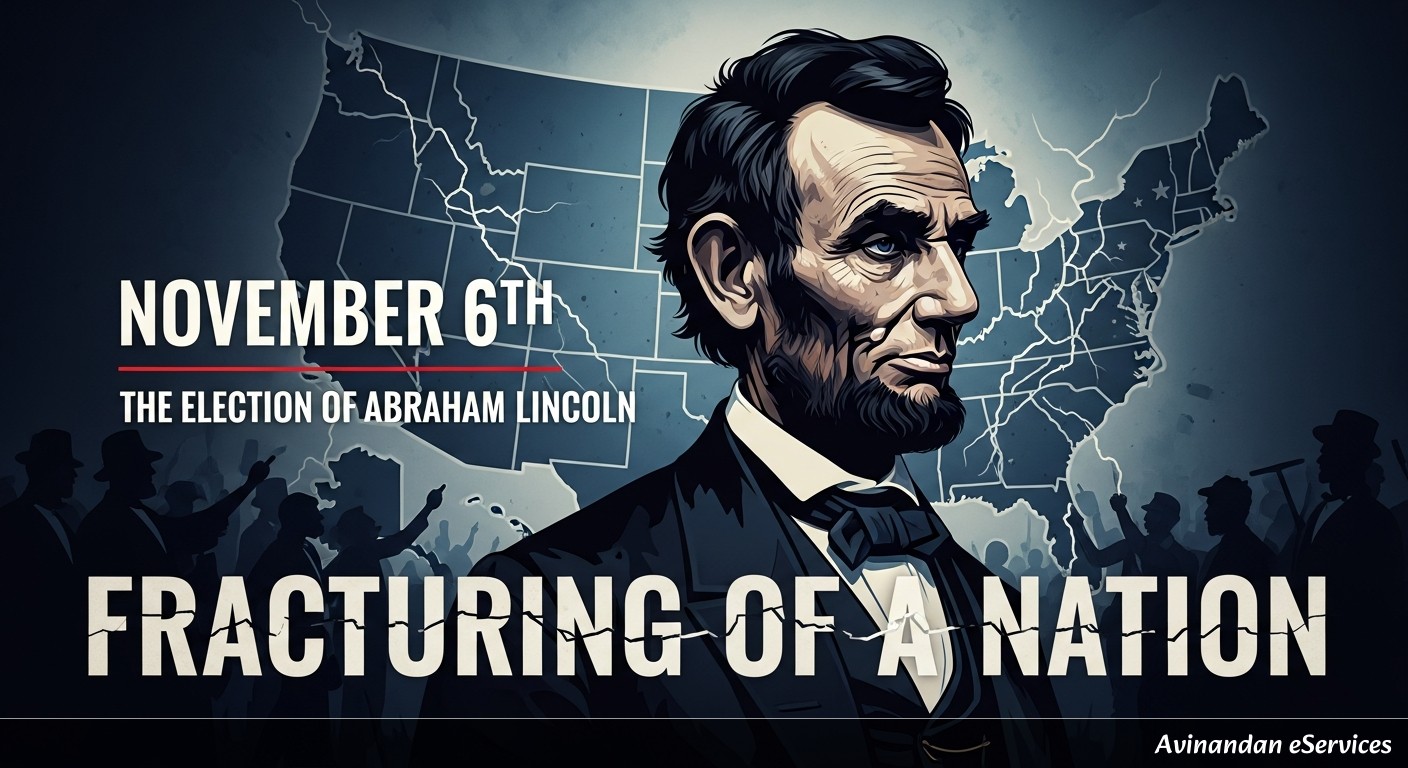
The air on November 6, 1860, was thick with more than just the autumn chill. Across the United States, a palpable tension hung heavy, a sense of impending change that was both exhilarating and terrifying. On this day, American men (as the franchise was then limited) went to the polls to cast their ballots in what would become one of the most consequential presidential elections in the nation's history. The contest was not merely a political race; it was a referendum on the very soul of the country, a tipping point that would irrevocably alter the course of American history. The election of a tall, lanky lawyer from Illinois, Abraham Lincoln, would be the spark that ignited the flames of a brutal and bloody Civil War, a conflict that would ultimately redefine the United States and its commitment to the principle of liberty for all. This was not just an election; it was the prelude to a national reckoning.
The Build-Up: What Led to This Day?
The election of 1860 did not occur in a vacuum. It was the culmination of decades of simmering conflict, a slow-burning fire fueled by the contentious issue of slavery. The nation had been geographically and ideologically divided for years. The industrializing North, with its burgeoning immigrant population and economy based on free labor, increasingly viewed slavery as a moral anachronism and a threat to the economic opportunities of free white workers. In contrast, the agrarian South's economy and social structure were inextricably linked to the institution of chattel slavery. This fundamental disagreement had led to a series of fragile political compromises, each one seeming to only delay the inevitable confrontation.
The 1850s, in particular, were a decade of escalating tensions. The passage of the Kansas-Nebraska Act in 1854, which allowed settlers in new territories to decide for themselves whether to permit slavery (a principle known as "popular sovereignty"), led to violent clashes in "Bleeding Kansas." The Supreme Court's 1857 Dred Scott decision further inflamed passions, as it declared that African Americans were not citizens and that Congress had no authority to prohibit slavery in the territories. These events shattered the existing political landscape, leading to the collapse of the Whig Party and the fracturing of the Democratic Party along sectional lines.
From this political turmoil, the Republican Party emerged in the North. Formed in 1854, it was a coalition of anti-slavery Whigs, Democrats, and Free Soilers united by the common goal of preventing the \textension of slavery into the western territories. Their platform did not call for the immediate abolition of slavery in the states where it already existed, but Southerners viewed the party and its rising influence as a direct threat to their way of life. The stage was set for a four-way presidential contest that would expose the deep fissures within the nation.
The Event Itself
The presidential election of 1860 was unique in that it was essentially two separate contests: one in the North and one in the South. Four major candidates vied for the presidency. The Republican Party nominated Abraham Lincoln, whose eloquence and moderate anti-slavery stance had gained him national recognition. The Democratic Party, unable to agree on a single candidate, split into two factions. Northern Democrats nominated Stephen A. Douglas, a proponent of popular sovereignty. Southern Democrats, who insisted on federal protection for slavery in the territories, nominated the incumbent Vice President, John C. Breckinridge. A fourth party, the Constitutional Union Party, emerged from the remnants of the Whig and Know-Nothing parties, nominating John Bell and attempting to find a middle ground by simply championing the Constitution and the Union.
On November 6, 1860, the American people cast their votes in a deeply divided political landscape. When the ballots were counted, Abraham Lincoln had secured a decisive victory in the Electoral College, winning 180 of the 303 electoral votes. However, he did so with only 39.8% of the popular vote, a testament to the fractured nature of the electorate. Lincoln's victory was entirely sectional; he swept the free states of the North and West but failed to win a single slave state. In ten Southern states, his name did not even appear on the ballot. John C. Breckinridge carried 11 of the 15 slave states, while John Bell won three border states, and Stephen Douglas, despite coming in second in the popular vote, won only Missouri. The election results starkly illustrated the nation's profound division. A man who was seen as a direct threat to the institution of slavery had been elected president, and the reaction from the South was swift and dramatic.
The Aftermath and Legacy
The election of Abraham Lincoln was the catalyst that pushed the nation into the abyss of civil war. For many in the South, Lincoln's victory was a sign that their influence in national politics was gone and that the federal government was now in the hands of a hostile, anti-slavery party. Before Lincoln was even inaugurated, the gears of secession were already in motion. On December 20, 1860, South Carolina became the first state to secede from the Union. By February 1861, six other states—Mississippi, Florida, Alabama, Georgia, Louisiana, and Texas—had followed suit, forming the Confederate States of America. The outgoing president, James Buchanan, proved ineffectual in the face of this crisis, and by the time Lincoln took the oath of office on March 4, 1861, the nation was on the brink of collapse.
In his inaugural address, Lincoln struck a conciliatory tone, promising not to interfere with slavery where it already existed and appealing to the "bonds of affection" that held the nation together. However, his refusal to recognize the legitimacy of secession set the stage for a confrontation. That confrontation came on April 12, 1861, when Confederate forces fired on Fort Sumter in Charleston, South Carolina. The Civil War had begun.
The legacy of the 1860 election is profound and far-reaching. It marked a permanent shift in American politics, leading to the dominance of the Republican and Democratic parties that continues to this day. More importantly, it set in motion the events that would lead to the abolition of slavery and the reunification of the nation under a stronger central government. The election of Abraham Lincoln on that fateful November day was a pivotal moment, a point of no return that, through the crucible of war, would ultimately lead to a "new birth of freedom" for the United States.
References
1. American Battlefield Trust. (2024, October 16). The Election of 1860. Retrieved from https://www.battlefields.org/learn/articles/election-1860
2. Encyclopaedia Britannica. (2025, October 30). United States presidential election of 1860. Retrieved from https://www.britannica.com/event/United-States-presidential-election-of-1860
3. Lincoln Home National Historic Site. (2022, October 24). The 1860 Presidential Election. U.S. National Park Service. Retrieved from https://www.nps.gov/liho/learn/historyculture/election1860.htm
4. National Museum of African American History & Culture. (n.d.). Election of 1860: Slavery & Southern Secession. Retrieved from https://nmaahc.si.edu/explore/stories/election-1860-slavery-southern-secession
5. Wikipedia. (n.d.). 1860 United States presidential election. Retrieved from https://en.wikipedia.org/wiki/1860_United_States_presidential_election
6. American Civil War Museum. (2024, January 10). The Election of 1860 | The Impending Crisis. Retrieved from https://acwm.org/learn/the-impending-crisis/the-election-of-1860/