Introduction: A Moment in Time
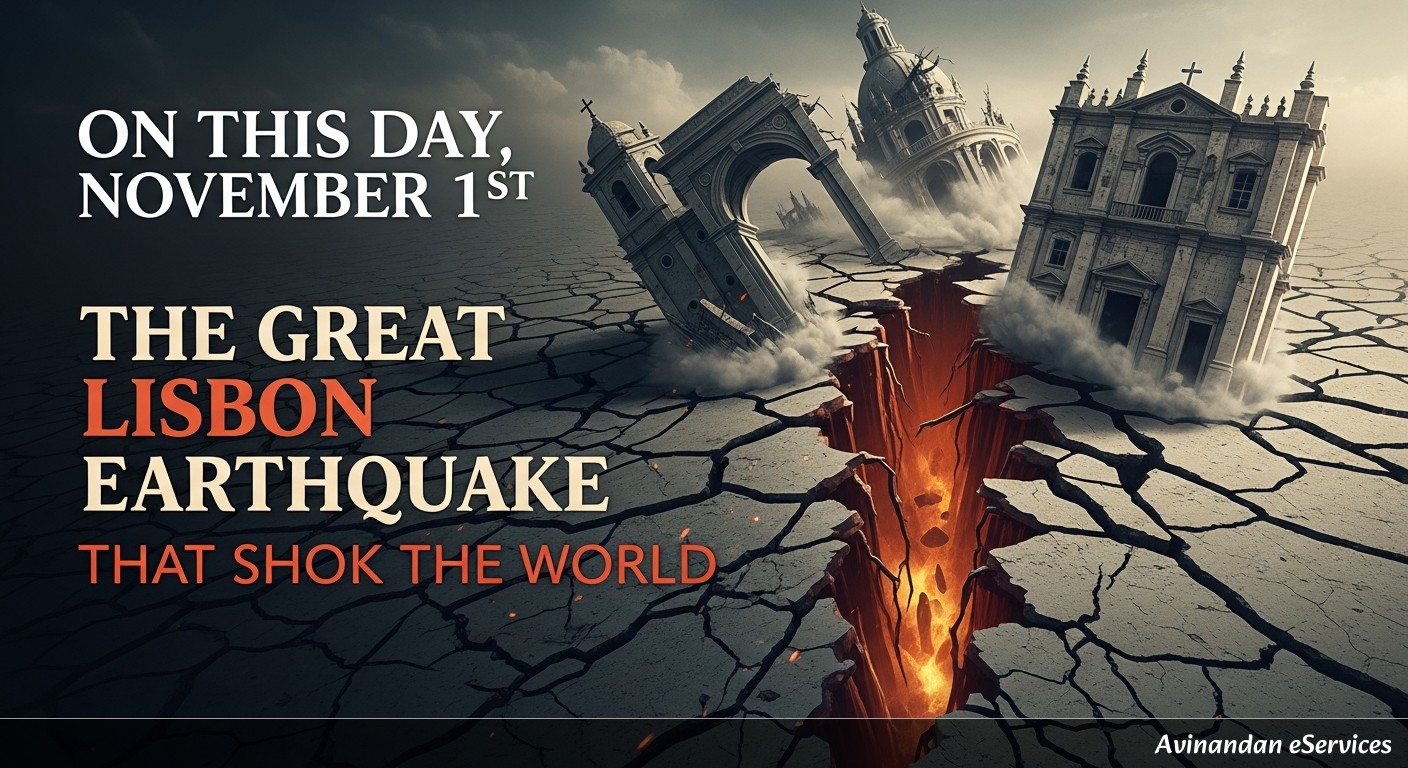
The morning of November 1, 1755, dawned with a sacred solemnity in Lisbon, the vibrant heart of the Portuguese Empire. It was All Saints' Day, a holy day of obligation, and the city's magnificent churches were filled with the faithful, their sanctuaries aglow with the light of thousands of devotional candles. Lisbon was one of Europe's most prosperous and cosmopolitan cities, its wealth fueled by the gold and diamonds of Brazil. Its skyline was a testament to its power and piety, a dense tapestry of palaces, convents, and ornate churches, many fine examples of the unique Manueline architectural style. But the divine beauty of the morning was about to be shattered by a cataclysm of unimaginable proportions. At approximately 9:40 AM, the ground began to heave and tremble, not with a fleeting tremor, but with a violent, terrifying convulsion that would last for several agonizing minutes. This was the beginning of the Great Lisbon Earthquake, a disaster that would not only reduce a great city to rubble but would also send shockwaves through the intellectual and spiritual foundations of 18th-century Europe.
The Build-Up: What Led to This Day?
In the mid-18th century, Europe was in the full flower of the Enlightenment, an age of reason and intellectual optimism. Philosophers like Gottfried Wilhelm Leibniz had popularized the idea of 'theodicy,' the belief that a benevolent God presided over a world that was, in its entirety, the 'best of all possible worlds'. Suffering and evil were seen as necessary components of a larger, divine plan that was ultimately good. This philosophical optimism was mirrored in the material prosperity of cities like Lisbon. The Portuguese capital was a bustling hub of global trade, its quays laden with the riches of its vast colonial empire. The city had experienced earthquakes before, notably in 1321 and 1531, but the collective memory of such a catastrophe had faded into the annals of history. There was no scientific understanding of seismology; earthquakes were often interpreted as manifestations of divine wrath, a punishment for sin. The city's very structure, with its narrow, winding medieval streets and top-heavy buildings, made it exceptionally vulnerable to seismic activity. The populace, deeply devout, placed their faith in God's protection. The confluence of a pious population gathered in architecturally vulnerable churches on a holy day, a city built on geologically unstable ground, and a prevailing philosophical belief in a benevolent world order created the perfect storm for a tragedy that would challenge every contemporary assumption about God, nature, and humanity.
The Event Itself
The earthquake struck with a terrifying fury. Modern seismologists estimate its magnitude to have been between 7.7 and 9.0, with an epicenter in the Atlantic Ocean about 200 to 290 kilometers southwest of Lisbon. Eyewitnesses described three distinct and violent tremors over a period of about six to ten minutes. The ground opened into gaping fissures, some five meters wide, swallowing people and buildings whole. Inside the packed churches, the scene was apocalyptic. Stone vaults and heavy roofs collapsed onto the congregations below, instantly killing thousands of worshippers. The grand Carmo Convent, like so many other architectural jewels of the city, was left a skeletal ruin. Survivors who stumbled out into the dust-choked streets found a cityscape transformed into a nightmarish landscape of rubble.
"I looked about me and see the walls a-shaking, and a-falling down, then I got up and took to my heels, with Jesus in my mouth...the lime and dust so thick there was no seeing." - Account of a British nun, Sister Witham
The terror, however, was far from over. Those who had fled to the open space of the riverfront, believing they were safe, soon witnessed a bizarre and horrifying spectacle. The waters of the Tagus River receded, exposing the riverbed littered with lost cargo and forgotten shipwrecks. This strange ebbing was the harbinger of a devastating tsunami. About 40 minutes after the earthquake, a series of massive waves, some estimated to be as high as 20 feet, roared up the Tagus and crashed into the city. The newly built marble quay, the Cais de Pedra, vanished beneath the waves, taking with it hundreds of people who had sought refuge there. The tsunami's destructive power was felt far and wide, with waves reaching the coasts of Spain, North Africa, and even across the Atlantic to Martinique in the Caribbean.
As if the earthquake and tsunami were not enough, a third wave of destruction was unleashed: fire. The countless candles lit for All Saints' Day in churches and homes were knocked over by the tremors, igniting a blaze that quickly spread through the debris-choked streets. The narrow lanes that had once been the city's arteries now acted as funnels for the flames, and the wind fanned the fire into an uncontrollable firestorm that raged for days, consuming what little the earthquake had spared. By the time the fires subsided, an estimated 85% of Lisbon's buildings had been destroyed, including the royal Ribeira Palace, which housed a library of over 70,000 volumes, and the newly opened opera house. The death toll was staggering; while impossible to know with certainty, estimates range from 30,000 to 70,000 people in Lisbon and surrounding areas, making it one of the deadliest earthquakes in history.
The Aftermath and Legacy
In the immediate aftermath, Lisbon was a scene of chaos and despair. The royal family, having fortuitously been outside the city center, was safe but the King, Joseph I, was so terrified by the event that he developed a lifelong fear of living within stone walls. With the government in shock, it was the King's prime minister, Sebastião José de Carvalho e Melo, the future Marquis of Pombal, who rose to the occasion with ruthless efficiency. His response was swift and pragmatic. He famously declared his intention to "bury the dead and feed the living." He dispatched the army to prevent looting, ordering the summary execution of looters to restore order. He organized relief efforts and, against the protestations of the Church, had the thousands of bodies loaded onto barges and buried at sea to prevent the outbreak of disease.
Pombal's vision \textended far beyond immediate relief. He saw the ruined city as a blank canvas upon which to build a new, modern Lisbon. He commissioned architects and engineers to design a new city center, the Baixa Pombalina, with wide, grid-like streets, and, most importantly, earthquake-resistant buildings. These 'Pombaline cages' were among the world's first examples of seismically protected construction. Troops were made to march around wooden models to simulate tremors and test their durability. This systematic approach to rebuilding marked a turning point in urban planning and disaster response.
The earthquake's impact resonated far beyond the borders of Portugal. The sheer scale of the disaster, striking a devoutly Catholic city on a major holy day, shattered the optimistic philosophical outlook of the Enlightenment. Thinkers across Europe grappled with the problem of evil. Voltaire, in his satirical novel Candide and his Poème sur le désastre de Lisbonne, famously attacked the Leibnizian notion that this was the 'best of all possible worlds'. The event spurred a shift away from divine explanations for natural disasters and towards scientific inquiry. Immanuel Kant, fascinated by the event, collected all available information and formulated a theory on the natural causes of earthquakes, a seminal moment in the birth of modern seismology. The Great Lisbon Earthquake of 1755 was a profound human tragedy, but it was also a catalyst for change. It not only gave birth to a new, more resilient city from the ashes of the old but also forced a fundamental rethinking of humanity's relationship with nature, God, and reason, leaving a legacy that continues to shape our world today.
References
- Britannica, T. Editors of Encyclopaedia (2023, October 25). Lisbon earthquake of 1755. Encyclopedia Britannica.
- Wikipedia contributors. (2023, November 1). 1755 Lisbon earthquake. In Wikipedia, The Free Encyclopedia.
- Europeana. (2023, November 1). What was the impact of the Great Lisbon Earthquake in 1755?.
- Quake Museum. (n.d.). The History & Science of the 1755 Lisbon Earthquake.
- EBSCO. (n.d.). Great Lisbon Earthquake | Research Starters.
- Travel Inspires. (n.d.). How Lisbon Rose Up After The 1755 Earthquake.
- MOTIVE. (2024, January 23). How the 1755 Lisbon Earthquake Influenced Humanities.
- Portugal Resident. (2022, November 12). British nun's first-hand account of 1755 Lisbon earthquake.