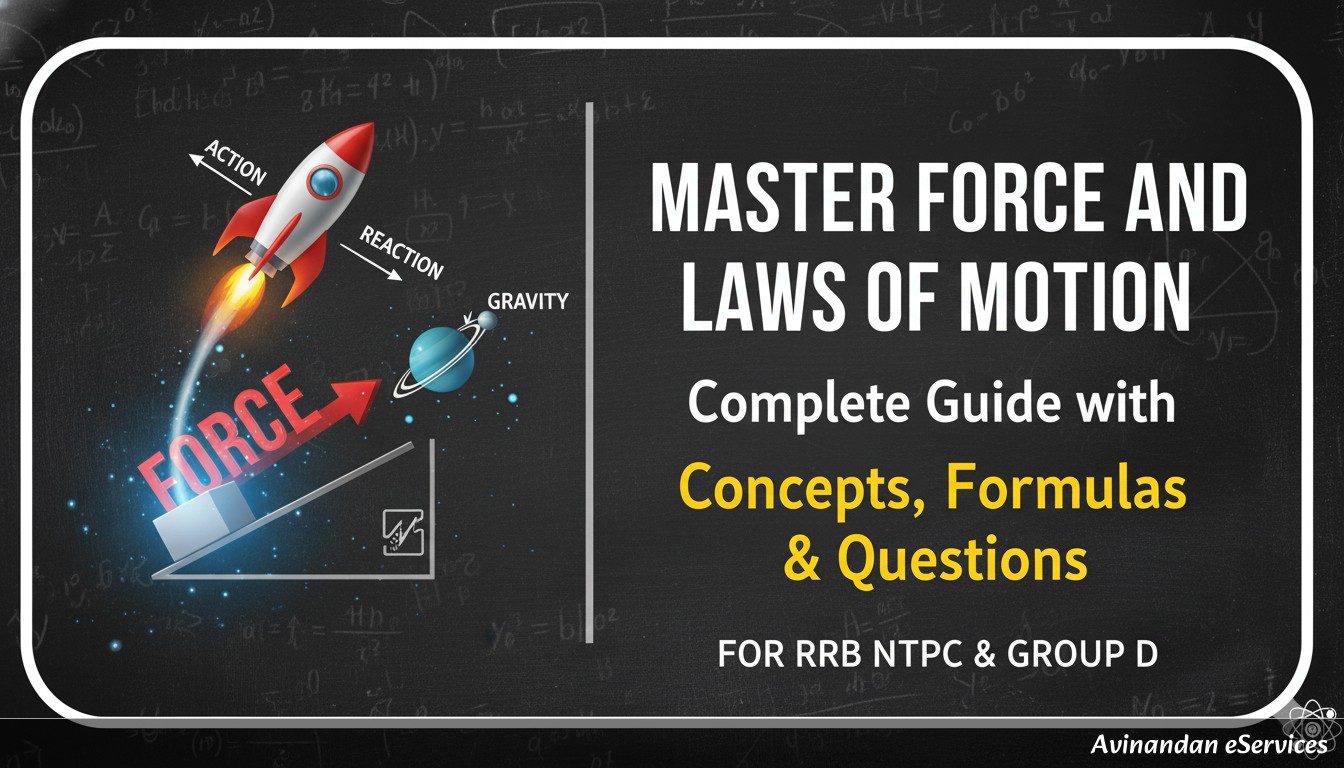
Introduction to Force and Laws of Motion for RRB Exams
Welcome, aspiring railway professionals! If you are preparing for the highly competitive RRB exams like NTPC, Group D, or Technician, you know that the General Science section holds significant weight. Within this section, Physics plays a crucial role, and one of its most fundamental and frequently tested topics is 'Force and the Laws of Motion'. Understanding these concepts is not just about memorizing formulas; it's about grasping the principles that govern every moving object in the universe.
A strong command of this topic can fetch you those crucial \textra marks that make all the difference in your final selection. This comprehensive guide is designed to be your one-stop resource. We will break down every concept, from the basics of force to the intricacies of Newton's three laws, momentum, and friction. Packed with clear explanations, practical examples, solved problems, and exam-oriented practice questions, this post will equip you with the knowledge and confidence to tackle any question on Force and Laws of Motion thrown at you in your RRB exam.
Understanding the Fundamental Concept: What is Force?
In the simplest terms, a force is a push or a pull upon an object resulting from the object's interaction with another object. Whenever there is an interaction between two objects, there is a force upon each of the objects. Force is a vector quantity, meaning it has both magnitude (how strong the push or pull is) and direction.
A force can cause several effects on an object:
- It can change the state of motion of an object (make a stationary object move, or stop a moving object).
- It can change the speed of a moving object.
- It can change the direction of motion of an object.
- It can change the shape or size of an object (e.g., squeezing a sponge).
The SI unit of force is the Newton (N). One Newton is defined as the amount of force required to give a mass of 1 kg an acceleration of 1 m/s².
Types of Forces
Forces are broadly categorized into two types based on their interaction:
1. Contact Forces: These are forces that act on an object by direct contact with it. Examples include:
- Frictional Force: The force that opposes motion between surfaces in contact.
- Muscular Force: The force exerted by the muscles of our body.
- Normal Force: The support force exerted upon an object that is in contact with another stable object.
2. Non-Contact Forces: These forces act on an object without coming physically in contact with it. Examples include:
- Gravitational Force: The force of attraction between any two objects with mass.
- Electrostatic Force: The force between charged particles.
- Magnetic Force: The force exerted by magnets on magnetic materials.
Balanced and Unbalanced Forces
Understanding the difference between balanced and unbalanced forces is key to understanding motion.
- Balanced Forces: When two or more forces acting on an object are equal in magnitude and opposite in direction, they are called balanced forces. They do not cause any change in the object's state of motion. The net force is zero. For example, in a game of tug-of-war, if both teams pull with equal force, the rope does not move.
- Unbalanced Forces: When the forces acting on an object are unequal, they are called unbalanced forces. They cause a change in the object's state of motion (i.e., they produce acceleration). The net force is non-zero. If one team in tug-of-war pulls harder, the rope moves in that direction.
Newton's Laws of Motion: The Cornerstone of Classical Mechanics
Sir Isaac Newton formulated three fundamental laws of motion that form the basis of classical mechanics. These laws describe the relationship between the forces acting on a body and its motion.
Newton's First Law of Motion (The Law of Inertia)
Statement: An object at rest will stay at rest, and an object in motion will stay in motion with the same speed and in the same direction unless acted upon by an unbalanced \texternal force.
This law introduces the concept of Inertia. Inertia is the property of an object to resist any change in its state of rest or of uniform motion. The mass of an object is a quantitative measure of its inertia. A heavier object has more inertia than a lighter one.
Practical Examples:
- Shaking a Carpet: When you shake a carpet to remove dust, the carpet moves, but the dust particles tend to remain at rest due to their inertia and fall off.
- Passenger in a Bus: When a moving bus suddenly stops, passengers lurch forward. This is because their bodies tend to continue moving forward due to inertia of motion, while the bus has stopped.
- Coin and Card Experiment: When a card placed over a glass with a coin on top is flicked away quickly, the coin falls into the glass because its inertia of rest keeps it from moving with the card.
Newton's Second Law of Motion (The Law of Acceleration)
Statement: The rate of change of momentum of an object is directly proportional to the applied unbalanced force and takes place in the direction of the force.
This law provides a way to measure force. It is mathematically expressed as:
F = ma
Where:
- F is the net \texternal force applied.
- m is the mass of the object.
- a is the acceleration produced in the object.
This law also connects force with momentum. Momentum (p) is the product of an object's mass and its velocity (p = mv). The second law states that F = Δp / Δt (Force is the rate of change of momentum).
Solved Example:
Question: A force of 50 N is applied to an object of mass 10 kg. What is the acceleration produced in the object?
Solution:
Given: Force (F) = 50 N, Mass (m) = 10 kg.
Using Newton's Second Law, F = ma.
We need to find acceleration (a).
a = F / m
a = 50 N / 10 kg
a = 5 m/s²
Answer: The acceleration produced is 5 m/s².
Newton's Third Law of Motion (The Law of Action and Reaction)
Statement: For every action, there is an equal and opposite reaction.
This law highlights a crucial aspect of forces: they always occur in pairs. If object A exerts a force on object B (the 'action'), then object B simultaneously exerts an equal and opposite force on object A (the 'reaction').
Key Points to Remember:
- The action and reaction forces act on different bodies.
- They are equal in magnitude.
- They are opposite in direction.
- Because they act on different bodies, they never cancel each other out.
Practical Examples:
- Rocket Propulsion: A rocket pushes hot gases downwards (action). The gases, in turn, push the rocket upwards with an equal and opposite force (reaction).
- Walking: When we walk, we push the ground backward with our feet (action). The ground pushes us forward with an equal and opposite force (reaction), which allows us to move.
- Recoil of a Gun: When a bullet is fired from a gun, the gun exerts a forward force on the bullet (action). The bullet exerts an equal and opposite backward force on the gun (reaction), which is felt as recoil.
Important Related Concepts for RRB Exams
Momentum and Impulse
Momentum (p) is often described as 'mass in motion'. It is a vector quantity calculated as the product of an object's mass and its velocity.
p = mv
The SI unit of momentum is kilogram-meter per second (kg m/s).
The Law of Conservation of Momentum states that in an isolated system (where no \texternal forces are acting), the total momentum before a collision is equal to the total momentum after the collision.
m₁u₁ + m₂u₂ = m₁v₁ + m₂v₂
Impulse (J) is the change in momentum of an object. It is also defined as the product of the force and the time interval over which the force acts.
J = F × Δt = Δp
The SI unit of impulse is Newton-second (N s), which is equivalent to kg m/s.
Understanding Friction
Friction is a contact force that opposes the relative motion or tendency of relative motion between two surfaces. It is a necessary evil; sometimes it's useful (walking, braking a car), and sometimes it's a hindrance (causes wear and tear, energy loss).
Types of Friction:
- Static Friction: The frictional force that acts between surfaces when they are at rest with respect to each other. It is a self-adjusting force and has a maximum value called limiting friction.
- Sliding (Kinetic) Friction: The frictional force that acts between surfaces when they are sliding over each other. It is smaller than static friction.
- Rolling Friction: The frictional force that acts when an object rolls over a surface. It is the weakest of the three. This is why it's easier to roll an object than to slide it.
Formulas at a Glance: Quick Revision Table
| Concept | Formula | Variables | SI Unit |
|---|---|---|---|
| Newton's Second Law | F = ma | F = Force, m = mass, a = acceleration | Newton (N) |
| Momentum | p = mv | p = momentum, m = mass, v = velocity | kg m/s |
| Impulse | J = F × Δt = Δp | J = Impulse, F = Force, Δt = time, Δp = change in momentum | N s or kg m/s |
| Conservation of Momentum | m₁u₁ + m₂u₂ = m₁v₁ + m₂v₂ | m = mass, u = initial velocity, v = final velocity | - |
Solved Examples from Previous RRB Papers
Example 1: Application of F=ma
Question: A car of mass 1200 kg is moving with a velocity of 10 m/s. Brakes are applied, and it comes to rest in 5 seconds. Calculate the retarding force exerted by the brakes.
Solution:
Step 1: Find the acceleration (in this case, retardation).
Given: Initial velocity (u) = 10 m/s, Final velocity (v) = 0 m/s, Time (t) = 5 s, Mass (m) = 1200 kg.
Using the first equation of motion: v = u + at
0 = 10 + a(5)
5a = -10
a = -2 m/s² (The negative sign indicates retardation)
Step 2: Calculate the force.
Using Newton's Second Law: F = ma
F = 1200 kg × (-2 m/s²)
F = -2400 N
Answer: The retarding force is 2400 N. The negative sign signifies that the force is acting opposite to the direction of motion.
Example 2: Conservation of Momentum
Question: A bullet of mass 20 g is fired from a pistol of mass 2 kg with a velocity of 150 m/s. What is the recoil velocity of the pistol?
Solution:
Step 1: List the given values and convert them to SI units.
Mass of bullet (m₁) = 20 g = 0.02 kg
Mass of pistol (m₂) = 2 kg
Initial velocities of both bullet and pistol are zero (u₁ = u₂ = 0), as they are initially at rest.
Final velocity of bullet (v₁) = 150 m/s
We need to find the final velocity of the pistol (v₂).
Step 2: Apply the Law of Conservation of Momentum.
Total momentum before firing = Total momentum after firing
m₁u₁ + m₂u₂ = m₁v₁ + m₂v₂
(0.02 × 0) + (2 × 0) = (0.02 × 150) + (2 × v₂)
0 = 3 + 2v₂
2v₂ = -3
v₂ = -3 / 2 = -1.5 m/s
Answer: The recoil velocity of the pistol is 1.5 m/s. The negative sign indicates that the pistol moves in the direction opposite to the bullet.
Practice Questions for RRB NTPC, Group D & Technician Exams
- Which of Newton's laws is also known as the law of inertia?
a) First Law
b) Second Law
c) Third Law
d) Law of Gravitation - The SI unit of force is named after which scientist?
a) Galileo Galilei
b) Albert Einstein
c) Isaac Newton
d) Michael Faraday - A body of mass 5 kg undergoes an acceleration of 2 m/s². The force acting on it is:
a) 10 N
b) 2.5 N
c) 7 N
d) 0.4 N - When a bus starts suddenly, the passengers are pushed backwards. This is an example of:
a) Inertia of motion
b) Inertia of rest
c) Inertia of direction
d) Newton's third law - The product of mass and velocity is known as:
a) Force
b) Impulse
c) Acceleration
d) Momentum - Rocket propulsion is based on the principle of:
a) Conservation of Mass
b) Conservation of Energy
c) Conservation of Momentum
d) Newton's First Law - A cricketer pulls his hands back while catching a fast-moving ball. This action is to:
a) Decrease the ball's momentum to zero
b) Increase the time to reduce the force
c) Decrease the impulse
d) Show off his skills - Which of the following types of friction is the weakest?
a) Static friction
b) Sliding friction
c) Rolling friction
d) All are equal - An object of mass 2 kg is sliding with a constant velocity of 4 m/s on a frictionless horizontal table. The force required to keep the object moving with the same velocity is:
a) 8 N
b) 2 N
c) 0 N
d) 32 N - If the force on an object is doubled and its mass is halved, its acceleration will be:
a) Halved
b) Doubled
c) Becomes four times
d) Remains the same
Solutions and Explanations to Practice Questions
- (a) First Law: Newton's first law explains that an object resists changes to its state of motion, which is the definition of inertia.
- (c) Isaac Newton: The SI unit of force is the Newton (N), named in honor of Sir Isaac Newton for his contributions to mechanics.
- (a) 10 N: Using F = ma, F = 5 kg × 2 m/s² = 10 N.
- (b) Inertia of rest: The passengers' bodies tend to remain at rest while the bus moves forward, causing them to be pushed backwards relative to the bus.
- (d) Momentum: Momentum (p) is defined as the product of mass (m) and velocity (v), i.e., p = mv.
- (c) Conservation of Momentum: It also perfectly illustrates Newton's Third Law. The rocket expels gas downwards (action), and the gas pushes the rocket upwards (reaction), conserving the overall momentum of the system.
- (b) Increase the time to reduce the force: By increasing the time (Δt) over which the ball's momentum is brought to zero, the player reduces the impact force (F = Δp/Δt), preventing injury to his hands.
- (c) Rolling friction: Rolling friction offers the least resistance to motion compared to static and sliding friction.
- (c) 0 N: According to Newton's first law, if an object is moving at a constant velocity (zero acceleration) on a frictionless surface, no \texternal force is required to maintain that state of motion. The net force is zero.
- (c) Becomes four times: Let initial force be F, mass m, and acceleration a. So, a = F/m. The new force F' = 2F and new mass m' = m/2. The new acceleration a' = F'/m' = (2F)/(m/2) = 4(F/m) = 4a.
Conclusion and Final Tips for Preparation
Mastering Force and the Laws of Motion is a significant step towards acing the General Science section of your RRB exams. This topic is not just about formulas; it is about understanding the 'why' behind the motion of objects. Remember to focus on the core concepts: Inertia (First Law), the F=ma relationship (Second Law), and the action-reaction pairs (Third Law). Also, pay close attention to the concepts of momentum, impulse, and friction, as questions are often framed around their practical applications.
To solidify your preparation:
- Practice Regularly: Solve as many numerical and conceptual problems as you can from previous years' papers and mock tests.
- Visualize Concepts: Try to relate the laws of motion to everyday occurrences. This will help you remember the concepts better.
- Revise Formulas: Keep the formula table handy for quick revisions before the exam.
With consistent effort and a clear understanding of these fundamental principles, you will be well-prepared to solve any related questions confidently. Best of luck with your preparation!