Introduction: A Moment in Time
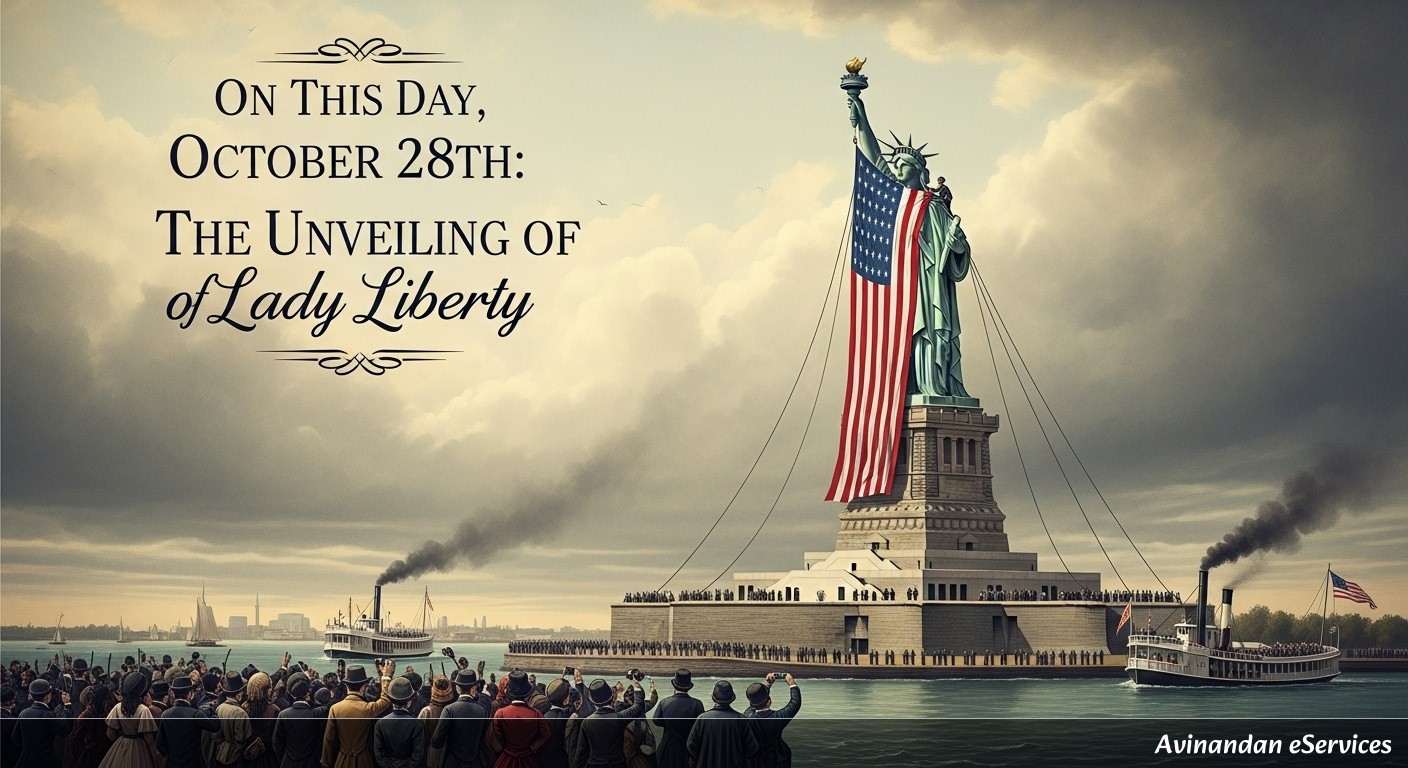
The air on October 28, 1886, was thick with anticipation and a persistent drizzle, but the dreary weather could not dampen the spirits of the over one million people who had gathered in New York City. A grand naval parade featuring a flotilla of 300 ships adorned in red, white, and blue navigated the waters of the Hudson River, all converging on a small piece of land then known as Bedloe's Island. It was here that a colossal figure, shrouded in a massive French flag, stood poised to be revealed to the world. This was the day of the dedication of the Statue of Liberty, a gift from the people of France to the United States, and a moment that would forever be etched in the annals of history. The official title of this magnificent work was "Liberty Enlightening the World," and on this day, its light was about to shine for the first time.
The Build-Up: What Led to This Day?
A Franco-American Dream
The story of the Statue of Liberty begins not in America, but in France, in the aftermath of the American Civil War. In 1865, the French political intellectual and anti-slavery activist Édouard de Laboulaye proposed the idea of a monument to commemorate the alliance between France and the United States and to celebrate the shared ideals of liberty and democracy. Laboulaye, a staunch supporter of the Union during the Civil War, saw the abolition of slavery in the United States as a victory for freedom everywhere. He envisioned a grand gift that would not only honor the centennial of American independence but also inspire the people of France to pursue their own democratic aspirations.
The Visionary Sculptor and the Master Engineer
To bring this monumental idea to life, Laboulaye enlisted the help of a talented French sculptor, Frédéric Auguste Bartholdi. Bartholdi was captivated by the concept and embarked on a trip to the United States in 1871 to find the perfect location for the statue. As he sailed into New York Harbor, he was immediately struck by the sight of Bedloe's Island, a small plot of land that he knew would be a gateway for ships arriving in the new world. It was here, he decided, that "Liberty" would stand to welcome all who came in search of a better life.
The sheer scale of Bartholdi's design presented a significant engineering challenge. To ensure the statue could withstand the strong winds of the harbor, Bartholdi sought the expertise of another brilliant Frenchman, Gustave Eiffel, who would later go on to create his eponymous tower. Eiffel designed an ingenious internal iron pylon and skeletal framework that would support the copper skin of the statue, allowing it to move independently and endure the elements. This innovative design was a bridge between art and engineering, a testament to the technological advancements of the 19th century.
A Transatlantic Effort and the Power of the People
The project was a collaborative effort, with the French people funding the statue's construction and the American people responsible for building its pedestal. Fundraising in France was a success, with contributions coming from all corners of the country through public fees, entertainment events, and a lottery. The construction of the statue took place in Paris, with skilled artisans meticulously crafting the copper sheets using the repoussé technique, hammering them into shape over wooden molds. The statue's arm and torch were even displayed at the Centennial Exposition in Philadelphia in 1876 to generate excitement and support for the project.
In the United States, however, fundraising for the pedestal languished. It was not until Joseph Pulitzer, the publisher of the "New York World" newspaper, launched a massive fundraising campaign that the necessary funds were secured. Pulitzer's appeal to the common person was incredibly effective, attracting over 120,000 donors, most of whom gave less than a dollar. This grassroots effort not only saved the project but also transformed the Statue of Liberty into a gift not just from the French elite, but from the French people to the American people.
The Event Itself
On that rainy October 28th, the culmination of years of dreaming, designing, and fundraising was finally at hand. A land parade of firefighters, soldiers, and veterans marched down Broadway, accompanied by the sounds of brass bands and cannons, in what is considered New York City's first-ever ticker-tape parade. The city was alive with excitement as people from all walks of life came to witness this historic event.
On Bedloe's Island, a crowd of over 2,000 men had gathered for the official dedication ceremony. Notably, very few women were in attendance, a fact that did not go unnoticed by the New York State Woman Suffrage Association, who chartered a boat to view the proceedings from the water and protest the irony of a female figure of liberty being unveiled in a country where women did not have the right to vote.
Frédéric Auguste Bartholdi himself was stationed in the statue's crown, ready to pull the cord that would release the French flag and reveal Liberty's face to the world. During a speech by Senator William M. Evarts, a lull in his remarks was mistaken for the signal, and Bartholdi prematurely unveiled the statue. The crowd erupted in a cacophony of cheers, whistles, and cannon fire, drowning out the remainder of the senator's speech.
President Grover Cleveland then formally accepted the statue on behalf of the United States. In his dedication address, he declared, "We will not forget that Liberty has here made her home; nor shall her chosen altar be neglected." He spoke of the statue not as a symbol of war, but as a beacon of peace and enlightenment, a light that would guide the way to man's enfranchisement. His words resonated with the thousands in attendance and the millions who would come to see the statue as a symbol of hope and freedom.
The Aftermath and Legacy
A Universal Symbol of Freedom
In the years following its dedication, the Statue of Liberty's meaning and significance continued to evolve. Initially a symbol of the friendship between France and the United States and the ideals of republicanism, it soon became a powerful emblem of hope for the millions of immigrants who sailed past her on their way to a new life in America. The statue's proximity to Ellis Island, the nation's busiest immigrant inspection station, solidified its role as the "Mother of Exiles."
The Enduring Power of "The New Colossus"
In 1903, a bronze plaque bearing the words of Emma Lazarus's sonnet, "The New Colossus," was affixed to the pedestal. Her famous lines, "Give me your tired, your poor, Your huddled masses yearning to breathe free," have become inextricably linked with the statue and its message of welcome and opportunity.
A Lasting Icon
Today, the Statue of Liberty is one of the most recognizable landmarks in the world. Designated a National Monument in 1924 and a UNESCO World Heritage Site in 1984, it continues to inspire people around the globe with its powerful message of liberty, democracy, and hope. From its conception as a gift between two nations to its transformation into a universal symbol of freedom, the story of the Statue of Liberty is a testament to the enduring power of human ideals and the remarkable things that can be achieved when people come together in the name of a common dream. The rainy day in October 1886 was not just the unveiling of a statue; it was the dawn of a new era of hope for millions, a legacy that continues to shine brightly to this day.
References
- Britannica, The Editors of Encyclopaedia. "Statue of Liberty". Encyclopedia Britannica, 7 Oct. 2025.
- National Park Service. "Opening Ceremony". Statue of Liberty National Monument.
- National Park Service. "Overview + History". Statue of Liberty.
- Wikipedia contributors. "Statue of Liberty". Wikipedia, The Free Encyclopedia.
- Mystic Stamp Discovery Center. "Grover Cleveland Dedicates Statue of Liberty".
- FOX 5 Atlanta. "On this day in history, Oct. 28, 1886, Statue of Liberty unveiled to the US". 28 Oct. 2022.
- Untapped New York. "Throw Back Thursday 1886: The Statue of Liberty is Dedicated". 27 Oct. 2016.
- American History. "Statue of Liberty Famous People".