Introduction
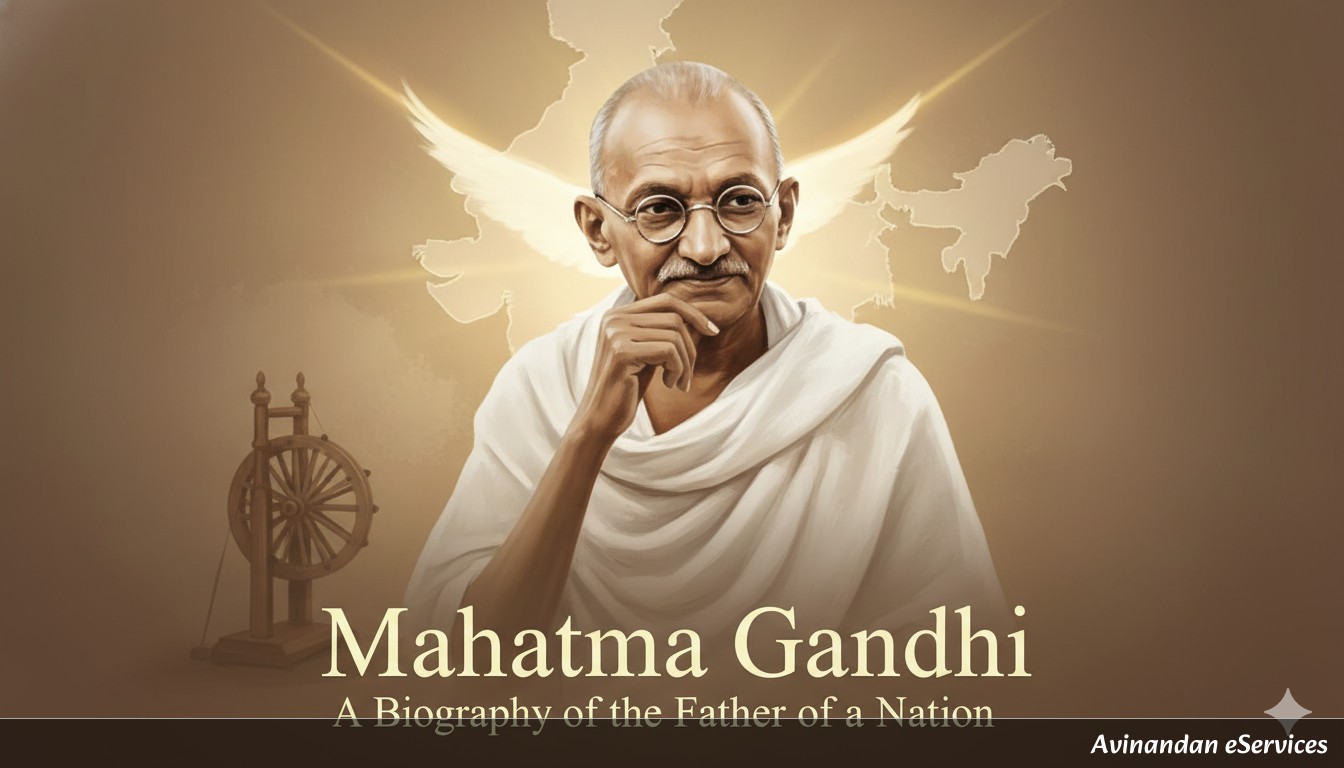
Mohandas Karamchand Gandhi, revered worldwide as Mahatma Gandhi, stands as one of the most influential figures of the 20th century. An Indian lawyer, anti-colonial nationalist, and political ethicist, he became the architect of India's independence from British rule through a philosophy of nonviolent resistance. His approach, known as Satyagraha, has inspired movements for civil rights and freedom across the globe. Fondly called Bapu, meaning father, by his followers, Gandhi is officially honored in India as the Father of the Nation. His life and teachings continue to resonate, offering profound lessons in courage, compassion, and the power of peaceful protest.
Early Life and Education
Mohandas Karamchand Gandhi was born on October 2, 1869, in Porbandar, a coastal town in Gujarat, India, to a devout Hindu family. His father, Karamchand Gandhi, served as a high-ranking official in several princely states, and his mother, Putlibai Gandhi, was a deeply religious woman who instilled in him the values of compassion, vegetarianism, and mutual tolerance. As a child, Gandhi was described as shy and timid. At the young age of 13, he was married to Kasturba Makanji Kapadia in an arranged marriage, a common practice at the time. The couple went on to have four sons.
After completing his initial schooling in India, Gandhi sailed to London in 1888 to study law at the Inner Temple, one of the city's four law colleges. He was called to the bar at the age of 22 in 1891. Upon returning to India, he struggled to establish a successful law practice. This led him to accept a year-long contract with an Indian firm in the British colony of Natal, South Africa, in 1893. This move would prove to be a pivotal turning point in his life.
Major Accomplishments and Career
Gandhi's 21 years in South Africa were transformative, shaping his political and ethical framework. It was here that he first experienced stark racial discrimination and began to formulate his philosophy of nonviolent resistance. He founded the Natal Indian Congress in 1894 to fight against discrimination and developed Satyagraha, or "truth force," as a tool for social and political change.
Return to India and Early Campaigns
Gandhi returned to India in 1915, aged 45, and brought his evolved philosophy of Satyagraha to the burgeoning Indian independence movement. He initially spent time traveling the country to understand the issues facing the common people. His first major success came with the Champaran Satyagraha in 1917, where he organized peasants in Bihar to protest against the exploitative indigo plantation system. This was followed by the Kheda Satyagraha in 1918, supporting farmers who were unable to pay high British taxes due to famine and crop failure. That same year, he led a strike of mill workers in Ahmedabad.
Leadership of the Indian National Congress
By 1920, Gandhi had become a dominant figure in the Indian National Congress, refashioning it into a mass movement for independence. He launched the Non-Cooperation Movement (1920-22), which called for a boycott of British goods, institutions, and courts. This was a nationwide campaign that unified millions of Indians in a common cause. Gandhi's emphasis on Swadeshi, the principle of self-sufficiency and reliance on indigenous goods, was central to this movement. He promoted hand-spinning and weaving of Khadi (homespun cloth) as a symbol of economic independence and resistance to British industrial might.
The Salt March and Civil Disobedience
One of the most iconic acts of defiance in the history of the independence movement was the Salt March, or Dandi March, in 1930. To protest the British-imposed salt tax, which heavily burdened the poor, Gandhi led a 240-mile march to the Arabian Sea to illegally produce salt from seawater. This simple act of civil disobedience sparked a massive nationwide movement, leading to the imprisonment of Gandhi and tens of thousands of others. The Salt March drew international attention and showcased the power of nonviolent protest against a colonial empire.
The Quit India Movement
In 1942, during the height of World War II, Gandhi launched the Quit India Movement, delivering a powerful speech with the call to "Do or Die" for independence. This was a demand for an immediate end to British rule in India. The British responded by imprisoning Gandhi and the entire Congress leadership, but the movement galvanized the Indian populace, making it clear that British rule was no longer tenable. Though the movement saw instances of violence, its sheer scale demonstrated the unwavering resolve of the Indian people to achieve freedom.
Legacy and Impact
Mahatma Gandhi's lifelong struggle culminated on August 15, 1947, when India achieved its independence. However, this victory was bittersweet for him, as it was accompanied by the partition of the subcontinent into India and Pakistan, a decision he had vehemently opposed. Tragically, on January 30, 1948, Gandhi was assassinated by Nathuram Godse, a Hindu nationalist who disagreed with Gandhi's advocacy for Hindu-Muslim unity.
Gandhi's legacy, however, is immortal. His philosophy of nonviolent resistance has had a profound and lasting impact on a global scale. He inspired and influenced numerous civil rights leaders and movements worldwide, most notably Martin Luther King Jr. in the United States and Nelson Mandela in South Africa. King studied Gandhi's principles of Satyagraha and applied them to the American Civil Rights Movement, seeing nonviolence as the "only morally and practically sound method open to oppressed people in their struggle for freedom." Gandhi's advocacy for social justice, equality, and the eradication of poverty continues to inspire activists and reformers to this day. His birthday, October 2nd, is celebrated as the International Day of Nonviolence, a testament to his enduring message of peace and truth.
Quick Facts
- Nobel Peace Prize Nominations: Despite being a global symbol of peace, Gandhi was nominated for the Nobel Peace Prize five times but never received the award.
- Global Correspondence: Gandhi corresponded with several international figures, including Russian author Leo Tolstoy, with whom he shared ideas on nonviolence.
- Football Enthusiast: In South Africa, Gandhi established two football clubs, one in Johannesburg and another in Pretoria, highlighting a lesser-known passion.
- Title of 'Mahatma': The honorific 'Mahatma', meaning 'Great Soul', was reportedly bestowed upon him in 1914 by the Nobel laureate and poet Rabindranath Tagore.
- Spoke English with an Irish Accent: Some of his first teachers were Irish, which influenced his spoken English.
- Time in Prison: He was imprisoned multiple times for his activism in both South Africa and India, spending many years behind bars for his leadership of the independence movement.
- Advocate for the 'Untouchables': Gandhi strongly campaigned against the caste system and the discrimination faced by the lowest caste, whom he called 'Harijans' or 'children of God'.