Introduction to the Topic
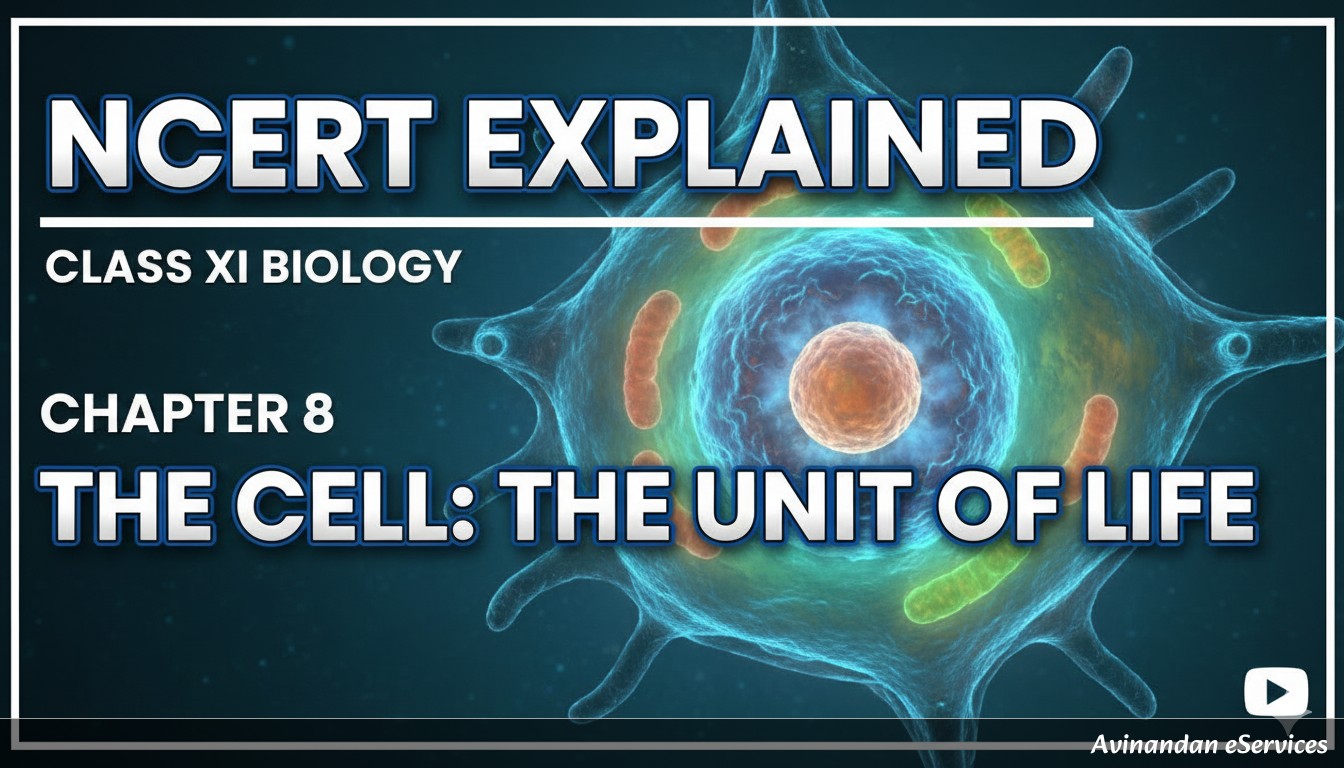
Welcome, young scientists, to an exciting journey into the fundamental building blocks of all living organisms! In Class XI Biology, Chapter 8, we delve deep into 'The Cell: The Unit of Life'. Have you ever wondered what makes a tiny ant and a giant elephant both alive? Or how a single sprout grows into a majestic tree? The answer lies in the incredible world of cells. Cells are the basic structural and functional units of all living beings. Understanding cells is like understanding the alphabet before you can read a book – it's the foundation of biology. This chapter will unlock the secrets of these microscopic powerhouses, revealing their structure, functions, and the diverse ways they contribute to life itself.
Key Concepts Explained
What is a Cell?
Imagine a tiny brick that makes up a huge building. A cell is just like that for living organisms. It's the smallest unit that can be called alive. All living things, from the smallest bacteria to the largest whale, are made up of cells. Some organisms, like amoeba or bacteria, are made of just one cell (unicellular), while others, like humans or trees, are made of millions or even trillions of cells (multicellular).
Discovery of the Cell
The story of cell discovery is fascinating! In 1665, an English scientist named Robert Hooke, using a primitive microscope, observed thin slices of cork. He saw small, compartmentalized structures that reminded him of the small rooms in a monastery, which were called 'cells'. This was the first time the term 'cell' was used to describe these biological units. Later, scientists like Antonie van Leeuwenhoek observed living cells, and others like Matthias Schleiden and Theodor Schwann proposed the 'Cell Theory'.
The Cell Theory
The Cell Theory is a fundamental concept in biology. It states that:
- All living organisms are composed of one or more cells.
- The cell is the basic unit of structure and function in all living organisms.
- All cells arise from pre-existing cells.
This theory revolutionized our understanding of life and its processes.
Types of Cells: Prokaryotic vs. Eukaryotic
Cells are broadly classified into two main types based on their internal structure:
- Prokaryotic Cells: These are simpler and older types of cells. They lack a well-defined nucleus and other membrane-bound organelles. The genetic material (DNA) is usually found in a region called the nucleoid, but it's not enclosed by a membrane. Bacteria and Archaea have prokaryotic cells.
- Eukaryotic Cells: These are more complex cells. They have a true nucleus, which is a membrane-bound organelle containing the cell's DNA. Eukaryotic cells also contain various other membrane-bound organelles, each performing specific functions. Plants, animals, fungi, and protists are made up of eukaryotic cells.
Structure of a Eukaryotic Cell
Eukaryotic cells, though diverse, share some common features:
- Cell Membrane: This is the outer boundary of the animal cell and lies just inside the cell wall of plant and fungal cells. It controls the movement of substances into and out of the cell.
- Cytoplasm: This is the jelly-like substance that fills the cell and surrounds the organelles. Many important chemical reactions occur here.
- Nucleus: Often called the 'control center' of the cell, the nucleus contains the cell's genetic material (DNA) and controls all cellular activities.
- Organelles: These are specialized structures within the cytoplasm that perform specific functions. Some key organelles include:
- Mitochondria: The 'powerhouses' of the cell, responsible for generating energy (ATP).
- Endoplasmic Reticulum (ER): Involved in protein and lipid synthesis and transport.
- Golgi Apparatus: Modifies, sorts, and packages proteins and lipids.
- Lysosomes: Contain digestive enzymes to break down waste materials and cellular debris.
- Vacuoles: Membrane-bound sacs that store water, nutrients, and waste products. They are much larger in plant cells.
- Chloroplasts: Found only in plant cells and some algae, these are responsible for photosynthesis (making food from sunlight).
- Ribosomes: Responsible for protein synthesis.
Differences between Plant and Animal Cells
While both are eukaryotic, plant and animal cells have some distinct differences:
- Cell Wall: Plant cells have a rigid cell wall outside the cell membrane, providing structural support and protection. Animal cells do not have a cell wall.
- Chloroplasts: Plant cells have chloroplasts for photosynthesis. Animal cells do not.
- Vacuoles: Plant cells typically have a large, central vacuole, while animal cells have smaller, temporary vacuoles, if any.
Cell Division
Cells reproduce through cell division. This process is essential for growth, repair, and reproduction. The two main types of cell division are:
- Mitosis: This process results in two daughter cells that are genetically identical to the parent cell. It's important for growth and asexual reproduction.
- Meiosis: This process involves two rounds of division and results in four daughter cells with half the number of chromosomes as the parent cell. It's essential for sexual reproduction.
Summary & Key Takeaways
- Cells are the fundamental structural and functional units of all life.
- Robert Hooke first observed and named cells.
- The Cell Theory states that all life is composed of cells, cells are the basic units of life, and all cells come from pre-existing cells.
- Prokaryotic cells are simple, lacking a nucleus and membrane-bound organelles.
- Eukaryotic cells are complex, with a nucleus and various organelles.
- Key organelles in eukaryotic cells include the nucleus, mitochondria, ER, Golgi apparatus, lysosomes, vacuoles, and ribosomes.
- Plant cells have a cell wall and chloroplasts, and a large central vacuole, unlike animal cells.
- Cell division (mitosis and meiosis) is crucial for growth, repair, and reproduction.