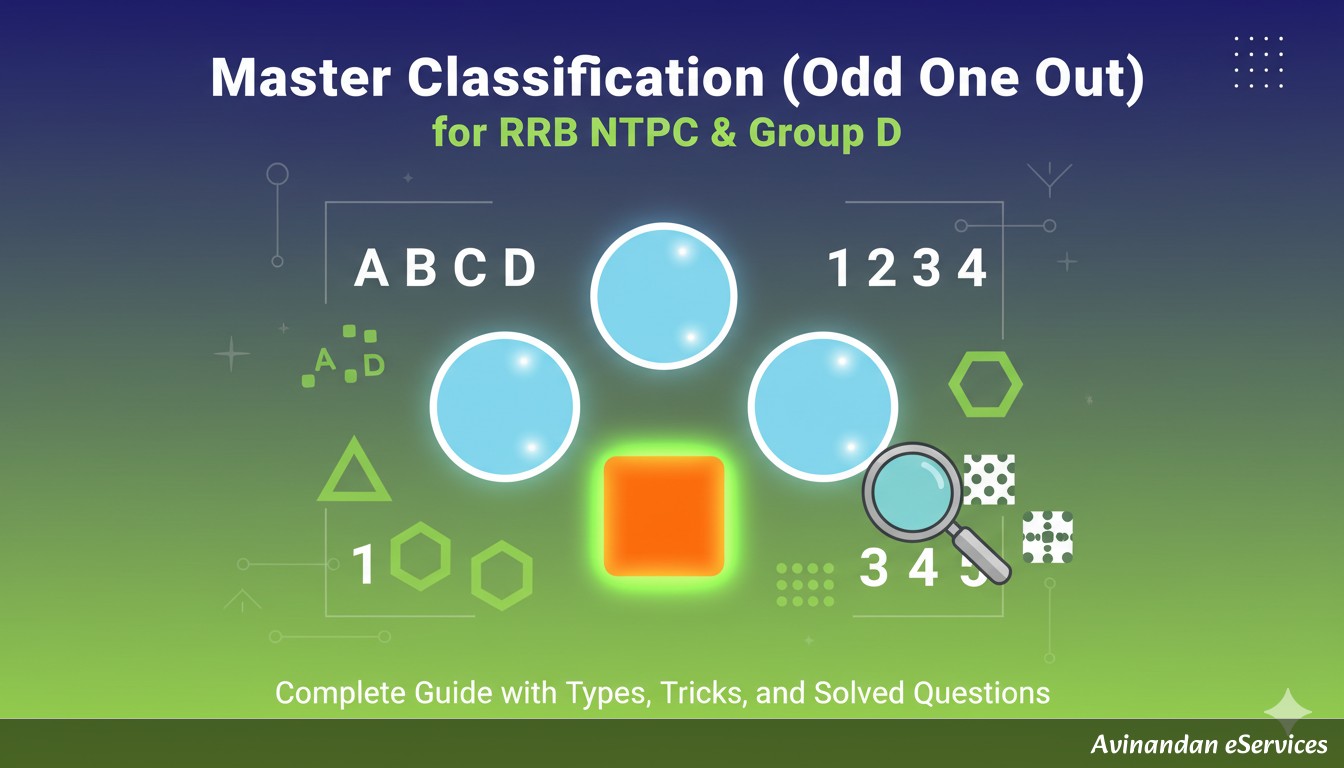
Introduction to Classification (Odd One Out) for RRB Exams
Welcome, future railway professionals! If you're gearing up for the competitive RRB NTPC, Group D, or Technician exams, you know that the General Intelligence and Reasoning section is a crucial battleground. One of the most frequently asked and high-scoring topics within this section is Classification, often called 'Odd One Out'. This topic is a fundamental test of your logical reasoning and analytical abilities. At its core, Classification asks you to identify an item from a given set that doesn't share the common characteristic or property possessed by the rest of the items.
The group might consist of words, letters, numbers, or even figures. Your task is to decipher the underlying pattern or relationship that connects most of the items and then pinpoint the one that breaks this rule. Mastering this topic can significantly boost your overall score, and this comprehensive guide is designed to help you do just that. We will delve deep into the various types of classification questions, equip you with powerful strategies and time-saving tricks, walk you through solved examples, and provide a robust set of practice questions to solidify your understanding. Let's begin your journey to mastering Classification!
Why is Classification Important for RRB NTPC, Group D & Technician Exams?
In any competitive exam, understanding the 'why' behind a topic is as important as the 'how'. So, why should you dedicate significant time to mastering Classification? Here’s a breakdown of its importance in the context of RRB exams:
- High Frequency and Weightage: Classification questions are a staple in the reasoning section of all major RRB exams. You can expect to encounter at least 2-4 questions from this topic, making it a reliable source of marks.
- Tests Core Reasoning Skills: These questions are not about complex calculations but about pure logic. They test your ability to observe, compare, differentiate, and identify patterns – skills that are essential for problem-solving in any role within the Indian Railways.
- Scoring and Time-Saving: With the right approach and sufficient practice, Classification questions can be solved in a matter of seconds. This speed and accuracy can save you precious time during the exam, which you can then allocate to more complex problems.
- Versatility: The topic spans across various domains – general knowledge, vocabulary, mathematics, and abstract reasoning. Excelling in Classification indirectly showcases your command over a wide range of subjects, which is a key trait of a successful candidate.
Types of Classification (Odd One Out) Questions
To conquer Classification, you must first understand its different forms. Questions are primarily categorized based on the type of elements given in the options. Let's explore each type with illustrative examples.
1. Word-Based Classification (Verbal)
In this type, you are given a set of words, and you need to find the one that doesn't fit the group. The relationship can be based on meaning, category, function, or general knowledge.
- Based on Category/Class: The most common type, where three options belong to a specific category, and one does not.
Example: Find the odd one out: (A) Lion (B) Tiger (C) Leopard (D) Cow
Logic: Lion, Tiger, and Leopard are wild carnivorous animals of the cat family. A cow is a domestic herbivorous animal. Hence, Cow is the odd one out. - Based on Meaning (Synonyms/Antonyms): Three words might be synonyms (have similar meanings), while one is an antonym (has the opposite meaning).
Example: Find the odd one out: (A) Enormous (B) Huge (C) Gigantic (D) Tiny
Logic: Enormous, Huge, and Gigantic are all synonyms for something very large. Tiny is the antonym. Hence, Tiny is the odd one out. - Based on Function/Purpose: The items might be related by their use or the function they perform.
Example: Find the odd one out: (A) Pen (B) Pencil (C) Chalk (D) Brush
Logic: Pen, Pencil, and Chalk are used for writing. A brush is primarily used for painting. Hence, Brush is the odd one out. - Based on General Knowledge: These questions test your awareness of geography, history, science, etc.
Example: Find the odd one out: (A) Ganga (B) Yamuna (C) Nile (D) Godavari
Logic: Ganga, Yamuna, and Godavari are rivers in India. The Nile is a river in Africa. Hence, Nile is the odd one out.
2. Letter-Based Classification
Here, the options are single letters or groups of letters (clusters). The logic is based on their position in the alphabet, the presence of vowels/consonants, or a specific pattern.
- Based on Vowels/Consonants: The logic revolves around whether the letters are vowels (A, E, I, O, U) or consonants.
Example: Find the odd one out: (A) EIO (B) UAI (C) PQR (D) AOU
Logic: The letter clusters in options A, B, and D consist exclusively of vowels. The cluster PQR consists of only consonants. Hence, PQR is the odd one out. - Based on Position and Gaps in the Alphabet Series: The relationship is based on the numeric positions of the letters (A=1, B=2, etc.) and the uniform or non-uniform gaps between them.
Example: Find the odd one out: (A) CDF (B) GHI (C) JKL (D) MNO
Logic: In options B, C, and D, the letters are consecutive (G,H,I; J,K,L; M,N,O). In option A, there is a gap: C, then D (+1), but then F (+2). Hence, CDF is the odd one out. - Based on Mirror/Opposite Letters: This involves pairs of letters that are opposites in the alphabet series (A-Z, B-Y, C-X, etc.).
Example: Find the odd one out: (A) AZ (B) BY (C) DW (D) EV
Logic: A and Z are the 1st letters from the start and end, respectively. B and Y are the 2nd. E and V are the 5th. However, for D (4th from the start), the opposite letter should be W (4th from the end), not C as in CX. Let's re-evaluate the example. A-Z, B-Y, D-W are correct opposite pairs. E-V is also a correct opposite pair. Let's use a different example: (A) AZ (B) CX (C) GT (D) KP. All are pairs of opposite letters. Let's try another logic. (A) AZ (B) BY (C) DW (D) FU. Here A-Z, B-Y, D-W are opposite pairs, but F(6th) and U(21st) are also opposite pairs. A better example: (A) AZ (B) BY (C) CX (D) DE. Here A, B, C are opposite pairs, while DE are consecutive letters. Hence, DE is the odd one.
3. Number-Based Classification
In this format, you are given a set of numbers. The underlying logic can be based on properties like even/odd, prime/composite, squares/cubes, divisibility, or other mathematical operations.
- Based on Even/Odd Numbers: The simplest logic, where three numbers are even and one is odd, or vice versa.
Example: Find the odd one out: (A) 34 (B) 58 (C) 72 (D) 95
Logic: 34, 58, and 72 are even numbers. 95 is an odd number. Hence, 95 is the odd one out. - Based on Prime/Composite Numbers: A prime number is divisible only by 1 and itself. A composite number has more than two factors.
Example: Find the odd one out: (A) 13 (B) 17 (C) 23 (D) 27
Logic: 13, 17, and 23 are prime numbers. 27 is a composite number (divisible by 1, 3, 9, 27). Hence, 27 is the odd one out. - Based on Squares/Cubes: The numbers might be perfect squares or cubes.
Example: Find the odd one out: (A) 8 (B) 64 (C) 125 (D) 216 (E) 256
Logic: 8 (2³), 64 (4³), 125 (5³), and 216 (6³) are perfect cubes. 256 is a perfect square (16²). Hence, 256 is the odd one out. - Based on Divisibility Rules: The numbers might share a common divisor.
Example: Find the odd one out: (A) 123 (B) 234 (C) 345 (D) 457
Logic: The sum of digits for 123 (1+2+3=6), 234 (2+3+4=9), and 345 (3+4+5=12) are all divisible by 3. The sum of digits for 457 (4+5+7=16) is not divisible by 3. Hence, 457 is the odd one out. - Based on Sum/Product of Digits: A common pattern can be found by adding or multiplying the digits of each number.
Example: Find the odd one out: (A) 246 (B) 358 (C) 426 (D) 178
Logic: In options A, C, and D, the sum of the first two digits equals the third digit (2+4=6; 4+2=6; 1+7=8). In option B, 3+5=8. This logic seems to apply to all. Let's try a different logic. Let's create a new example: (A) 257 (B) 347 (C) 167 (D) 428. Here, 2+5=7, 3+4=7, 1+6=7. But in D, 4+2=6, not 8. So, 428 is the odd one.
4. Image-Based Classification (Non-Verbal)
This type presents a set of figures or images. You need to identify the figure that does not follow the pattern of the others. The logic can be based on shape, rotation, number of elements, or orientation.
- Based on Number of Sides/Lines: Four figures are given, three of which have an even number of sides, and one has an odd number, or vice versa.
Example: Imagine four figures: (A) A Triangle (3 sides) (B) A Square (4 sides) (C) A Pentagon (5 sides) (D) A Hexagon (6 sides). If the question was based on even/odd sides, there's no clear odd one. Let's re-frame. Imagine figures: (A) Square (B) Rectangle (C) Pentagon (D) Rhombus. Here A, B, and D are quadrilaterals (4 sides), while C is a pentagon (5 sides). Hence, the Pentagon is the odd one out. - Based on Rotation: The elements within the figures might be rotating clockwise or anti-clockwise by a certain degree.
Example: Imagine four squares. In each square, an arrow points: (A) North (B) East (C) South (D) North-West. Figures A, B, and C show a 90-degree clockwise rotation. Figure D breaks this pattern. Hence, the figure with the North-West arrow is the odd one out.
Strategies and Tricks to Solve Classification Questions Quickly
Knowing the types is half the battle. Executing with speed and accuracy is the other half. Here are some proven strategies:
- Identify the Common Property First: Don't start by looking for the odd one out. Instead, scan the options to find a clear, unifying theme or property that three of the four options share. The one left out is your answer.
- Check for Obvious Logic: For numbers, always perform a quick mental check in this order: Even/Odd -> Prime/Composite -> Square/Cube -> Divisibility -> Sum/Product of digits. This hierarchical check saves time.
- Master Alphabet Positions: For letter-based questions, you must know the forward (A=1...Z=26) and backward (A=26...Z=1) positions of all alphabets by heart. Words like 'EJOTY' (5, 10, 15, 20, 25) can be a helpful mnemonic.
- Expand Your General Knowledge: For word-based questions, a strong GK is non-negotiable. Read regularly about state capitals, countries and currencies, scientific terms, animal categories, etc.
- Eliminate, Don't Just Select: The process of elimination is very powerful. When you confirm a shared property between two options, you can be more confident in checking the third against them.
- Beware of Multiple Logics: Sometimes, a question might have more than one possible logic. In such cases, the most universal and simple logic takes precedence over a more complex or obscure one. For instance, the 'Even/Odd' logic is generally stronger than a logic based on the 'sum of digits'.
- Practice, Practice, Practice: There is no substitute for practice. The more questions you solve, the faster your brain will recognize patterns, making you quicker and more accurate on exam day.
Solved Examples: Step-by-Step Solutions
Let's apply our knowledge to some real examples.
Example 1: Word-Based (Category)
Question: Find the odd one out from the following: (A) Carrot, (B) Ginger, (C) Potato, (D) Spinach
Solution:
- Step 1: Analyze the options. The options are all vegetables. We need to find a more specific classification.
- Step 2: Find the common property. Think about how these vegetables grow. Carrots, Ginger, and Potatoes are all root vegetables or tubers that grow underground.
- Step 3: Identify the odd one out. Spinach is a leafy green vegetable that grows above the ground.
- Conclusion: Spinach does not belong to the group of underground vegetables. Therefore, (D) Spinach is the correct answer.
Example 2: Number-Based (Square/Cube Logic)
Question: Find the odd one out: (A) 27, (B) 125, (C) 343, (D) 729, (E) 512
Wait, let's make it more exam-like with four options. Question: (A) 27 (B) 125 (C) 216 (D) 343 (E) 511
Solution:
- Step 1: Analyze the options. The options are three-digit numbers.
- Step 2: Check for common properties (Square/Cube). Let's test if they are perfect cubes.
- 27 = 3 x 3 x 3 = 3³
- 125 = 5 x 5 x 5 = 5³
- 216 = 6 x 6 x 6 = 6³
- 343 = 7 x 7 x 7 = 7³
- Step 3: Identify the odd one out. Let's check 511. We know that 8³ is 512. So, 511 is not a perfect cube.
- Conclusion: All options except 511 are perfect cubes. Therefore, (E) 511 is the correct answer.
Example 3: Letter-Based (Gap Pattern)
Question: Find the odd one out: (A) DGI, (B) KNP, (C) RUX, (D) TWZ
Solution:
- Step 1: Analyze the options. The options are clusters of three letters. The best approach is to check the gap between the letters using their alphabetical positions.
- Step 2: Decode the pattern for each option.
- (A) D(4) G(7) I(9) -> Gap is +3, +2
- (B) K(11) N(14) P(16) -> Gap is +3, +2
- (C) R(18) U(21) X(24) -> Gap is +3, +3
- (D) T(20) W(23) Z(26) -> Wait, Z is 26, so T(20) W(23) Y(25). The gap should be +3, +2. Let's use Y instead of Z. (D) TWY -> T(20) W(23) Y(25) -> Gap is +3, +2.
- Step 3: Compare the patterns. Options A, B, and D follow the pattern of (+3, +2). Option C follows a different pattern of (+3, +3).
- Conclusion: RUX breaks the common pattern. Therefore, (C) RUX is the correct answer.
Practice Questions with Solutions for RRB Exams
Now it's your turn to practice. Solve the following questions and then check your answers and explanations below.
| Question No. | Question: Find the Odd One Out |
|---|---|
| 1 | (A) Sparrow (B) Parrot (C) Vulture (D) Swan |
| 2 | (A) Huge (B) Big (C) Large (D) Tiny |
| 3 | (A) Rupee (B) Dollar (C) Pound (D) Currency |
| 4 | (A) F (B) L (C) E (D) M |
| 5 | (A) DEB (B) FGD (C) PQS (D) HIL |
| 6 | (A) 28 (B) 44 (C) 68 (D) 85 |
| 7 | (A) 23 (B) 29 (C) 31 (D) 33 |
| 8 | (A) 27 (B) 64 (C) 125 (D) 144 |
| 9 | (A) 123-6 (B) 234-9 (C) 345-12 (D) 456-18 |
| 10 | (A) 11-121 (B) 13-169 (C) 15-225 (D) 17-287 |
| 11 | (A) Axe (B) Sword (C) Knife (D) Hammer |
| 12 | (A) India (B) China (C) Japan (D) London |
| 13 | (A) 145 (B) 197 (C) 257 (D) 399 |
| 14 | (A) Triangle (B) Circle (C) Rectangle (D) Square |
| 15 | (A) Heart (B) Lungs (C) Kidney (D) Nose |
Answers and Explanations
- Answer: (D) Swan. Sparrow, Parrot, and Vulture are flying birds. A swan is a water bird.
- Answer: (D) Tiny. Huge, Big, and Large are synonyms. Tiny is the antonym.
- Answer: (D) Currency. Rupee, Dollar, and Pound are specific types of currencies. 'Currency' is the general category itself.
- Answer: (C) E. E is a vowel, while F, L, and M are consonants.
- Answer: (C) PQS. In all others, letters are consecutive in some order. DEB (B, D, E). FGD (D, F, G). HIL (H, I, L). PQS has gaps (P, Q, skip R, S). A better logic: D(4)+E(5)=9, B(2). F(6)+G(7)=13, D(4). H(8)+I(9)=17, L(12). P(16)+Q(17)=33, S(19). The logic here is not simple addition. Let's re-evaluate. D-E is +1, E-B is -3. F-G is +1, G-D is -3. H-I is +1, I-L is +3. P-Q is +1, Q-S is +2. The change in direction/gap is different for HIL and PQS. A much simpler logic: The middle letter is alphabetically between the other two in DEB, FGD. In HIL and PQS this is not the case. Let's try another logic. Vowels! DEB has vowel E. FGD no vowel. PQS no vowel. HIL has vowel I. This is not a good separator. Let's stick to positions. DEB: 4,5,2. FGD: 6,7,4. PQS: 16,17,19. HIL: 8,9,12. The jump from the middle letter to the last is inconsistent. In PQS, the letters are in alphabetical order, while in others they are jumbled. This is the simplest logic.
- Answer: (D) 85. All other numbers are even. 85 is odd.
- Answer: (D) 33. 23, 29, and 31 are prime numbers. 33 is a composite number (3 x 11).
- Answer: (D) 144. 27 (3³), 64 (4³), and 125 (5³) are perfect cubes. 144 is a perfect square (12²).
- Answer: (D) 456-18. The logic is that the number after the hyphen is the sum of the digits of the first number. 1+2+3=6. 2+3+4=9. 3+4+5=12. But 4+5+6=15, not 18.
- Answer: (D) 17-287. The relationship is x : x². 11²=121, 13²=169, 15²=225. But 17²=289, not 287.
- Answer: (D) Hammer. Axe, Sword, and Knife are cutting tools. A hammer is a striking tool.
- Answer: (D) London. India, China, and Japan are countries. London is a city.
- Answer: (D) 399. The pattern is (even number)² + 1. 12²+1 = 145. 14²+1 = 197. 16²+1 = 257. But 399 is 20² - 1.
- Answer: (B) Circle. Triangle, Rectangle, and Square are made of straight lines (polygons). A circle is a curve.
- Answer: (D) Nose. Heart, Lungs, and Kidney are internal organs. The nose is an \texternal sensory organ.
Conclusion and Final Tips
Classification, or 'Odd One Out', is an indispensable part of the RRB reasoning syllabus. As we've seen, the questions can come from any domain, testing everything from your vocabulary to your knowledge of prime numbers. However, they all share a common foundation: pattern recognition. Your success in this topic hinges on your ability to quickly identify the thread that connects three of the options and spot the one that doesn't belong.
To seal your mastery, remember these final tips:
- Solve Previous Year Papers: This is the best way to understand the exact level and type of questions the RRB asks.
- Time Yourself: When practicing, use a stopwatch. Aim to solve each classification question in under 20-30 seconds.
- Learn from Your Mistakes: Don't just check the right answer. Understand the logic behind your incorrect attempts to avoid repeating them.
By consistently applying the strategies outlined in this guide and dedicating regular time to practice, you can transform Classification from a challenging puzzle into a guaranteed source of marks. Stay focused, practice smart, and march confidently towards your goal of securing a job in the Indian Railways. All the best!