Introduction to Indian Ocean and Island Groups for RRB Exams
General Awareness is a high-scoring section in all Indian Railway Recruitment Board (RRB) examinations, including RRB NTPC, Group D, and Technician grades. Within Geography, the study of the Indian Ocean and its Island Groups holds immense significance. As the only ocean named after a nation, the Indian Ocean is a critical trade route, a major climatic regulator, and a zone of immense strategic and geopolitical importance. Aspirants must understand its physical boundaries, marginal seas, trenches, and the two major Indian island groups—the Andaman and Nicobar Islands and the Lakshadweep Islands—to score well in the CBT exams.
Topic Weightage and Importance
In RRB NTPC (CBT 1 and CBT 2) and RRB Group D exams, candidates can expect 2 to 3 questions directly or indirectly related to physical geography and Indian island groups. These questions typically test factual knowledge regarding highest peaks, channels separating specific islands, capital cities, indigenous tribes, and neighboring countries. Scoring full marks in this subsection can significantly boost your overall percentile.
Key Concepts and Formulas
To master the Indian Ocean and Island Groups, candidates must memorize several crucial geographical facts and boundaries. Let us break them down systematically:
1. Boundaries of the Indian Ocean
- North: Bounded by the Indian subcontinent and Southern Asia.
- West: Bounded by the eastern coast of Africa and the Arabian Peninsula.
- East: Bounded by the Malay Peninsula, the Sunda Islands of Indonesia, and Australia.
- South: Bounded by the Southern Ocean (or Antarctica, depending on the geographical convention).
2. Major Island Groups of India
India has a coastline of 7,516.6 km, with major island groups situated in the Bay of Bengal and the Arabian Sea.
A. Andaman and Nicobar Islands (Bay of Bengal)
- Known as the 'Emerald Isles', this archipelago consists of nearly 572 islands and islets.
- Divided into the Andaman Islands in the north and the Nicobar Islands in the south, separated by the Ten Degree Channel ($10^\circ \text{N}$ parallel).
- Capital: Port Blair (located in South Andaman).
- Highest Peak: Saddle Peak ($738 \text{ meters}$), located in North Andaman.
- Active Volcano: Barren Island, the only active volcano in South Asia.
- Important Channels: Coco Channel separates North Andaman from Coco Islands (Myanmar); Duncan Passage separates Little Andaman and South Andaman.
B. Lakshadweep Islands (Arabian Sea)
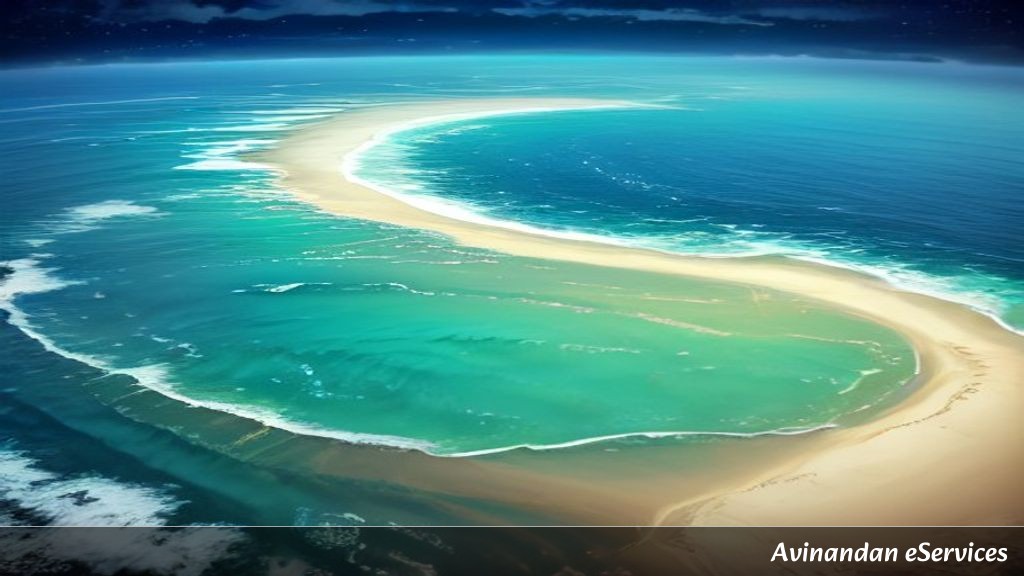
- A group of coral islands (atolls) consisting of 36 islands.
- Formerly known as Laccadive, Minicoy, and Amindivi islands; renamed Lakshadweep in 1973.
- Capital: Kavaratti.
- Important Channels: Minicoy is separated from the rest of the Lakshadweep group by the Nine Degree Channel ($9^\circ \text{N}$). The Maldives is separated from Minicoy by the Eight Degree Channel ($8^\circ \text{N}$).
Solved Examples (Step-by-Step)
Let us practice some standard multiple-choice questions frequently asked in previous RRB examinations.
Example 1
Question: Which channel separates the Andaman Islands from the Nicobar Islands?
Step-by-step Solution:
1. Recall the geographic divisions of the Bay of Bengal archipelago.
2. The northern group comprises the Andaman islands, while the southern group comprises the Nicobar islands.
3. The parallel of latitude running between them is the $10^\circ$ parallel.
Answer: Ten Degree Channel.
Example 2
Question: Where is Barren Island, the only active volcano in India, located?
Step-by-step Solution:
1. Identify the two main island territories of India: Andaman & Nicobar and Lakshadweep.
2. Active volcanism in India is restricted to the eastern island territories in the Bay of Bengal.
3. Specifically, it lies in the Andaman and Nicobar archipelago.
Answer: Andaman and Nicobar Islands.
Example 3
Question: What is the total number of islands in the Lakshadweep group?
Step-by-step Solution:
1. Lakshadweep is a coral island group in the Arabian Sea.
2. Fact check the total count of islands (inhabited and uninhabited).
3. The total number is 36.
Answer: 36 islands.
Common Mistakes to Avoid
- Confusing the Eight, Nine, and Ten Degree Channels. Remember: $8^\circ$ separates India (Minicoy) and Maldives; $9^\circ$ separates Minicoy from Lakshadweep; $10^\circ$ separates Andaman from Nicobar.
- Assuming Lakshadweep islands are of volcanic origin; they are actually coral atolls.
- Forgetting the capital cities (Port Blair for Andaman & Nicobar, Kavaratti for Lakshadweep).
Practice Questions with Solutions
- Q: Which is the highest peak in the Andaman and Nicobar Islands?
Options: (a) Mount Thuiller (b) Saddle Peak (c) Mount Diavolo (d) Mount Koyob
Solution: (b) Saddle Peak ($738 \text{ m}$) located in North Andaman is the highest point. - Q: The Eight Degree Channel separates which two regions?
Options: (a) Minicoy and Maldives (b) India and Sri Lanka (c) Andaman and Nicobar (d) South Andaman and Little Andaman
Solution: (a) Minicoy and Maldives. - Q: Lakshadweep islands are primarily formed of which substance?
Options: (a) Volcanic lava (b) Sedimentary rock (c) Coral reefs (d) Alluvial deposits
Solution: (c) Coral reefs. - Q: Which strait separates India from Sri Lanka in the Indian Ocean region?
Options: (a) Malacca Strait (b) Palk Strait (c) Sunda Strait (d) Bass Strait
Solution: (b) Palk Strait. - Q: Indira Point, the southernmost point of India's territory, is located in which island?
Options: (a) Great Nicobar (b) Little Andaman (c) Car Nicobar (d) North Andaman
Solution: (a) Great Nicobar.
Frequently Asked Questions (FAQs)
Q1: Are questions from physical geography mandatory for RRB NTPC?
Yes, Indian and world physical geography, including oceans, rivers, and islands, forms a core part of the General Awareness syllabus for both CBT 1 and CBT 2.
Q2: How should I memorize the channels easily?
Use mnemonics or draw a quick sketch of latitudes from south to north ($8^\circ$ Maldives-Minicoy, $9^\circ$ Minicoy-Lakshadweep, $10^\circ$ Andaman-Nicobar) during your revision sessions.
Q3: Are Lakshadweep islands inhabited?
Out of 36 islands, only 10 are inhabited. Kavaratti is the administrative capital.
Conclusion and Final Tips
Mastering the Indian Ocean and Island Groups requires focused reading of standard maps and factual revision. Keep practicing previous years' question papers and test your knowledge regularly. Consistent revision will ensure you secure full marks in the geography section of your RRB exam. Good luck!