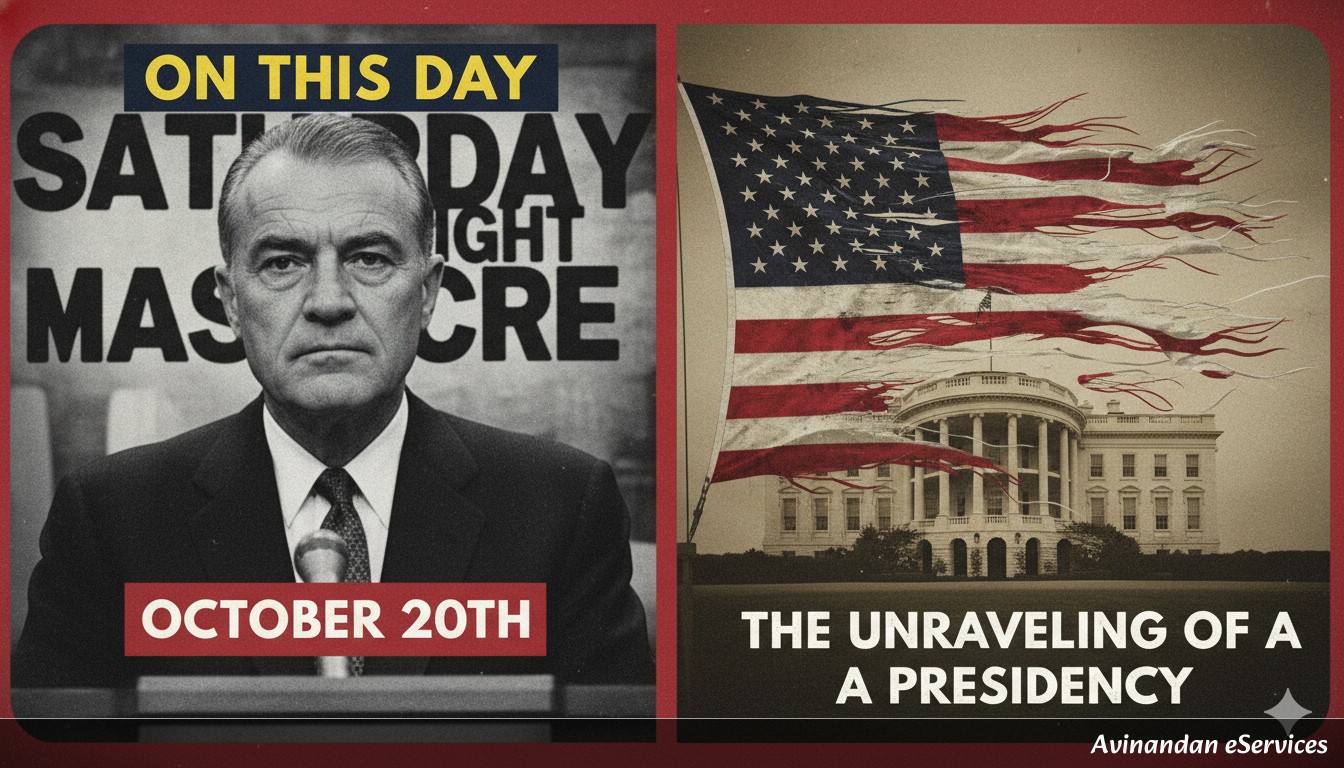
Introduction: A Moment in Time
The evening of Saturday, October 20, 1973, began like any other autumn weekend in Washington D.C., but it would end with a political firestorm that would forever be etched in American history as the 'Saturday Night Massacre.' This was not a scene of physical violence, but a constitutional crisis of the highest order, a dramatic series of events that would lay bare the deep-seated corruption of the Watergate scandal and set in motion the final act of Richard Nixon's presidency. In a stunning display of executive power, a president would clash with the very foundations of the justice system, leading to a cascade of resignations and a public outcry that would echo through the halls of power and ultimately lead to the downfall of a president.
The Build-Up: What Led to This Day?
The roots of the Saturday Night Massacre lay in the murky depths of the Watergate scandal, which began with a seemingly minor break-in at the Democratic National Committee headquarters in the Watergate complex on June 17, 1972. What initially appeared to be a 'third-rate burglary' soon unraveled into a vast conspiracy of political espionage and a cover-up that reached the highest levels of the Nixon administration. As investigative journalists and a Senate committee dug deeper, the trail of evidence led closer and closer to the Oval Office.
In May 1973, amidst mounting public pressure, Attorney General Elliot Richardson appointed Archibald Cox, a respected Harvard law professor, as a special prosecutor to investigate the Watergate affair. Cox was granted a significant degree of independence, a crucial factor that would later put him on a collision course with the White House. The investigation took a dramatic turn in July 1973 when a former White House aide revealed the existence of a secret taping system in the Oval Office, a system that had recorded conversations which could potentially prove or disprove the president's involvement in the cover-up.
The Tapes: A Constitutional Showdown
Cox, determined to follow the evidence wherever it led, issued a subpoena for the tapes. President Nixon, however, refused to comply, citing executive privilege and national security concerns. This set the stage for a constitutional showdown between the executive branch and the special prosecutor's office. The courts sided with Cox, ordering Nixon to turn over the recordings. Instead of complying, Nixon offered a compromise: he would provide summaries of the tapes, which would be verified by the staunchly conservative Senator John C. Stennis. Cox, however, rejected this 'Stennis compromise,' viewing it as an unacceptable limitation on his investigation. He believed that only the original tapes could provide the unvarnished truth. On the morning of October 20, 1973, Cox held a press conference to publicly announce his refusal of the President's offer, a bold move that would trigger the dramatic events of that evening.
The Event Itself
With Cox's public defiance, a furious President Nixon set in motion a chain of events that would become known as the Saturday Night Massacre. That evening, he ordered Attorney General Elliot Richardson to fire Archibald Cox. Richardson, a man of principle who had personally assured the Senate during his confirmation hearings that he would not interfere with the special prosecutor, found himself in an impossible position. Faced with a direct order that he believed was a grave abuse of power, Richardson refused and promptly resigned in protest.
Undeterred, Nixon then turned to the Deputy Attorney General, William Ruckelshaus, and gave him the same order. Ruckelshaus, like his superior, also refused to be the president's instrument in what he saw as an obstruction of justice. He too chose to resign rather than carry out the order. The presidency was in a standoff with its own Justice Department.
The Final Act
With the top two officials at the Justice Department gone, the responsibility fell to the third in command, Solicitor General Robert Bork. Unlike Richardson and Ruckelshaus, Bork had not made any prior commitments to Congress regarding the special prosecutor's independence. While he reportedly considered resigning, Bork ultimately carried out the president's order and formally dismissed Archibald Cox. In a matter of hours, the independent investigation into the president had been decapitated, and the top echelons of the Justice Department were in turmoil. To further assert control, FBI agents were dispatched to seal off the offices of Cox, Richardson, and Ruckelshaus, a move that only intensified the perception of a president acting above the law.
The Aftermath and Legacy
The public reaction to the Saturday Night Massacre was immediate and overwhelming. A 'firestorm' of protest erupted across the nation. The White House and Congress were inundated with an unprecedented number of telegrams and letters from outraged citizens who saw Nixon's actions as a direct assault on the rule of law. For the first time, polls showed that a majority of Americans favored the impeachment of the president.
The political fallout was equally severe. The firings and resignations galvanized Congress, which had been taking a more cautious approach to the Watergate scandal. In the days following the 'massacre,' numerous resolutions for impeachment were introduced in the House of Representatives. The immense public and political pressure forced the Nixon administration to backtrack. On November 1, 1973, a new special prosecutor, Leon Jaworski, was appointed, and he continued the investigation with the same tenacity as his predecessor.
"Whether ours shall continue to be a government of laws and not of men is now for Congress and ultimately the American people [to decide]." - Archibald Cox, in a statement read after his firing.
The Saturday Night Massacre is widely considered a turning point in the Watergate scandal. Nixon's brazen attempt to quash the investigation backfired spectacularly, eroding his public support and emboldening his opponents. It was a clear demonstration of his willingness to abuse the power of his office to protect himself, a realization that shocked the nation. Ultimately, the events of October 20, 1973, accelerated the very outcome Nixon had sought to avoid. The investigation continued, the Supreme Court eventually ordered the release of the tapes, and the evidence they contained would prove to be the final nail in the coffin of his presidency. Facing certain impeachment, Richard Nixon resigned from office on August 9, 1974. The Saturday Night Massacre stands as a stark reminder of the fragility of democratic institutions and the enduring power of the rule of law.
References
- Wikipedia: Saturday Night Massacre
- PBS: Inside the Saturday Night Massacre
- EBSCO: Saturday Night Massacre | Research Starters
- Wikipedia: Watergate scandal
- Wikipedia: Archibald Cox
- The Washington Post: Nixon Forces Firing of Cox; Richardson, Ruckelshaus Quit
- The National Constitution Center: The Saturday Night Massacre: How our Constitution trumped a reckless President
- PBS LearningMedia: The "Saturday Night Massacre" and Calls for Nixon's Impeachment
- Miller Center: Saturday Night Massacre
- Political Dictionary: Saturday Night Massacre
- Politics Stack Exchange: Why did Richardson and Ruckelshaus resign during the Watergate "Saturday Night Massacre", rather than simply refuse?
- Princeton Alumni Weekly: Q&A: William Ruckelshaus '55 on the Watergate Scandal
- The Nation: Saturday Night Massacre