A 2,000-Year-Old Computer Found in a Shipwreck? It Sounds Like Science Fiction!
Samir: Ananya, you won't believe this amazing calendar app I found! It can show me exactly when the next solar eclipse will happen and where all the planets will be in the sky ten years from now. Isn't modern technology incredible?
Ananya: It really is, Samir! But what if I told you that people had a device that could do something very similar... more than two thousand years ago?
Samir: No way! You’re kidding, right? A two-thousand-year-old computer? Did it run on stone tablets and have a mouse carved out of wood?
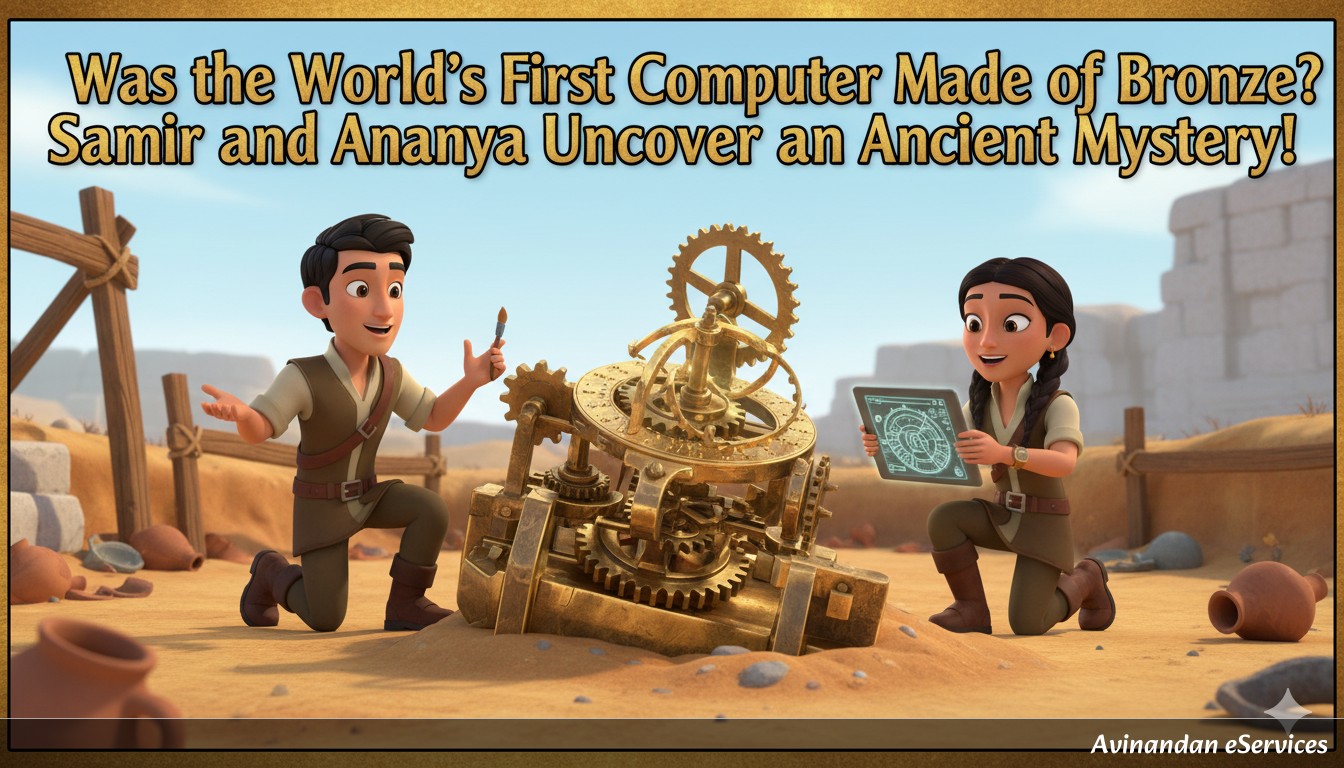
Ananya: Haha, not quite! But you’re on the right track with it being a physical object. It wasn't digital like our apps, but it was a mind-blowing piece of technology for its time. It was made of bronze, filled with complex gears, and it's called the Antikythera Mechanism.
Samir: Anti-key-thera? That’s a mouthful. What does that even mean? And how do we know about it if it's so old?
Ananya: It’s named after the Greek island of Antikythera, which is where it was found. And the story of its discovery is like something out of an adventure movie! Back in the year 1900, a group of Greek sponge divers were sheltering from a storm. When the storm passed, they dived into the water and found an ancient Roman shipwreck. It was full of statues and treasures!
Samir: Wow, real-life treasure hunters! So they found this computer thing in the shipwreck?
Ananya: Exactly! Well, at first, they didn't know what it was. A year later, an archaeologist was studying the artifacts they brought up and noticed a lump of corroded bronze and wood. It just looked like a rock. But then, it cracked open, and he saw something incredible inside: gears! Tiny, precise, interlocking gears, like you'd see in a very complicated clock.
Samir: Gears inside a rock from the bottom of the sea? That is so cool! But what were all those gears for? What did it actually do?
Ananya: That was the big mystery! For decades, scientists had no idea. The mechanism was in dozens of fragments and was too fragile to take apart. It wasn't until they could use modern technology, like special X-rays and 3D imaging, that they could finally see all the hidden layers of gears inside and read the faint inscriptions on its surfaces.
A Clock for the Cosmos
Samir: So the X-rays let them see inside? What did they find out?
Ananya: They discovered it was an incredibly sophisticated astronomical calculator. It was a mechanical model of the solar system, as they understood it back then. By turning a handle on the side, a person could set it to a specific date, and a whole system of pointers on the front and back dials would move to show the positions of the Sun, the Moon, and the five planets that were known at the time—Mercury, Venus, Mars, Jupiter, and Saturn.
Samir: It could track all the planets? My app does that! So it was an ancient Greek planet-tracker?
Ananya: It was that and so much more! It could predict solar and lunar eclipses with amazing accuracy. It even accounted for the Moon's tricky, wobbly orbit, which is a very complex thing to model with gears. One of the dials on the back was a calendar for timing important events, like the famous Olympic Games!
Samir: The Olympic Games?! So you could use it to find out when the next chariot race was happening? That’s amazing! But how did it all work? How could a bunch of gears know about eclipses?
Ananya: The genius of it is in the gears. The ancient Greek astronomers had observed the sky for centuries. They knew the mathematical cycles of how the planets and moon moved. The person who designed the Antikythera Mechanism was a brilliant engineer who figured out how to translate all that complex math into a physical machine. Each gear was cut with a specific number of teeth, and when they were all connected, their turning ratios would mimic the movements of the objects in the sky. It was the world's first known analog computer.
Samir: An analog computer. So, not digital with screens, but a physical machine that calculates things. That is just… mind-boggling. To think someone, so long ago, could build something so smart without electricity or modern tools.
Ananya: It completely changed what historians thought was possible for ancient technology. It’s like finding a jet engine in a medieval castle—it’s that far ahead of its time. Nothing as complex is known to have been made for another thousand years, until the astronomical clocks of the Middle Ages. The Antikythera Mechanism shows us that our ancestors were more brilliant and capable than we ever imagined.
So, What Did We Learn Today?
Ananya: Let's quickly recap what makes the Antikythera Mechanism so special.
- It is a 2,000-year-old mechanical device discovered in an ancient shipwreck off the coast of Greece.
- It's considered the world's oldest known analog computer, built by ancient Greeks.
- It used a complex system of over 30 interlocking bronze gears to model the cosmos.
- It could predict the positions of the sun, moon, and planets, forecast eclipses, and even track the four-year cycle of the Olympic Games.
- Its existence proves that ancient civilizations possessed a much higher level of scientific and engineering knowledge than was previously believed.
Samir: I'll never look at a clock or a calendar app the same way again! It just goes to show you that there are still so many amazing secrets from the past waiting to be discovered, maybe even at the bottom of the ocean!