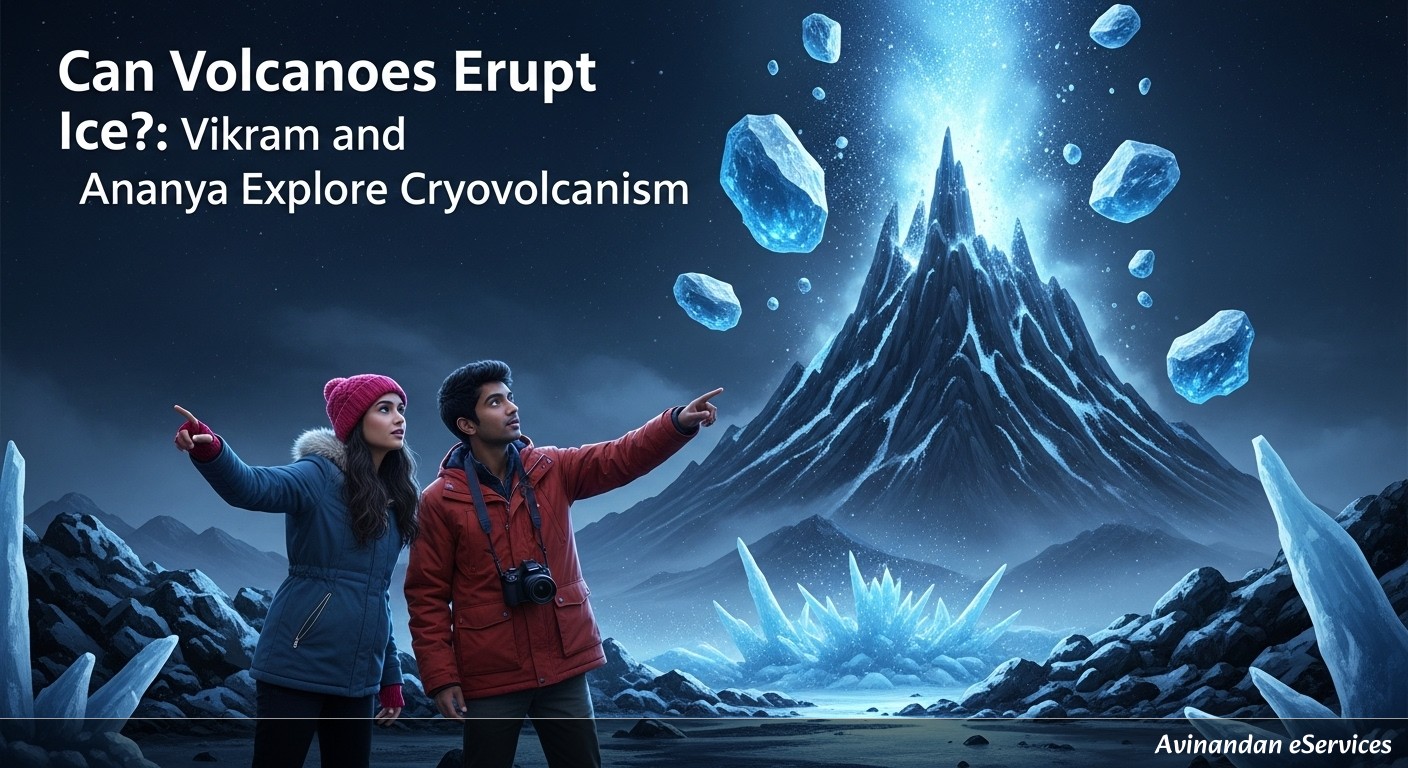
A Super-Cool Chat About Volcanoes That Aren't Hot!
Vikram: Ananya, I was just reading a comic book about a superhero on a frozen planet who makes volcanoes shoot out giant beams of ice. It was so cool, but it's totally made up, right? Volcanoes are all about fiery, hot lava!
Ananya: That's what I thought too, Vikram! On Earth, you're absolutely right. Our volcanoes are like fiery mountains. But what if I told you that in our very own solar system, there are real volcanoes that erupt ice? They're called cryovolcanoes!
Vikram: Wait, seriously? Cryo-what? Ice volcanoes? No way! How can something be a volcano if it’s frozen? That sounds like a total opposite!
Ananya: It does sound strange, doesn't it? The 'cryo' part comes from a Greek word meaning 'cold' or 'ice'. So 'cryovolcano' literally means 'ice volcano'. They don't exist here on our warm planet, but far away on the icy moons of giant planets like Saturn and Neptune.
Vikram: Wow! So how do they work? Our volcanoes erupt because it's super hot deep inside the Earth, and the molten rock, or magma, has to escape. Is it hot inside those icy moons, too?
Ananya: That’s the brilliant question! It’s not hot in the same way. The core of a small, icy moon isn't a giant furnace like Earth's. Instead, they get their energy from something called 'tidal heating'.
Vikram: Tidal heating? Like the tides in the ocean?
Ananya: Exactly like that! Imagine holding a small rubber ball in your hand. If you keep squeezing and stretching it, the ball will start to get warm from the friction. Now, picture a tiny moon, like Saturn's moon Enceladus. Saturn is huge, so its gravity is incredibly strong. As Enceladus orbits, Saturn's gravity constantly pulls and stretches it. This constant squeezing and stretching heats up the moon's interior, just enough to melt some of the ice deep below its frozen surface.
Vikram: Okay, I get it! The giant planet is like a giant hand squeezing the moon until its insides get warm and melty. So what actually shoots out? Is it just melted water?
Ananya: It's a bit more like a slushy! Scientists call it 'cryomagma'. It’s often a mixture of liquid water, ammonia, and methane. The amazing thing is that substances like ammonia act like antifreeze, allowing the mixture to stay liquid at \textremely low temperatures, well below zero degrees Celsius!
Vikram: So this super-cold slush builds up pressure under the icy shell of the moon?
Ananya: You've got it! The pressure builds and builds until—whoosh! The cryomagma bursts through cracks in the surface, erupting out into space as a plume of ice crystals, water vapour, and other gases. They look more like giant geysers than the lava-spewing volcanoes we see in movies.
Vikram: That is mind-blowing! So they're like giant space sprinklers! Have we ever actually seen one of these eruptions happen?
Ananya: We have! It's one of the most exciting discoveries in space exploration. A NASA spacecraft called Cassini flew past Enceladus many times. It actually flew right through the giant plumes erupting from its south pole! Its instruments confirmed they were made of tiny water ice particles and vapour, which proved that cryovolcanoes are real. It's how we know there's a liquid water ocean hiding under all that ice.
Vikram: That's incredible! So a science fiction idea from my comic book is actually real science happening on other worlds. Space is even cooler than I thought. So instead of making a planet hot and fiery, these volcanoes just add more ice and frost to the surface.
Ananya: Exactly! They are a totally different kind of volcano for a totally different kind of world. It just shows how creative the universe can be.
So, What Did We Learn Today?
Ananya: Let's quickly go over what we discovered about these amazing ice volcanoes!
- Cryovolcanoes are real volcanoes that erupt icy, slushy material instead of hot, molten rock.
- They are found on the icy moons of planets in the outer solar system, like Enceladus (a moon of Saturn) and Triton (a moon of Neptune).
- They aren't powered by a hot core, but by 'tidal heating'—the friction created when a giant planet's gravity stretches and squeezes its moon.
- The material that erupts, called cryomagma, is a mix of water, ammonia, and methane that can stay liquid at freezing temperatures.
- Real spacecraft, like NASA's Cassini, have flown through their plumes and confirmed what they are made of!
Vikram: This is amazing! Next time someone talks about volcanoes, I'm going to tell them about the super-cool ice volcanoes of space. Thanks, Ananya!