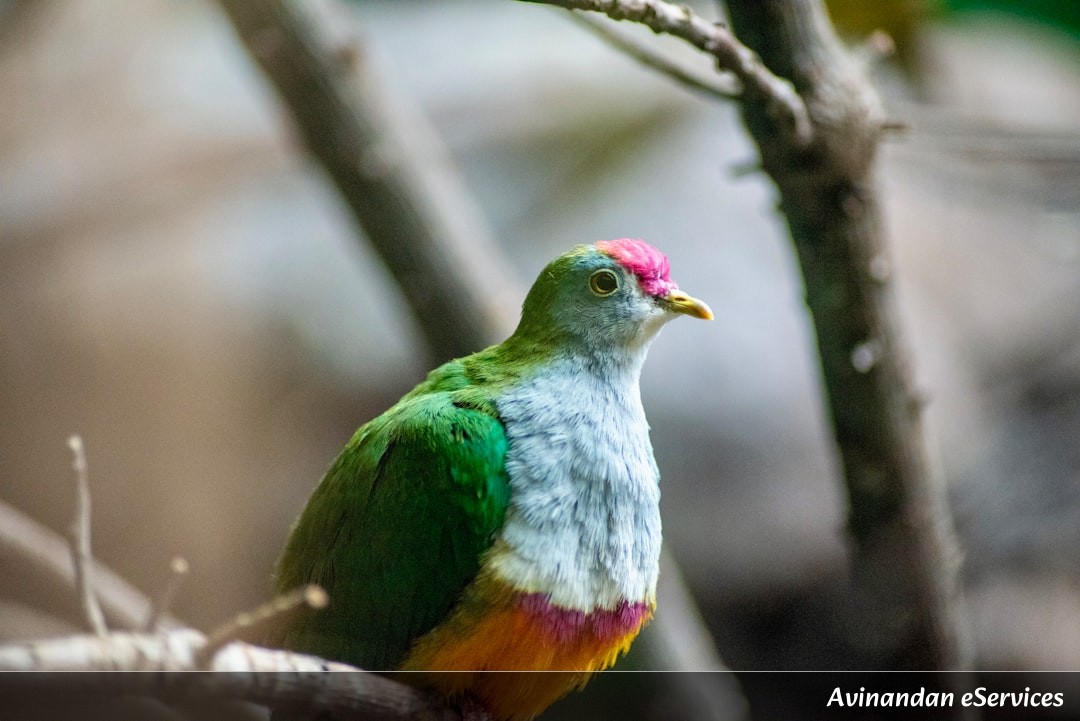
Rohan: Ananya, look at that little sparrow on the balcony! It is so... well, ordinary. Just brown, grey, and a bit of white. Don’t you wish birds in India were all as bright as the peacocks we saw at the zoo?
Ananya: Oh, Rohan, you would be absolutely shocked if you could see that sparrow through a bird’s eyes! To us, it looks like a dusty little ball of feathers, but to another bird, it might be shimmering with neon patterns that we cannot even imagine. In the bird world, there is no such thing as a 'boring' brown bird.
Rohan: Wait, what do you mean? How can a bird see something that I can’t? My eyesight is 20/20! I can see the cricket score from the back of the room!
Ananya: It’s not about how sharp your vision is, Rohan. It’s about the science of color. Humans have what we call trichromatic vision. That’s a fancy way of saying our eyes have three types of color receptors, called 'cones.' These cones are sensitive to red, green, and blue light. Every color you see—from the orange of a mango to the purple of a Jamun fruit—is just a mix of those three.
Rohan: Okay, like the RGB settings on my computer screen. But what’s different about birds?
Ananya: Most birds are 'tetrachromats.' They have a fourth type of cone in their retinas that is specifically designed to detect ultraviolet (UV) light. UV light has shorter wavelengths than the blue light we can see, so it is completely invisible to humans. But for birds, it’s a whole \textra dimension of color!
Rohan: A whole \textra dimension? That sounds like a superpower! Is it like X-ray vision?
Ananya: Not exactly X-ray, but it is definitely a superpower! Think about it: because they see UV light, the world looks entirely different to them. For example, some flowers that look like a solid color to us actually have 'nectar guides'—special patterns that only appear in UV light—that act like landing lights on a runway to show birds exactly where the food is.
Rohan: Wow! So the flowers are basically talking to the birds in a secret code?
Ananya: Exactly! And it’s not just for finding flowers. Many birds use this to find breakfast in much grosser ways. Have you ever heard of a bird called a Kestrel? It’s a type of falcon. They hunt small rodents called voles. It turns out that vole urine reflects UV light. So, a Kestrel flying high in the sky can see glowing UV trails on the ground, almost like a glowing map leading straight to the vole’s burrow!
Rohan: That is both amazing and very disgusting, Ananya. But why would that 'boring' sparrow need UV vision? It’s not hunting voles.
Ananya: For many songbirds, UV vision is all about family and fashion. To our eyes, a male and female sparrow might look almost identical. But in UV light, the male’s feathers might be incredibly bright and reflective, helping the female pick the strongest mate. It also helps them tell their eggs apart. Some sneaky birds, like the Cuckoo, try to lay their eggs in other birds' nests. To us, the eggs look the same, but the parent birds can sometimes spot the 'fake' egg because it reflects UV light differently.
Rohan: I feel like I’m missing out on half the world! Why don't we have this fourth cone? Did humans ever have it?
Ananya: Scientists believe our very distant mammalian ancestors actually lost those \textra cones millions of years ago. Back in the time of the dinosaurs, most mammals were small and nocturnal—they only came out at night. Since you don't need fancy color vision in the dark, they lost the UV and even some other color receptors. We eventually gained some color vision back, but we never got that fourth UV cone back like birds, reptiles, and some fish did.
Rohan: So, we are actually the ones with 'limited' vision compared to the birds in our backyard. Does the sky look different to them too?
Ananya: Most likely! For us, the sky is blue because of how sunlight scatters. For a bird, the sky might have gradients of UV light that help them figure out exactly where the sun is, even on a cloudy day. It helps them navigate during those long migrations across the ocean.
Rohan: This changes everything. Next time I see a crow or a sparrow, I’m going to imagine them wearing a glowing, UV-neon superhero suit.
Ananya: That’s the spirit, Rohan! Nature is always much more colorful than it first appears.
So, What Did We Learn Today?
- Tetrachromacy: Most birds have four types of color cones in their eyes, while humans only have three.
- Ultraviolet Light: The fourth cone allows birds to see UV light, which is a part of the light spectrum invisible to the human eye.
- Finding Food: Birds use UV vision to see secret patterns on flowers or even track the trails left by prey.
- Social Lives: Birds use UV-reflective feathers to identify each other and choose mates, even when they look 'plain' to us.
- Evolutionary History: Humans have 'trichromatic' vision because our ancestors were nocturnal and didn't need as many color receptors.
Rohan: Science really makes you realize that just because we can't see something, doesn't mean it isn't there in bright, beautiful color!