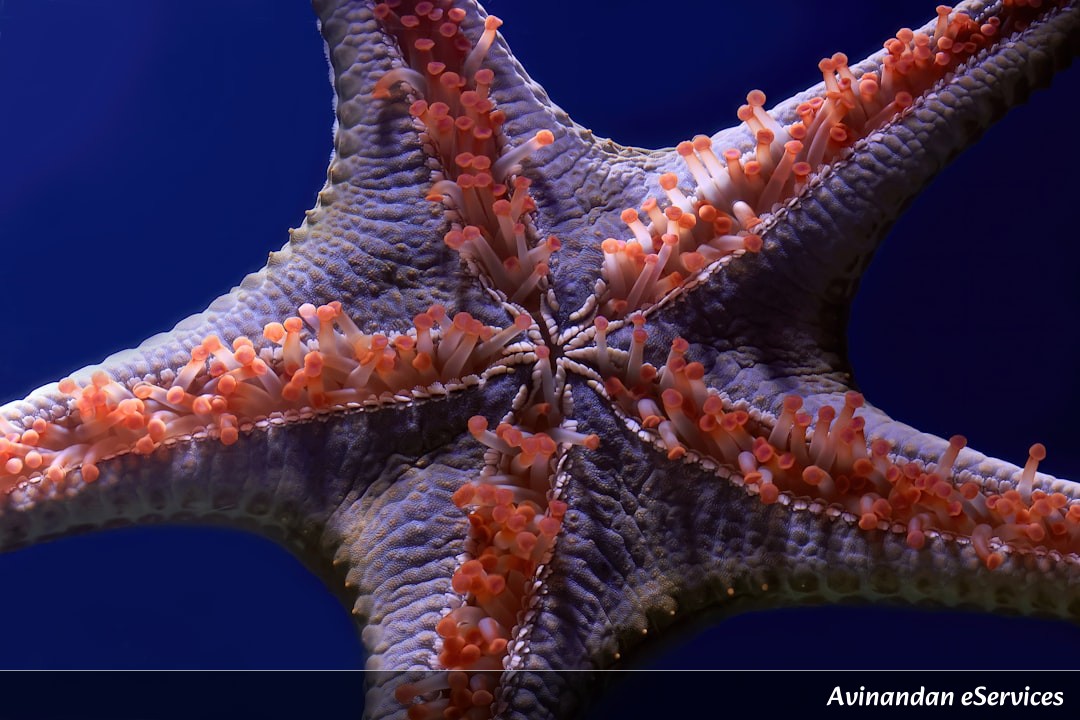
Aarav: Priya, look at this photo I took at the beach in Goa last week! This red starfish was just sitting on a rock. But honestly, I felt kind of bad for it. I mean, it must be so boring to just sit there and not be able to see the beautiful ocean around you.
Priya: That is a great photo, Aarav! But why do you think it can’t see? Starfish might not have big, bubbly eyes like yours, but they definitely aren’t blind.
Aarav: Wait, what? I looked everywhere for eyes! There’s no face, no head, and definitely no eyes in the middle of its body. Is it like a mole? Does it just feel its way around with those tiny tube feet?
Priya: Actually, it’s much weirder than that. Starfish have eyes, but they are hiding in plain sight. They are located at the very tips of their arms!
Aarav: No way! You’re telling me that if a starfish has five arms, it has five eyes? And they’re at the ends of the arms? That sounds like a sci-fi alien!
Priya: It really does! These are called 'eyespots.' If you look really closely at the very tip of each arm, you’ll see a tiny red or orange dot. Each of those dots is a compound eye, similar to the eyes of an insect, but much simpler.
Aarav: Wow, how does that even work? If I had eyes on my fingertips, I’d be seeing my own shoes all day. How does a starfish process five different images at once without a brain?
Priya: That’s the fascinating part. Starfish don’t have a centralized brain like we do. Instead, they have a complex nervous system with a 'nerve ring' in the center and nerves running down each arm. Each eyespot sends signals to the arm it’s on. It’s like having five little mini-computers working together to decide where to go!
Aarav: So, if they see through these eyespots, can they see me? Like, could that starfish see me taking its picture?
Priya: Not exactly. Their vision is very basic. Scientists used to think they could only tell the difference between light and dark, but a big study back in 2014 proved they can actually see 'images' of a sort. However, those images are very blurry and have no color. To a starfish, the world looks like a pixelated, low-resolution black-and-white movie.
Aarav: If the vision is so blurry, what’s the point? They can’t see a predator coming or find a tiny snack, can they?
Priya: You’re right, they can't see details. But they use their eyes for something much more important: finding home. For many starfish, 'home' is a coral reef. A coral reef is a big, dark shape against the bright, sunlit water of the open ocean. By using their eyespots to find those big dark blobs, they make sure they don’t accidentally wander off into the deep, empty sea where they would starve.
Aarav: That makes so much sense! It’s like a biological GPS that only looks for the biggest landmark. But Priya, what happens if a starfish loses an arm? Does it lose its vision too?
Priya: Well, it would lose one 'eye,' but starfish are famous for their ability to regenerate. If a predator bites off an arm, the starfish can grow a completely new one, and a brand-new eyespot will grow right back at the tip! It’s like having a spare set of eyes that can replace themselves.
Aarav: That is officially the coolest thing I’ve heard all week. They are like five-armed, multi-eyed, self-repairing robots of the sea. I’m going to look way more closely at the next one I see!
Priya: Just remember to be gentle! They are very sensitive. The fact that they can navigate a whole reef with just a few tiny dots of light is a reminder of how diverse life can be. We think our way of seeing is the only way, but nature has thousands of different designs for 'eyes.'
So, What Did We Learn Today?
- Priya: Starfish have eyespots at the very tip of each of their arms, meaning a five-armed starfish has five eyes!
- Aarav: These eyes are compound eyes, similar to those of insects, but they don't see colors or sharp details like we do.
- Priya: Their vision is mostly used to detect large, dark objects like coral reefs, which helps them stay in their habitat and avoid getting lost in the open ocean.
- Aarav: Even though they don't have a central brain, their nervous system coordinates the signals from all their different 'arm-eyes' to help them move!
- Priya: And best of all, if they lose an arm, they can regrow both the arm and the eye!