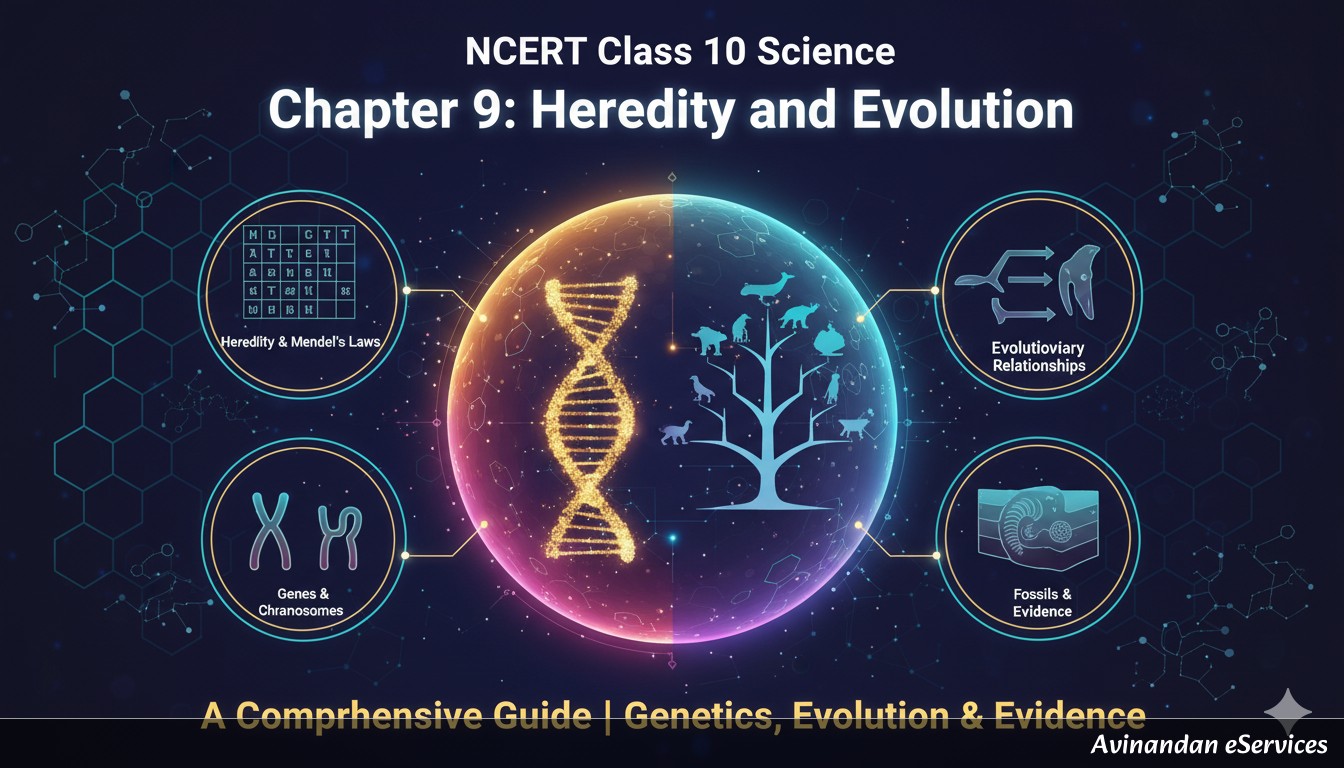
Introduction to Heredity and Evolution
Welcome, students, to a fascinating journey into the very blueprint of life! Chapter 9 of your Class 10 Science syllabus, 'Heredity and Evolution,' delves into two of the most fundamental concepts in biology. Have you ever wondered why you have your mother's eyes or your father's height? That's heredity – the process of passing traits from one generation to the next. But life isn't just about similarities. We also see incredible diversity, from the smallest bacterium to the largest whale. How did this diversity come to be? That's the story of evolution – the gradual change in living organisms over millions of years. This chapter connects these two ideas, showing how the inheritance of traits, combined with variations, drives the magnificent process of evolution. Understanding these principles is key to understanding ourselves and the world around us.
Accumulation of Variation during Reproduction
The foundation of both heredity and evolution is reproduction. Reproduction ensures the continuation of a species, but it also introduces something crucial: variation. Variation refers to the differences found among individuals of the same species. No two individuals (except identical twins) are exactly alike. But where do these variations come from?
The accuracy of DNA (Deoxyribonucleic Acid) copying during cell division is remarkably high, but not perfect. Minor errors or changes can occur, leading to new variations. This process is more pronounced in different modes of reproduction:
- Asexual Reproduction: In this mode, a single parent is involved. Offspring are genetically very similar to the parent, and variations are rare. They arise mainly from small inaccuracies in DNA replication. While the number of variations is low, they can still be significant over long periods, especially in organisms that reproduce rapidly, like bacteria.
- Sexual Reproduction: This involves two parents and the fusion of their gametes (sex cells). This process shuffles the genetic material from both parents, creating unique combinations of genes in the offspring. This reshuffling is a major source of variation. Offspring inherit traits from both parents but in a new combination, making them different from their parents and siblings.
Why is variation important? Variation is the raw material for evolution. It provides a species with the diversity needed to adapt to changing environments. For example, consider a population of bacteria living in temperate water. If the water temperature suddenly increases due to global warming, most bacteria might die. However, if a few bacteria have a pre-existing variation that makes them resistant to heat, they will survive, reproduce, and pass this trait to their offspring. Over time, the entire population will become heat-resistant. Without that initial variation, the species would have gone \textinct.
Heredity: The Passing of Traits
Heredity is the mechanism by which traits or characteristics are passed from parents to offspring. The scientific study of heredity and variation is called genetics.
Mendel's Contribution to Genetics
For a long time, people knew that traits were inherited, but the rules were a mystery. It was an Austrian monk, Gregor Johann Mendel (1822-1884), who first unlocked these secrets. Through his meticulous experiments on garden pea plants (Pisum sativum), he laid the foundation for modern genetics. For this reason, he is rightly called the 'Father of Genetics'.
Mendel chose pea plants because they were ideal for his experiments:
- They had several easily observable, contrasting traits (e.g., tall/dwarf height, round/wrinkled seeds).
- They are normally self-pollinating but can be easily cross-pollinated manually.
- They have a short life cycle, allowing for the study of several generations in a short time.
Mendel's Monohybrid Cross
A monohybrid cross is a cross between two parents that differ in only one pair of contrasting traits. Mendel's most famous experiment involved plant height.
The Experiment:
- Parental Generation (P): Mendel took a pure-bred tall pea plant (genotype TT) and a pure-bred dwarf pea plant (genotype tt) and cross-pollinated them.
- First Filial Generation (F1): He observed that all the plants in the F1 generation were tall. The dwarf trait seemed to have disappeared! From this, Mendel concluded that the trait for tallness was dominant over the trait for dwarfness, which he called recessive. The genotype of all F1 plants was Tt.
- Second Filial Generation (F2): Next, Mendel allowed the F1 generation plants (Tt) to self-pollinate. In the F2 generation, he found that both tall and dwarf plants appeared. Out of 1064 plants, 787 were tall and 277 were dwarf. This is approximately a 3:1 ratio.
Conclusions from the Monohybrid Cross:
- Law of Dominance: When two different alleles (alternative forms of a gene) for a trait are present in an individual, only one, the dominant allele, expresses itself. The other, the recessive allele, remains hidden. (Tallness (T) is dominant over dwarfness (t)).
- Law of Segregation: The two alleles for a trait separate (segregate) from each other during the formation of gametes (sperm and egg cells), so that each gamete receives only one allele for that trait. They then randomly re-combine during fertilization. This explains why the dwarf trait reappeared in the F2 generation.
The results can be visualized using a Punnett square, which predicts the genotypes of the offspring. The genotypic ratio in the F2 generation was 1 TT : 2 Tt : 1 tt, while the phenotypic (observable trait) ratio was 3 Tall : 1 Dwarf.
Mendel's Dihybrid Cross
Building on his success, Mendel then studied the inheritance of two pairs of contrasting traits simultaneously. This is known as a dihybrid cross. For example, he crossed a plant with round, yellow seeds (RRYY) with a plant with wrinkled, green seeds (rryy).
The Experiment:
- Parental Generation (P): A pure-bred plant with Round Yellow seeds (RRYY) was crossed with a pure-bred plant with Wrinkled Green seeds (rryy).
- First Filial Generation (F1): All plants in the F1 generation produced Round Yellow seeds. This confirmed that Round (R) is dominant over wrinkled (r), and Yellow (Y) is dominant over green (y). The genotype of all F1 plants was RrYy.
- Second Filial Generation (F2): Mendel self-pollinated the F1 plants (RrYy). The F2 generation showed four different phenotypes in a specific ratio: Round Yellow, Round Green, Wrinkled Yellow, and Wrinkled Green. The phenotypic ratio was approximately 9:3:3:1.
Conclusion from the Dihybrid Cross:
- Law of Independent Assortment: This law states that when two or more pairs of traits are inherited together, the alleles for each trait assort independently of the alleles for the other traits during gamete formation. In simple terms, the inheritance of seed shape (Round/Wrinkled) has no effect on the inheritance of seed color (Yellow/Green).
How are Traits Expressed? The Mechanism of Heredity
Mendel described the 'factors' that are passed down, which we now call genes. But how do these genes actually create a trait like 'tallness'?
The process begins with DNA, the molecule of life. DNA is found in the chromosomes within the nucleus of our cells.
- DNA contains information: A gene is a specific segment of DNA that holds the instructions to build a particular protein.
- Proteins do the work: The cell uses the gene's instructions to synthesize a protein. These proteins can be enzymes, hormones, or structural components.
- Proteins determine traits: The action of these proteins results in the observable trait (phenotype). For example, a gene for 'tallness' might code for an enzyme that produces a growth hormone. A functional gene produces an efficient enzyme, leading to more hormone and a tall plant. A altered or less-efficient version of the gene (the recessive allele) might produce a less effective enzyme, resulting in less hormone and a dwarf plant.
Therefore, heredity is a story of information flow: DNA (gene) → Protein → Trait.
Sex Determination in Humans
One of the most fundamental inherited traits is an individual's sex. In humans, this is determined genetically.
Human cells contain 23 pairs of chromosomes. 22 of these pairs are called autosomes, which control body traits. The 23rd pair is the sex chromosomes, which determine the sex.
- Females have two identical sex chromosomes, called X chromosomes. Their genetic makeup is 44 + XX.
- Males have one X chromosome and one smaller Y chromosome. Their genetic makeup is 44 + XY.
During gamete formation (meiosis), a female produces eggs that all contain one X chromosome. A male, however, produces two types of sperm in equal numbers: half contain an X chromosome, and the other half contain a Y chromosome.
The sex of the child is determined at the moment of fertilization:
- If a sperm carrying an X chromosome fertilizes the egg (X), the resulting zygote will be XX, and the child will be a girl.
- If a sperm carrying a Y chromosome fertilizes the egg (X), the resulting zygote will be XY, and the child will be a boy.
Since the male produces two types of sperm, it is the father's contribution that determines the sex of the baby. There is always a 50% probability of having a boy and a 50% probability of having a girl. It is scientifically incorrect and socially unjust to blame the mother for the sex of the child.
Evolution: The Story of Change
While heredity explains the continuity of life, evolution explains its diversity and history. Biological evolution is the process of change in the inherited traits of a population of organisms over successive generations.
An Illustration: The Beetle Population
The NCERT textbook provides a simple yet powerful illustration using a population of red beetles living on green bushes, which are eaten by crows.
- Scenario 1: Survival of the Fittest (Natural Selection)
A natural color variation arises during reproduction, resulting in a green beetle instead of a red one. The red beetles are easily spotted and eaten by crows. The green beetle, however, is camouflaged against the green leaves and is less likely to be eaten. It survives, reproduces, and passes its green color gene to its offspring. Over generations, the green beetles have a survival advantage, and their population grows, while the red beetle population dwindles. This is natural selection: nature 'selects' individuals with advantageous traits to survive and reproduce more successfully. - Scenario 2: An Accident of Chance (Genetic Drift)
In another beetle population, a color variation results in a few blue beetles among the majority red ones. One day, an elephant randomly walks through the bushes, stamping on and killing most of the beetles. By pure chance, most of the red beetles are killed, but a few blue ones survive. This surviving blue population now reproduces, and their offspring are mostly blue. The change in the frequency of the blue gene was not due to any survival advantage but due to a random, chance event. This mechanism is called genetic drift. It is more impactful in small populations. - Scenario 3: Acquired vs. Inherited Traits
Imagine the beetle population faces a plant disease, and food becomes scarce. The beetles become undernourished and smaller in size. This change in body weight is an acquired trait—it is a change that happens during an organism's lifetime due to environmental factors. It does not change the DNA of the beetle's germ cells. Therefore, this trait of smaller size will not be passed on to the next generation. If food becomes plentiful again, the beetles will return to their normal size.
Acquired vs. Inherited Traits
This brings us to a crucial distinction:
| Inherited Traits | Acquired Traits |
|---|---|
| These are characteristics passed from parents to offspring through genes. | These are characteristics developed by an individual during its lifetime. |
| They are caused by changes in the DNA of germ cells (sperm and eggs). | They are caused by environmental influences, use/disuse of organs, or learning. |
| They can be passed on to the next generation. | They cannot be passed on to the next generation. |
| They are the raw material for evolution. | They have no role in the process of evolution. |
| Examples: Eye color, blood type, natural hair color. | Examples: Building muscles through exercise, learning to play a musical instrument, scars from injuries. |
Speciation: The Origin of New Species
Evolution, over vast periods, can lead to the formation of entirely new species from existing ones. This process is called speciation.
A species is a group of organisms that can interbreed with each other to produce fertile offspring.
Speciation can occur when a population gets split into two or more geographically isolated sub-populations. Let's revisit our beetles. Imagine a river forms and floods, splitting the beetle population into two groups on opposite banks. This is geographical isolation.
- The two populations can no longer interbreed.
- Genetic drift and natural selection will act differently on each population. For instance, on one bank, crows might be the main predator (favoring green beetles), while on the other, a different predator might exist that preys on something other than color.
- Over thousands of generations, the genetic makeup of the two populations will diverge so much that even if the river dries up and they meet again, they will be unable to reproduce with each other. They have become reproductively isolated.
- At this point, two new, distinct species have been formed.
Evolution and Classification
Evolutionary relationships are the foundation of modern biological classification. The more characteristics two species have in common, the more closely related they are, meaning they shared a more recent common ancestor.
Tracing Evolutionary Relationships: Evidence for Evolution
How do we know evolution has occurred and how do we trace these relationships? We rely on several lines of evidence.
Homologous Organs
These are organs in different species that have a similar basic structure and developmental origin but have been modified to perform different functions. Homologous structures are evidence of divergent evolution from a common ancestor.
- Example: The forelimbs of a human, a cheetah, a whale, and a bat. They all share the same basic bone pattern (humerus, radius, ulna, carpals, metacarpals, phalanges) inherited from a common mammalian ancestor. However, in humans, they are used for grasping; in cheetahs, for running; in whales, for swimming; and in bats, for flying.
Analogous Organs
These are organs in different species that have different structures and origins but perform a similar function. Analogous structures are evidence of convergent evolution, where unrelated species adapt to similar environments in similar ways.
- Example: The wings of a bird and the wings of an insect. A bird's wing is a modified forelimb with bones, flesh, and feathers. An insect's wing is a thin membrane \textension of its exoskeleton. They have completely different structures and origins but serve the same function: flight.
Fossils
Fossils are the preserved remains, traces, or impressions of organisms that lived in the geological past. They are direct evidence of evolution.
- How they help: Fossils show us what ancient organisms looked like. By arranging them in chronological order based on the rock layers (strata) they are found in, we can trace the evolutionary history of a species. Deeper layers contain older fossils.
- Dating Fossils: We can determine the age of fossils through relative dating (comparing its position to other fossils in rock layers) or absolute dating (using radiometric methods like Carbon-14 dating to find a more precise age).
- Connecting Links: Some fossils, like Archaeopteryx, act as 'connecting links'. It had features of both reptiles (teeth, long bony tail) and birds (feathers, wings), providing strong evidence that birds evolved from reptilian ancestors.
Evolution by Stages
Complex organs like the eye or wings did not appear suddenly. They evolved through a series of small, incremental changes over millions of years. Each intermediate stage, however simple, provided some survival advantage to the organism.
For example, the evolution of the eye could have started with simple light-sensitive spots (like in Planaria), which gave an organism the ability to distinguish light from dark. Gradually, more complex structures evolved, leading to the sophisticated eyes we see today.
Sometimes, a trait that evolves for one purpose can later be co-opted for a different function. This is called exaptation. For example, feathers are thought to have first evolved in dinosaurs for insulation to keep them warm. Only much later were these feathers modified and used for flight by their descendants, the birds.
Human Evolution
The story of human evolution is one of the most compelling examples of this process. It's important to correct a common misconception: humans did not evolve from modern-day chimpanzees. Rather, humans and chimpanzees share a common ancestor that lived millions of years ago, from which our two lineages diverged.
Tools for studying human evolution include excavating fossils, dating them, studying their bone structures, and analyzing DNA sequences.
While the full 'family tree' is complex and still being researched, some key highlights include:
- A vast diversity of human-like species once existed.
- The earliest members of the human genus, Homo, like Homo habilis, appeared in Africa.
- Over time, features like bipedal locomotion (walking upright), a large and complex brain, tool-making abilities, and language developed.
- Modern humans, Homo sapiens, also first arose in Africa and later migrated out to colonize the rest of the world (the 'Out of Africa' theory).
Human evolution is not a linear ladder of progress from a 'primitive' ancestor to a 'perfect' modern human. It's a complex, branching tree, with many side branches and \textinct relatives. We are the only surviving species of a once diverse group of hominins.
Important Questions and Answers
Question 1: A man with blood group A marries a woman with blood group O and their daughter has blood group O. Is this information enough to tell you which of the traits – blood group A or O – is dominant? Why or why not?
Answer: Yes, this information is enough. The gene for blood group A has two alleles, IA and i. The gene for blood group O has the allele i. A person with blood group A can have the genotype IAIA or IAi. A person with blood group O has the genotype ii.
The man has blood group A, and the woman has blood group O (ii). They have a daughter with blood group O (ii). The daughter must inherit one 'i' allele from her mother and one 'i' allele from her father. Since the father has blood group A but passed on an 'i' allele, his genotype must be IAi. The fact that he has the 'i' allele but expresses the 'A' phenotype proves that blood group A is dominant over blood group O.
Question 2: How is the sex of a child determined in human beings?
Answer: The sex of a child in humans is determined by the sex chromosomes inherited from the parents. Females have two X chromosomes (XX), while males have one X and one Y chromosome (XY). A female produces only one type of egg, each containing an X chromosome. A male produces two types of sperm in equal proportions: 50% carry an X chromosome and 50% carry a Y chromosome. If an X-carrying sperm fertilizes the egg, the child will be a girl (XX). If a Y-carrying sperm fertilizes the egg, the child will be a boy (XY). Therefore, it is the sperm from the father that determines the sex of the child.
Question 3: Differentiate between homologous and analogous organs with examples.
Answer:
Homologous Organs: These are organs that have a common basic structure and origin but have evolved to perform different functions in different species. They indicate a common ancestry. For example, the forelimbs of a human, a bat, and a whale all share a similar bone structure but are used for grasping, flying, and swimming, respectively.
Analogous Organs: These are organs that have different origins and structures but have evolved to perform a similar function. They do not indicate common ancestry but rather convergent evolution. For example, the wings of a bird and the wings of an insect both serve the function of flight, but their underlying structures are completely different.
Question 4: What are fossils? What do they tell us about the process of evolution?
Answer: Fossils are the preserved remains or traces of organisms that lived in the distant past. They can be bones, teeth, shells, impressions, or footprints preserved in rocks.
Fossils provide direct evidence for evolution in several ways:
- They show that life on Earth was different in the past.
- By arranging fossils chronologically, we can observe the gradual changes in species over time.
- They can reveal 'transitional forms' or 'connecting links' between different groups of organisms (like Archaeopteryx between reptiles and birds), showing how one group evolved from another.
- Fossils help us reconstruct the evolutionary history (phylogeny) of living organisms.
Chapter Summary
- Heredity is the transmission of traits from parents to offspring. The study of heredity is called genetics.
- Gregor Mendel, through his experiments on pea plants, established the fundamental laws of inheritance: the Law of Dominance, the Law of Segregation, and the Law of Independent Assortment.
- Genes, which are segments of DNA on chromosomes, control the expression of traits by coding for proteins.
- Variation refers to the differences among individuals of a species. It arises from DNA copying errors and is greatly enhanced by sexual reproduction.
- In humans, sex is determined by the X and Y chromosomes. Females are XX and males are XY. The father's sperm determines the sex of the child.
- Evolution is the gradual change in the inherited characteristics of a population over generations.
- The main mechanisms of evolution are natural selection (survival of the fittest) and genetic drift (random chance events).
- Speciation is the formation of new species, often occurring when a population is divided by geographical isolation, leading to reproductive isolation.
- Evidence for evolution comes from the study of homologous organs, analogous organs, and fossils.
- Evolution happens in stages, and complex organs evolve through gradual modifications over long periods.
- Humans and modern apes share a common ancestor. Human evolution is a complex, branching process that originated in Africa.