Introduction to Work and Energy
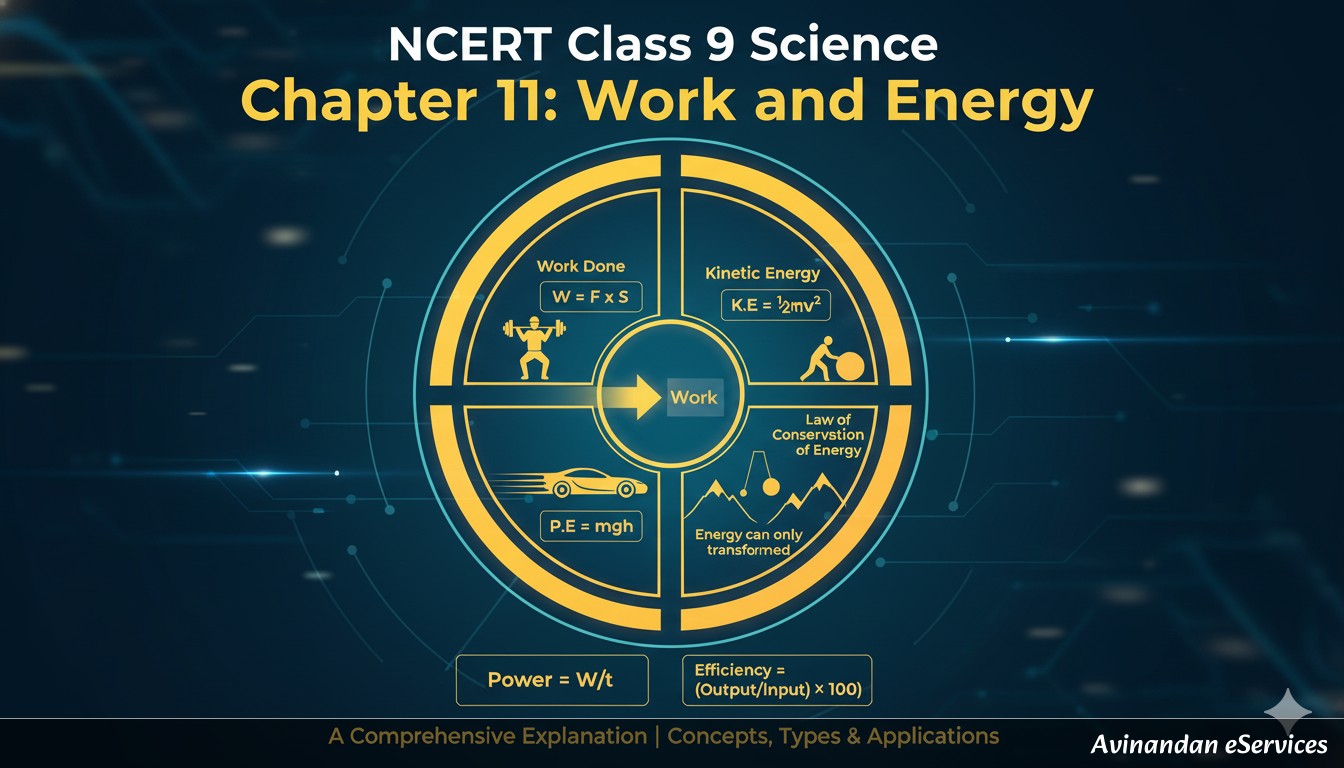
Welcome, students! In our daily lives, we use words like 'work' and 'energy' very frequently. We say we are 'working' hard while studying, or we feel 'energetic' after a good meal. But in the world of science, especially in Physics, these terms have very precise and specific meanings. This chapter, 'Work and Energy' from your Class 9 Science syllabus, will introduce you to these scientific definitions. Understanding these concepts is fundamental because they govern everything that happens in the universe, from a ball rolling down a hill to the stars shining in the sky. We will explore what it means to do 'work' in a scientific sense, what 'energy' is and its various forms, and how the two are interconnected. We will also delve into the concept of 'power', which tells us how fast work is done, and uncover one of the most fundamental laws of nature: the Law of Conservation of Energy. So, let's begin this exciting journey to understand the mechanics of our world!
What is Work in Science?
In everyday language, any activity that requires physical or mental effort is called work. A student preparing for an exam, a person holding a heavy suitcase without moving, or an artist painting a landscape are all said to be 'working'. However, the scientific definition of work is much more specific and requires two conditions to be met:
- A force should act on an object.
- The object must be displaced (it must move from one position to another).
If either of these conditions is not met, no work is done in the scientific sense. For example, if you push a massive wall with all your might, you will get tired, but if the wall doesn't move, you have done zero scientific work on the wall. This is because there was no displacement.
Scientific Conception of Work
Work is done by a force when the force applied to an object causes the object to move in the direction of the force. The amount of work done is calculated as the product of the magnitude of the force and the displacement of the object along the direction of the force.
Mathematically, if a constant force F acts on an object and the object is displaced by a distance s in the direction of the force, then the work done, W, is given by:
Work (W) = Force (F) × Displacement (s)
This formula is central to understanding the concept. Let's break it down:
- W is the work done.
- F is the magnitude of the constant force applied.
- s is the magnitude of the displacement.
Unit of Work
The SI unit of force is the newton (N), and the SI unit of displacement is the metre (m). Therefore, the SI unit of work is the newton-metre (N m). This unit has been given a special name, the joule (J), in honour of the physicist James Prescott Joule.
So, 1 joule is defined as the amount of work done on an object when a force of 1 newton displaces it by 1 metre along the line of action of the force.
1 J = 1 N × 1 m
Positive, Negative, and Zero Work
Work is a scalar quantity, meaning it has magnitude but no direction. However, it can be positive, negative, or zero, depending on the direction of the force relative to the direction of displacement.
Positive Work
Work done is considered positive when the force applied is in the same direction as the displacement of the object. In this case, the force helps the motion.
Example: When you kick a football, the force you apply and the displacement of the football are in the same direction. The work done by you on the ball is positive. Similarly, a horse pulling a cart is doing positive work.
Negative Work
Work done is considered negative when the force applied is in the opposite direction to the displacement of the object. In this case, the force opposes the motion.
Example 1: Friction. When a box is slid across the floor, the force of friction acts in the direction opposite to its motion. Therefore, the work done by the frictional force is negative.
Example 2: Gravity. When you lift an object upwards, you apply an upward force, and the object moves upwards. The work done by you is positive. However, the force of gravity is acting downwards, opposite to the displacement. So, the work done by gravity is negative.
Zero Work
Work done is zero in the following two scenarios:
- When there is no displacement (s = 0): As discussed, pushing a stationary wall results in zero work because s = 0, even though a large force is applied.
- When the force is perpendicular to the displacement: If the angle between the force and displacement is 90°, the work done is zero.
Example 1: A coolie carrying a load. A porter carrying a suitcase on his head and walking on a horizontal platform is doing zero work on the suitcase with respect to gravity. The force he applies to support the suitcase is vertically upwards, while his displacement is horizontal. Since the force and displacement are perpendicular to each other, the work done is zero.
Example 2: Earth revolving around the Sun. The Earth moves in a nearly circular orbit around the Sun. The Sun's gravitational force acts towards the center of the circle (along the radius), while the Earth's displacement at any instant is along the tangent. Since the radius and tangent are perpendicular, the work done by the Sun's gravity on the Earth is zero.
Energy: The Capacity to Do Work
Now that we understand work, let's move on to energy. An object that has the capability to do work is said to possess energy. In simple terms, energy is the capacity to do work. The object which does the work loses energy, and the object on which the work is done gains energy.
Since energy is a measure of the total work an object can do, the unit of energy is the same as the unit of work. The SI unit of energy is the joule (J).
1 kilojoule (kJ) = 1000 J
Forms of Energy
Energy exists in many different forms in the universe. Some of the common forms you might be familiar with include:
- Mechanical Energy: The sum of kinetic and potential energy. This is the main focus of our chapter.
- Heat Energy: Energy associated with the random motion of atoms and molecules.
- Chemical Energy: Energy stored in the bonds of chemical compounds (e.g., in food, batteries, fuel).
- Electrical Energy: Energy of moving electric charges (electrons).
- Light Energy: A form of electromagnetic radiation that is visible to the human eye.
- Nuclear Energy: Energy stored in the nucleus of an atom.
In this chapter, we will focus primarily on mechanical energy, which is further divided into two types: kinetic energy and potential energy.
Kinetic Energy
An object in motion possesses energy. This energy due to the motion of an object is called kinetic energy. A speeding car, a rolling stone, a flying bird, and flowing water all possess kinetic energy. The amount of kinetic energy an object has depends on two factors: its mass and its velocity (or speed).
Formula for Kinetic Energy
Consider an object of mass m, initially at rest. Let a constant force F be applied to it, causing it to accelerate to a velocity v over a displacement s. The work done on the object is W = F × s.
From the second law of motion, we know F = m × a. So, W = (m × a) × s.
From the third equation of motion, we have v² - u² = 2as. Since the object starts from rest, u = 0. So, v² = 2as, which gives us s = v² / 2a.
Now, substitute the value of s back into the work equation:
W = m × a × (v² / 2a)
The 'a' cancels out, and we are left with:
W = ½ mv²
This work done on the object to bring it to a velocity 'v' is stored in the object as its kinetic energy (Eₖ). Therefore, the kinetic energy of an object of mass m moving with a uniform velocity v is:
Eₖ = ½ mv²
From this formula, we can see that if you double the mass of an object, you double its kinetic energy. However, if you double its velocity, you quadruple its kinetic energy (because of the v² term)! This is why high-speed collisions are so much more destructive.
Potential Energy
Potential energy is the 'stored' energy that an object possesses due to its position or configuration. It is the energy that has the 'potential' to be converted into other forms of energy, like kinetic energy.
- Energy due to position: A book placed on a high shelf has potential energy. If it falls, this potential energy gets converted into kinetic energy. The water stored in a dam has a huge amount of potential energy due to its height.
- Energy due to configuration (shape): A stretched rubber band or a compressed spring has potential energy. When you release it, this stored energy is converted into kinetic energy. The string of a bow, when pulled back, stores potential energy.
Potential Energy of an Object at a Height
Let's derive the expression for the potential energy of an object due to its height. This is also known as gravitational potential energy.
Consider an object of mass m. To lift it to a height h from the ground, we must apply a force. The minimum force required to lift the object is equal to its weight, which is F = mg, where 'g' is the acceleration due to gravity.
The work done (W) in lifting the object is the product of the force and the displacement (which is the height h).
W = Force × Displacement
W = (mg) × h
W = mgh
This work done against gravity is stored in the object as its potential energy (Eₚ). Therefore, the gravitational potential energy of an object at a height h is:
Eₚ = mgh
It is important to note that the value of potential energy depends on the chosen reference level or 'ground level'. The height 'h' is always measured relative to a reference point (usually the ground), where the potential energy is considered to be zero.
Law of Conservation of Energy
One of the most profound and fundamental principles in all of science is the law of conservation of energy. It states that:
Energy can neither be created nor destroyed; it can only be transformed from one form to another. The total energy of an isolated system remains constant.
This means that whenever energy seems to disappear in one form, it reappears in an equal amount in other forms. Let's understand this with the classic example of a freely falling body.
Conservation of Energy in a Freely Falling Body
Consider an object of mass m at a height h above the ground. For simplicity, we will ignore air resistance.
Position A (at height h):
- The object is stationary, so its velocity is 0. Kinetic Energy (KE) = ½ m(0)² = 0.
- Potential Energy (PE) = mgh.
- Total Mechanical Energy = KE + PE = 0 + mgh = mgh
Position B (falling, at height x from the ground):
- The object has fallen a distance of (h-x). Let its velocity at this point be v₁.
- Using v² = u² + 2as, we get v₁² = 0² + 2g(h-x) = 2g(h-x).
- Kinetic Energy (KE) = ½ mv₁² = ½ m [2g(h-x)] = mg(h-x) = mgh - mgx.
- Potential Energy (PE) at height x is mgx.
- Total Mechanical Energy = KE + PE = (mgh - mgx) + mgx = mgh
Position C (just before hitting the ground):
- The height is 0. Potential Energy (PE) = mg(0) = 0.
- The object has fallen a total distance of h. Let its final velocity be v₂.
- Using v² = u² + 2as, we get v₂² = 0² + 2gh = 2gh.
- Kinetic Energy (KE) = ½ mv₂² = ½ m (2gh) = mgh.
- Total Mechanical Energy = KE + PE = mgh + 0 = mgh
As you can see, at all three points (and any point in between), the total mechanical energy (PE + KE) of the object remains constant at mgh. The potential energy gradually transforms into kinetic energy as the object falls, but their sum is always the same. This perfectly illustrates the law of conservation of energy.
Rate of Doing Work: Power
Sometimes, it's not just about how much work is done, but also about how fast it is done. Two people might do the same amount of work, say lifting 10 bricks to the first floor, but one might do it in 2 minutes while the other takes 10 minutes. The person who does it faster is considered more 'powerful'.
Power is defined as the rate at which work is done, or the rate of transfer of energy.
If an amount of work W is done in time t, then power P is given by:
Power (P) = Work (W) / Time (t)
Unit of Power
The SI unit of work is the joule (J) and the unit of time is the second (s). Therefore, the SI unit of power is the joule per second (J/s). This unit is called the watt (W), in honour of the scientist James Watt.
1 watt is the power of an agent which does work at the rate of 1 joule per second.
1 W = 1 J/s
Since power is often large, we use bigger units like the kilowatt (kW).
1 kilowatt (kW) = 1000 watts (W)
An alternative formula for power can be derived: P = W/t = (F × s) / t. Since s/t (displacement/time) is velocity (v), we get:
P = F × v
This means power is also the product of force and the average velocity.
Commercial Unit of Energy
The joule is a very small unit of energy. Using it to measure the large amounts of energy consumed in homes, industries, and businesses would result in inconveniently large numbers. For this reason, a larger commercial unit of energy called the kilowatt-hour (kWh) is used.
One kilowatt-hour is the amount of energy consumed when an electrical appliance with a power rating of 1 kilowatt is used for 1 hour.
Let's find the relationship between kWh and joules:
1 kWh = 1 kilowatt × 1 hour
1 kWh = 1000 watts × (60 × 60 seconds)
1 kWh = 1000 J/s × 3600 s
1 kWh = 3,600,000 J = 3.6 × 10⁶ J
The electricity bills you receive at home measure energy consumption in 'units'. One 'unit' of electricity is equal to one kilowatt-hour (1 kWh).
Important Questions and Answers
Here are some solved questions from the NCERT chapter exercises to help you solidify your understanding.
Question 1: A force of 7 N acts on an object. The displacement is, say 8 m, in the direction of the force. Let us take it that the force acts on the object through the displacement. What is the work done in this case?
Answer:
Given:
- Force (F) = 7 N
- Displacement (s) = 8 m
The force is acting in the direction of the displacement.
The formula for work done is: W = Force × Displacement
W = F × s
W = 7 N × 8 m
W = 56 N m
W = 56 J
Therefore, the work done on the object is 56 joules.
Question 2: What is the kinetic energy of an object? Write an expression for the kinetic energy of an object.
Answer:
Kinetic energy is the energy possessed by an object due to its motion. Any moving object has the capacity to do work, and this capacity is its kinetic energy. The amount of kinetic energy depends on the object's mass and its velocity.
The expression for the kinetic energy (Eₖ) of an object of mass 'm' moving with a velocity 'v' is:
Eₖ = ½ mv²
Where:
- Eₖ is the kinetic energy in joules (J).
- m is the mass of the object in kilograms (kg).
- v is the velocity of the object in metres per second (m/s).
Question 3: An object of mass 15 kg is moving with a uniform velocity of 4 m/s. What is the kinetic energy possessed by the object?
Answer:
Given:
- Mass (m) = 15 kg
- Velocity (v) = 4 m/s
The formula for kinetic energy is Eₖ = ½ mv²
Substitute the given values into the formula:
Eₖ = ½ × 15 kg × (4 m/s)²
Eₖ = ½ × 15 × 16
Eₖ = 15 × 8
Eₖ = 120 J
Therefore, the kinetic energy possessed by the object is 120 joules.
Question 4: An electric heater is rated 1500 W. How much energy does it use in 10 hours?
Answer:
Given:
- Power (P) = 1500 W
- Time (t) = 10 hours
First, let's convert the power from watts (W) to kilowatts (kW) since we want to find the energy in the commercial unit (kWh).
P = 1500 W = 1500 / 1000 kW = 1.5 kW
The formula relating energy, power, and time is: Energy = Power × Time
Energy = 1.5 kW × 10 h
Energy = 15 kWh
The electric heater uses 15 kWh or 15 units of energy in 10 hours.
If we want the answer in joules:
Energy = 15 kWh = 15 × 3.6 × 10⁶ J = 54 × 10⁶ J = 5.4 × 10⁷ J.
Chapter Summary
Let's quickly recap the key concepts we've learned in this chapter.
- Work: In science, work is done when a force causes an object to displace in the direction of the force. W = F × s.
- Joule (J): The SI unit of work and energy. 1 J of work is done when a force of 1 N displaces an object by 1 m.
- Positive, Negative, Zero Work: Work is positive if force is in the direction of displacement, negative if opposite, and zero if force is perpendicular to displacement or if there is no displacement.
- Energy: The capacity to do work. Its SI unit is also the joule (J).
- Kinetic Energy (Eₖ): Energy of motion. Eₖ = ½ mv².
- Potential Energy (Eₚ): Stored energy due to position or configuration. For an object at height 'h', gravitational potential energy is Eₚ = mgh.
- Law of Conservation of Energy: Energy can neither be created nor destroyed, only transformed. The total energy of an isolated system remains constant.
- Power (P): The rate of doing work. P = W / t.
- Watt (W): The SI unit of power. 1 W = 1 J/s.
- Kilowatt-hour (kWh): The commercial unit of energy. 1 kWh = 3.6 × 10⁶ J.