Introduction to The Mauryan Empire for RRB Exams
Welcome, future railway professionals! In your journey to conquer the RRB NTPC, Group D, and Technician exams, a strong grasp of the General Awareness section is non-negotiable. Within this vast syllabus, Ancient Indian History holds a place of prominence, and towering over all ancient dynasties is the magnificent Mauryan Empire (c. 322 BCE – 185 BCE). This was not just another kingdom; it was the first great pan-Indian empire that unified the subcontinent, established a robust administrative framework, and left an indelible mark on Indian culture, art, and philosophy.
Understanding the Mauryan Empire is crucial for any serious RRB aspirant. Questions frequently revolve around its great rulers like Chandragupta Maurya and Ashoka the Great, the political treatise Arthashastra, the famous Kalinga War, and the iconic Ashokan pillars. This comprehensive guide is designed to be your one-stop resource. We will break down every essential aspect of the Mauryan Empire, from its foundation to its decline, providing you with the knowledge, practice questions, and strategic tips needed to answer any question on this topic with confidence.
Topic Weightage and Importance in RRB NTPC & Group D
In the competitive landscape of RRB exams, every single mark counts. The Mauryan Empire is a high-yield topic within the Ancient History segment of the General Awareness paper. Here’s a breakdown of its importance:
- Direct Questions: You can expect at least 1-3 direct questions from the Mauryan period in the Computer Based Tests (CBT-1 and CBT-2) for RRB NTPC and the single-stage CBT for RRB Group D.
- High Relevance: Questions are often direct and factual, making them easy marks if you've studied the topic well. They typically focus on rulers, key events (like the Kalinga War), administrative terms, important literary sources (Arthashastra, Indica), and art/architecture (Sarnath Lion Capital).
- Interconnected Knowledge: Understanding the Mauryan period provides context for later historical developments, including the rise of subsequent dynasties and the spread of Buddhism.
Scoring well on questions from this era can significantly boost your overall GA score. Therefore, investing time in mastering the Mauryan Empire is a smart strategy for every RRB aspirant.
Key Concepts and Major Aspects of the Mauryan Empire
To master this topic, we need to explore it systematically. Let's delve into the sources, rulers, administration, economy, and culture of this great empire.
Sources of Mauryan History
Our understanding of the Mauryan period is built upon two main types of sources: literary and archaeological.
- Literary Sources:
- Kautilya's Arthashastra: A detailed treatise on statecraft, economy, and military strategy, written by Kautilya (also known as Chanakya or Vishnugupta), the prime minister of Chandragupta Maurya. It provides a comprehensive picture of Mauryan administration.
- Megasthenes' Indica: Megasthenes was a Greek ambassador sent by Seleucus Nicator to the court of Chandragupta Maurya. Though the original book is lost, its fragments survive in the works of later Greek writers. It offers a valuable foreign perspective on Mauryan society, administration, and geography.
- Puranas: Texts like the Vishnu Purana provide a chronology and list of Mauryan kings.
- Buddhist Literature: Texts such as the Jatakas, the Sri Lankan chronicles Dipavamsa and Mahavamsa, and the Divyavadana provide information, especially about Ashoka and his role in spreading Buddhism.
- Archaeological Sources:
- Ashokan Edicts: These are the most important and reliable sources. Inscribed on rocks and pillars across the empire in Prakrit language (using Brahmi and Kharosthi scripts), they are royal orders and proclamations from Ashoka that shed light on his policy of Dhamma and the \textent of his empire.
- Punch-marked Coins: Silver and copper coins with symbols punched on them were the currency of the era. Their discovery helps in understanding the economy and the empire's reach.
- Monuments: Remains of the grand Mauryan palace at Kumrahar (Patna), stupas like the one at Sanchi, and rock-cut caves in the Barabar Hills provide insights into Mauryan art and architecture.
Founding and Major Rulers
The Mauryan dynasty was home to three legendary emperors who shaped its destiny.
1. Chandragupta Maurya (c. 322-298 BCE)
- The Founder: With the astute guidance of his mentor, Chanakya, Chandragupta overthrew the powerful Nanda Dynasty and established the Mauryan Empire with its capital at Pataliputra (modern-day Patna).
- Conquest of the North-West: After the death of Alexander the Great, Chandragupta moved to the north-west and defeated Seleucus Nicator, Alexander's general, in 305 BCE. Following a treaty, he gained control over Afghanistan, Balochistan, and the area west of the Indus. He also married the daughter of Seleucus.
- Extent of Empire: He built a vast empire that stretched from Bengal in the east to the Hindu Kush in the west, and from the Himalayas in the north to the Narmada River in the south.
- Later Life: According to Jain tradition, he abdicated his throne, became a Jain monk under Bhadrabahu, and went to Shravanabelagola (in Karnataka), where he ended his life by sallekhana (fasting unto death).
2. Bindusara (c. 298-272 BCE)
- Successor to Chandragupta: Bindusara, son of Chandragupta, inherited a vast empire and maintained it successfully.
- Known as 'Amitraghata': Greek sources refer to him as 'Amitrochates' or 'Allitrochades', the Sanskrit equivalent of which is Amitraghata (Slayer of Foes), indicating his military prowess.
- Foreign Relations: He maintained friendly relations with the Greek kings. Deimachus was a Greek ambassador at his court.
3. Ashoka the Great (c. 268-232 BCE)
- The Greatest Mauryan: Ashoka is arguably one of the greatest monarchs in world history. His reign marks the zenith of the Mauryan Empire.
- The Kalinga War (261 BCE): The most significant event of his reign was the war against Kalinga (modern-day Odisha). The massive bloodshed and suffering in the war deeply moved Ashoka, leading to a profound change of heart.
- Adoption of Dhamma: After the Kalinga War, Ashoka abandoned the policy of physical conquest (Bherighosha) in favour of cultural conquest (Dhammaghosha). He embraced Buddhism and dedicated his life to propagating his policy of Dhamma—a moral and ethical code of conduct. It included principles like non-violence, respect for elders, tolerance for all religions, and kindness to all living beings.
- Propagator of Buddhism: He sent Buddhist missions to various parts of India and abroad, including Sri Lanka, and is credited with building numerous stupas. He also convened the Third Buddhist Council at Pataliputra.
Mauryan Administration
The Mauryans established a highly centralized and efficient administrative system, a model for future Indian kingdoms.
| Level of Administration | Key Features and Officials |
|---|---|
| Central Administration | The King was the supreme authority. He was assisted by a Mantriparishad (Council of Ministers). Key officials were called Tirthas (like the Prime Minister, Treasurer, etc.). The administration had numerous departments, each headed by an Adhyaksha (Superintendent) who controlled economic activities. |
| Provincial Administration | The empire was divided into four major provinces (Chakras) with capitals at Taxila (north), Ujjain (west), Suvarnagiri (south), and Tosali (east). These were governed by a royal prince known as Kumara or Aryaputra. |
| District Administration | Provinces were further divided into districts, which were administered by officials known as Pradesikas (in charge of modern-day districts) and Rajukas (responsible for land measurement and justice). |
| Village Administration | The village was the smallest unit of administration, headed by a Gramika. Officials named Gopas were responsible for accounts of several villages. |
| Military & Espionage | The Mauryans maintained a huge, well-equipped standing army (infantry, cavalry, elephants, and chariots). They also had a highly efficient spy system with spies known as Gudhapurushas. |
Economy, Society, and Art
- Economy: The economy was predominantly agrarian. The state levied a tax on land, typically one-sixth of the produce, known as Bhaga. Trade, both internal and \texternal, flourished. The state also controlled mines, forests, and other resources. Punch-marked coins were the main currency.
- Society: The varna system (Brahmin, Kshatriya, Vaishya, Shudra) formed the basis of society. Megasthenes, in his Indica, mentions seven classes or castes in Indian society, which was likely a classification based on occupation.
- Art and Architecture: Mauryan art is renowned for its grandeur. Key examples include:
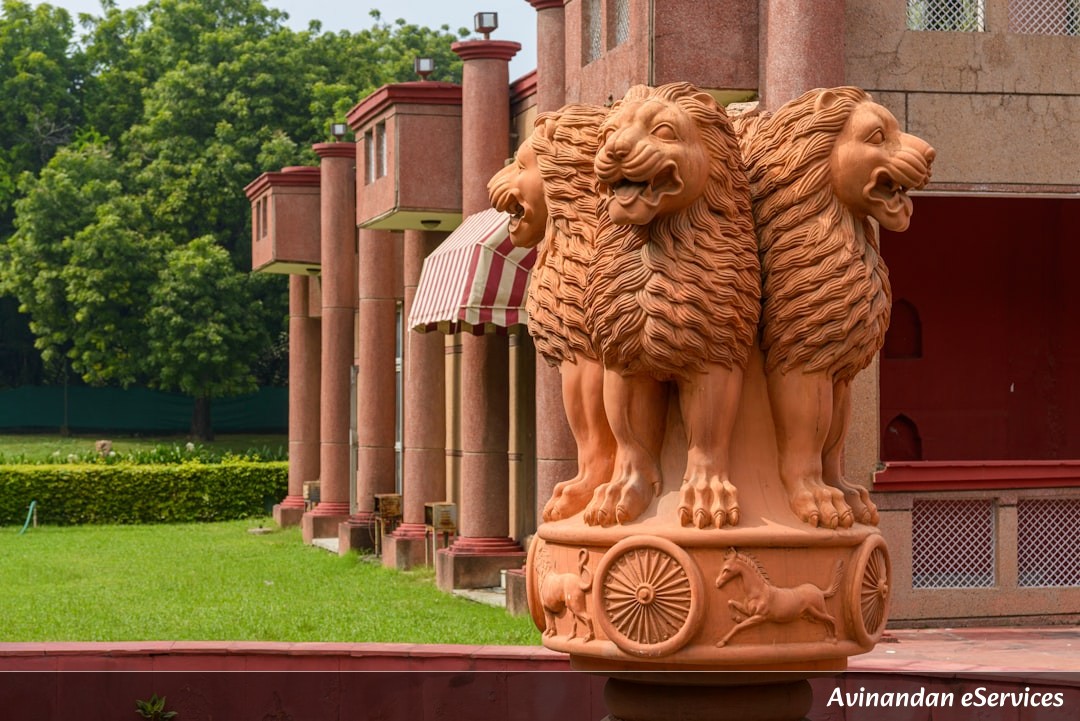
- Pillars: Highly polished monolithic stone pillars, with capitals adorned with animal figures. The most famous is the Lion Capital of Ashoka at Sarnath, which is the National Emblem of India.
- Stupas: Dome-shaped structures containing relics of the Buddha or other holy figures. The Great Stupa at Sanchi (originally built by Ashoka) is a prime example.
- Rock-Cut Caves: Caves were excavated for monks to live in, such as the Barabar Caves in Bihar, dedicated by Ashoka to the Ajivika sect.
Solved Examples (Step-by-Step Question Analysis)
Let's analyze how questions from this topic are framed in RRB exams with some solved examples.
Example 1:
Question: The famous political treatise 'Arthashastra' is attributed to whom?
- Megasthenes
- Bindusara
- Kautilya
- Ashoka
Step-by-step Solution:
- Identify Keywords: The keywords are 'Arthashastra' and 'attributed to'.
- Recall Knowledge: Recall the key literary sources for the Mauryan Empire. The Arthashastra is the most important Indian text on statecraft from this period.
- Connect Author to Text: Remember that Arthashastra was written by Chanakya, the mentor and prime minister of Chandragupta Maurya. Chanakya is also known by two other names: Kautilya and Vishnugupta.
- Evaluate Options:
- Megasthenes wrote 'Indica'.
- Bindusara and Ashoka were emperors, not authors of this text.
- Kautilya is another name for Chanakya.
- Final Answer: Therefore, the correct answer is (3) Kautilya.
Example 2:
Question: The profound transformation in Ashoka's character and policies was brought about by which event?
- His coronation
- The Third Buddhist Council
- The Kalinga War
- His mission to Sri Lanka
Step-by-step Solution:
- Identify Keywords: 'Ashoka', 'profound transformation', 'event'.
- Recall Ashoka's Reign: Think about the major events in Ashoka's life. His early reign was marked by expansion, but a significant event changed his outlook completely.
- Pinpoint the Turning Point: The Kalinga War in 261 BCE was a brutal conflict. The immense loss of life horrified Ashoka and led him to renounce warfare and adopt the policy of Dhamma. This was the key turning point.
- Evaluate Options:
- His coronation was the beginning of his rule, not the transformation.
- The Third Buddhist Council was convened by him *after* his transformation.
- The mission to Sri Lanka was a result of his new policy, not the cause of it.
- Final Answer: The correct answer is (3) The Kalinga War.
Example 3:
Question: The National Emblem of India, the 'Lion Capital', was adopted from which Mauryan monument?
- Lumbini Pillar
- Sanchi Stupa
- Sarnath Pillar
- Barabar Caves
Step-by-step Solution:
- Identify Keywords: 'National Emblem of India', 'Lion Capital', 'Mauryan monument'.
- Recall Mauryan Art: Think about the most famous examples of Mauryan art, especially the pillars erected by Ashoka.
- Connect Emblem to Monument: The Indian National Emblem features four lions standing back to back. This sculpture is the capital (top part) of a pillar erected by Ashoka at Sarnath, near Varanasi, to commemorate the spot where Buddha gave his first sermon.
- Evaluate Options:
- Lumbini Pillar marks Buddha's birthplace.
- Sanchi Stupa is a dome structure.
- Barabar Caves are rock-cut shelters.
- Sarnath Pillar is the source of the Lion Capital.
- Final Answer: The correct answer is (3) Sarnath Pillar.
Common Mistakes to Avoid
Aspirants often lose marks due to some common and avoidable mistakes. Be mindful of the following:
- Confusing Maurya with Gupta: Do not mix up Chandragupta Maurya (founder of the Mauryan Empire) with Chandragupta I or II of the later Gupta Empire. They are from entirely different dynasties and time periods.
- Incorrect Author-Book Pairing: A common error is swapping the authors of Arthashastra and Indica. Remember: Kautilya (Indian) wrote Arthashastra (Sanskrit), and Megasthenes (Greek) wrote Indica (Greek).
- Ignoring Administrative Terms: RRB exams sometimes ask questions on specific administrative terms like 'Rajukas', 'Adhyaksha', or 'Tirthas'. Do not skip these while studying.
- Forgetting the Chronology: The order of the first three great rulers is crucial: Chandragupta Maurya -> Bindusara -> Ashoka. Reversing them is a frequent mistake.
- Misunderstanding 'Dhamma': Ashoka's Dhamma was not a new religion. It was an ethical code of conduct based on moral values, aimed at promoting social harmony and welfare.
Practice Questions with Solutions
Now, test your knowledge with these practice questions designed in the RRB exam pattern.
Q1. Who was the last ruler of the Mauryan Dynasty?
(a) Ashoka
(b) Brihadratha
(c) Bindusara
(d) Devavarman
Q2. Megasthenes was the ambassador of which Greek ruler?
(a) Alexander the Great
(b) Ptolemy II
(c) Antiochus I
(d) Seleucus Nicator
Q3. In which language were most of the Ashokan edicts written?
(a) Sanskrit
(b) Pali
(c) Prakrit
(d) Greek
Q4. The Third Buddhist Council was held at Pataliputra under the patronage of which king?
(a) Kanishka
(b) Kalasoka
(c) Ajatashatru
(d) Ashoka
Q5. The Mauryan capital, Pataliputra, is located in the present-day state of:
(a) Uttar Pradesh
(b) Bihar
(c) Madhya Pradesh
(d) West Bengal
Q6. The tax on land during the Mauryan period, which was one-sixth of the produce, was known as:
(a) Shulka
(b) Kara
(c) Bali
(d) Bhaga
Q7. Which Ashokan Rock Edict provides a detailed account of the Kalinga War and its effects?
(a) Major Rock Edict X
(b) Major Rock Edict XIII
(c) Pillar Edict VII
(d) Minor Rock Edict I
Solutions:
A1. (b) Brihadratha - The last Mauryan ruler, Brihadratha, was assassinated in 185 BCE by his commander-in-chief, Pushyamitra Shunga, who then established the Shunga Dynasty.
A2. (d) Seleucus Nicator - After his defeat by Chandragupta Maurya, Seleucus Nicator sent Megasthenes as his ambassador to the Mauryan court in Pataliputra.
A3. (c) Prakrit - Most of Ashoka's inscriptions were in the Prakrit language. The script used varied by region, with Brahmi being the most common, followed by Kharosthi in the north-west.
A4. (d) Ashoka - The Third Buddhist Council was convened by Emperor Ashoka around 250 BCE at Pataliputra to settle disputes and purify the Buddhist movement. It was presided over by Moggaliputta Tissa.
A5. (b) Bihar - Pataliputra, the grand capital of the Mauryan Empire, is identified with the modern city of Patna in the state of Bihar.
A6. (d) Bhaga - Bhaga was the primary land tax, which was the state's share of the agricultural produce, typically fixed at 1/6th.
A7. (b) Major Rock Edict XIII - This edict is the most important one as it gives a vivid account of the Kalinga War, mentioning the large number of casualties and describing Ashoka's remorse and his subsequent adoption of Dhamma.
Frequently Asked Questions (FAQs)
- Q1: Why is the Mauryan Empire considered a major turning point in Indian history?
- A: The Mauryan Empire is a turning point because it was the first time a vast majority of the Indian subcontinent was unified under a single, centralized rule. It established a template for administration, economy, and foreign policy that influenced successive dynasties for centuries.
- Q2: What is the main difference between Chandragupta Maurya and Chandragupta I?
- A: Chandragupta Maurya (c. 322-298 BCE) was the founder of the Mauryan Empire. Chandragupta I (c. 320-335 CE) was the founder of the Gupta Empire, which emerged over 500 years after the Mauryan Empire's decline. It's crucial not to confuse them.
- Q3: What was Ashoka's policy of Dhamma? Was it a religion?
- A: Ashoka's Dhamma was not a religion or a religious doctrine. It was a secular moral and social code of conduct that he propagated to promote harmony, tolerance, and well-being among his subjects. Its principles, like non-violence, respect for elders, and religious tolerance, were derived from the teachings of various religions, including Buddhism.
- Q4: How did the Mauryan Empire decline?
- A: The decline began after Ashoka's death. His successors were weak and could not manage the vast empire. Factors contributing to the decline include Brahminical reaction against Ashoka's policies, financial crisis due to a large army and grants, oppressive rule in provinces, and the invasion of Bactrian Greeks from the north-west. The empire ended when the last ruler, Brihadratha, was assassinated.
Conclusion and Final Tips
The Mauryan Empire is more than just a chapter in a history book; it's a saga of ambition, conquest, and profound transformation. For an RRB aspirant, mastering this topic is a definite step towards securing a high score in the General Awareness section. Remember the key takeaways:
- The chronological order of rulers: Chandragupta Maurya, Bindusara, Ashoka.
- The key literary sources: Kautilya's Arthashastra and Megasthenes' Indica.
- The pivotal event: The Kalinga War (261 BCE) and its impact on Ashoka.
- The core philosophy: Ashoka's policy of Dhamma.
- The iconic art: The Sarnath Lion Capital and Ashokan pillars.
To solidify your preparation, create a timeline of major events, make short notes of administrative terms, and most importantly, solve as many previous years' questions as possible. Stay consistent, stay focused, and you will surely conquer this topic and move one step closer to your dream job in the Indian Railways. All the best!


