Introduction to the Topic
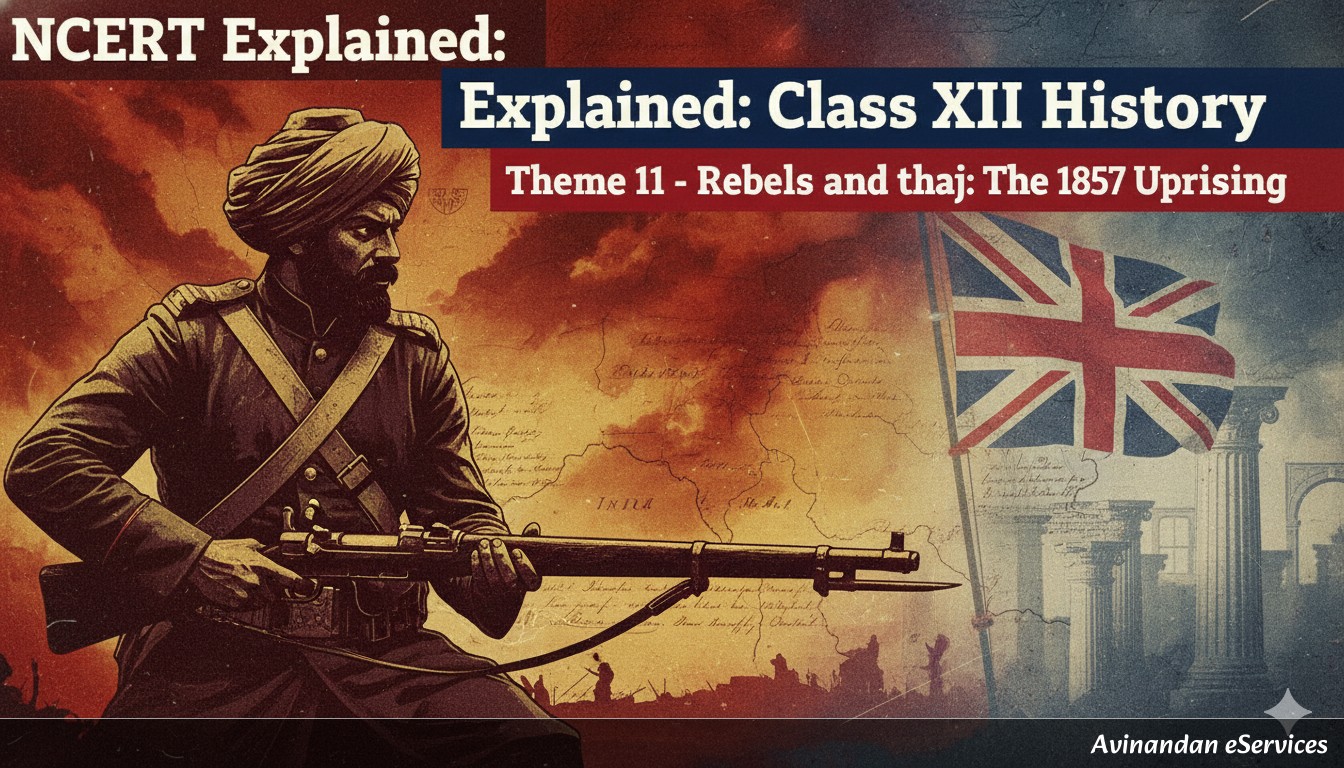
The year 1857 marks a watershed moment in the history of modern India. It was the year when decades of simmering discontent against British rule erupted into a massive, violent uprising that shook the very foundations of the East India Company's empire. Often termed the 'Sepoy Mutiny' by British historians and celebrated as the 'First War of Independence' by Indian nationalists, the Revolt of 1857 was far more than just a military insurrection. It was a complex event involving peasants, artisans, zamindars, and royalty, all united by a common desire to overthrow foreign rule.
This chapter from the NCERT Class XII History textbook, "Rebels and the Raj," doesn't just chronicle the events of the rebellion. It delves deeper, exploring the patterns of the revolt, the leaders who emerged, the vision that united them, and the brutal methods used by the British to crush it. Crucially, it also examines how this monumental event was perceived and represented by both sides—the British and the Indians. Understanding 1857 is essential to understanding the nature of colonial rule, the birth of Indian nationalism, and the long, arduous journey towards freedom. Let's unpack this pivotal chapter and explore the story of the rebels and their struggle against the Raj.
Key Concepts Explained
The Spark and the Spread: How the Rebellion Began
Every great fire starts with a single spark. For the Revolt of 1857, that spark was the introduction of the new Enfield rifle. The cartridges for this rifle were rumoured to be greased with the fat of cows and pigs. To load the rifle, sepoys had to bite off the end of the cartridge. This was a direct affront to the religious sentiments of both Hindu and Muslim sepoys, for whom the cow is sacred and the pig is taboo, respectively. They saw it as a deliberate attempt by the British to defile their religion and convert them to Christianity.
The story of the rebellion's beginning is a dramatic one. It started at the cantonment of Meerut on the afternoon of May 10, 1857. The Indian sepoys of the cavalry and infantry regiments rose in mutiny. They stormed the armoury, seized weapons, and attacked white officers and civilians. They then set out on a historic march to Delhi, arriving at the Red Fort the next morning. There, they proclaimed the aged and reluctant Mughal emperor, Bahadur Shah Zafar, as the Shahenshah-e-Hindustan (Emperor of Hindustan). This act was symbolic; it transformed a sepoy mutiny into a full-fledged political rebellion by providing a legitimate, traditional source of authority to lead the uprising.
What is fascinating is the pattern of the revolt's spread. As news of the events in Meerut and Delhi travelled, it created a domino effect. Cantonment after cantonment in the Gangetic plain and central India joined the rebellion. The timeline was remarkably similar: sepoys would begin by seizing the bell of arms (armoury) and plundering the treasury. They would then attack government buildings—the jail, telegraph office, records office, and bungalows—destroying everything connected with British rule. The telegraph lines, which the British used for rapid communication, were a primary target. The common people, especially in the towns and villages of North India, soon joined the sepoys, and the rebellion took on the character of a popular revolt.
Lines of Communication: The Secret Language of Revolt
Was the revolt a spontaneous outburst, or was there an element of planning and coordination? The evidence suggests a mix of both. While the sepoys acted with a degree of spontaneity, there were clear signs of communication and coordination among different cantonments. Sepoys from different stations often served together and shared common grievances, creating natural networks of communication.
One of the most intriguing aspects discussed in the chapter is the role of mysterious signals that circulated in the months before the uprising. There were reports of chapatis being distributed from village to village in North India. A person would arrive with a chapati, instruct the village watchman to make five more and pass them on to the next village. The meaning of this is still debated, but it was undoubtedly a signal of an impending upheaval, creating an atmosphere of suspense and anticipation.
Similarly, there were stories of lotus flowers being circulated among sepoy regiments. These acts suggest a concerted effort to spread the message of rebellion. Within the cantonments, decisions were often made collectively in panchayats, comprising sepoys from different regiments. These panchayats acted as councils, making decisions about strategy and leadership. This indicates that the rebels were not just an unruly mob but were capable of a degree of organization, even if it was decentralized and informal.
Why the Rebellion? Unpacking the Deeper Causes
The greased cartridges were merely the immediate trigger. The real causes of the 1857 Revolt were buried deep in a century of British policies that had alienated almost every section of Indian society. The chapter helps us understand these cumulative grievances.
Political Causes: The aggressive expansionist policies of the East India Company had created widespread resentment. Lord Dalhousie's 'Doctrine of Lapse' was particularly notorious. Under this policy, if an Indian ruler died without a natural male heir, his kingdom was annexed by the British. States like Satara, Nagpur, and Jhansi fell victim to this. The annexation of Awadh in 1856 on the pretext of 'misgovernance' was a major political blunder. The Nawab, Wajid Ali Shah, was popular, and his removal was seen as a grave injustice. This act alienated not only the ruling class but also the thousands of sepoys, officials, and artisans who lost their livelihoods when the royal court was disbanded. The feeling was that the British could not be trusted and were determined to wipe out the traditional Indian political order.
Economic Causes: The Company's economic policies were ruinous for India. The new revenue settlements, like the Permanent Settlement and the Ryotwari Settlement, imposed exorbitant taxes on peasants. They were often forced to take loans from moneylenders at high interest rates and frequently lost their lands. The British also systematically destroyed Indian industries and handicrafts to promote their own manufactured goods. This 'de-industrialization' led to massive unemployment among artisans and weavers. The economic drain of wealth from India to Britain further impoverished the country, creating a fertile ground for rebellion.
Socio-Religious Causes: The British, with their evangelizing zeal, were seen as a threat to Indian religions and culture. Many British officials openly looked down upon Indian customs. Reforms like the abolition of Sati (1829) and the legalization of widow remarriage (1856), while progressive, were seen by orthodox sections of society as an interference in their religious matters. The activities of Christian missionaries, who were often seen working with government officials, fueled fears of forced conversions. Rumours spread that the British were mixing bone dust of cows and pigs into the flour sold in the market to corrupt the faith of the people. These fears, combined with the greased cartridge incident, created a potent cocktail of religious anger.
Military Causes: The Indian sepoys, who formed the backbone of the Company's army, had their own list of grievances. They were paid significantly less than their British counterparts, had bleak promotion prospects, and were often treated with contempt by their white officers. The General Service Enlistment Act of 1856 mandated that all future recruits must be prepared to serve overseas if required. This was a direct challenge to the caste rules of many Hindu sepoys, for whom crossing the sea meant losing their caste. The sepoys felt that their professional and religious lives were under attack.
Leaders and Followers: A Diverse Coalition
The 1857 Revolt threw up a remarkable array of leaders from different backgrounds, highlighting its broad-based nature. While Bahadur Shah Zafar was the symbolic head, the real leadership was often local and decentralized.
- In Kanpur, the rebellion was led by Nana Saheb, the adopted son of the last Peshwa, Baji Rao II. He had been denied his father's pension by the British and was a rallying point for discontented forces.
- In Lucknow, the capital of the recently annexed state of Awadh, the revolt was led by Begum Hazrat Mahal, the wife of the deposed Nawab. She declared her young son, Birjis Qadr, as the new Nawab and became a symbol of resistance.
- In Jhansi, the 22-year-old Rani Lakshmibai became one of the most iconic figures of the revolt. Her kingdom had been annexed under the Doctrine of Lapse, and she led her troops with exemplary courage, fighting the British until her death on the battlefield.
- In Arrah, Bihar, the rebellion was led by Kunwar Singh, an old zamindar from a noble family who had been deprived of his estates by the British.
Beyond these well-known figures, the rebellion was sustained by countless local leaders—zamindars, religious figures (like the Maulvi Ahmadullah Shah in Faizabad), and tribal leaders (like Gonoo in the Chotanagpur plateau). This diverse leadership indicates that the revolt was not just a conspiracy of the elite but a movement that drew strength from different strata of society, including peasants and artisans who formed the bulk of the fighting force.
Visions of Unity: Forging a Common Front
One of the most striking features of the 1857 Revolt was the incredible display of Hindu-Muslim unity. Despite British attempts to create divisions, both communities fought side-by-side against a common enemy. The rebels' proclamations and manifestos, like the famous Azamgarh Proclamation, consistently appealed to both Hindus and Muslims. They framed the struggle as a fight to save 'dharma' and 'deen' (faith) from the corrupting influence of the British. The proclamations highlighted the economic exploitation and the threat to their way of life, urging all sections of the population—zamindars, merchants, artisans, and sepoys—to unite.
The choice of Bahadur Shah Zafar, a Mughal, as the leader was a powerful symbol of this unity. The Mughals had traditionally commanded respect from rulers and chieftains across the subcontinent. By rallying under his banner, the rebels were invoking a pre-British political order where different communities had co-existed. In regions like Awadh and Rohilkhand, the unity was particularly strong, with Hindus and Muslims collectively planning strategies and fighting battles.
The British Response: Repression and Retaliation
Faced with a rebellion of this scale, the British responded with overwhelming and brutal force. They were fighting not just to regain territory but to restore their prestige and send a message. The suppression of the revolt was a long and bloody affair. The British passed a series of laws in May and June 1857 that suspended ordinary legal procedures. These laws gave military officers and even ordinary Britons the power to try and execute Indians without due process. The country was effectively put under martial law.
The recapture of key cities was a priority. Delhi was retaken in September 1857 after a prolonged siege and fierce fighting. The city was plundered, and its inhabitants were subjected to a horrific massacre. The Mughal princes were captured and executed, and Bahadur Shah Zafar was tried for treason and exiled to Rangoon, bringing the Mughal dynasty to a final, tragic end.
The methods of punishment were deliberately designed to create terror. Rebels were publicly hanged from trees, and in many cases, they were tied to the mouths of cannons and blown to pieces. Villages suspected of harbouring rebels were burned to the ground. This campaign of terror was meant to break the will of the Indian people and ensure that such a challenge to British authority would never happen again.
Images of the Revolt: The Power of Representation
The NCERT chapter places special emphasis on how the Revolt of 1857 was visually represented, as these images shaped public opinion and memory. The British and Indian perspectives were starkly different.
British Representations: In Britain, the revolt was a major news event. Newspapers, magazines, and journals were filled with stories and images of the 'Indian Mutiny.' British paintings and sketches invariably portrayed the British as heroes and the Indian rebels as inhuman savages. For example, Thomas Jones Barker’s painting, "The Relief of Lucknow," depicts British commanders as saviours arriving to rescue the besieged garrison. Joseph Noel Paton’s painting, "In Memoriam," shows English women and children huddled together, seemingly awaiting a terrible fate at the hands of the rebels, designed to evoke sympathy for the British and hatred for the Indians. Cartoons in magazines like Punch often depicted the British lion pouncing on the Bengal Tiger, or a vengeful Britannia figure crushing the sepoys. These images were powerful propaganda tools, justifying the brutal repression and reinforcing the idea of Britain's civilizing mission.
Indian Representations: In contrast, there are very few contemporary Indian paintings or sketches of the revolt. The rebels were fighting a war and did not have the means or the time to create visual records. However, the memory of the revolt was preserved and transmitted through oral traditions—folk songs, poems, and legends. These narratives celebrated the heroism of leaders like Rani Lakshmibai and Kunwar Singh. In the 20th century, as the nationalist movement gained strength, these leaders were resurrected as icons of freedom. Nationalist artists depicted Rani Lakshmibai as a heroic figure, riding a horse with a sword in hand, a powerful symbol of Indian resistance against foreign rule. This re-imagining transformed the 'mutiny' into the 'First War of Independence' in the collective Indian consciousness.
The Aftermath: A New Era of British Rule
The Revolt of 1857 failed in its objective of overthrowing British rule, but it fundamentally altered the nature of that rule. The British Crown realized that the East India Company could no longer be trusted to govern India. The Government of India Act of 1858 was passed, which transferred power directly to the British Crown. The Company was dissolved, and India was to be governed by a Secretary of State for India, aided by a council.
Queen Victoria issued a proclamation in 1858 that made several promises to the Indian people. It promised that the British Crown would not annex any more Indian states, that it would honor the treaties made with Indian princes, and that it would not interfere in the religious and social customs of the people. This was a direct reversal of the policies that had led to the revolt.
The most significant changes were in the military. The army was completely reorganized to prevent another rebellion. The proportion of British soldiers to Indian soldiers was increased. Key positions and artillery were placed exclusively in British hands. The policy of recruitment was also changed. Instead of recruiting heavily from Awadh and Bihar, the regions that had been the heart of the rebellion, the British started recruiting from communities they deemed 'martial races,' such as the Sikhs, Gurkhas, and Pathans, who had largely remained loyal during the revolt. This was a classic application of the 'divide and rule' policy. The revolt also deepened the racial gulf between the British and Indians. A sense of fear and mistrust pervaded their relationship for decades to come.
Summary & Key Takeaways
The Revolt of 1857 was a defining moment in Indian history. Here are the key points to remember from this chapter:
- Trigger and Spread: The immediate cause was the greased cartridges, which offended the religious sensibilities of both Hindu and Muslim sepoys. The revolt began in Meerut and quickly spread to Delhi, with Bahadur Shah Zafar being declared the symbolic leader.
- Deeper Causes: The revolt was the culmination of long-standing political (Doctrine of Lapse, annexation of Awadh), economic (heavy taxes, destruction of industries), socio-religious (fears of forced conversion), and military (discrimination, low pay) grievances.
- Broad-based Participation: It was not just a sepoy mutiny but involved a wide cross-section of society, including peasants, zamindars, and artisans, led by figures like Nana Saheb, Begum Hazrat Mahal, and Rani Lakshmibai.
- Hindu-Muslim Unity: The revolt was marked by a strong sense of unity between Hindus and Muslims, who fought together against a common enemy.
- Brutal Suppression: The British suppressed the rebellion with extreme violence and brutality, using public executions and terror tactics to re-establish their authority.
- War of Representations: The British depicted the revolt as a barbaric mutiny, justifying their rule and repression. Indian nationalists later re-framed it as the First War of Independence, creating inspiring symbols of resistance.
- Significant Aftermath: The revolt led to the end of the East India Company's rule, the beginning of direct rule by the British Crown (the Raj), a major reorganization of the army, and a deepening of the racial divide in India.