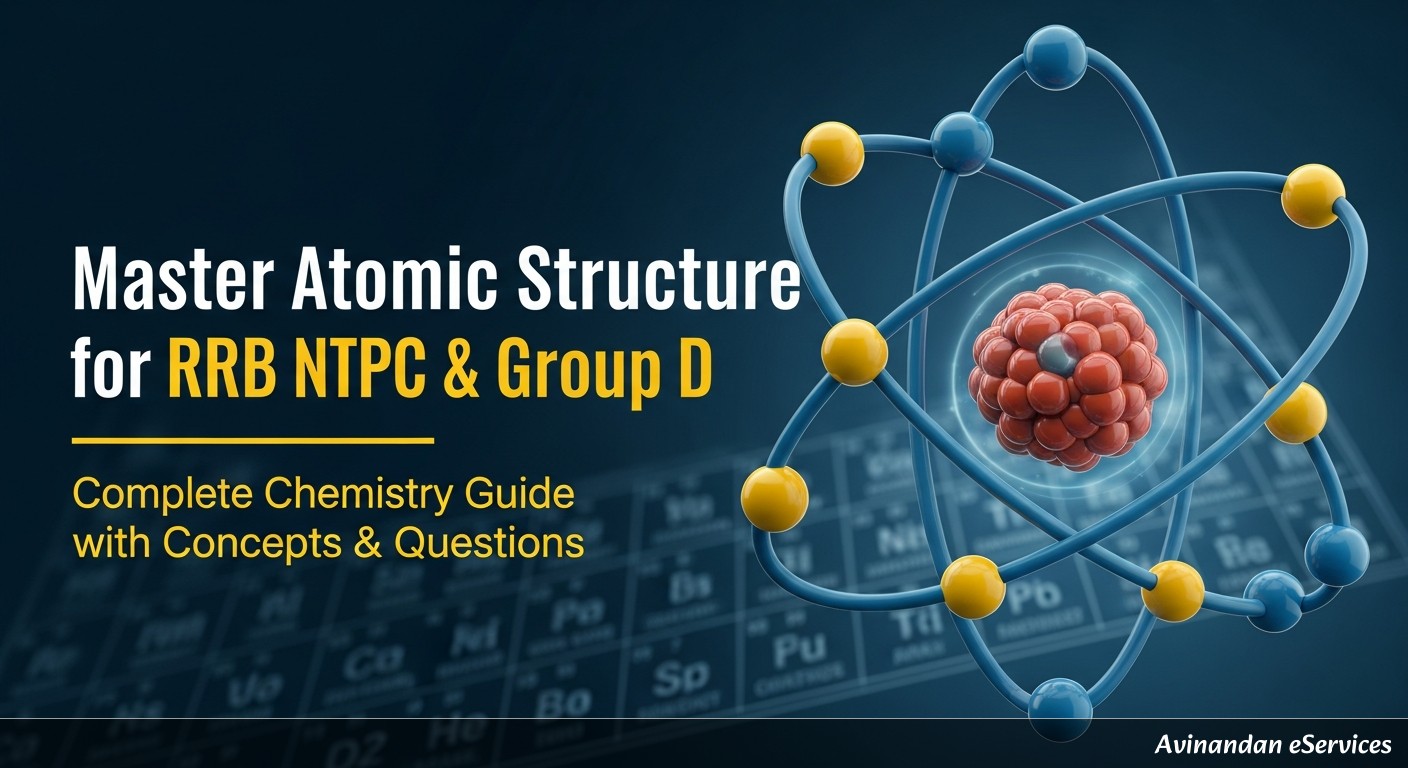
Introduction to Atomic Structure for RRB Exams
Welcome, aspiring railway professionals! In your journey to crack the RRB NTPC, RRB Group D, or RRB Technician exams, a strong grasp of General Science is non-negotiable. Among the most fundamental and frequently tested topics in Chemistry is the 'Atomic Structure'. Understanding the atom is like learning the alphabet of chemistry; it's the foundation upon which everything else is built. Questions from this chapter often test your conceptual clarity, and with the right preparation, they can be easy marks to score.
This comprehensive guide is designed to be your one-stop resource for mastering Atomic Structure. We will journey from the earliest theories to the modern quantum model, breaking down complex concepts into simple, digestible points. We'll cover key definitions, subatomic particles, atomic models, and electronic configurations. To solidify your understanding, we have included solved examples and a set of practice questions, mirroring the pattern of RRB examinations. Let's begin our deep dive into the world of the atom!
The Journey of Discovering the Atom: Key Models
Our understanding of the atom wasn't built in a day. It evolved over centuries, with each scientist building upon the work of their predecessors. For your RRB exams, knowing the key postulates and limitations of major atomic models is crucial.
1. John Dalton's Atomic Theory (1808)
John Dalton, an English chemist, proposed the first modern atomic theory based on experimental evidence. His model pictured the atom as a tiny, indivisible, and indestructible sphere.
Key Postulates of Dalton's Theory:- All matter is composed of \textremely small particles called atoms.
- Atoms are indivisible and cannot be created or destroyed in a chemical reaction.
- Atoms of a given element are identical in mass and chemical properties.
- Atoms of different elements have different masses and chemical properties.
- Atoms combine in a ratio of small whole numbers to form compounds.
- The relative number and kinds of atoms are constant in a given compound.
Limitations: Dalton's theory was groundbreaking, but it was later found to have some inaccuracies. It could not explain the existence of subatomic particles (electrons, protons, neutrons), isotopes, and isobars. The postulate that atoms are indivisible was disproven by later discoveries.
2. J.J. Thomson's Plum Pudding Model (1897)
Following his discovery of the electron in 1897, J.J. Thomson proposed a new model for the atom. He suggested that an atom is a uniform sphere of positive charge with negatively charged electrons embedded in it, much like plums (or raisins) in a pudding.
Key Features of Thomson's Model:- An atom consists of a positively charged sphere.
- Electrons are embedded within this sphere.
- The negative and positive charges are equal in magnitude, so the atom as a whole is electrically neutral.
Limitations: While it explained the neutrality of an atom, Thomson's model failed to explain the results of the alpha-particle scattering experiment conducted by his student, Ernest Rutherford. It could not account for a dense, central nucleus.
3. Ernest Rutherford's Nuclear Model (1911)
Rutherford's famous gold foil experiment revolutionized our understanding of the atom. He bombarded a thin sheet of gold with positively charged alpha (α) particles.
Observations of the Gold Foil Experiment:- Most of the alpha particles passed straight through the foil, undeflected.
- A small fraction of the alpha particles were deflected by small angles.
- A very few alpha particles (about 1 in 20,000) bounced back completely.
- Most of the atom is empty space: This explained why most particles passed through without deflection.
- Dense, Positive Nucleus: The atom has a small, dense, positively charged center called the nucleus, where almost all the mass is concentrated. This caused the deflection and bouncing back of the positive alpha particles.
- Orbital Electrons: Electrons revolve around the nucleus in circular paths called orbits, much like planets around the sun.
Major Drawback: According to Maxwell's theory of electromagnetism, any charged particle in acceleration (like an electron in a circular orbit) should radiate energy continuously. This would cause the electron to lose energy, spiral into the nucleus, and the atom would collapse. Thus, Rutherford's model could not explain the stability of the atom.
4. Niels Bohr's Atomic Model (1913)
To overcome the limitations of Rutherford's model, Niels Bohr proposed a new model for the hydrogen atom, incorporating ideas from quantum mechanics.
Key Postulates of Bohr's Model:- Electrons revolve around the nucleus only in certain specific circular paths called orbits or shells.
- Each orbit has a fixed energy level, so these are also called energy shells or stationary states.
- While revolving in these discrete orbits, an electron does not radiate energy. This explained the stability of the atom.
- An electron can jump from a lower energy level to a higher energy level by absorbing energy, and it can jump from a higher level to a lower level by emitting energy in the form of electromagnetic radiation (light).
- These orbits or shells are represented by the letters K, L, M, N... or by the numbers n=1, 2, 3, 4...
Limitations: Bohr's model was a significant improvement but was not perfect. It could only explain the spectrum of hydrogen and hydrogen-like ions (e.g., He+, Li2+) and failed for multi-electron atoms. It also couldn't explain the splitting of spectral lines in magnetic (Zeeman effect) and electric fields (Stark effect).
Understanding the Modern Atomic Structure
The modern concept of the atom, based on quantum mechanics, is more complex. However, for RRB exams, a solid understanding of the fundamental components and properties derived from these early models is sufficient.
Subatomic Particles: The Building Blocks
An atom is composed of three primary subatomic particles: protons, neutrons, and electrons. Their properties are a very common source of questions in RRB exams.
| Property | Proton (p+) | Neutron (n) | Electron (e-) |
|---|---|---|---|
| Discoverer | Ernest Rutherford | James Chadwick (1932) | J.J. Thomson (1897) |
| Location | Inside the nucleus | Inside the nucleus | Orbits around the nucleus |
| Charge (Relative) | +1 | 0 (Neutral) | -1 |
| Charge (Absolute) | +1.602 x 10⁻¹⁹ C | 0 C | -1.602 x 10⁻¹⁹ C |
| Mass (Relative) | ~1 amu | ~1 amu | ~1/1837 amu (Negligible) |
| Mass (Absolute) | 1.672 x 10⁻²⁷ kg | 1.674 x 10⁻²⁷ kg | 9.109 x 10⁻³¹ kg |
Key Atomic Terms You Must Know
These definitions are crucial and form the basis of many numerical and conceptual questions.
- Atomic Number (Z): It is the number of protons present in the nucleus of an atom. The atomic number defines an element. For a neutral atom, the number of electrons is equal to the number of protons. Z = Number of Protons.
- Mass Number (A): It is the total number of protons and neutrons present in the nucleus. Protons and neutrons are collectively called nucleons. A = (Number of Protons) + (Number of Neutrons).
- Isotopes: These are atoms of the same element having the same atomic number (Z) but a different mass number (A). This means they have the same number of protons but a different number of neutrons. For example, Hydrogen has three isotopes: Protium (¹H), Deuterium (²H), and Tritium (³H).
- Isobars: These are atoms of different elements having the same mass number (A) but a different atomic number (Z). For example, Argon-40 (¹⁸Ar⁴⁰) and Calcium-40 (²⁰Ca⁴⁰) are isobars.
- Isotones: These are atoms of different elements having the same number of neutrons. For example, Silicon-30 (¹⁴Si³⁰) and Phosphorus-31 (¹⁵P³¹) are isotones (both have 16 neutrons).
Electronic Configuration and Rules
Electronic configuration is the arrangement of electrons in the different energy shells of an atom. Understanding this helps in determining the chemical properties and valency of an element.
The distribution of electrons into different orbits of an atom was suggested by Bohr and Bury. The following are the key rules:
- The maximum number of electrons that can be accommodated in a shell is given by the formula 2n², where 'n' is the orbit number or energy level index (n = 1, 2, 3...).
- K shell (n=1): Max electrons = 2(1)² = 2
- L shell (n=2): Max electrons = 2(2)² = 8
- M shell (n=3): Max electrons = 2(3)² = 18
- N shell (n=4): Max electrons = 2(4)² = 32
- The maximum number of electrons that can be accommodated in the outermost orbit is 8.
- Electrons are not accommodated in a given shell unless the inner shells are filled. Shells are filled in a step-wise manner.
Valency
Valency is the combining capacity of an element. It is determined by the number of electrons in the outermost shell, also known as valence electrons. An atom achieves a stable configuration (usually 8 electrons, called an octet) in its outermost shell by losing, gaining, or sharing electrons. For metals, valency is typically the number of valence electrons. For non-metals, it is often (8 - number of valence electrons).
Example: Sodium (Na), Atomic Number = 11. Electronic Configuration = 2, 8, 1. It has 1 valence electron, which it can easily lose. So, its valency is 1.
Example: Chlorine (Cl), Atomic Number = 17. Electronic Configuration = 2, 8, 7. It has 7 valence electrons. It is easier to gain 1 electron to complete its octet. So, its valency is 1.
Solved Examples (Based on RRB Exam Pattern)
Let's apply these concepts to solve some questions that are typical for RRB exams.
Example 1
Question: Who is credited with the discovery of the neutron?
- J.J. Thomson
- Ernest Rutherford
- James Chadwick
- Niels Bohr
Solution: The neutron, the neutral subatomic particle in the nucleus, was discovered by James Chadwick in 1932. J.J. Thomson discovered the electron, and Rutherford discovered the proton/nucleus.
Correct Answer: C
Example 2
Question: An atom of an element has 13 protons and 14 neutrons. What is its mass number?
- 13
- 14
- 27
- 1
Solution: The mass number (A) is the sum of the number of protons and neutrons.
Mass Number (A) = Number of Protons + Number of Neutrons
A = 13 + 14 = 27.
The element is Aluminum (Al).
Correct Answer: C
Example 3
Question: Isotopes of an element have:
- Same number of protons but different number of neutrons
- Same number of neutrons but different number of protons
- Same number of protons and neutrons
- Different number of protons and neutrons
Solution: By definition, isotopes are atoms of the same element, which means they must have the same number of protons (same atomic number). They differ in their mass number, which is due to a different number of neutrons in their nuclei.
Correct Answer: A
Example 4
Question: What is the maximum number of electrons that can be accommodated in the M shell of an atom?
- 2
- 8
- 18
- 32
Solution: The shells are K, L, M, N... which correspond to n=1, 2, 3, 4... The M shell corresponds to n=3. The maximum number of electrons in a shell is given by the formula 2n².
For the M shell (n=3), Maximum electrons = 2 * (3)² = 2 * 9 = 18.
Correct Answer: C
Practice Questions for RRB Aspirants
Now it's your turn! Test your understanding with these practice questions. The answers are provided at the end.
- The plum pudding model of an atom was proposed by ________.
- Ernest Rutherford
- J.J. Thomson
- Niels Bohr
- John Dalton
- Rutherford's alpha-particle scattering experiment resulted in the discovery of the:
- Electron
- Proton
- Atomic Nucleus
- Neutron
- The atomic number of an element is equal to the number of ________ in the nucleus of its atom.
- Electrons
- Protons
- Neutrons
- Nucleons
- Which of the following pairs are isobars?
- ¹H¹ and ¹H²
- ¹⁸Ar⁴⁰ and ²⁰Ca⁴⁰
- ¹²C⁶ and ¹⁴N⁷
- ¹⁶O⁸ and ¹⁷O⁸
- What is the electronic configuration of Calcium (Atomic Number = 20)?
- 2, 8, 10
- 2, 8, 8, 2
- 2, 10, 8
- 2, 8, 6, 4
- The charge of an electron is:
- +1.6 x 10⁻¹⁹ C
- -1.6 x 10⁻¹⁹ C
- +9.1 x 10⁻³¹ C
- 0
- The subatomic particle with no charge is the:
- Proton
- Electron
- Neutron
- Positron
- The valency of Oxygen (Atomic Number = 8) is:
- 6
- 8
- 2
- 4
- The stability of the atom was first explained correctly by:
- J.J. Thomson
- John Dalton
- Ernest Rutherford
- Niels Bohr
- An atom has a mass number of 37 and an atomic number of 17. How many neutrons does it have?
- 17
- 20
- 37
- 54
Answers to Practice Questions:
| 1. b | 6. b |
| 2. c | 7. c |
| 3. b | 8. c |
| 4. b | 9. d |
| 5. b | 10. b |
Explanation for Q.8: Oxygen (Z=8) has an electronic configuration of 2, 6. It has 6 valence electrons. To achieve a stable octet (8 electrons), it needs to gain 2 electrons. Therefore, its valency is 2.
Explanation for Q.10: Number of Neutrons = Mass Number (A) - Atomic Number (Z) = 37 - 17 = 20.
Conclusion and Key Takeaways
Mastering Atomic Structure is a crucial step in your RRB exam preparation. It's a high-yield topic that builds the foundation for understanding other concepts in chemistry like chemical bonding, the periodic table, and chemical reactions.
Remember these key points:- Key Scientists: Dalton (first theory), Thomson (electron, plum pudding), Rutherford (nucleus, nuclear model), Chadwick (neutron), Bohr (stable orbits).
- Subatomic Particles: Know the charge, mass, location, and discoverer of protons, neutrons, and electrons.
- Core Definitions: Be crystal clear on the definitions of Atomic Number (Z), Mass Number (A), Isotopes, Isobars, and Isotones.
- Electronic Configuration: Understand the 2n² rule and how to determine the valency of the first 20 elements.
Regularly revise these concepts and practice as many MCQs as possible from previous years' papers. With consistent effort, you can turn this topic into one of your strongest scoring areas. Keep up the hard work, and success will be yours!