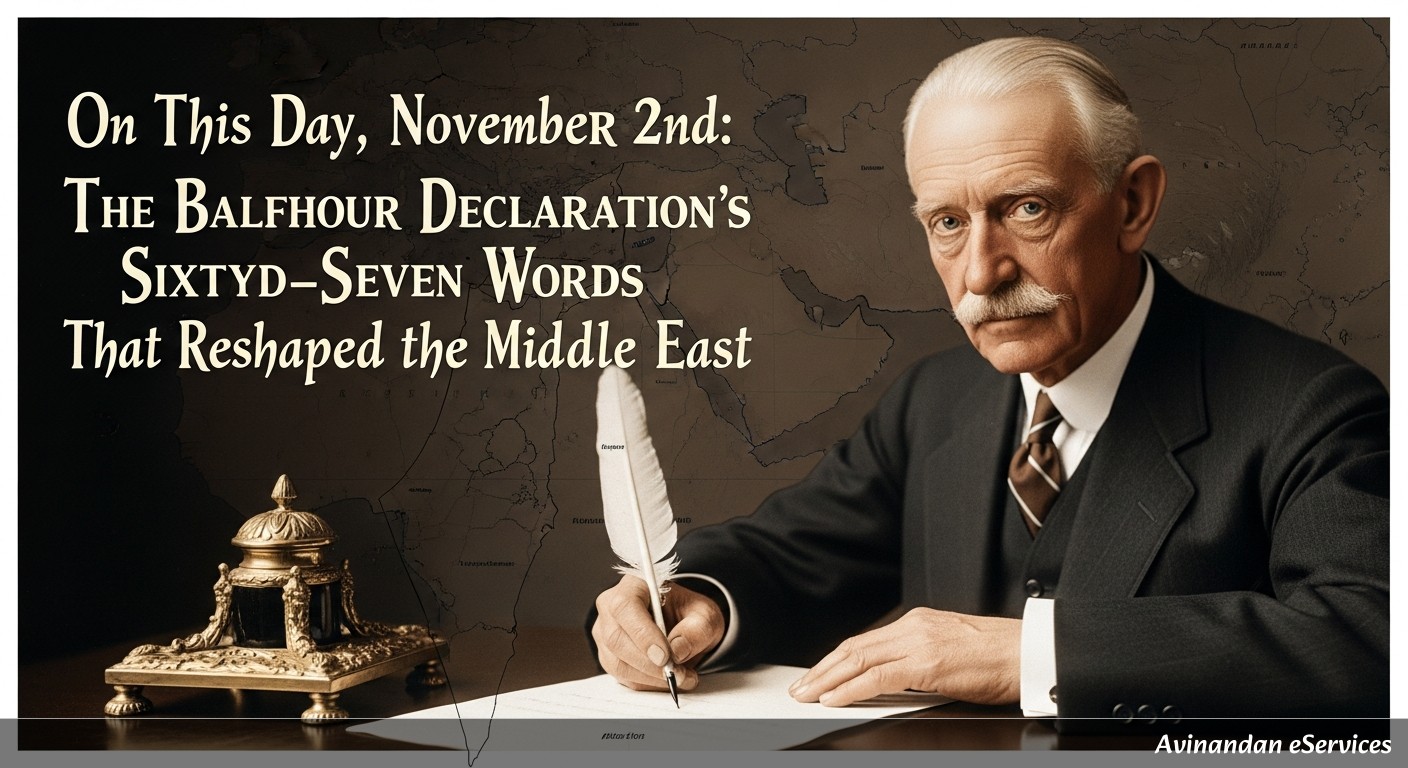
Introduction: A Moment in Time
History is often a slow, grinding process, a series of seemingly disconnected events that only in hindsight reveal their true, earth-shattering significance. But sometimes, history pivots on a single day, on a few carefully chosen words committed to paper. November 2nd, 1917, was one such day. In the heart of London, amidst the turmoil of the First World War, a letter was dispatched that would irrevocably alter the map of the Middle East and sow the seeds of a conflict that continues to this day. This was the day the Balfour Declaration was issued, a document whose sixty-seven words would echo through the coming century with the force of a thousand cannons.
The declaration was, on its surface, a simple letter from the British Foreign Secretary, Arthur James Balfour, to Lord Rothschild, a prominent figure in the British Jewish community. It conveyed the British government's support for the establishment of a "national home for the Jewish people" in Palestine. A seemingly straightforward statement of policy, yet beneath its diplomatic language lay a web of geopolitical ambition, religious fervor, and competing nationalisms that would ensnare the region for generations to come. To understand the gravity of this single sheet of paper, we must journey back to a world at war, a world where empires were crumbling and new nations were waiting to be born.
The Build-Up: What Led to This Day?
The Great War and the Ailing Ottoman Empire
By 1917, the First World War had raged for three brutal years, and the Allied powers were desperate for a breakthrough. The Ottoman Empire, the so-called "sick man of Europe," had sided with the Central Powers, and its vast territories in the Middle East were a key strategic prize. Britain, with its imperial interests in India and the Suez Canal, was particularly keen to secure its influence in the region. As the war dragged on, the British government began to contemplate the post-war fate of the Ottoman lands, including a sparsely populated but historically significant region known as Palestine.
The Rise of Zionism
At the same time, a powerful new force was gaining momentum within the Jewish world: Zionism. For centuries, the Jewish people had been scattered across the globe, a diaspora yearning for a return to their ancestral homeland. In the late 19th century, this yearning coalesced into a political movement dedicated to the establishment of a Jewish state in Palestine. Led by charismatic figures like Theodor Herzl and, in Britain, Chaim Weizmann, the Zionists tirelessly lobbied the great powers for support. Weizmann, a brilliant chemist who had made a vital contribution to the British war effort, had the ear of some of the most powerful men in the British government, including Prime Minister David Lloyd George and Foreign Secretary Arthur Balfour.
A Web of Contradictory Promises
The British, in their eagerness to win the war, made a series of overlapping and ultimately contradictory promises to various groups. In the McMahon-Hussein Correspondence of 1915-1916, they had seemingly promised independence to the Arabs in exchange for their revolt against the Ottomans. Yet, in the secret Sykes-Picot Agreement of 1916, Britain and France had carved up the Middle East for themselves, assigning spheres of influence that paid little heed to the aspirations of the local populations.
It was into this murky diplomatic landscape that the idea of a declaration in favor of Zionism was born. For the British, it was a calculated gamble. They believed that such a declaration would rally Jewish support for the Allied cause, particularly in the United States and Russia. They also saw a pro-British Jewish entity in Palestine as a strategic asset that could help protect the Suez Canal and secure British dominance in the post-war Middle East.
The Event Itself
Crafting the Declaration
The final text of the Balfour Declaration was the product of months of intense negotiation and debate within the British War Cabinet. There was significant opposition, most notably from Edwin Montagu, the only Jewish member of the cabinet, who feared that the declaration would lead to anti-Semitism and undermine the rights of Jews in other countries. After several drafts and heated discussions, a final version was approved on October 31st, 1917.
The Fateful Letter
On November 2nd, 1917, Arthur Balfour penned the now-famous letter to Lord Rothschild. It read:
"His Majesty's Government view with favour the establishment in Palestine of a national home for the Jewish people, and will use their best endeavours to facilitate the achievement of this object, it being clearly understood that nothing shall be done which may prejudice the civil and religious rights of existing non-Jewish communities in Palestine, or the rights and political status enjoyed by Jews in any other country."
The language was deliberately ambiguous. The term "national home" was a novelty in international law, and its precise meaning was left open to interpretation. Furthermore, the declaration contained a crucial, and ultimately fateful, caveat: the protection of the "civil and religious rights of existing non-Jewish communities in Palestine." At the time, these "non-Jewish communities"—overwhelmingly Arab—constituted more than 90 percent of the population. The declaration made no mention of their political or national rights.
A Triumph for Zionism
For the Zionist movement, the Balfour Declaration was a monumental victory. It was the first time a major world power had publicly endorsed their aspirations. The declaration was greeted with jubilation in Jewish communities around the world, and it gave a powerful impetus to the cause of Jewish settlement in Palestine. As Chaim Weizmann would later write, it was as if a key had been given to them, a key that would unlock the gates of their ancestral home.
The Aftermath and Legacy
The British Mandate
Following the end of the First World War and the collapse of the Ottoman Empire, the Balfour Declaration was incorporated into the British Mandate for Palestine, which was formally approved by the League of Nations in 1922. This gave the declaration the force of international law and entrusted Britain with the task of putting its principles into effect. The British now found themselves in the unenviable position of having to govern a territory with two communities with mutually exclusive national aspirations.
Rising Tensions and the Seeds of Conflict
The years of the British Mandate were marked by escalating tensions and outbreaks of violence. The Arabs of Palestine, who had been promised independence, felt betrayed. They viewed the Balfour Declaration as a gross injustice, a colonial power promising their land to another people. As Jewish immigration to Palestine increased, particularly in the 1930s with the rise of Nazism in Europe, Arab fears of dispossession grew. A series of riots and uprisings, most notably the Arab Revolt of 1936-1939, signaled the depth of Arab opposition to the Zionist project and British rule.
The Birth of Israel and the Nakba
The British, unable to reconcile their conflicting obligations, eventually washed their hands of Palestine. In 1947, they turned the problem over to the newly formed United Nations, which voted to partition Palestine into separate Arab and Jewish states. The Jewish leadership accepted the plan, but the Arab states and the Palestinian Arabs rejected it. On May 14th, 1948, the British Mandate ended, and the State of Israel was proclaimed. The following day, the armies of five Arab nations invaded, sparking the 1948 Arab-Israeli War.
For the Jews, it was a war of independence, the culmination of a two-thousand-year-old dream. For the Palestinians, it was the Nakba, or "catastrophe," a conflict that resulted in the displacement of over 700,000 people and the loss of their homeland. The legacy of the Balfour Declaration was now written in blood and fire.
A Century of Conflict
The Balfour Declaration is not merely a historical curiosity; it is a document whose consequences are felt every day in the ongoing Israeli-Palestinian conflict. It is seen by many as the original sin, the moment when the seeds of dispossession and conflict were planted. The declaration's inherent contradiction—the promise of a national home for one people in a land inhabited by another, without safeguarding the political rights of the majority—created a zero-sum game that has defied resolution for over a century.
On this day, November 2nd, we remember a letter that changed the world. We remember the hopes it inspired and the tragedies it unleashed. The story of the Balfour Declaration is a sobering reminder of the power of words, of how a few sentences typed on a piece of paper can shape the destinies of millions and echo through the corridors of history for generations to come.
References
- Britannica. (n.d.). Balfour Declaration.
- History.com. (2021, November 2). Balfour Declaration.
- United Nations. (n.d.). History of the Question of Palestine.
- Interactive Encyclopedia of the Palestine Question. (n.d.). Balfour Declaration, 2 November 1917.
- GOV.UK. (n.d.). History of Arthur James Balfour.
- Wikipedia. (n.d.). Balfour Declaration.