Introduction: A Moment in Time
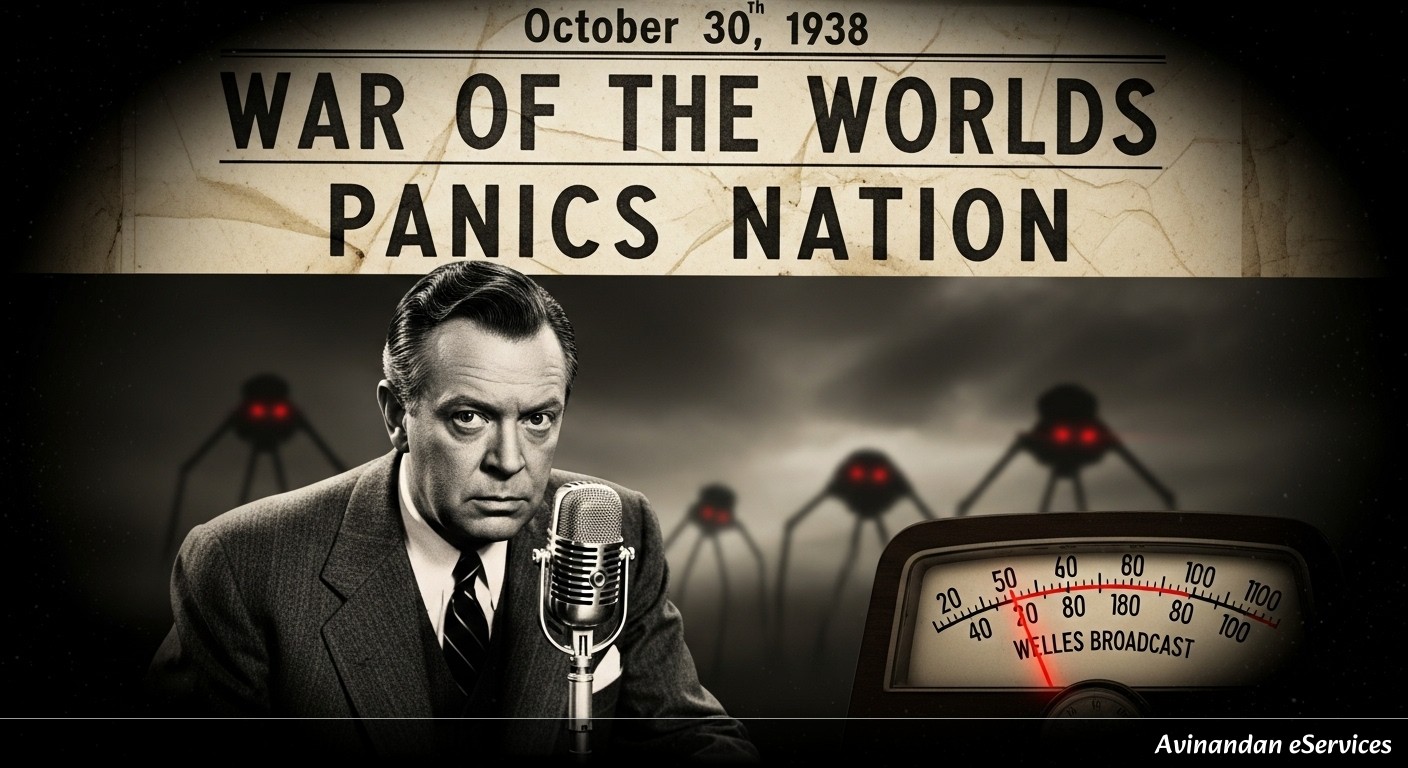
Imagine settling down in your living room on a quiet Sunday evening, the day before Halloween. It's October 30, 1938, and the warm glow of the radio dial is a familiar comfort. You tune in to the CBS Radio Network, expecting the usual musical programming. Instead, you're met with a startling news bulletin: strange explosions have been observed on Mars. This is how it began for millions of Americans, a night where the line between entertainment and reality blurred, sparking a panic that would become legendary. On this day, a 23-year-old Orson Welles and his Mercury Theatre on the Air unleashed a radio drama so realistic that it convinced many that the end of the world was nigh. This wasn't just another radio play; it was a cultural phenomenon that would forever change the way we think about the power of media.
The Build-Up: What Led to This Day?
To understand the panic that ensued, we must first understand the world of 1938. It was a time of great anxiety and uncertainty. The Great Depression still cast a long shadow over the United States, and the winds of war were blowing fiercely in Europe. Radio had become the primary source of news and entertainment for many families, a trusted voice that brought the world into their homes. Just a month prior, the Munich Crisis had kept Americans glued to their radios, listening to breathless, real-time updates of the unfolding political drama in Europe. This had conditioned the public to expect urgent and sometimes alarming news bulletins to interrupt their regular programming.
It was into this tense atmosphere that a young and ambitious Orson Welles sought to make a name for himself. His weekly radio series, "The Mercury Theatre on the Air," was critically acclaimed but suffered from low ratings, largely due to its time slot opposite the much more popular "Chase and Sanborn Hour." Welles knew he needed to do something dramatic to capture the public's attention. For the Halloween episode, he chose to adapt H.G. Wells' 1898 science fiction novel, "The War of the Worlds." But a straight adaptation wouldn't do. Welles and his team, including writer Howard Koch, ingeniously decided to stage the 40-year-old story as a series of simulated live news bulletins, interrupting a program of dance music. This format, inspired by the real-life radio coverage of the Hindenburg disaster and the Munich Crisis, was designed for maximum realism and dramatic effect.
The Event Itself
At 8 p.m. Eastern Time on October 30, 1938, the show began. An announcer introduced the program as a dramatization of H.G. Wells' novel, but many who tuned in late missed this crucial disclaimer. The first part of the broadcast was deceptively calm, featuring the soothing sounds of Ramón Raquello and his orchestra. Soon, however, the music was interrupted by a news flash about a series of strange gas explosions on the surface of Mars. The interruptions became more frequent and more alarming. A "meteor" was reported to have crashed in Grover's Mill, New Jersey. A reporter, live on the scene, described a cylindrical object and the emergence of a terrifying creature with snake-like tentacles and glistening skin.
The broadcast's pacing was a work of genius. It started slowly, lulling the audience into a false sense of security, before gradually accelerating into a frenzy of chaos and destruction. Listeners heard the sounds of panicked crowds, the deployment of the military, and the chillingly calm voice of a military official declaring martial law. The fictional news reporters, with their increasingly desperate and terrified voices, described giant Martian war machines armed with a deadly heat-ray, incinerating everything in their path. The broadcast painted a vivid and horrifying picture of a full-scale alien invasion, with New York City being one of the prime targets. For many, the realistic sound effects and the authoritative tone of the actors made the unbelievable seem terrifyingly real.
The Aftermath and Legacy
The immediate aftermath of the broadcast was chaotic, though the true \textent of the panic has been debated by historians. Newspapers, eager to discredit their new rival, radio, ran sensational headlines about nationwide hysteria, mass stampedes, and even suicides. While some of these reports were exaggerated, there is no doubt that the broadcast caused genuine fear and confusion. Police stations and newspaper offices were inundated with frantic calls from people seeking information and advice. Some listeners packed their bags and fled their homes, while others sought refuge in churches, convinced that the end of the world was at hand. In Newark, New Jersey, several people were treated for shock.
The following morning, a contrite Orson Welles faced a barrage of reporters, claiming he had no idea the broadcast would cause such a panic. The Federal Communications Commission (FCC) launched an investigation but ultimately took no punitive action against Welles or CBS. Instead of ending his career, the notoriety from "The War of the Worlds" catapulted the 23-year-old Welles to international fame and a lucrative Hollywood contract, which would lead to the creation of his masterpiece, "Citizen Kane."
The 1938 broadcast of "The War of the Worlds" remains a landmark event in media history. It served as a powerful, if unintentional, demonstration of the influence of radio and the importance of media literacy. The event highlighted the public's trust in the then-new medium and its vulnerability to misinformation, a lesson that remains incredibly relevant in our modern age of social media and "fake news." More than just a Halloween prank, the broadcast was a cultural touchstone that blurred the lines between fiction and reality, forever cementing Orson Welles' legacy as a master storyteller and a pioneer of modern media.
References
- Britannica. (n.d.). *War of the Worlds | radio drama by Welles [1938]*.
- EBSCO. (n.d.). *Analysis: On The War of the Worlds Radio Broadcast | Research Starters*.
- EBSCO. (n.d.). *Welles Broadcasts The War of the Worlds | Research Starters*.
- Jagran Josh. (2025, October 29). *This Day in History: What Happened Today in History – 30 October*.
- London Daily News. (2025, February 13). *Celebrating the legacy of radio: From Orson Welles' 1938 mercury theatre classic to Jeff Wayne's immersive experience of The War of The Worlds*.
- Lunatics Radio Hour. (2024, September 4). *The History of The War of The Worlds Radio Broadcast from 1938*.
- National Day Calendar. (2024, October 30). *OCTOBER 30 | Events and Birthdays*.
- On-This-Day.com. (n.d.). *History for October 30*.
- Poynter. (2014, October 30). *Today in Media History: Martians attack Earth in Orson Welles' 1938 'War of the Worlds' radio broadcast*.
- Smithsonian Magazine. (2015, May 6). *The Infamous 'War of the Worlds' Radio Broadcast Was a Magnificent Fluke*.
- The History Place. (n.d.). *This Month in History: October*.
- The Mining Gazette. (2025, October 29). *Today in history, October 30*.
- The Vintage News. (2025, October 22). *October 30th, 1938: 'The War of the Worlds' Radio Broadcast Causes Mass Panic*.
- Wikipedia. (n.d.). *The War of the Worlds (1938 radio drama)*.