Introduction to the Topic
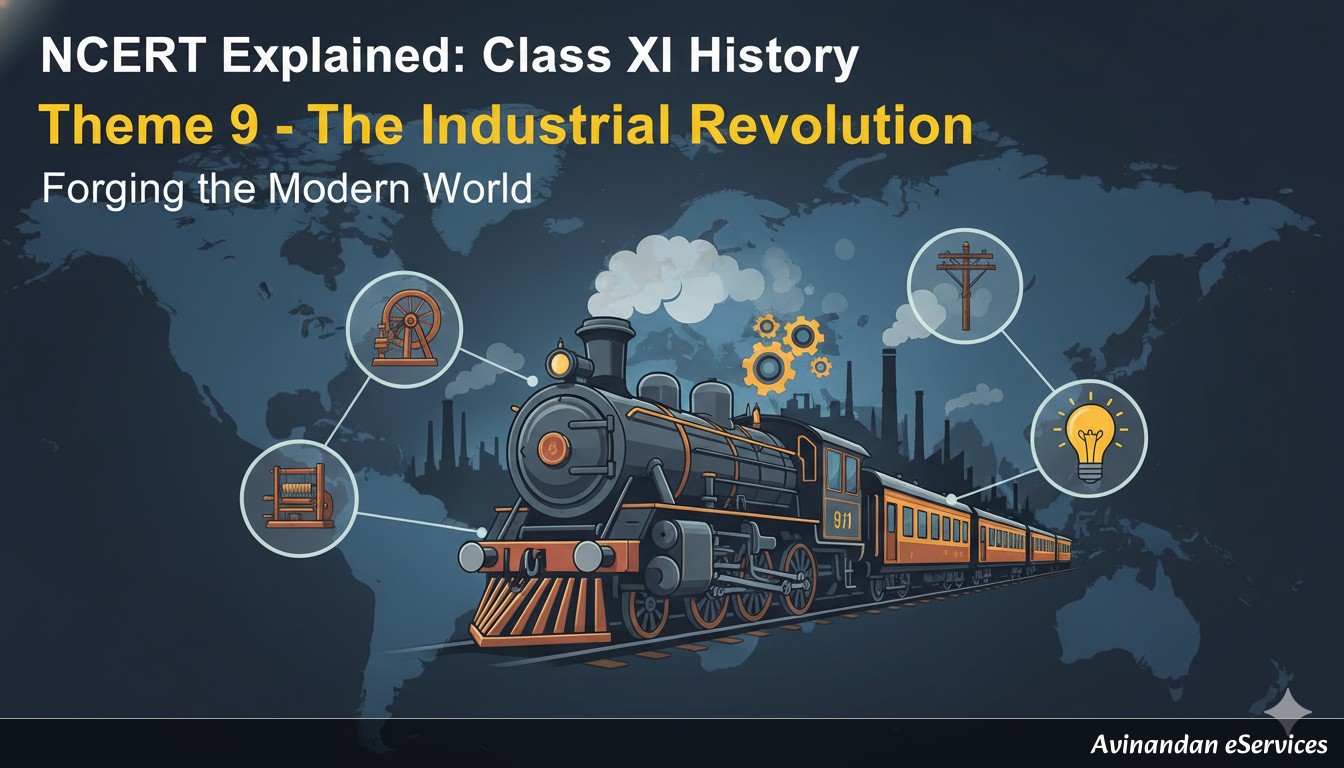
Welcome, history explorers! Today, we journey back in time to one of the most transformative periods in human history: the Industrial Revolution. What comes to your mind when you hear these words? Towering factory chimneys, chugging steam trains, bustling cities? You're on the right track! But the Industrial Revolution was so much more than just machines. It was a fundamental change in the way we live, work, and interact with the world. Based on Theme 9 of your Class XI NCERT History textbook, 'The Industrial Revolution', this post will unpack this complex and fascinating era.
The term 'Industrial Revolution' refers to the period from roughly 1760 to 1840 when major changes in agriculture, manufacturing, mining, transport, and technology had a profound effect on the social, economic, and cultural conditions of the time. It began in Great Britain and then spread throughout the world. Before this, economies were largely based on agriculture and handmade goods. Life was rural, and change was slow. The Industrial Revolution flipped this world upside down, replacing hand tools with power-driven machines, human and animal power with steam power, and marking the shift from a rural, agrarian society to an urban, industrial one. Understanding this revolution is crucial because its ripples are still felt today—in the technology we use, the cities we live in, the global economy, and even the environmental challenges we face. Let's fire up the engine of knowledge and explore how this revolution forged the modern world.
Key Concepts Explained
Why Britain? The Seeds of Revolution
Have you ever wondered why this world-changing event started on a relatively small island nation? Britain in the 18th century was a fertile ground for industrialization due to a unique cocktail of factors that other nations lacked at the time. It wasn't a coincidence; it was a convergence of historical, geographical, and political advantages.
- Political Stability: Since the 17th century, England, Wales, and Scotland had been unified under a single monarchy. This meant the kingdom had common laws, a single currency, and a market that was not fragmented by local taxes and tariffs. This stability created a predictable environment for business and investment.
- The Agricultural Revolution: This was a prequel to the industrial story. Landlords began consolidating their lands into larger, more efficient farms through a process called 'enclosure'. While this displaced many small farmers, it led to a massive increase in food production. More food meant a healthier, growing population that could be sustained even if they weren't farming. The displaced farmers, in turn, became a ready workforce for the new factories.
- Abundant Natural Resources: Britain was blessed with large, easily accessible deposits of coal and iron ore, the two essential ingredients of industrialization. Coal was the fuel, and iron was the material for building the new machines and infrastructure.
- A Global Empire and Trade: Britain's vast colonial empire gave it two crucial advantages: a source of cheap raw materials (like cotton from India and the American colonies) and a captive market to sell its finished manufactured goods. Its powerful navy protected these trade routes, ensuring a smooth flow of goods and profits.
- Financial Infrastructure: The Bank of England, founded in 1694, provided financial stability. A network of other banks meant that entrepreneurs could get loans to start new factories and invest in new technologies. A culture of capitalism and investment was already taking root.
- Transport Network: Britain had a good network of rivers that were used for transport. This was massively expanded during the 18th century with the construction of canals, which made it much cheaper and easier to move heavy goods like coal and iron across the country.
The Engines of Change: Key Inventions and Industries
The Industrial Revolution was driven by a wave of technological innovation that transformed key industries. Let's look at the big three: cotton, iron, and steam power.
The Cotton Industry: The First Spark
The revolution first took hold in the textile industry. For centuries, Britain's main textile was wool. However, the demand for lighter, cheaper, and more easily washable cotton fabrics was growing, fueled by imports from India. British entrepreneurs wanted to produce cotton cloth domestically and compete. The problem was that the traditional process—spinning thread and weaving cloth by hand—was incredibly slow. This created a bottleneck and spurred a series of game-changing inventions:
- The Flying Shuttle (1733): Invented by John Kay, this device allowed a single weaver to weave much wider fabrics and mechanized the process, speeding it up significantly. This created a new problem: weavers could now work so fast that the spinners couldn't supply them with enough thread.
- The Spinning Jenny (c. 1765): James Hargreaves' invention tackled this problem. It was a multi-spindle spinning frame that enabled one worker to spin eight or more threads at once, dramatically increasing the output of spinners.
- The Water Frame (1769): Richard Arkwright developed a spinning frame that used water power. It produced a much stronger cotton thread than the Jenny and marked a crucial shift. Because it was large and powered by a water wheel, it couldn't fit in a cottage. This led to the creation of the first factories, where workers came to a central location to operate machines.
- The Mule (c. 1779): Samuel Crompton's 'Mule' combined the best features of the Spinning Jenny and the Water Frame. It could produce thread that was both fine and strong, revolutionizing the industry once again.
- The Power Loom (1787): Edmund Cartwright invented a loom that was powered by water or steam, mechanizing the weaving process completely.
Together, these inventions destroyed the old cottage industry and gave birth to the factory system, changing the nature of work forever.
Steam Power: The Heartbeat of the Revolution
If cotton was the spark, steam was the explosive fuel. The true power of the Industrial Revolution was unleashed by the steam engine. Early steam engines existed before the 18th century, but they were inefficient and used mainly to pump water out of coal mines. The real breakthrough came with James Watt. In 1769, Watt patented a series of improvements, most notably a separate condenser, that made the steam engine vastly more efficient and versatile. Watt's engine could be used to power all sorts of machinery. It freed factories from the need to be located next to a fast-flowing river. Now, factories could be built anywhere—in cities, near coalfields, or close to ports. Steam became the universal power source, driving everything from textile looms to locomotives.
The Iron Industry: The Skeleton of Modernity
The new machines, factories, and railways needed to be built from something strong and durable. That something was iron. For centuries, iron was smelted using charcoal (burnt wood), which was inefficient and led to widespread deforestation. The Darby family of Shropshire revolutionized the process. In 1709, Abraham Darby I perfected a method of using coke (a purified form of coal) to smelt iron ore. Coke was cheaper, more efficient, and produced a higher quality of iron. Later, in the 1780s, Henry Cort developed the 'puddling' process to remove impurities from pig iron and the 'rolling mill' to shape it. These innovations made high-quality, cheap iron abundant. This iron was used to build bridges (like the iconic Iron Bridge in 1779), factory frames, machines, and, most importantly, railway tracks.
The Revolution in Transport: Connecting a Nation
All these new goods being produced needed to be moved. The old system of horse-drawn carts on muddy roads was too slow and expensive. The Industrial Revolution, therefore, also sparked a revolution in transport.
- Canals: From the 1760s onwards, Britain experienced a period of 'canal mania'. Canals were man-made waterways that could carry heavy barges. They were a much cheaper and smoother way to transport bulk goods like coal than roads. The Duke of Bridgewater's canal, built in 1761 to carry coal from his mines to Manchester, halved the price of coal in the city overnight, demonstrating their immense economic benefit.
- Railways: The Iron Horse: The most iconic and transformative transport innovation was the railway. It combined two key elements of the revolution: steam power and iron. The first public railway using a steam locomotive was built by George Stephenson, running from Stockton to Darlington in 1825. However, the first line to connect two major cities, Liverpool and Manchester, opened in 1830. Stephenson's famous locomotive, 'The Rocket', proved that steam-powered rail travel was fast, reliable, and commercially viable. Railways changed everything. They slashed travel times, cut the cost of transporting goods, connected previously remote areas, stimulated the coal and iron industries, and even changed people's perception of time and space.
The Human Cost: Changed Lives and Social Upheaval
While the Industrial Revolution brought wealth and progress for some, it came at a terrible human cost for many. The NCERT textbook rightly emphasizes the dark side of this transformation, focusing on the lives of the ordinary workers who fueled this new industrial age.
Urbanization and Living Conditions
The factory system pulled people from the countryside into the cities in unprecedented numbers. Cities like Manchester, Liverpool, and Leeds exploded in size almost overnight. This growth was unplanned and chaotic. Workers were crammed into hastily built, overcrowded slums. Housing was appalling, often lacking basic sanitation, ventilation, or clean water. Diseases like cholera, typhoid, and tuberculosis spread like wildfire through these squalid neighborhoods. Life expectancy in the industrial cities was shockingly low.
Working Conditions
Life inside the factories was often a living nightmare. Workers, including women and young children, faced grueling conditions:
- Long Hours: A typical workday was 12 to 16 hours long, six days a week, with very few breaks.
- Low Wages: Pay was barely enough to survive. Factory owners often kept wages low to maximize profits.
- Dangerous Environments: Factories were filled with dangerous, unfenced machinery. Accidents were common, resulting in lost limbs or death. There was no compensation for injuries. The air in textile mills was thick with cotton dust, leading to lung diseases.
- Child Labour: Children were \textensively used in factories and mines. Their small size made them ideal for crawling under machinery to fix broken threads or for pulling carts in narrow mine shafts. They worked the same long hours as adults for a fraction of the pay and were often subjected to brutal discipline.
Protest and Resistance
It's no surprise that workers did not accept these conditions passively. They protested and organized in various ways:
- Luddism (1811-1816): This was an early, desperate form of protest. Named after a mythical leader, General Ned Ludd, the Luddites were skilled artisans who saw the new machines as a threat to their livelihood. They organized nighttime raids to smash factory machinery. While seen as simply anti-technology, historians now view it as a form of 'collective bargaining by riot' by workers who had no other legal means to voice their grievances.
- Political Action and the Peterloo Massacre (1819): Workers also began to demand political rights, especially the right to vote. In 1819, a massive, peaceful crowd of around 60,000 people gathered at St. Peter's Fields in Manchester to demand parliamentary reform. The local authorities panicked and ordered armed cavalry to charge the crowd, killing over a dozen people and injuring hundreds. The event, ironically dubbed the 'Peterloo Massacre', became a powerful symbol of government repression.
- Rise of Trade Unions: Despite being illegal for many years under the Combination Acts (1799-1824), workers secretly formed unions to demand better wages and conditions. After the repeal of these acts, trade unionism grew, becoming a major force for workers' rights in the later 19th century.
Debates on the Industrial Revolution: A Blessing or a Curse?
Historians have long debated the true nature of the Industrial Revolution. Was it a period of glorious progress or one of catastrophic social misery?
- The Optimistic View: Early historians and economists celebrated the revolution for its technological marvels, its creation of immense wealth, and its role in building Britain's global power. They argued that while there was short-term pain, it ultimately led to a higher standard of living for everyone in the long run.
- The Pessimistic View: Social historians like E.P. Thompson and Marxist thinkers like Friedrich Engels focused on the exploitation and suffering of the working class. They argued that the wealth created was built on the backs of exploited workers, and that the revolution destroyed traditional communities and created deep class divisions.
- A Balanced Perspective: Today, most historians take a more nuanced view. The Industrial Revolution was a complex and contradictory process. It was a period of both incredible innovation and immense suffering; of economic growth and growing inequality; of progress and profound social dislocation. It undoubtedly laid the foundations for our modern, technological world, but its benefits were not shared equally, and its social and environmental costs were enormous.
Summary & Key Takeaways
As we close this chapter, let's distill the key points to remember about this monumental period:
- Birthplace Britain: The Industrial Revolution began in Britain due to a unique mix of factors including political stability, agricultural advancements, abundant resources like coal and iron, and a vast colonial empire.
- Key Innovations: It was propelled by technological breakthroughs in key industries. The textile industry was transformed by inventions like the Spinning Jenny and the Power Loom. The iron industry boomed thanks to coke smelting, and the entire revolution was powered by James Watt's improved steam engine.
- Transport Revolution: The movement of goods was revolutionized first by canals and then, most profoundly, by the invention of the steam-powered railway.
- Societal Transformation: It caused a massive shift of population from rural areas to cities (urbanization), creating a new industrial working class.
- The Human Cost: This progress came at a high price for the working class, who faced horrific conditions in factories and slums, including long hours, low pay, dangerous work, and widespread child labor.
- Worker Resistance: Workers fought back through various means, from machine-breaking (Luddism) and political protests to the formation of trade unions to fight for their rights.
- A Complex Legacy: The Industrial Revolution's legacy is dual-sided. It created the modern industrial economy and many of the technologies we take for granted, but it also created deep social inequalities and environmental problems that we are still grappling with today.