Introduction: Ace Quantitative Aptitude in RRB Exams
Welcome, future railway professionals! If you are preparing for competitive exams like the RRB NTPC, RRB Group D, or RRB Technician, you know that the Quantitative Aptitude section can be a game-changer. Among the many topics in this section, 'Pipes and Cisterns' is a classic and frequently tested concept. Often considered a special case of 'Time and Work', these problems are logical, formula-based, and can fetch you easy marks if you master the underlying principles.
Many aspirants find these questions tricky, but with the right approach, a clear understanding of the concepts, and some clever shortcuts, you can solve them in under a minute. This comprehensive guide is designed to be your one-stop resource for mastering Pipes and Cisterns. We will break down the topic from the basics to advanced levels, providing clear concepts, essential formulas, solved examples, and a set of practice questions to test your skills. Let's dive in and fill your tank of knowledge!
Understanding the Basics: Pipes and Cisterns Explained
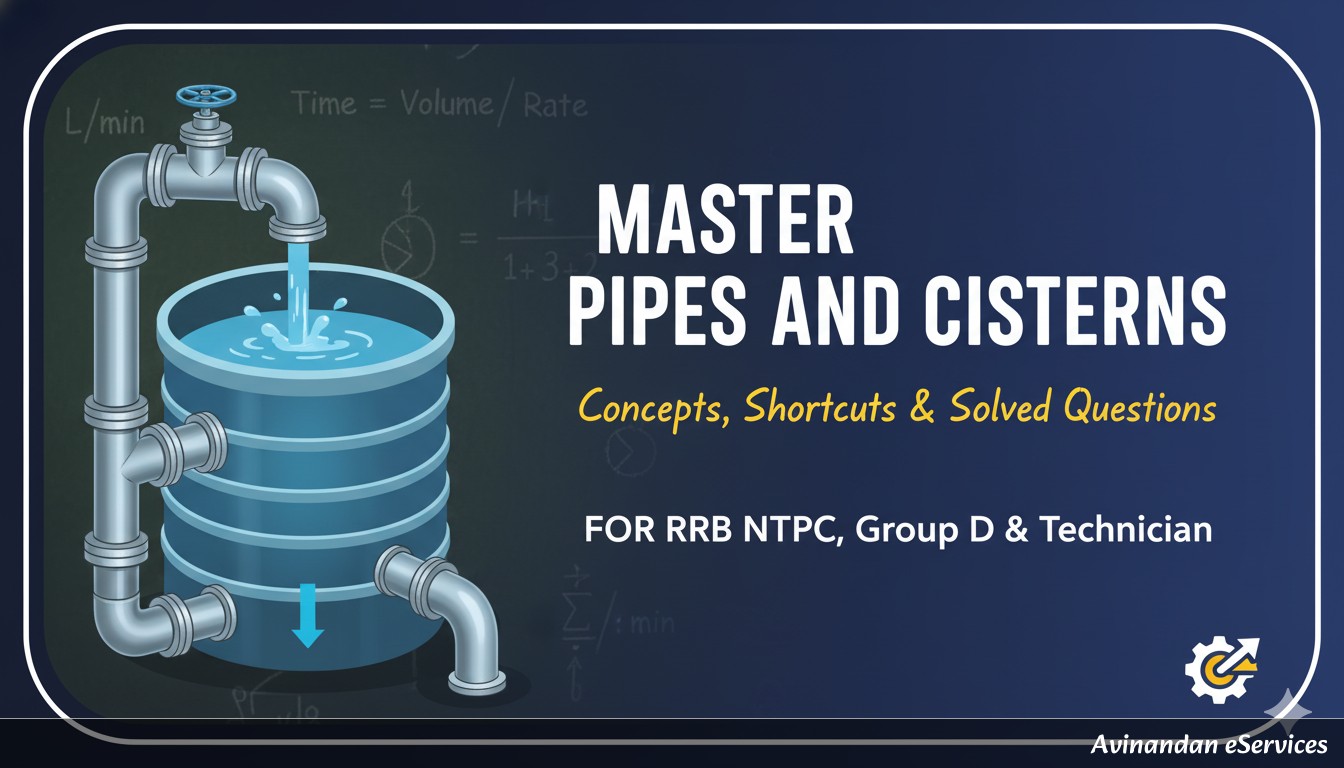
Before we jump into formulas and problems, let's get our fundamentals right. Imagine a simple water tank (a cistern) and a few pipes connected to it. Some pipes fill the tank, while others drain it. That's the entire setup for this topic!
- Cistern/Tank: A reservoir or container for storing water. The problems revolve around filling or emptying this tank.
- Inlet Pipe: A pipe connected to fill the cistern. The work done by an inlet pipe is always considered positive (+) work.
- Outlet/Leak Pipe: A pipe or a leak used to empty the cistern. The work done by an outlet pipe is always considered negative (-) work.
The core idea is to calculate the rate at which a pipe works. The 'work' here is filling or emptying a certain volume of the tank, and the 'rate' is the portion of the tank it can fill or empty in a single unit of time (like an hour or a minute).
Core Concepts and Formulas for Pipes and Cisterns
The concepts for Pipes and Cisterns are direct \textensions of the Time and Work topic. If you understand one, the other becomes significantly easier.
Concept 1: Individual Rate of Work
This is the most fundamental principle. The rate of work is the reciprocal of the time taken to complete the entire work.
- If an inlet pipe can fill a tank completely in 'x' hours, then the part of the tank it fills in 1 hour is 1/x.
- Similarly, if an outlet pipe can empty a full tank in 'y' hours, then the part of the tank it empties in 1 hour is 1/y.
Concept 2: Combined Rate of Work (Multiple Pipes)
This is where problems get interesting. We combine the rates of different pipes to find their collective effect.
- Two Inlet Pipes: If Pipe A fills a tank in 'x' hours and Pipe B fills it in 'y' hours, their combined work in 1 hour is (1/x + 1/y). The total time to fill the tank together is (xy / (x+y)) hours.
- One Inlet and One Outlet Pipe: If Pipe A fills a tank in 'x' hours and Pipe B empties it in 'y' hours, their combined work in 1 hour is (1/x - 1/y). The net effect depends on which rate is higher. The total time to fill the tank (assuming y > x) is (xy / (y-x)) hours.
Concept 3: The LCM Method (Efficiency Method) - The Ultimate Shortcut!
While the fraction method works, the LCM method is faster, avoids complex fraction calculations, and is highly recommended for competitive exams. Let's understand it step-by-step.
Steps for the LCM Method:
- Assume Tank Capacity: Take the LCM (Least Common Multiple) of the times given for all pipes. This LCM value represents the total capacity of the tank in 'units'.
- Calculate Efficiency: Efficiency is the work done per unit of time. Calculate the efficiency of each pipe using the formula:
Efficiency = Total Capacity (LCM) / Time Taken by the pipe. This gives you the number of 'units' of water a pipe adds or removes per hour/minute. - Assign Signs: The efficiency of an inlet pipe is positive (+), and the efficiency of an outlet/leak pipe is negative (-).
- Calculate Combined Efficiency: Add the efficiencies of all pipes that are working together.
- Find Total Time: Use the formula:
Time Taken = Total Capacity (LCM) / Combined Efficiency.
Example of LCM Method: Pipe A fills a tank in 10 hours, and Pipe B fills it in 15 hours. How long will they take together?
- Step 1 (Capacity): LCM of 10 and 15 is 30. Let the tank capacity be 30 units.
- Step 2 (Efficiency):
Efficiency of A = 30 / 10 = +3 units/hour.
Efficiency of B = 30 / 15 = +2 units/hour. - Step 3 (Combined Efficiency): Total efficiency = 3 + 2 = 5 units/hour.
- Step 4 (Total Time): Time taken = Total Capacity / Combined Efficiency = 30 / 5 = 6 hours.
See how simple that was? No fractions involved!
Types of Problems in Pipes and Cisterns with Solved Examples
Let's apply these concepts to the types of questions frequently asked in RRB exams.
Type 1: Basic Problems with Two or More Pipes
These are the most straightforward questions, directly applying the concepts we just learned.
Solved Example 1: An inlet pipe A can fill a tank in 8 hours, and an outlet pipe B can empty the same full tank in 12 hours. If both pipes are opened simultaneously, in how much time will the tank be filled?
Solution (Using LCM Method):
- Capacity: LCM of 8 and 12 is 24 units.
- Efficiency of A (Inlet): 24 / 8 = +3 units/hour.
- Efficiency of B (Outlet): 24 / 12 = -2 units/hour. (Negative sign for outlet)
- Combined Efficiency: (+3) + (-2) = 1 unit/hour.
- Time to fill the tank: Total Capacity / Combined Efficiency = 24 / 1 = 24 hours.
Answer: The tank will be filled in 24 hours.
Type 2: Pipes Opened and Closed Intermittently or Alternately
In these problems, pipes are not open for the entire duration. They might be opened for a certain period and then closed, or opened on alternate hours.
Solved Example 2: Pipe A can fill a tank in 6 hours and Pipe B can fill it in 8 hours. If they are opened on alternate hours, starting with Pipe A, how long will it take to fill the tank?
Solution (Using LCM Method):
- Capacity: LCM of 6 and 8 is 24 units.
- Efficiency of A: 24 / 6 = +4 units/hour.
- Efficiency of B: 24 / 8 = +3 units/hour.
- Work in a 2-hour cycle (A then B):
1st hour (A): +4 units
2nd hour (B): +3 units
Total work in 2 hours = 4 + 3 = 7 units. - Cycles to get close to 24 units: We need to fill 24 units. Let's see how many 7-unit cycles we can complete. 24 / 7 gives 3 with a remainder. So, we run 3 full cycles.
Work done in 3 cycles = 3 * 7 = 21 units.
Time taken for 3 cycles = 3 * 2 = 6 hours. - Remaining Work: Total Capacity - Work Done = 24 - 21 = 3 units.
- Who's next?: After 3 cycles (6 hours), it's Pipe A's turn. Pipe A's efficiency is 4 units/hour. It needs to fill only 3 more units.
- Time for remaining work: Time = Work / Efficiency = 3 / 4 hours.
- Total Time: 6 hours + 3/4 hours = 6 hours and (3/4 * 60) minutes = 6 hours and 45 minutes.
Answer: The tank will be filled in 6 hours and 45 minutes.
Type 3: Problems with a Leak in the Tank
A leak is simply an outlet pipe. The problem might give you the time taken with and without the leak, and you'll have to find the leak's individual rate.
Solved Example 3: A tap can fill a tank in 10 hours. However, due to a leak in the bottom, it takes 12 hours to fill the tank. If the tank is full, how long will the leak take to empty it?
Solution (Using LCM Method):
- Let the tap be 'T' and the leak be 'L'.
- Time taken by Tap (T) = 10 hours.
- Time taken by Tap and Leak (T - L) = 12 hours.
- Capacity: LCM of 10 and 12 is 60 units.
- Efficiency of T: 60 / 10 = +6 units/hour.
- Combined Efficiency of (T - L): 60 / 12 = +5 units/hour.
- We know, Efficiency(T) + Efficiency(L) = Combined Efficiency(T-L)
- (+6) + Efficiency(L) = +5
- Efficiency(L) = 5 - 6 = -1 unit/hour. The negative sign confirms it's a leak.
- Time for Leak to empty the tank: Total Capacity / Efficiency of Leak = 60 / 1 = 60 hours.
Answer: The leak will empty the full tank in 60 hours.
Type 4: Problems Based on Pipe Efficiency
Here, the relationship between the efficiencies (or speeds) of pipes is given, rather than their individual times.
Solved Example 4: Pipe A is twice as efficient as Pipe B. If they together can fill a tank in 18 hours, in how much time can Pipe B alone fill the tank?
Solution:
- Efficiency Ratio: Let the efficiency of Pipe B be 'x' units/hour. Then the efficiency of Pipe A is '2x' units/hour.
- Combined Efficiency: x + 2x = 3x units/hour.
- Total Capacity (Work): We know Work = Efficiency × Time.
Total Capacity = Combined Efficiency × Total Time = (3x) * 18 = 54x units. - Time for B alone: Time = Total Capacity / Efficiency of B = 54x / x = 54 hours.
Answer: Pipe B alone can fill the tank in 54 hours.
Pro Tips and Shortcuts to Solve Questions Faster
- Master the LCM Method: It is consistently the fastest and most reliable method. Practice it until it becomes second nature.
- Positive and Negative Work: Always remember to assign a '+' sign to the efficiency of inlets and a '-' sign to outlets/leaks. This single step prevents most common errors.
- Read Carefully: Pay close attention to what the question is asking. Is it the time to fill the remaining part? Or the total time? Is the tank initially empty or partially full?
- Unit Consistency: Ensure all time units are consistent. If times are given in hours and minutes, convert everything to either hours or minutes before you start.
- Visualize the Problem: A quick mental picture of the tank and pipes can often help clarify the process and prevent silly mistakes.
Practice Questions with Solutions for RRB Exams
Now it's time to test your understanding. Try to solve these problems on your own before looking at the solutions. These questions are designed to reflect the difficulty level of RRB exams.
Question 1: Two pipes A and B can fill a tank in 20 and 30 minutes respectively. If both pipes are opened together, how long will it take to fill the tank?
Solution:
Capacity = LCM(20, 30) = 60 units.
Efficiency of A = 60/20 = +3 units/min.
Efficiency of B = 60/30 = +2 units/min.
Combined Efficiency = 3 + 2 = 5 units/min.
Time = 60 / 5 = 12 minutes.
Question 2: A cistern has two taps which fill it in 12 minutes and 15 minutes respectively. There is also a waste pipe in the cistern. When all three are opened, the empty cistern is full in 20 minutes. How long will the waste pipe take to empty the full cistern?
Solution:
Let the taps be A, B and the waste pipe be C.
Capacity = LCM(12, 15, 20) = 60 units.
Efficiency of A = 60/12 = +5 units/min.
Efficiency of B = 60/15 = +4 units/min.
Combined Efficiency (A+B-C) = 60/20 = +3 units/min.
We have: Eff(A) + Eff(B) + Eff(C) = 3
5 + 4 + Eff(C) = 3
9 + Eff(C) = 3
Eff(C) = 3 - 9 = -6 units/min.
Time for C to empty = Total Capacity / |Eff(C)| = 60 / 6 = 10 minutes.
Question 3: A tank is filled in 5 hours by three pipes A, B, and C. Pipe C is twice as fast as B, and B is twice as fast as A. How much time will pipe A alone take to fill the tank?
Solution:
Let efficiency of A = x units/hr.
Efficiency of B = 2x units/hr.
Efficiency of C = 2 * (2x) = 4x units/hr.
Combined Efficiency (A+B+C) = x + 2x + 4x = 7x units/hr.
Total Capacity = Combined Efficiency * Time = 7x * 5 = 35x units.
Time for A alone = Total Capacity / Efficiency of A = 35x / x = 35 hours.
Question 4: Two pipes A and B can fill a tank in 15 hours and 20 hours respectively, while a third pipe C can empty the full tank in 25 hours. All three pipes are opened in the beginning. After 10 hours, C is closed. In how much time will the tank be full?
Solution:
Capacity = LCM(15, 20, 25) = 300 units.
Eff(A) = 300/15 = +20.
Eff(B) = 300/20 = +15.
Eff(C) = 300/25 = -12.
For the first 10 hours, combined efficiency (A+B+C) = 20 + 15 - 12 = 23 units/hr.
Water filled in first 10 hours = 23 * 10 = 230 units.
Remaining Capacity = 300 - 230 = 70 units.
After 10 hours, C is closed. New combined efficiency (A+B) = 20 + 15 = 35 units/hr.
Time to fill remaining part = Remaining Capacity / New Efficiency = 70 / 35 = 2 hours.
Total time to fill the tank = 10 hours + 2 hours = 12 hours.
Question 5: A tap can fill a tank in 6 hours. After half the tank is filled, three more similar taps are opened. What is the total time taken to fill the tank completely?
Solution:
Let capacity = 6 units. Efficiency of one tap = 6/6 = 1 unit/hr.
Time to fill half the tank (3 units) by one tap = 3 units / 1 unit/hr = 3 hours.
Remaining capacity = 3 units.
Now, there are 1 (original) + 3 (new) = 4 taps.
Combined efficiency of 4 taps = 4 * 1 = 4 units/hr.
Time to fill the remaining 3 units = 3 units / 4 units/hr = 0.75 hours = 45 minutes.
Total time = 3 hours + 45 minutes = 3 hours 45 minutes.
Conclusion
Mastering 'Pipes and Cisterns' is a significant step towards boosting your Quantitative Aptitude score in RRB examinations. As we've seen, the problems are built on simple logic and can be solved quickly using the right techniques, especially the LCM method. The key to success is consistent practice. Work through these examples again, find more practice questions from previous year's papers, and time yourself as you solve them.
By internalizing these concepts and shortcuts, you can turn a potentially confusing topic into a reliable source of marks. Keep up the hard work, stay focused, and you will surely achieve your goal of securing a job in the Indian Railways. All the best!