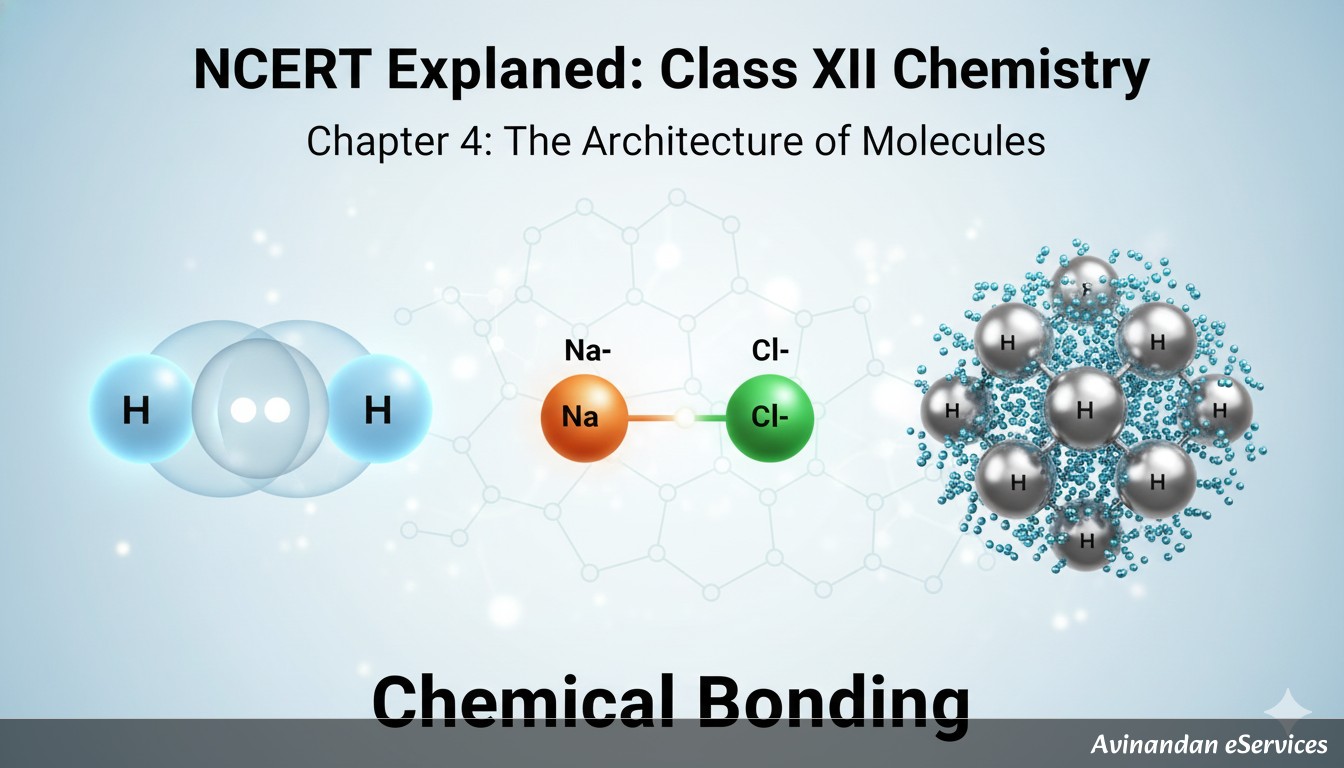
Introduction to the Topic
Have you ever wondered what holds the world together? Look around you. The water you drink, the air you breathe, the chair you're sitting on, and even you yourself – everything is made of atoms. But these atoms aren't just floating around randomly. They are intricately connected, holding hands in a cosmic dance to form molecules, which in turn build the matter we see and interact with. The force that holds these atoms together in a molecule is known as a chemical bond. Understanding this fundamental concept is like learning the grammar of chemistry; it allows us to read the language of matter itself.
This blog post will demystify Chapter 4, 'Chemical Bonding and Molecular Structure,' from the NCERT Class XI Chemistry textbook. We will explore why atoms combine, the different ways they do so, and how these connections determine the three-dimensional shape of molecules. The shape of a molecule is not just an aesthetic detail; it dictates its properties and how it interacts with other molecules. For instance, the specific shape of a drug molecule allows it to fit perfectly into a receptor in our body, like a key in a lock, to produce a therapeutic effect. So, let's embark on this exciting journey to uncover the secrets behind the architecture of molecules!
Key Concepts Explained
1. Why Do Atoms Combine? The Quest for Stability
The primary driver behind chemical bond formation is the universal tendency of systems to move towards a state of lower energy and greater stability. For atoms, this stability is often achieved by having a specific number of electrons in their outermost shell, also known as the valence shell. The 'magic number' is usually eight, a concept encapsulated in the Octet Rule, proposed by G.N. Lewis.
The Octet Rule: This rule states that atoms tend to bond in such a way that they each have eight electrons in their valence shell, mimicking the stable electron configuration of the noble gases (like Neon, Argon, etc.). An atom can achieve this stable octet in three primary ways:
- By completely giving away one or more electrons to another atom.
- By accepting one or more electrons from another atom.
- By sharing one or more electrons with another atom.
This simple yet powerful rule forms the basis for understanding the two major types of chemical bonds: Ionic and Covalent.
2. Ionic Bonds: The Art of Giving and Taking
An ionic bond is formed by the complete transfer of one or more valence electrons from one atom (usually a metal) to another (usually a non-metal). This transfer creates ions – atoms that have a net positive or negative charge.
- The atom that loses electrons becomes a positively charged ion (a cation).
- The atom that gains electrons becomes a negatively charged ion (an anion).
The strong electrostatic force of attraction between these oppositely charged ions is what constitutes the ionic bond. Think of it as a magnetic attraction holding the two ions together in a crystal lattice structure.
Example: The Formation of Sodium Chloride (NaCl)
- Sodium (Na) has an electron configuration of 2, 8, 1. It has one electron in its valence shell. To achieve a stable octet (2, 8), it readily loses this one electron, forming a Na⁺ cation.
- Chlorine (Cl) has an electron configuration of 2, 8, 7. It has seven valence electrons. It eagerly accepts one electron to complete its octet (2, 8, 8), forming a Cl⁻ anion.
- The Na⁺ cation and Cl⁻ anion are then held together by a strong electrostatic attraction, forming the ionic compound NaCl, or common table salt.
Factors favouring ionic bond formation include low ionization enthalpy for the metal (easy to lose an electron) and high negative electron gain enthalpy for the non-metal (strong tendency to gain an electron).
3. Covalent Bonds: The Power of Sharing
What happens when atoms have similar tendencies to gain or lose electrons, like two non-metals? They can't just transfer electrons. Instead, they achieve stability by sharing valence electrons. A covalent bond is the chemical bond formed by the mutual sharing of one or more pairs of electrons between two atoms.
The shared pair of electrons belongs to both atoms simultaneously, allowing both to count those electrons towards their stable octet. We can represent these shared pairs using Lewis Dot Structures, where valence electrons are shown as dots around the atomic symbol.
- Single Bond: One pair of electrons is shared (e.g., in H₂ or Cl₂). Represented by a single line (H-H).
- Double Bond: Two pairs of electrons are shared (e.g., in O₂). Represented by two lines (O=O).
- Triple Bond: Three pairs of electrons are shared (e.g., in N₂). Represented by three lines (N≡N).
Example: The Formation of Methane (CH₄)
- Carbon (C) has four valence electrons. It needs four more to complete its octet.
- Hydrogen (H) has one valence electron. It needs one more to achieve the stable configuration of Helium (two electrons - a 'duplet').
- One Carbon atom shares its four valence electrons with four separate Hydrogen atoms. Each Hydrogen, in turn, shares its single electron with the Carbon.
- This results in the Carbon atom being surrounded by eight shared electrons (completing its octet) and each Hydrogen atom being surrounded by two shared electrons (completing its duplet). Four single covalent bonds are formed.
4. The Shape of Molecules: Valence Shell Electron Pair Repulsion (VSEPR) Theory
Lewis structures tell us about the connectivity of atoms, but they don't tell us about the 3D shape or geometry of the molecule. This is where the VSEPR theory comes in. It's a simple yet remarkably accurate model for predicting the geometry of molecules.
The core idea of VSEPR is straightforward: Electron pairs in the valence shell of a central atom repel each other. To minimize this repulsion, these electron pairs will arrange themselves in space to be as far apart from each other as possible. This arrangement dictates the molecule's geometry.
It's crucial to distinguish between two types of electron pairs:
- Bonding Pairs (BP): Electrons shared between two atoms in a covalent bond.
- Lone Pairs (LP): Valence electrons not involved in bonding, belonging exclusively to one atom.
The repulsion strength follows this order: Lone Pair - Lone Pair (LP-LP) > Lone Pair - Bonding Pair (LP-BP) > Bonding Pair - Bonding Pair (BP-BP). A lone pair is more spread out and exerts a stronger repulsive force, thus compressing the bond angles.
Let's look at some examples:
- Methane (CH₄): The central Carbon has 4 bonding pairs and 0 lone pairs. To get as far apart as possible, these four pairs arrange themselves in a tetrahedral geometry with bond angles of 109.5°.
- Ammonia (NH₃): The central Nitrogen has 3 bonding pairs and 1 lone pair. The four electron pairs still have a basic tetrahedral arrangement. However, the stronger repulsion from the lone pair pushes the bonding pairs closer together, resulting in a trigonal pyramidal shape with bond angles of approximately 107°.
- Water (H₂O): The central Oxygen has 2 bonding pairs and 2 lone pairs. Again, the four electron pairs have a tetrahedral arrangement. But now, the repulsion between the two lone pairs is even greater, squeezing the H-O-H bond angle to about 104.5°. The shape of the molecule is described as bent or V-shaped.
5. Advanced Concepts: Valence Bond Theory (VBT) and Hybridization
While VSEPR theory is great for predicting shapes, it doesn't explain how bonds are actually formed. Valence Bond Theory provides a more quantum mechanical picture. VBT states that a covalent bond is formed by the overlap of half-filled atomic orbitals containing electrons of opposite spin.
However, a simple overlap of pure atomic orbitals (like s and p) cannot explain the observed geometries of many molecules. For example, in methane (CH₄), carbon forms four identical bonds in a tetrahedral arrangement. But carbon's ground state electron configuration (2s²2p²) only has two unpaired electrons in p-orbitals. How can it form four bonds?
This is explained by the concept of Hybridization. Hybridization is the idea that atomic orbitals of slightly different energies on the same atom mix to form a new set of equivalent orbitals, called hybrid orbitals. These new hybrid orbitals have different energies, shapes, and orientations than the original atomic orbitals and are much better at forming stable bonds.
- sp³ Hybridization: One 's' orbital and three 'p' orbitals mix to form four equivalent sp³ hybrid orbitals. These orbitals are arranged tetrahedrally. This explains the bonding in methane (CH₄), ammonia (NH₃), and water (H₂O).
- sp² Hybridization: One 's' orbital and two 'p' orbitals mix to form three equivalent sp² hybrid orbitals, arranged in a trigonal planar geometry. The remaining unhybridized p-orbital is used to form a π (pi) bond. This is seen in molecules with double bonds, like ethene (C₂H₄).
- sp Hybridization: One 's' orbital and one 'p' orbital mix to form two equivalent sp hybrid orbitals, arranged linearly. The two remaining unhybridized p-orbitals form two π bonds. This is seen in molecules with triple bonds, like ethyne (C₂H₂).
6. Molecular Orbital Theory (MOT): A More Complete Picture
Molecular Orbital Theory is an even more advanced model that treats the entire molecule as a single unit. In MOT, the atomic orbitals of the combining atoms are considered to combine to form a new set of orbitals called molecular orbitals (MOs), which are spread over the entire molecule.
When two atomic orbitals combine, they form two molecular orbitals:
- Bonding Molecular Orbital (BMO): Lower in energy than the original atomic orbitals. Electrons in a BMO stabilize the molecule.
- Antibonding Molecular Orbital (ABMO): Higher in energy than the original atomic orbitals. Electrons in an ABMO destabilize the molecule.
Electrons from the atoms then fill these molecular orbitals according to the same rules used for atomic orbitals (Aufbau principle, Pauli exclusion principle, Hund's rule). A key concept in MOT is Bond Order, calculated as:
Bond Order = ½ [ (Number of electrons in BMOs) - (Number of electrons in ABMOs) ]
A positive bond order indicates a stable molecule, while a bond order of zero suggests the molecule cannot exist. For example, MOT correctly predicts that the Helium molecule (He₂) does not exist (Bond Order = 0), while the Oxygen molecule (O₂) is stable and paramagnetic (Bond Order = 2, with two unpaired electrons).
7. Hydrogen Bonding: A Special Intermolecular Attraction
Beyond the strong intramolecular forces (ionic, covalent) that hold atoms together within a molecule, there are also weaker intermolecular forces that act between molecules. The strongest of these is the hydrogen bond.
A hydrogen bond is an electrostatic attraction between a hydrogen atom covalently bonded to a highly electronegative atom (like Nitrogen, Oxygen, or Fluorine) and another nearby electronegative atom. The H-atom acts as a 'bridge' between two electronegative atoms.
For example, in water (H₂O), the Oxygen atom is highly electronegative, pulling the shared electrons closer to itself. This gives the Oxygen a partial negative charge (δ-) and the Hydrogen atoms partial positive charges (δ+). The partially positive Hydrogen of one water molecule is then attracted to the partially negative Oxygen of a neighboring water molecule. This powerful intermolecular attraction is responsible for many of water's unique properties, such as its high boiling point, surface tension, and the fact that ice is less dense than liquid water.
Summary & Key Takeaways
Understanding chemical bonding and molecular structure is central to the study of chemistry. It allows us to predict and explain the physical and chemical properties of substances. Let's recap the essential points from this chapter:
- Why Bonds Form: Atoms combine to achieve a stable electron configuration (usually an octet), which is a state of lower energy.
- Ionic Bonds: Formed by the complete transfer of electrons between a metal and a non-metal, resulting in electrostatic attraction between oppositely charged ions (e.g., NaCl).
- Covalent Bonds: Formed by the mutual sharing of electron pairs between atoms, typically non-metals. Can be single, double, or triple bonds (e.g., CH₄, O₂).
- VSEPR Theory: Predicts the 3D geometry of molecules based on the principle of minimizing repulsion between valence shell electron pairs (both bonding and lone pairs).
- Molecular Shape: The shape is determined by the arrangement of atoms, which is influenced by the repulsion from lone pairs. For example, CH₄ is tetrahedral, NH₃ is trigonal pyramidal, and H₂O is bent.
- Valence Bond Theory & Hybridization: Explains covalent bond formation as the overlap of atomic orbitals. Hybridization (sp³, sp², sp) is the mixing of atomic orbitals to form new hybrid orbitals that explain observed molecular geometries.
- Molecular Orbital Theory: A more advanced model where atomic orbitals combine to form molecular orbitals (bonding and antibonding) that span the entire molecule. It helps explain properties like bond order and magnetism.
- Hydrogen Bonding: A special, strong type of intermolecular force responsible for many unique properties of substances like water.
By mastering these concepts, you have built a powerful foundation for understanding the reactions, structures, and functions of the countless chemical compounds that make up our world.