Introduction: What is the Full Form of LASER?
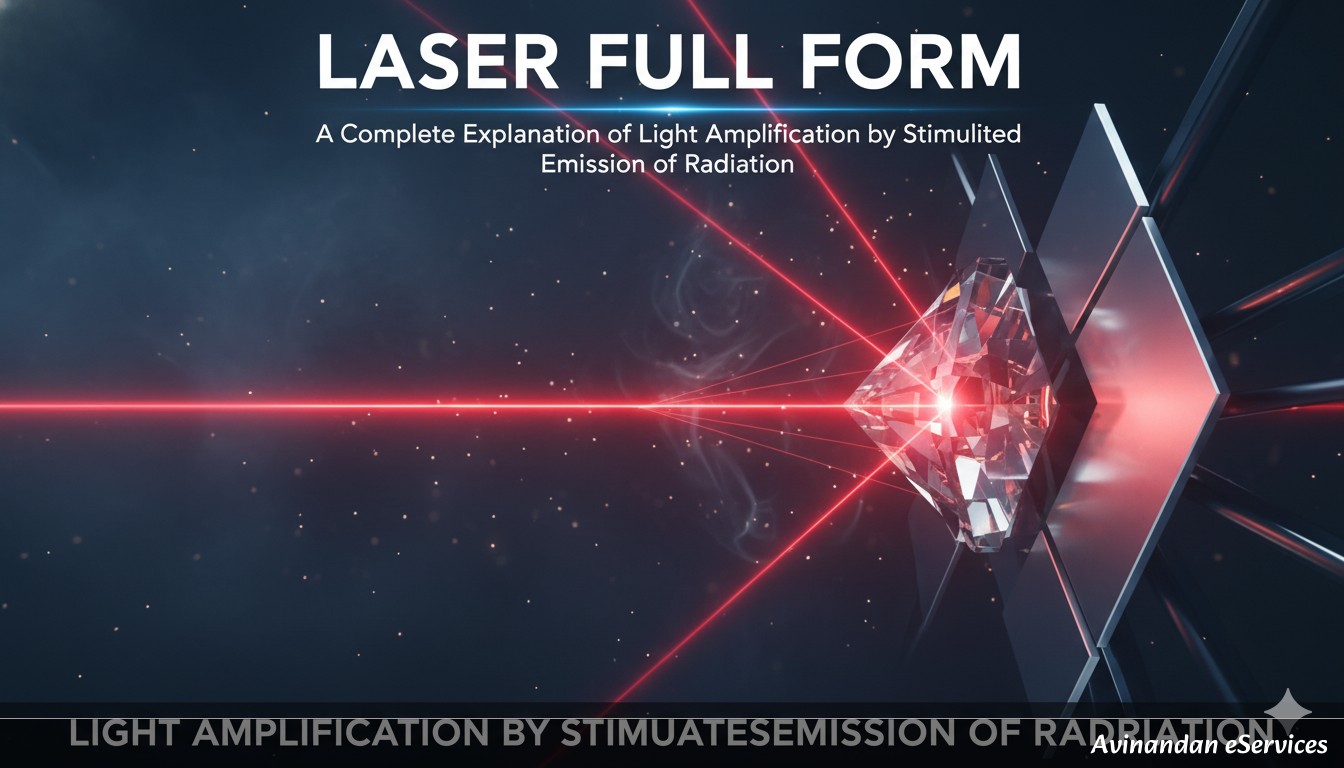
The full form of the acronym LASER is Light Amplification by Stimulated Emission of Radiation. A laser is a device that generates a beam of light with unique properties that differentiate it from conventional light sources like a light bulb. This beam is highly focused, coherent (all light waves are in phase), and monochromatic (a single color or wavelength). These characteristics allow lasers to travel long distances without spreading out and to concentrate a significant amount of energy onto a very small area.
Detailed Breakdown of the Acronym
Understanding the full form of LASER provides a clear insight into the fundamental principles of how this technology works. Each part of the acronym describes a key step in the process of generating a laser beam.
L - Light
This refers to the form of electromagnetic radiation that the device produces. While many lasers emit visible light, others can produce invisible forms of light, such as infrared or ultraviolet radiation.
A - Amplification
This is the core process of a laser. It involves increasing the intensity of the light. The process starts with a small amount of light and progressively strengthens it, resulting in a powerful, concentrated beam. This amplification is what makes laser light so much more intense than ordinary light.
by
S - Stimulated
This term is crucial to how a laser operates. The process of light emission is not random or spontaneous; it is 'stimulated' or triggered. An initial photon of light prompts other excited atoms or molecules to release identical photons.
E - Emission
This refers to the release of photons (particles of light) from atoms or molecules. In a laser, this emission is controlled and directed. When an atom in a high-energy state is stimulated, it releases a photon as it drops to a lower energy state.
of
R - Radiation
In this context, 'radiation' simply refers to the energy that is being emitted in the form of electromagnetic waves or photons. The laser radiation is the resulting beam of light that has been amplified and made coherent through the process of stimulated emission.
History and Purpose
The theoretical foundations for the laser were laid by Albert Einstein in 1917 when he introduced the concept of "stimulated emission." However, it took several decades of scientific research and development to turn this theory into a practical device. The precursor to the laser was the "maser" (Microwave Amplification by Stimulated Emission of Radiation), developed by Charles Townes and his students in the early 1950s. The maser worked with microwaves instead of visible light. The acronym "LASER" itself was first coined by Gordon Gould in his notebooks in 1957. The race to build the first functional laser was a competitive one, involving multiple research teams. On May 16, 1960, physicist and engineer Theodore H. Maiman successfully operated the first working laser at Hughes Research Laboratories in Malibu, California. Maiman's laser used a synthetic ruby crystal to produce a pulsed beam of red light, marking a pivotal moment in technological history. Initially, this groundbreaking invention was famously described as "a solution looking for a problem," but its immense potential was quickly realized.
Importance and Usage
Today, LASER technology is an indispensable tool across a vast array of fields, impacting everything from consumer electronics to advanced scientific research. Its unique properties of coherence, monochromaticity, and directionality make it incredibly versatile.
Key Applications Include:
- Medicine: Lasers are fundamental in many medical procedures, including LASIK eye surgery, hair and tattoo removal, and precision surgical cutting where they can minimize bleeding and damage to surrounding tissue.
- Telecommunications: The global internet and modern communication networks are built on fiber optic technology, which uses lasers to transmit vast amounts of data as pulses of light over long distances.
- Manufacturing and Industry: High-power lasers are used for cutting, welding, drilling, and engraving materials with incredible precision and speed, from delicate microchips to heavy industrial steel.
- Consumer Electronics: You interact with lasers daily through devices like Blu-ray and DVD players, barcode scanners at the supermarket, and laser printers.
- Science and Research: Scientists use lasers for a multitude of applications, including spectroscopy to identify materials, measuring vast distances (like the distance to the Moon), and in advanced fields like nuclear fusion research.
- Military and Defense: Lasers are used for target designation, range finding, and in the development of directed-energy weapons.
- Entertainment: Laser light shows are a staple in concerts and events, creating spectacular visual displays.
The invention of the laser is regarded as one of the most significant technological achievements of the 20th century, and its applications continue to expand, driving innovation in countless areas.
Frequently Asked Questions (FAQs) about LASER
- Who is credited with inventing the first LASER?
Theodore H. Maiman, an American engineer and physicist, is widely credited with inventing and operating the first functional laser on May 16, 1960, at Hughes Research Laboratories. - Are all lasers dangerous to the eyes?
Yes, it is never safe to look directly into a laser beam. The eye can focus the laser's tight beam onto a tiny spot on the retina, causing a burn and potential blindness. Even low-power laser pointers can be hazardous if misused. Laser products are classified by their power output and potential hazard, with Classes IIIb and IV being reserved for professional use due to their high risk. - How do lasers differ from regular light?
Laser light is different from ordinary light (like from a lightbulb) in three key ways: it is monochromatic (one color), coherent (all light waves are in phase), and directional (it forms a tight, focused beam that doesn't spread out much). - Can lasers be any color?
Yes, the color (or wavelength) of a laser's light is determined by the material used as its gain medium. For example, the first laser used a ruby crystal and produced red light, while other materials can generate green, blue, ultraviolet, or infrared laser light.